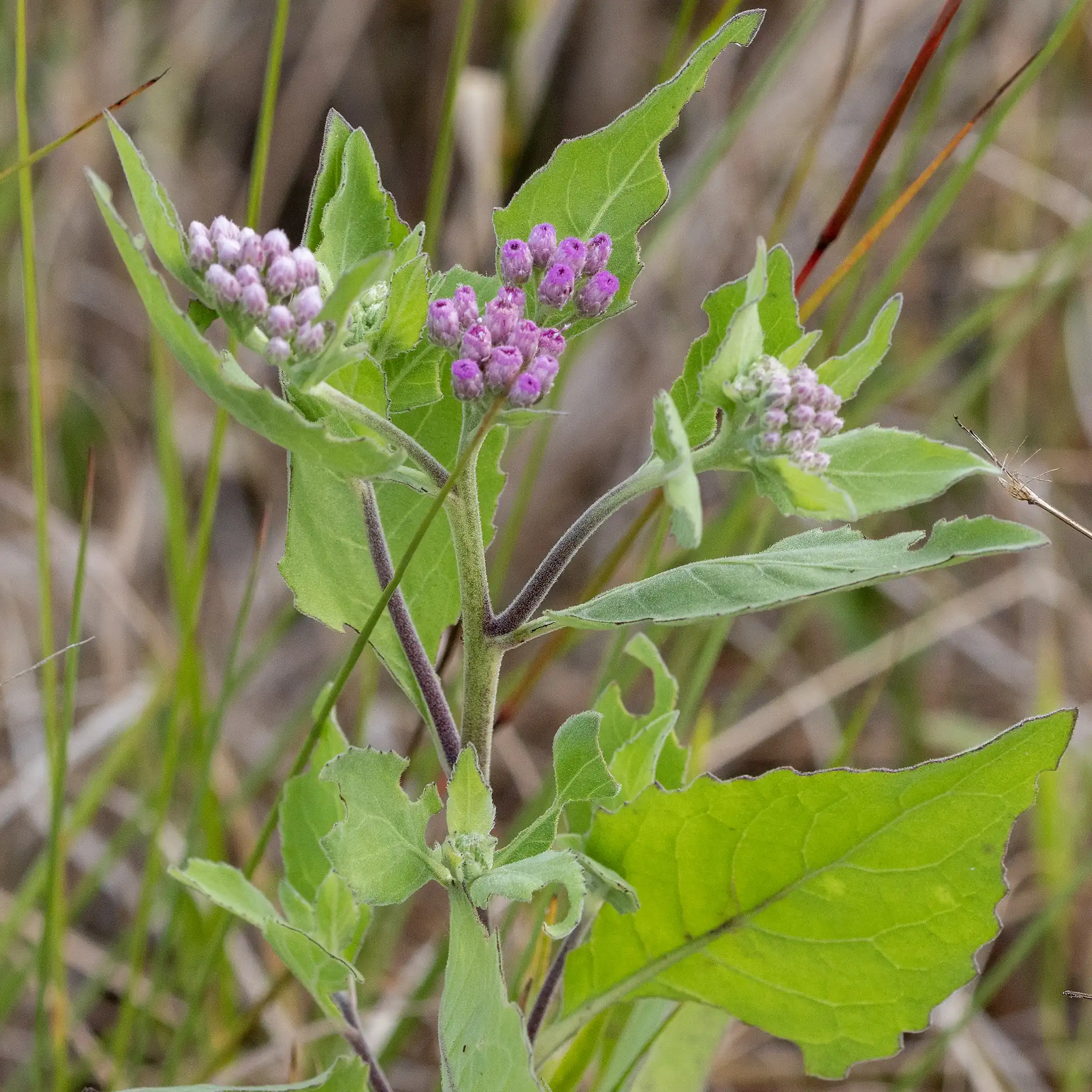
The Story
Plant Bio
Pluchea odorata is an erect short-lived perennial or subshrub native to wet coastal marshes and damp inland depressions across the Americas. Stiff, upright stems branch near the top to support dense, flat-topped clusters of pink to light magenta disk flowers from summer into fall.
Crushing the simple oval leaves releases a strong, volatile camphor aroma that makes the plant highly resistant to mammalian herbivores. The species exhibits strong tolerance to saline soils, coastal salt spray, and heavy clay soils with poor aeration.
Uses & Benefits:
Essentials
At a Glance
Plant Type
Perennial
Height
71"
Width
39"
Light
Full Sun, Partial Sun
Zones
6, 7, 8, 9, 10
Water
High
Humidity
High
Lifespan
Short-lived perennial
Native To
Americas
Toxicity
Non-toxic (may cause mild skin irritation)
Bloom period
Summer – Fall
In flower about 6 months of the year
Planting
How to Grow
- Select a planting location in full sun or light shade with continuously moist, wet, or seasonally flooded soil.
- Incorporate organic matter into sandy or lean soils to improve moisture retention prior to planting.
- Set nursery plugs or potted plants so the crown rests level with the surrounding soil line, and water thoroughly.
- Maintain consistent moisture levels, as prolonged soil drying induces leaf drop and premature dormancy.
Pro Tip
Cut back dead, frosted stems to ground level in late winter before new spring growth begins to prevent untidy woody buildup.
Keep It Thriving
Care Guide
Do
- Keep soil damp to saturated throughout the active growing season.
- Prune old stems to the ground in late winter or early spring.
Don't
- Do not allow soil around the roots to dry out completely.
- Do not fertilize heavily, as excess nutrients cause weak, floppy stem growth.
Seasonal Care Calendar
| Task | Jan | Feb | Mar | Apr | May | Jun | Jul | Aug | Sep | Oct | Nov | Dec |
|---|---|---|---|---|---|---|---|---|---|---|---|---|
| Pest Check | ||||||||||||
| Plant | ||||||||||||
| Propagate | ||||||||||||
| Prune |
Watch Out For
Pests & Diseases
Common Pests
Common Diseases
In the Garden
Landscape Uses & Companions
Landscape Uses
Multiply
Propagation Methods
Good to Know
Common Questions
Sweetscent questions
What zones can Sweetscent grow in?
Sweetscent is hardy in USDA Zones 6–10: in that range it survives winter in the ground. Colder than Zone 6, grow it in a container you can move to shelter for the winter, or as an annual.
Is Sweetscent deer resistant?
Yes — Sweetscent is rated deer-resistant. Deer typically pass it over, though extreme hunger can override any plant's defenses.
When does Sweetscent bloom?
Sweetscent typically blooms from summer to fall. Exact timing shifts a week or two with your zone — Sow's bloom calendar maps it to your garden.
Does Sweetscent need full sun?
Sweetscent does best in full sun to part shade. In hot climates, afternoon shade keeps blooms fresher longer.
More Pluchea to compare
Keep exploring
Explore the genus
Hardy in your zone?
Grow Sweetscent with confidence
See it in a design of your actual yard, get zone-matched care reminders, and track it season by season in your garden journal.