The Story
Plant Bio
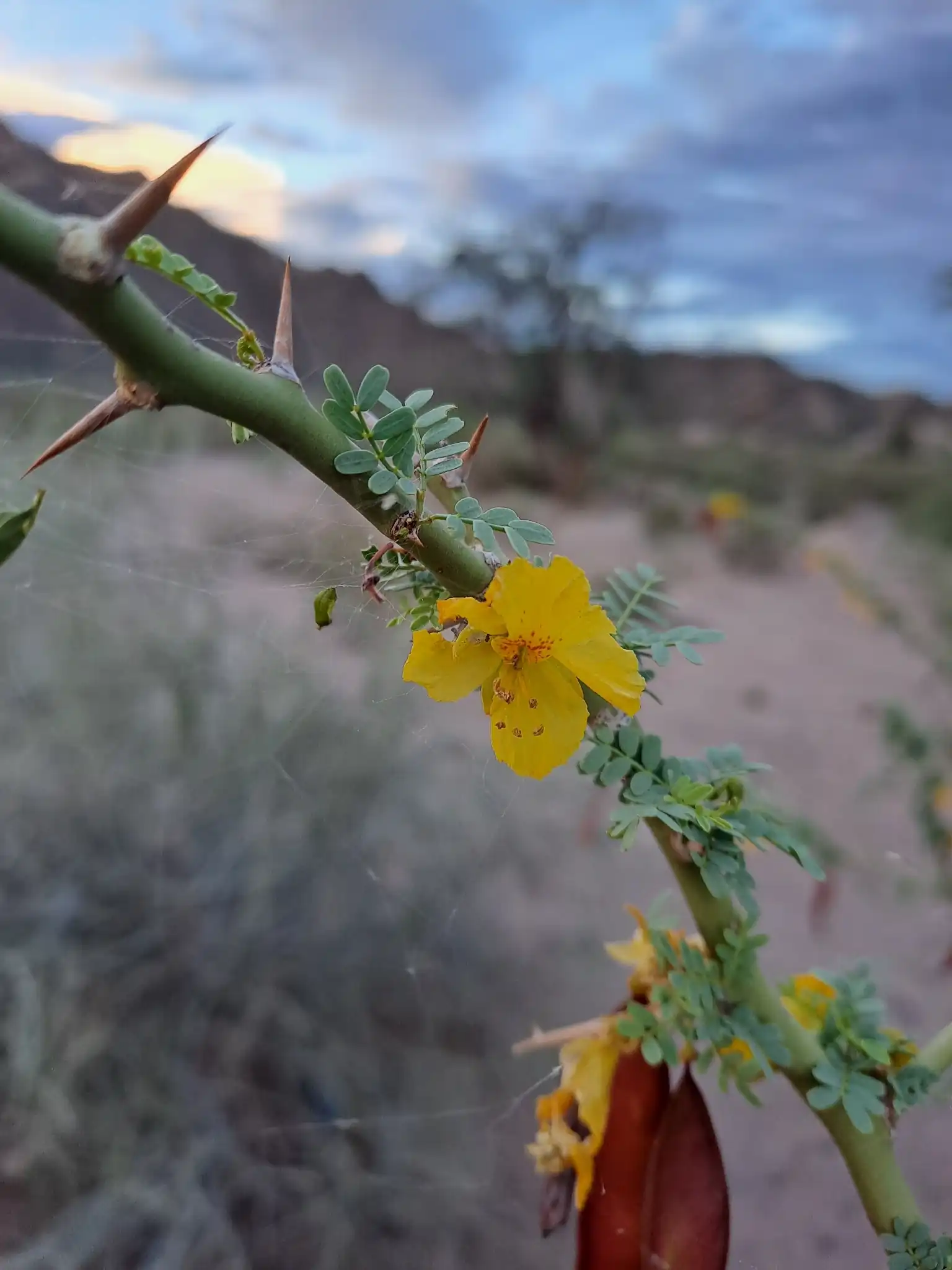
Parkinsonia praecox, the palo brea, is a drought-deciduous small desert tree reaching 20 to 30 feet tall with a broad rounded flat-topped crown wider than tall, carried on irregularly angled green branches from multiple trunks. The leaves are brief 2- to 4-inch pinnate leaves with 9 to 19 pairs of leaflets per pinna, and the smooth green bark continues to photosynthesize after the leaves drop.
It is the earliest Sonoran Desert palo verde to bloom, covering the leafless crown in masses of axillary clusters of bright yellow flowers with a few small red dots on the upper petal. It differs from Jerusalem-thorn and Desert Museum in its flat-topped form, short spines on green branchlets, and intolerance of lawn water and annual heavy pruning, which rots roots and stalls regrowth.
Uses & Benefits:
Essentials
At a Glance
Plant Type
Tree
Height
300"
Width
300"
Light
Full Sun
Zones
9, 10
Water
Low
Humidity
Low
Lifespan
Long-lived tree
Native To
Mexico to Argentina
Toxicity
Non-toxic
Bloom period
Spring – Summer
In flower about 6 months of the year
Planting
How to Grow
- Plant in fall or spring in full sun with room for a 25- to 30-foot crown.
- Set into deep, rocky, well-drained soil at the same depth it grew in the container.
- Water deeply every two weeks the first summer and monthly in winter, then reduce to little or no supplemental water once established.
- Prune lightly only to shape in warm weather and leave the green bark to feed the tree when leafless.
Pro Tip
Prune only to shape in warm dry weather; cold-weather cuts invite infection and overwatering rots the roots faster than drought ever will.
Keep It Thriving
Care Guide
Do
- Plant in full sun in deep, well-drained soil.
- Water deeply and infrequently, allowing soil to dry between waterings.
- Fertilize young trees annually and leave established trees unfertilized.
Don't
- Do not overwater or plant in lawn irrigation.
- Do not prune in cold weather.
- Do not shear annually back into old bare wood.
Seasonal Care Calendar
| Task | Jan | Feb | Mar | Apr | May | Jun | Jul | Aug | Sep | Oct | Nov | Dec |
|---|---|---|---|---|---|---|---|---|---|---|---|---|
| Fertilize | ||||||||||||
| Pest Check | ||||||||||||
| Plant | ||||||||||||
| Prune |
Watch Out For
Pests & Diseases
Common Pests
Common Diseases
In the Garden
Landscape Uses & Companions
Landscape Uses
Multiply
Propagation Methods
Good to Know
Common Questions
Palo Brea questions
What zones can Palo Brea grow in?
Palo Brea is hardy in USDA Zones 9–10: in that range it survives winter in the ground. Colder than Zone 9, winters are too cold for it to survive outdoors.
When does Palo Brea bloom?
Palo Brea typically blooms from spring to summer. Exact timing shifts a week or two with your zone — Sow's bloom calendar maps it to your garden.
Does Palo Brea need full sun?
Palo Brea does best in full sun (6+ hours).
Is Palo Brea drought tolerant?
Yes — once established (usually after the first full season), Palo Brea handles dry spells with minimal watering. Water deeply its first year to build the root system that makes that possible.
More Parkinsonia to compare
Keep exploring
Explore the genus
Hardy in your zone?
Grow Palo Brea with confidence
See it in a design of your actual yard, get zone-matched care reminders, and track it season by season in your garden journal.