The Story
Plant Bio
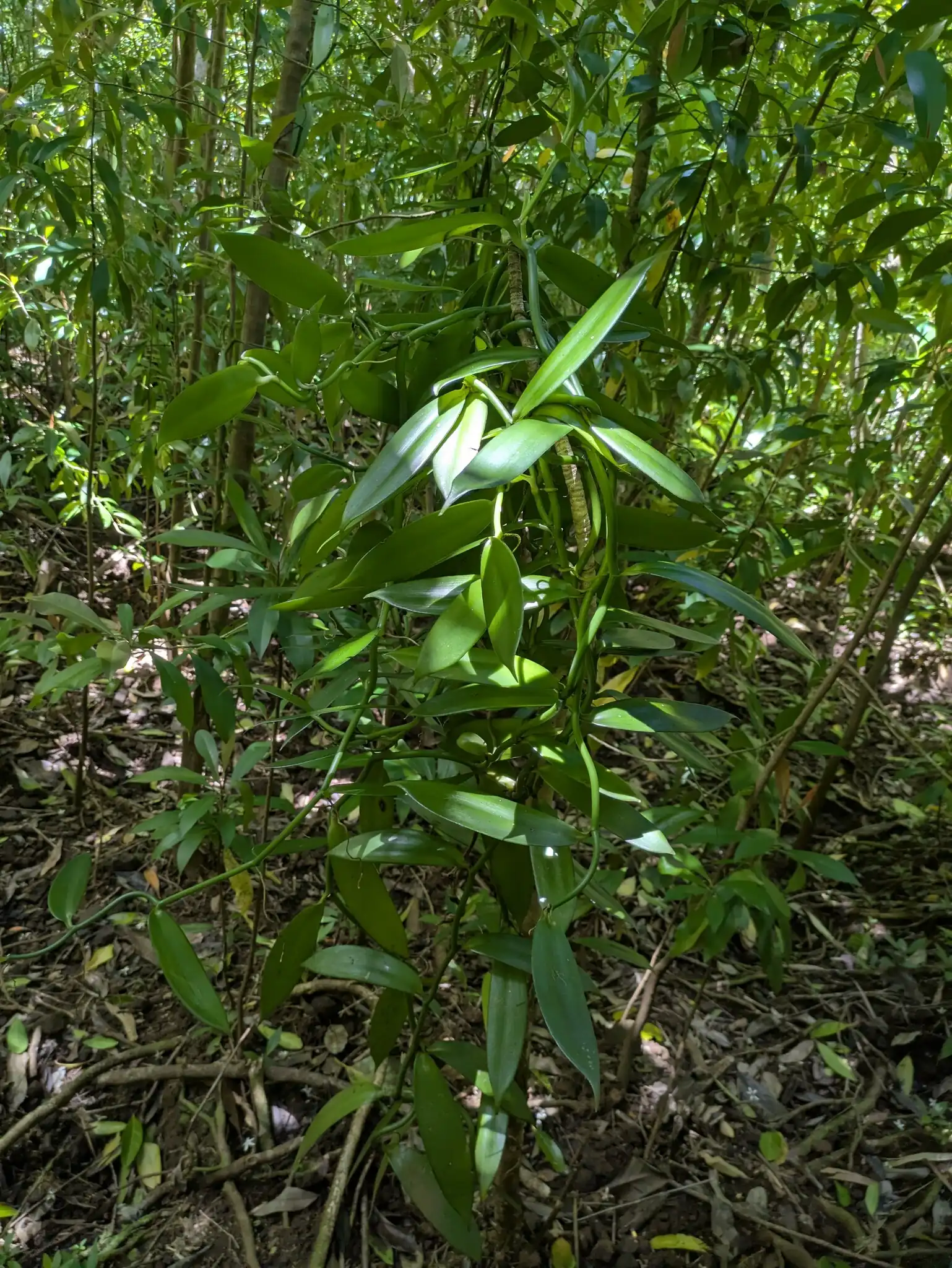
Vanilla planifolia, the commercial vanilla, is a fleshy-stemmed evergreen climbing orchid that grips trees and trellises with thick aerial roots borne opposite the leaves. In a container or greenhouse it climbs 8 to 10 feet with support, with thick flat succulent leaves to about 5 inches long that remain evergreen.
The flowers are pale green-yellow trumpets carried in axillary clusters of 12 to 20 buds, each flower opening for one day only in spring into summer. Only mature vines over about 10 feet long and 2 to 3 years old can set the slender 6- to 10-inch pods that ripen over 6 to 9 months and cure into edible vanilla beans.
Uses & Benefits:
Essentials
At a Glance
Plant Type
Vine
Height
120"
Width
72"
Light
Partial Sun, Shade
Water
Medium - evenly moist, never soggy
Humidity
High - needs warm humid air and daily misting
Lifespan
Long-lived evergreen vine
Native To
Mexico and Central America to northern South America
Toxicity
Non-toxic to people and pets; sap may irritate skin
Bloom period
Spring – Summer
In flower about 6 months of the year
Marketplace
Where to Buy
Shipping costs Year-round shipping Free shipping
Planting
How to Grow
- Grow frost-free indoors or in a greenhouse at 80 to 85F day and 60 to 65F night with warm humid air.
- Give bright shade with some early morning sun; shield from hot midday sun.
- Pot in coarse bark-based orchid mix that drains fast yet holds humidity, and water to keep it evenly moist but never soggy.
- Mist daily and feed lightly through the growing season; provide a stout trellis or tree fern pole and tie new growth in.
- Hand-pollinate each flower on the morning it opens, then leave pods on the vine 6 to 9 months to size and mature.
Pro Tip
Pollinate each morning a flower opens: lift the rostellum flap with a toothpick and press the anther down onto the stigma; without that same-day contact no pod forms outside Mexico.
Keep It Thriving
Care Guide
Do
- Keep humidity high with daily misting and good air movement.
- Use a coarse bark orchid mix and a pot with large drainage holes.
- Tie the fleshy stem to a trellis as it climbs.
Don't
- Do not let pots sit in water; fleshy roots rot quickly in soggy, airless mix.
- Do not expect beans on a small young vine under about 10 feet.
- Do not cut back hard into old leafless stem to control size.
Seasonal Care Calendar
| Task | Jan | Feb | Mar | Apr | May | Jun | Jul | Aug | Sep | Oct | Nov | Dec |
|---|---|---|---|---|---|---|---|---|---|---|---|---|
| Fertilize | ||||||||||||
| Harvest | ||||||||||||
| Pest Check | ||||||||||||
| Propagate | ||||||||||||
| Stake |
Watch Out For
Pests & Diseases
Common Pests
Common Diseases
In the Garden
Landscape Uses & Companions
Landscape Uses
Multiply
Propagation Methods
Good to Know
Common Questions
Vanilla Orchid questions
When does Vanilla Orchid bloom?
Vanilla Orchid typically blooms from spring to summer. Exact timing shifts a week or two with your zone — Sow's bloom calendar maps it to your garden.
Does Vanilla Orchid need full sun?
Vanilla Orchid does best in part shade.
More Vanilla to compare
Keep exploring
Explore the genus
Grow Vanilla Orchid with confidence
See it in a design of your actual yard, get zone-matched care reminders, and track it season by season in your garden journal.