The Story
Plant Bio
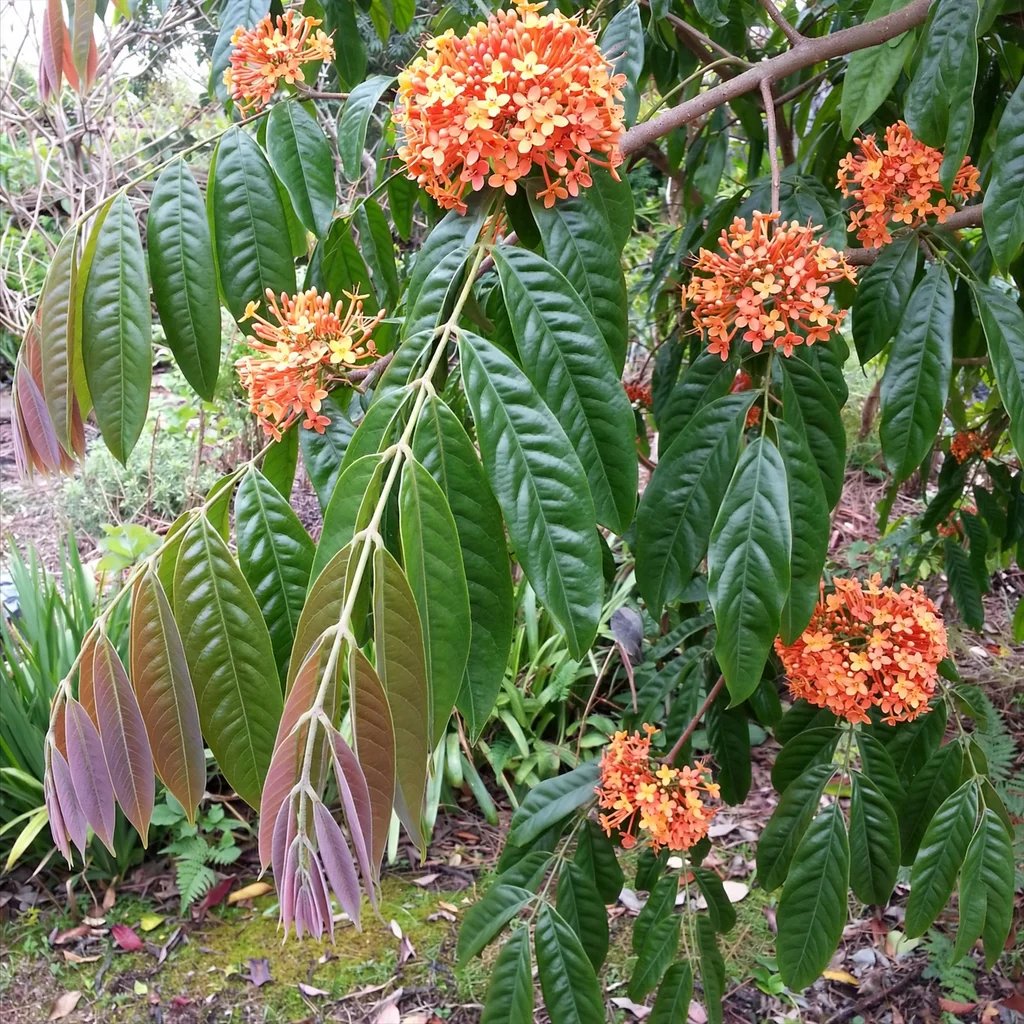
Saraca indica, sold as Saraca bijuga, is an evergreen small to medium tree reaching sixteen to thirty-three feet in gardens, with a spreading crown and a bole to about thirteen inches across. The leaves are paripinnate to twelve inches long with two to four pairs of elliptic-ovate to lanceolate leaflets six to eight inches long, glabrous, the new flush pendulous and white-pink to purple before hardening green.
What is sold as S. bijuga bears dense rounded corymbs directly on the trunk and older branches, the flowers without petals but with petaloid sepals in orange-yellow to scarlet on a half-inch hypanthium tube with four to eight exserted stamens. It flowers in late winter to spring and repeats through the year where warm and humid, and it is the Southeast Asian streamside rainforest species, not the Indian S. asoca from west of the Irrawaddy.
Uses & Benefits:
Essentials
At a Glance
Plant Type
Tree
Height
394"
Width
240"
Light
Full Sun, Partial Sun
Zones
10
Water
Evenly moist
Humidity
High
Lifespan
Long-lived tree
Native To
Indo-China to W. Malesia
Toxicity
Unknown; young leaves and flowers reported edible
Bloom period
Late winter – Spring
In flower about 4 months of the year
Planting
How to Grow
- Plant in fertile organic loam that drains yet holds moisture, in full sun to partial shade with shelter from frost and wind.
- Water to keep soil consistently moist, mulching to hold humidity but keeping mulch off the trunk.
- Feed lightly through the warm growing season with balanced fertilizer; avoid cold wet soil after feeding.
- Prune only to shape after the main spring flush; bring pots under glass before first chill.
Pro Tip
Keep the root zone evenly moist in fertile organic soil and never let a potted plant sit cold and wet; chill plus saturation stalls growth faster than shade does.
Keep It Thriving
Care Guide
Do
- Give full sun to partial shade with warm humid air.
- Keep soil fertile, organic and consistently moist.
- Grow frost-free, moving pots indoors before cold nights.
Don't
- Do not let soil dry out or stay cold and waterlogged.
- Do not cut back into old bare wood to reshape.
- Do not expect outdoor hardiness or drought tolerance.
Seasonal Care Calendar
| Task | Jan | Feb | Mar | Apr | May | Jun | Jul | Aug | Sep | Oct | Nov | Dec |
|---|---|---|---|---|---|---|---|---|---|---|---|---|
| Mulch | ||||||||||||
| Pest Check | ||||||||||||
| Plant | ||||||||||||
| Prune | ||||||||||||
| Winter Prep |
Watch Out For
Pests & Diseases
Common Pests
Common Diseases
In the Garden
Landscape Uses & Companions
Landscape Uses
Multiply
Propagation Methods
Good to Know
Common Questions
Asoka Tree questions
What zones can Asoka Tree grow in?
Asoka Tree is hardy in USDA Zone 10: in that range it survives winter in the ground. Colder than Zone 10, winters are too cold for it to survive outdoors.
When does Asoka Tree bloom?
Asoka Tree typically blooms from late winter to late spring. Exact timing shifts a week or two with your zone — Sow's bloom calendar maps it to your garden.
Does Asoka Tree need full sun?
Asoka Tree does best in full sun to part shade. In hot climates, afternoon shade keeps blooms fresher longer.
More Saraca to compare
Keep exploring
Explore the genus
Hardy in your zone?
Grow Asoka Tree with confidence
See it in a design of your actual yard, get zone-matched care reminders, and track it season by season in your garden journal.