The Story
Plant Bio
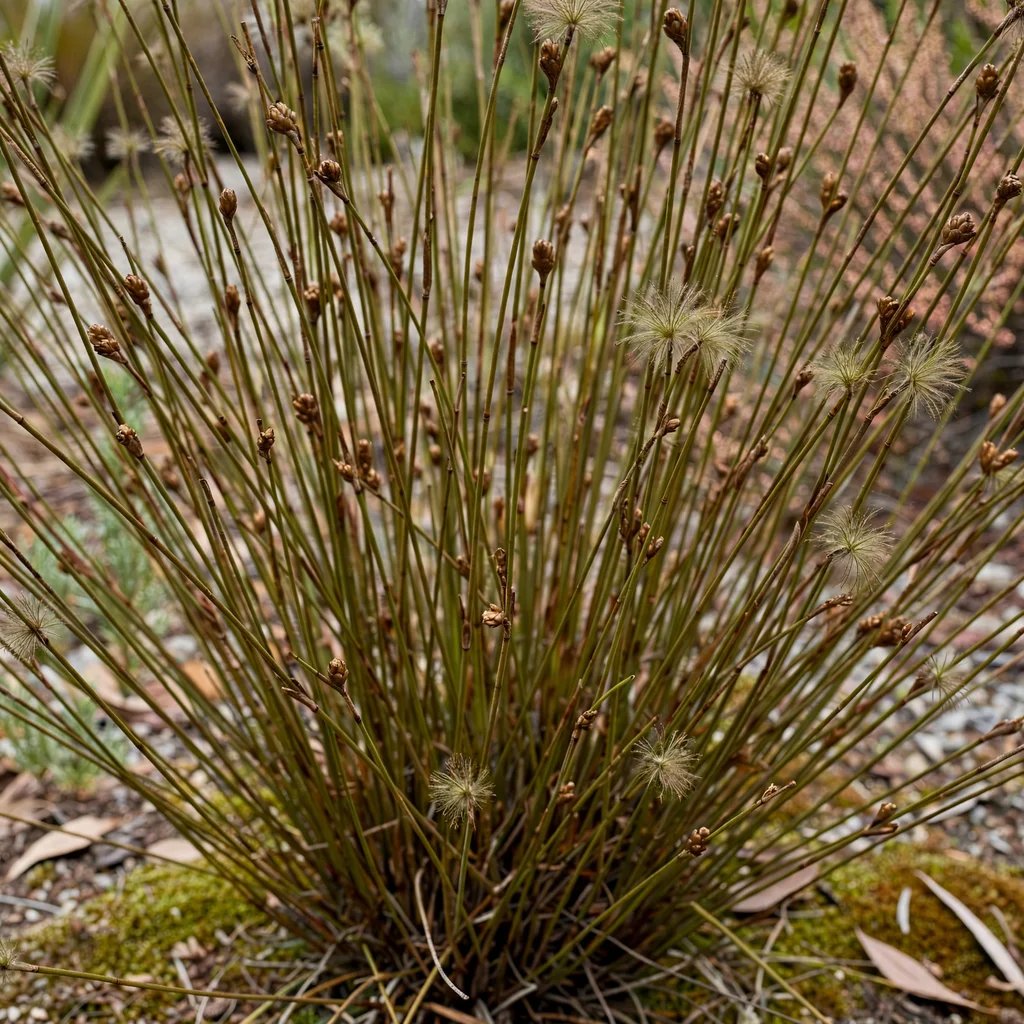
Restio similis is an evergreen reed-like perennial from Western Cape fynbos, forming a dense clump of photosynthetic stems with no true leaves. The display comes from dark-green rounded culms sheathed in pale brown-grey, topped with dense wind-pollinated spikelets rather than showy petals.
This species stays compact at about two feet high and three feet wide in gardens, with sparsely branched culms that emerge finely divided and fluffy before hardening to the adult reed form. Male and female flowers grow on separate plants, with chestnut-brown bracts at the stem tips and, on females, white feathery styles that ripen to small round white seed.
Uses & Benefits:
Essentials
At a Glance
Plant Type
Perennial
Height
24"
Width
35"
Light
Full Sun
Zones
9, 10
Water
Low
Humidity
Low
Lifespan
Long-lived perennial
Native To
Western Cape, South Africa
Toxicity
Non-toxic
Bloom period
Summer – Late summer
In flower about 3 months of the year
Marketplace
Where to Buy
Shipping costs Year-round shipping Free shipping
Planting
How to Grow
- Plant in fall in full sun in sharply drained acidic sand or stony mix with low fertility.
- Space plants 2 to 3 feet apart in groups with both male and female plants for best display.
- Water in once, then keep seedlings evenly moist but never wet; cut back to occasional deep water once established.
- Topdress with gravel or acidic leaf mulch and keep the crown open to air movement.
- Feed rarely and only with low-phosphorus organic fertilizer if seedlings yellow in the growing season.
Pro Tip
Plant male and female plants together in poor acid sand in full sun with open air, and water sparingly once established; shearing it like grass or feeding high-phosphorus fertilizer kills it.
Keep It Thriving
Care Guide
Do
- Grow in full sun with open air movement and excellent drainage.
- Plant in fall to catch winter rain and let roots establish in cool soil.
- Remove only dead stems at the base as new culms overtake them.
Don't
- Do not feed high-phosphorus fertilizer or rich alkaline soils.
- Do not shear or mow the clump like an ornamental grass.
- Do not overwater or let pots sit in saucers; soggy roots rot.
Seasonal Care Calendar
| Task | Jan | Feb | Mar | Apr | May | Jun | Jul | Aug | Sep | Oct | Nov | Dec |
|---|---|---|---|---|---|---|---|---|---|---|---|---|
| Fertilize | ||||||||||||
| Mulch | ||||||||||||
| Pest Check | ||||||||||||
| Plant | ||||||||||||
| Prune |
Watch Out For
Pests & Diseases
Common Pests
Common Diseases
In the Garden
Landscape Uses & Companions
Landscape Uses
Multiply
Propagation Methods
Good to Know
Common Questions
Dwarf Restio questions
What zones can Dwarf Restio grow in?
Dwarf Restio is hardy in USDA Zones 9–10: in that range it survives winter in the ground. Colder than Zone 9, grow it in a container you can move to shelter for the winter, or as an annual.
When does Dwarf Restio bloom?
Dwarf Restio typically blooms in summer. Exact timing shifts a week or two with your zone — Sow's bloom calendar maps it to your garden.
Does Dwarf Restio need full sun?
Dwarf Restio does best in full sun (6+ hours).
Is Dwarf Restio drought tolerant?
Yes — once established (usually after the first full season), Dwarf Restio handles dry spells with minimal watering. Water deeply its first year to build the root system that makes that possible.
More Restio to compare
Keep exploring
Explore the genus
Hardy in your zone?
Grow Dwarf Restio with confidence
See it in a design of your actual yard, get zone-matched care reminders, and track it season by season in your garden journal.