The Story
Plant Bio
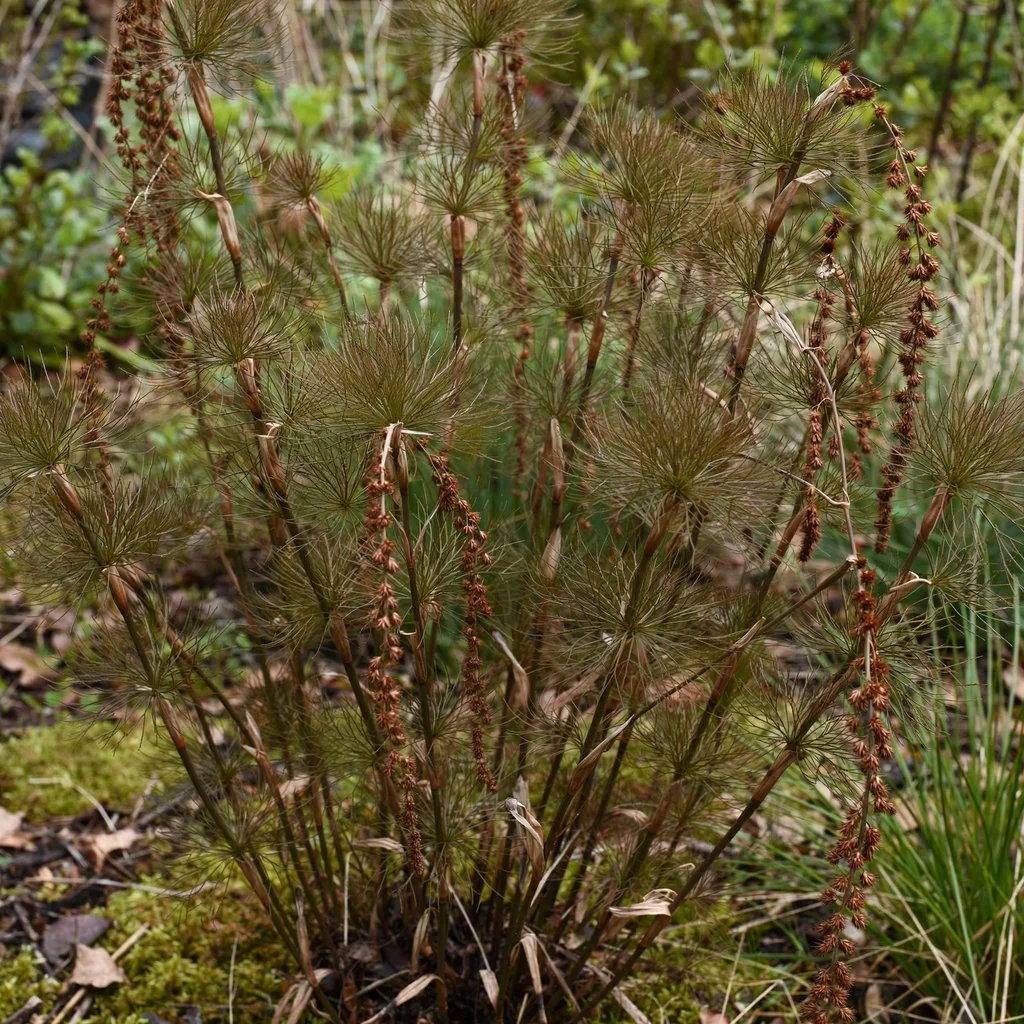
Baloskion tetraphyllum, the tassel cord rush, is a dioecious evergreen perennial from swampy ground in southeastern Australia that forms a tufted clump of stiff bright green stems to six feet tall in cultivation. True leaves are reduced to brown-banded bracts, and photosynthesis comes from dense whorls of finely divided feathery branchlets that give the clump a bamboo-like texture.
Male and female flowers grow on separate plants as narrow loose terminal panicles of small reddish-brown spikelets in spring to summer that dry into feathery seed heads. It spreads by creeping rhizome into a columnar-upright clump that stays evergreen and performs best with roots kept constantly damp at a pond margin or in a bog bed.
Uses & Benefits:
Essentials
At a Glance
Plant Type
Grass
Height
72"
Width
36"
Light
Full Sun, Partial Sun
Zones
9, 10
Water
High - constantly moist
Humidity
Moderate to high
Lifespan
Perennial
Native To
Southeastern Australia
Toxicity
Unknown - no toxicity reported
Bloom period
Spring – Summer
In flower about 6 months of the year
Planting
How to Grow
- Plant in full sun to part shade in moisture-retentive sandy loam that stays damp year-round.
- Set the crown level with the soil surface in a bog bed, rain garden, or at the edge of a pond.
- Water deeply at planting and keep the root zone constantly moist through the first season.
- Mulch with 2 inches of bark to conserve moisture and top up as it breaks down.
Pro Tip
Buy it under its old name Restio tetraphyllus and never let the rootball dry out; plants are male or female, so grow one of each if you want viable seed.
Keep It Thriving
Care Guide
Do
- Keep soil constantly moist to boggy, especially in heat.
- Grow in full sun to part shade with good air movement.
- Divide congested clumps in spring to renew vigor.
Don't
- Do not let the rootball dry out completely.
- Do not plant in dry, fast-draining upland soil.
- Do not expect seed unless male and female plants grow together.
Seasonal Care Calendar
| Task | Jan | Feb | Mar | Apr | May | Jun | Jul | Aug | Sep | Oct | Nov | Dec |
|---|---|---|---|---|---|---|---|---|---|---|---|---|
| Divide | ||||||||||||
| Mulch | ||||||||||||
| Pest Check | ||||||||||||
| Plant | ||||||||||||
| Winter Prep |
Watch Out For
Pests & Diseases
Common Pests
Common Diseases
In the Garden
Landscape Uses & Companions
Landscape Uses
Companion Plants
Multiply
Propagation Methods
Good to Know
Common Questions
Tassel Cord Rush questions
What zones can Tassel Cord Rush grow in?
Tassel Cord Rush is hardy in USDA Zones 9–10: in that range it survives winter in the ground. Colder than Zone 9, grow it in a container you can move to shelter for the winter, or as an annual.
When does Tassel Cord Rush bloom?
Tassel Cord Rush typically blooms from spring to summer. Exact timing shifts a week or two with your zone — Sow's bloom calendar maps it to your garden.
Does Tassel Cord Rush need full sun?
Tassel Cord Rush does best in full sun to part shade. In hot climates, afternoon shade keeps blooms fresher longer.
More Restio to compare
Keep exploring
Explore the genus
Hardy in your zone?
Grow Tassel Cord Rush with confidence
See it in a design of your actual yard, get zone-matched care reminders, and track it season by season in your garden journal.