The Story
Plant Bio
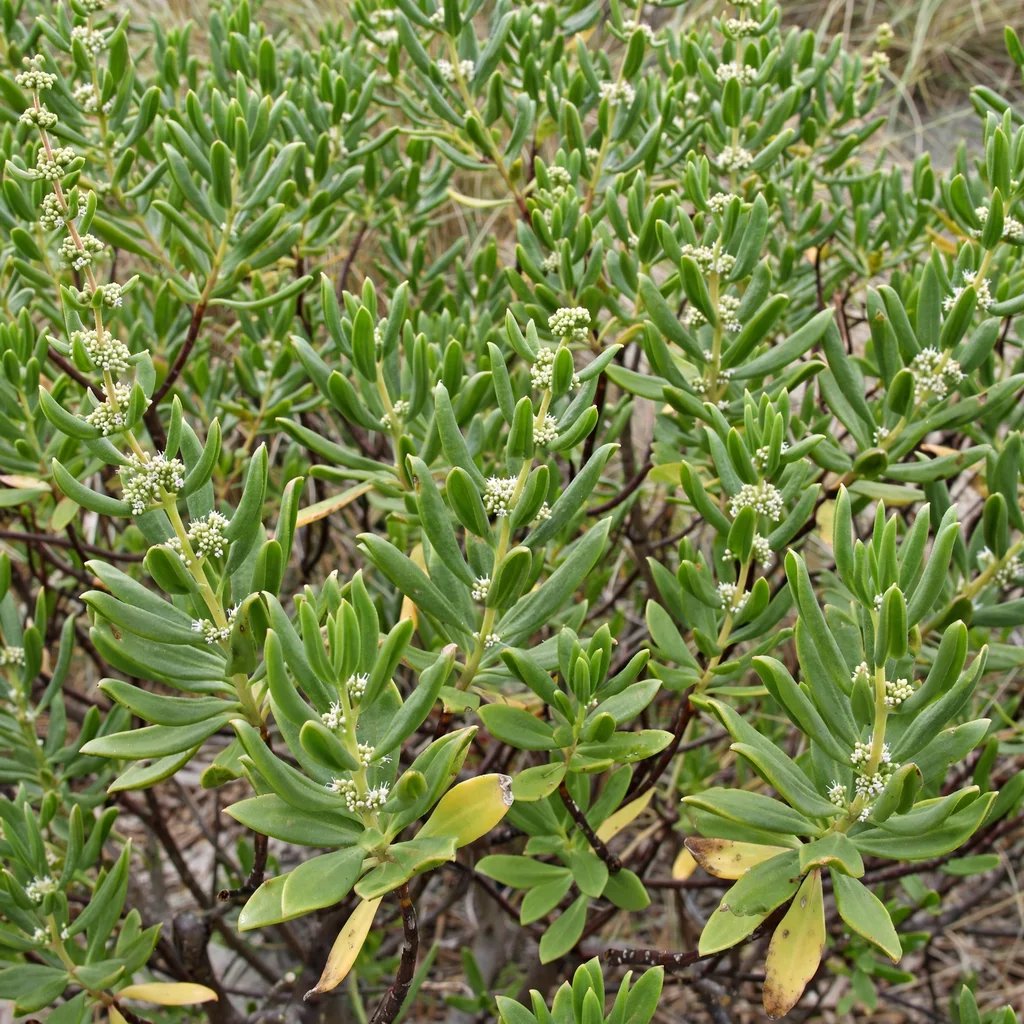
Iva imbricata, a member of the aster family, is a semi-woody perennial herb reaching two to three feet tall with decumbent branching stems that spread wider than tall to form low mats. The leaves are thick, smooth and oblanceolate to linear-oblong, opposite below and alternate above, built to hold water and shed wind on hot sand.
It holds the upper beach and foredune where salt spray and brief overwash kill less tolerant plants, making it the most seaward perennial of the southeastern strand. The summer to fall bloom is a set of small whitish heads with no showy rays that shed copious wind-borne pollen known to trigger ragweed-type hay fever.
Uses & Benefits:
Essentials
At a Glance
Plant Type
Perennial
Height
36"
Width
48"
Light
Full Sun
Zones
8, 9, 10
Water
Low
Humidity
Unknown
Lifespan
Perennial
Native To
Southeastern U.S. coast, Bahamas, Cuba
Toxicity
Severe pollen allergen
Bloom period
Summer – Fall
In flower about 6 months of the year
Planting
How to Grow
- Plant plugs or small pots in spring into loose dune sand in full hot sun, spacing to allow the mat to spread.
- Set the crown at sand level and firm sand around roots, then water in to settle.
- Water sparingly until rooted, then back off; established plants take drought and salt spray with no fertilizer.
- Leave stems to layer and mat; remove only storm-broken wood and keep foot traffic off new planting.
Pro Tip
Set plugs deep in loose sand in full sun and leave the mat unclipped; cutting into old bare stems gives slow, patchy regrowth.
Keep It Thriving
Care Guide
Do
- Do plant in full sun in sharp, well-drained sand.
- Do use it for dune hold and upper-beach cover where spray is constant.
- Do start new plants from cuttings to keep the local coastal form.
Don't
- Do not plant in rich loam or irrigated beds that stay wet.
- Do not shear for a tidy mound; it breaks the mat habit.
- Do not plant by patios or bedrooms if ragweed pollen triggers asthma.
Seasonal Care Calendar
| Task | Jan | Feb | Mar | Apr | May | Jun | Jul | Aug | Sep | Oct | Nov | Dec |
|---|---|---|---|---|---|---|---|---|---|---|---|---|
| Pest Check | ||||||||||||
| Plant | ||||||||||||
| Propagate | ||||||||||||
| Prune |
Watch Out For
Pests & Diseases
Common Pests
Common Diseases
In the Garden
Landscape Uses & Companions
Landscape Uses
Companion Plants
Multiply
Propagation Methods
Good to Know
Common Questions
Dune Marsh-Elder questions
What zones can Dune Marsh-Elder grow in?
Dune Marsh-Elder is hardy in USDA Zones 8–10: in that range it survives winter in the ground. Colder than Zone 8, grow it in a container you can move to shelter for the winter, or as an annual.
When does Dune Marsh-Elder bloom?
Dune Marsh-Elder typically blooms from summer to fall. Exact timing shifts a week or two with your zone — Sow's bloom calendar maps it to your garden.
Does Dune Marsh-Elder need full sun?
Dune Marsh-Elder does best in full sun (6+ hours).
Is Dune Marsh-Elder drought tolerant?
Yes — once established (usually after the first full season), Dune Marsh-Elder handles dry spells with minimal watering. Water deeply its first year to build the root system that makes that possible.
More Iva to compare
Keep exploring
Explore the genus
Hardy in your zone?
Grow Dune Marsh-Elder with confidence
See it in a design of your actual yard, get zone-matched care reminders, and track it season by season in your garden journal.