The Story
Plant Bio
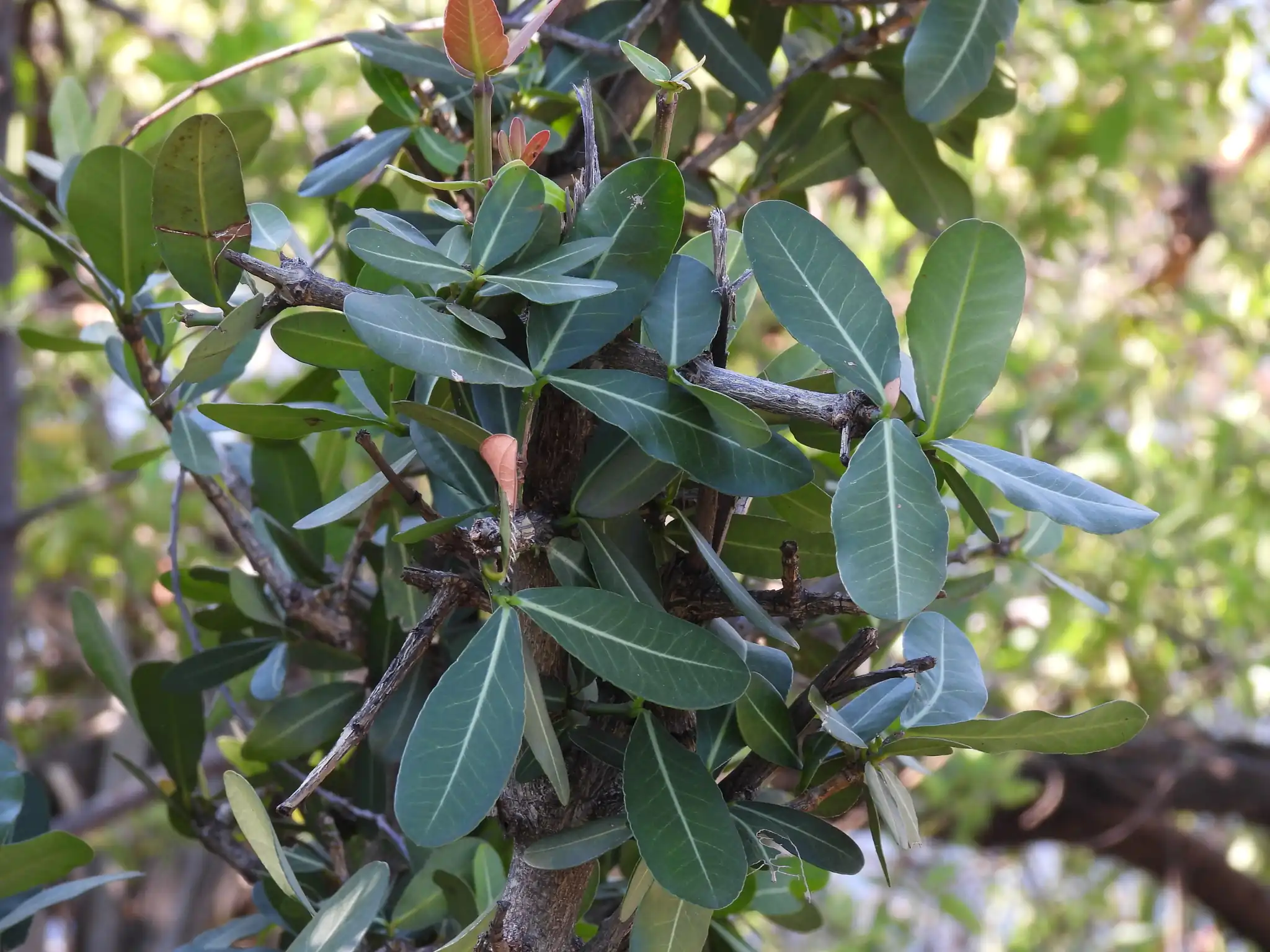
Garcinia livingstonei is an evergreen African shrub to small tree reaching 10 to 20 feet in gardens, with stiff, low-branching stems forming a dense spreading crown. The thick oval leaves sit in whorls of three, dark glossy green above and pale beneath with white veins, flushing deep blue-green when new.
Plants are dioecious, with tiny greenish-white four-petaled flowers borne in clusters at the leaf axils and on old wood, the males sweetly fragrant. Female plants ripen apricot-flavored orange-red fruit in about six months, but only when a male grows nearby or both sexes are grafted to one tree.
Uses & Benefits:
Essentials
At a Glance
Plant Type
Tree
Height
180"
Width
197"
Light
Full Sun, Partial Sun
Zones
9, 10
Water
Low once established; water for fruit
Humidity
Dry to moderately humid
Lifespan
Long-lived evergreen tree
Native To
Africa
Toxicity
Ripe pulp edible; sap, stems and unripe parts toxic
Bloom period
Spring – Early fall
In flower about 7 months of the year
Planting
How to Grow
- Plant after frost danger in full sun in sandy or loamy, well-drained soil enriched with organic matter.
- Set the rootball level with the grade and water in deeply; never leave the hole waterlogged.
- Water through the spring dry period to size the fruit crop; established trees tolerate drought but fruit better with steady moisture.
- Protect below 26F with frost cloth and a warm microclimate; young trees are frost-sensitive.
- Prune lightly to shape and to encourage lateral branches into a bushy globe.
Pro Tip
Plant one male with your fruiting female, or buy a tree carrying both grafts, and hold it in acid to near-neutral soil; alkaline ground locks up zinc.
Keep It Thriving
Care Guide
Do
- Grow in full sun for best fruiting, with light shade tolerated.
- Water during spring dry spells if fruit is wanted.
- Mulch with organic matter to keep acid to near-neutral soil moist but drained.
- Prune to control size and to keep the dense crown balanced.
Don't
- Do not plant in waterlogged or heavy clay that stays wet.
- Do not expect fruit from a lone seedling without a male nearby or a dual graft.
- Do not chew stems or unripe parts; cut stems exude sticky yellow latex.
- Do not leave young trees exposed to hard frost without protection.
Seasonal Care Calendar
| Task | Jan | Feb | Mar | Apr | May | Jun | Jul | Aug | Sep | Oct | Nov | Dec |
|---|---|---|---|---|---|---|---|---|---|---|---|---|
| Harvest | ||||||||||||
| Pest Check | ||||||||||||
| Plant | ||||||||||||
| Prune | ||||||||||||
| Winter Prep |
Watch Out For
Pests & Diseases
Common Pests
Common Diseases
In the Garden
Landscape Uses & Companions
Landscape Uses
Multiply
Propagation Methods
Good to Know
Common Questions
Imbe questions
What zones can Imbe grow in?
Imbe is hardy in USDA Zones 9–10: in that range it survives winter in the ground. Colder than Zone 9, winters are too cold for it to survive outdoors.
When does Imbe bloom?
Imbe typically blooms from early spring to early fall. Exact timing shifts a week or two with your zone — Sow's bloom calendar maps it to your garden.
Does Imbe need full sun?
Imbe does best in full sun to part shade. In hot climates, afternoon shade keeps blooms fresher longer.
Is Imbe drought tolerant?
Yes — once established (usually after the first full season), Imbe handles dry spells with minimal watering. Water deeply its first year to build the root system that makes that possible.
More Garcinia to compare
Keep exploring
Explore the genus
Hardy in your zone?
Grow Imbe with confidence
See it in a design of your actual yard, get zone-matched care reminders, and track it season by season in your garden journal.