The Story
Plant Bio
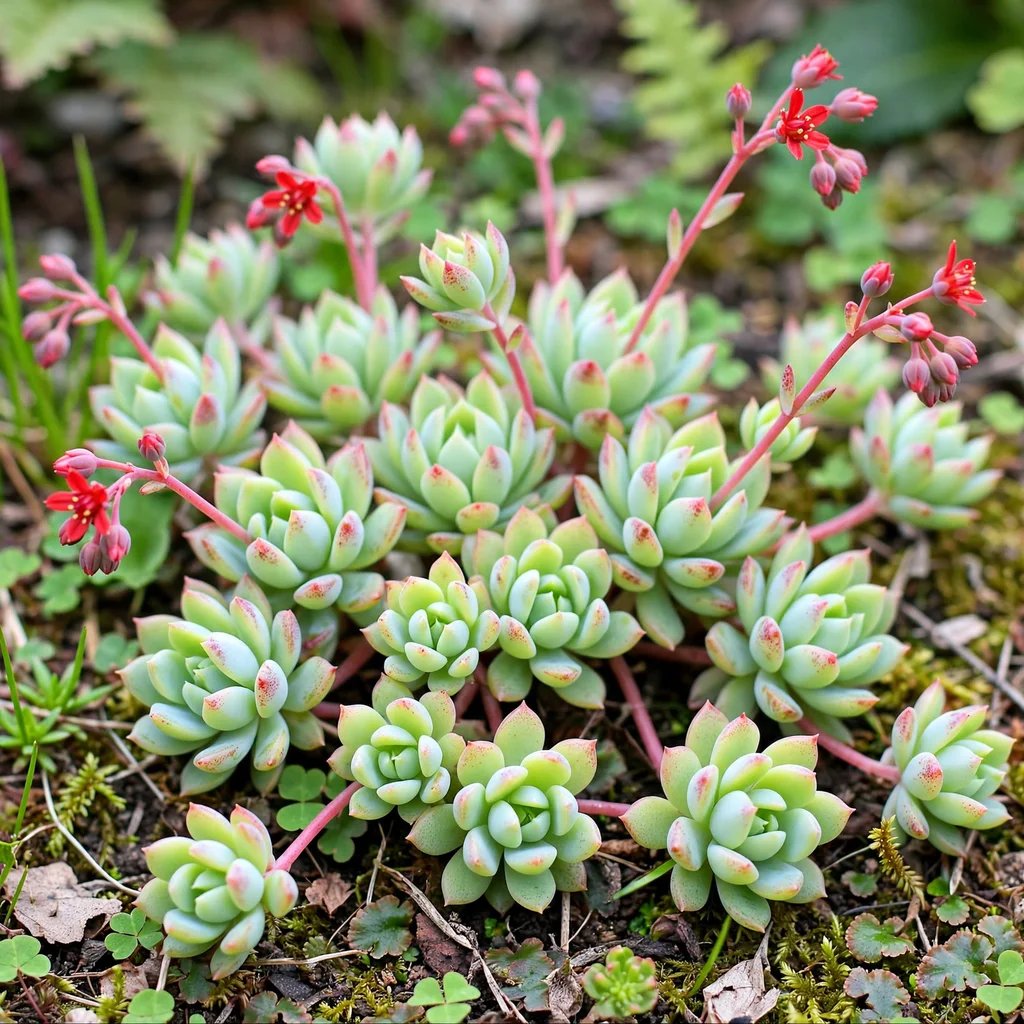
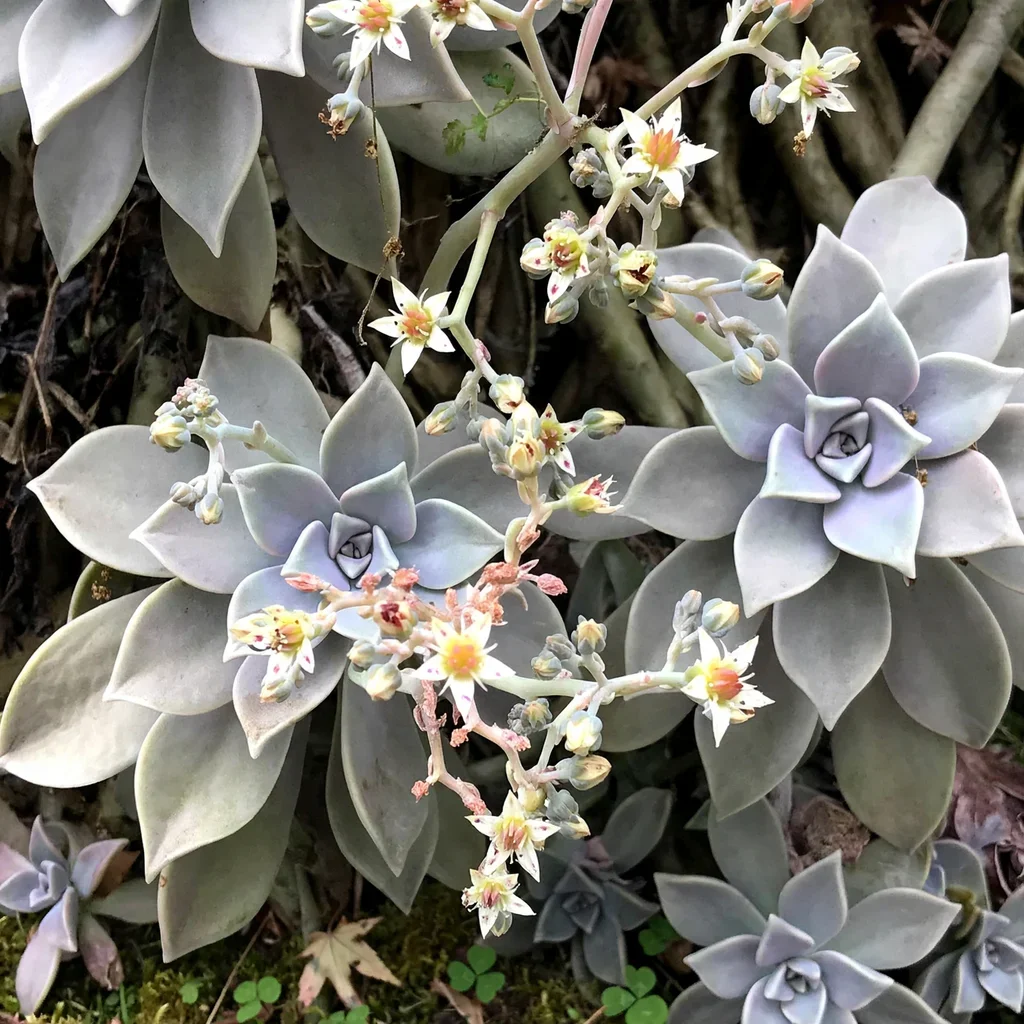
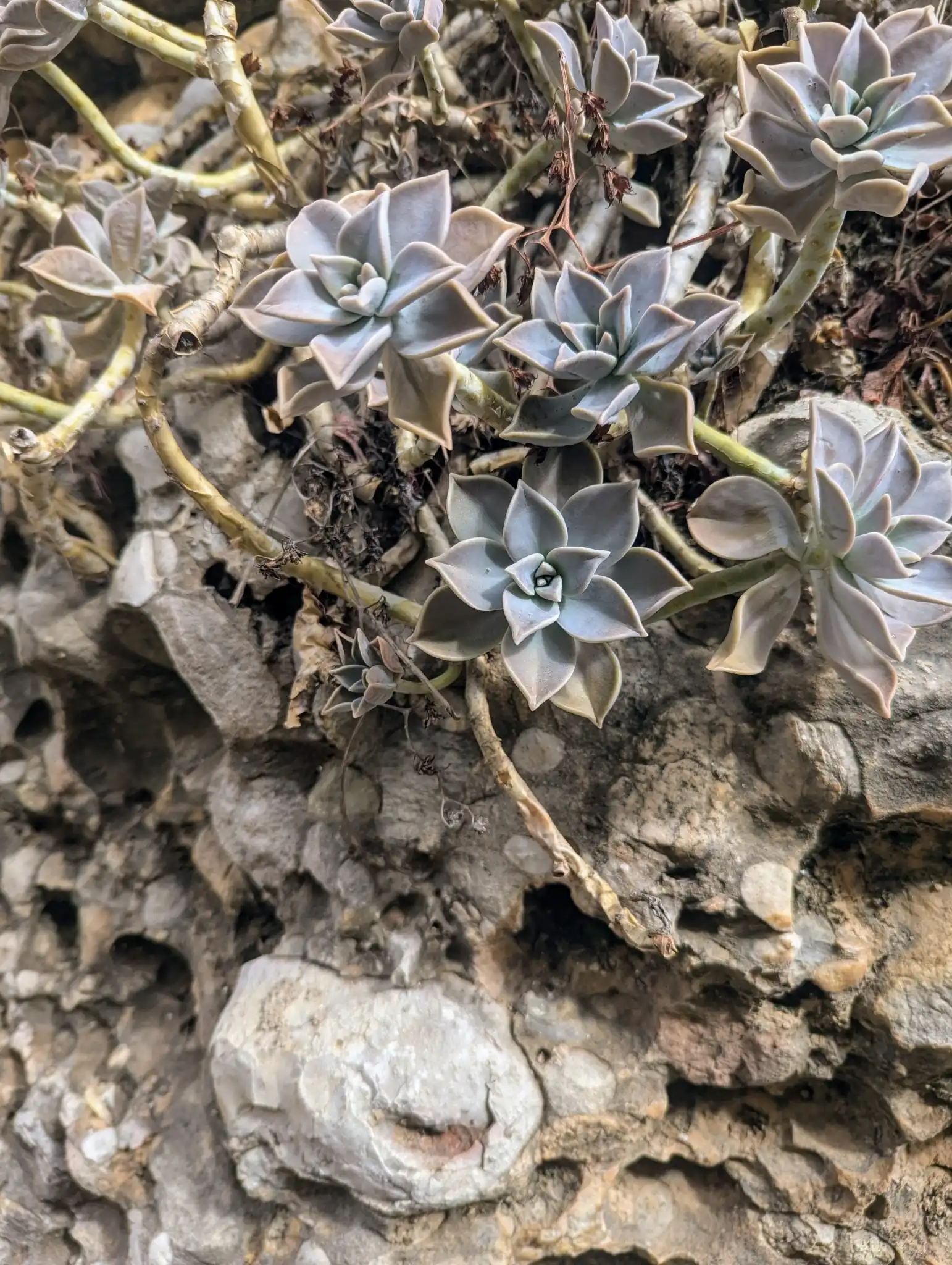
Graptopetalum macdougallii is a caulescent mat-forming evergreen succulent from shady rocks in the mountains west of Tehuantepec, Oaxaca. It builds ground-hugging rosettes 2 to 3 inches across on short stolons, the tongue-shaped leaves coated in waxy farina that shifts blue-white to lime-green with pink-red edging in sun.
Unlike most leatherpetals it prefers light shade and steady summer water, and it spreads by basal stolons into a tight mat rather than staying solitary. The branched 2- to 6-inch thyrse carries 3/4-inch five-pointed stars, whitish-green densely striped red-brown, that only set after a month below 60F in winter.
Uses & Benefits:
Essentials
At a Glance
Plant Type
Cactus Succulent
Height
8"
Width
8"
Light
Full Sun, Partial Sun
Zones
9, 10
Water
Low
Humidity
Low
Lifespan
Perennial
Native To
Mexico (Oaxaca)
Toxicity
Non-toxic
Bloom period
Late winter – Summer
In flower about 7 months of the year
Planting
How to Grow
- Plant in gritty porous loam cut with pumice or gravel that drains instantly yet holds some moisture.
- Set in full sun to light shade, with afternoon shade in hot inland gardens to hold the blue-white farina color.
- Water deeply, then let the mix dry fully; water sparingly from October to March and keep water off leaves and stems.
- Overwinter frost-free above 20F; bring pots indoors under bright light before first freeze and keep dry.
- Feed once in spring at one-quarter strength and leave the stolon mat to fill; remove only spent flower stalks and dead leaves.
Pro Tip
Give light shade and a cool dry winter below 60F for a month to trigger bloom; water kills faster than neglect, so let the clump mat undisturbed.
Keep It Thriving
Care Guide
Do
- Do provide light shade and airflow to prevent rot in tight rosettes.
- Do let soil dry fully between deep waterings.
- Do keep winter cool and dry for a month to set buds.
Don't
- Do not overwater or let pots sit in soggy soil.
- Do not overfeed; full-rate fertilizer burns the mat.
- Do not wet the crown or strip the farina from leaves.
Seasonal Care Calendar
| Task | Jan | Feb | Mar | Apr | May | Jun | Jul | Aug | Sep | Oct | Nov | Dec |
|---|---|---|---|---|---|---|---|---|---|---|---|---|
| Fertilize | ||||||||||||
| Pest Check | ||||||||||||
| Plant | ||||||||||||
| Propagate | ||||||||||||
| Winter Prep |
Watch Out For
Pests & Diseases
Common Pests
Common Diseases
In the Garden
Landscape Uses & Companions
Landscape Uses
Companion Plants
Multiply
Propagation Methods
Good to Know
Common Questions
MacDougall's Ghost Plant questions
What zones can MacDougall's Ghost Plant grow in?
MacDougall's Ghost Plant is hardy in USDA Zones 9–10: in that range it survives winter in the ground. Colder than Zone 9, grow it in a container you can move to shelter for the winter, or as an annual.
When does MacDougall's Ghost Plant bloom?
MacDougall's Ghost Plant typically blooms from late winter to late summer. Exact timing shifts a week or two with your zone — Sow's bloom calendar maps it to your garden.
Does MacDougall's Ghost Plant need full sun?
MacDougall's Ghost Plant does best in full sun to part shade. In hot climates, afternoon shade keeps blooms fresher longer.
Is MacDougall's Ghost Plant drought tolerant?
Yes — once established (usually after the first full season), MacDougall's Ghost Plant handles dry spells with minimal watering. Water deeply its first year to build the root system that makes that possible.
More Graptopetalum to compare


Keep exploring
Explore the genus
Hardy in your zone?
Grow MacDougall's Ghost Plant with confidence
See it in a design of your actual yard, get zone-matched care reminders, and track it season by season in your garden journal.