Quick answer
Prune forsythia as soon as its flowers drop in spring and finish by mid-July, because the shrub forms next year's flower buds on summer growth. That puts the job in March or April in the Deep South, April or May in the Midwest, and May to early June in Minnesota. Each year, remove up to one-third of the oldest canes at the ground instead of shearing.
Key facts
- Best time
- Right after the flowers drop in spring
- Last safe cut
- Mid-July; later cuts remove next spring's flower buds
- Yearly method
- Remove up to one-third of the oldest canes at ground level
- Overgrown shrub
- Cut to 3 to 4 inches (8 to 10 cm) in late winter or early spring; flowers return within about two years
- Avoid
- Shearing into balls or boxes, and any shaping cuts between mid-July and bloom
- Cold limit for flowers
- Typical border forsythia buds die below about -5°F (-21°C)
- Pets
- Non-toxic to dogs, cats and horses
Prune forsythia in the weeks after its yellow flowers drop in spring, and have every cut made by mid-July. The shrub starts building next year's flower buds on its new stems in summer. A cut made after that point, or at any time in fall or winter, removes flowers you would otherwise see in a few months.
How you cut matters as much as when. A border forsythia flowers best on young canes rising from the base, so the routine job is taking the oldest canes out at ground level, not trimming the outside. Even a shrub left unpruned for years can be cut to the ground and will flower again within about two years.
Why forsythia is pruned right after it blooms
Forsythia flowers on old wood: the buds that open in spring formed during the previous summer and fall, and they are complete by autumn. Flowers sit singly or in clusters of two to six along stems that are one or two years old, so the shoots growing this summer carry next spring's display.
That cycle sets the window. A cut made just after bloom gives the shrub the whole growing season to replace what you removed, and the replacement stems set their buds from midsummer onward. Cuts made after mid-July start removing those buds. The same logic applies to most shrubs that flower before May, while shrubs that bloom on the current year's growth, such as panicle and smooth hydrangeas, run on a different calendar (see when to prune hydrangeas).
Fall and winter pruning is the most common reason a healthy forsythia blooms poorly. Forsythia also keeps its leaves later into fall than most deciduous shrubs, which tempts gardeners to tidy it in October, exactly when every shortened branch costs its flowers.
Winter is the one season when cutting forsythia pays off, for the vase. In the South, branches cut between early January and late February open indoors in about 10 days. Take them from old canes you were planning to remove anyway.
When to prune forsythia in your region
Your window opens when your own shrub finishes flowering, which runs from March in the Deep South to May in Minnesota. Bloom lasts two to three weeks in South Carolina unless cold cuts it short, and one to two weeks in the upper Midwest.
| Region (example) | Usual bloom | Prune window |
|---|---|---|
| South Carolina | Late February to March; late January after a mild winter | March to April |
| Georgia (Atlanta) | February to March | March to April |
| St. Louis | March to early April | April to May |
| Chicago | Late March into April | April to May |
| Wisconsin | Late March to mid-April | Late April to May |
| Minnesota | April to early May | May to early June |
Prune windows follow local bloom. In every region, finish by mid-July.
Use the table as a guide and the shrub as the clock. A mild winter can pull bloom forward by a month or more, but the signal never changes: once most flowers have fallen and leaves are unfolding, start cutting.
In the northern tier, winter cold matters more than the calendar. Flower buds on typical border forsythia die when temperatures fall below about -5°F (-21°C), so after a hard winter a shrub may flower only on branches that sat under snow. Border forsythia grows in Zones 5 to 8 but may not flower well in Zone 5. If you garden near that limit, look up your USDA zone on the 2023 map before choosing a cultivar.
Newly planted shrubs need almost nothing. For their first few years, remove only dead, damaged or badly placed shoots after bloom.
Tools and safety
Three tools handle nearly every forsythia. Use bypass hand pruners for stems up to 1/2 inch (13 mm) thick and loppers for stems from 1/2 to 1 1/2 inches (13 to 38 mm). For the thick old canes at the base, a tri-cut pruning saw handles wood up to about 4 inches (10 cm). Bypass pruners, which cut like scissors, leave a closer, cleaner cut than anvil pruners, although an anvil cuts thick stems with less effort. Save hedge shears for a formal hedge.
Clean the blades with alcohol or a 10 percent bleach solution, especially after cutting out diseased wood.
If you take a chainsaw to a very thick old cane, keep it below shoulder height and never run it from a ladder.
How to prune an established forsythia
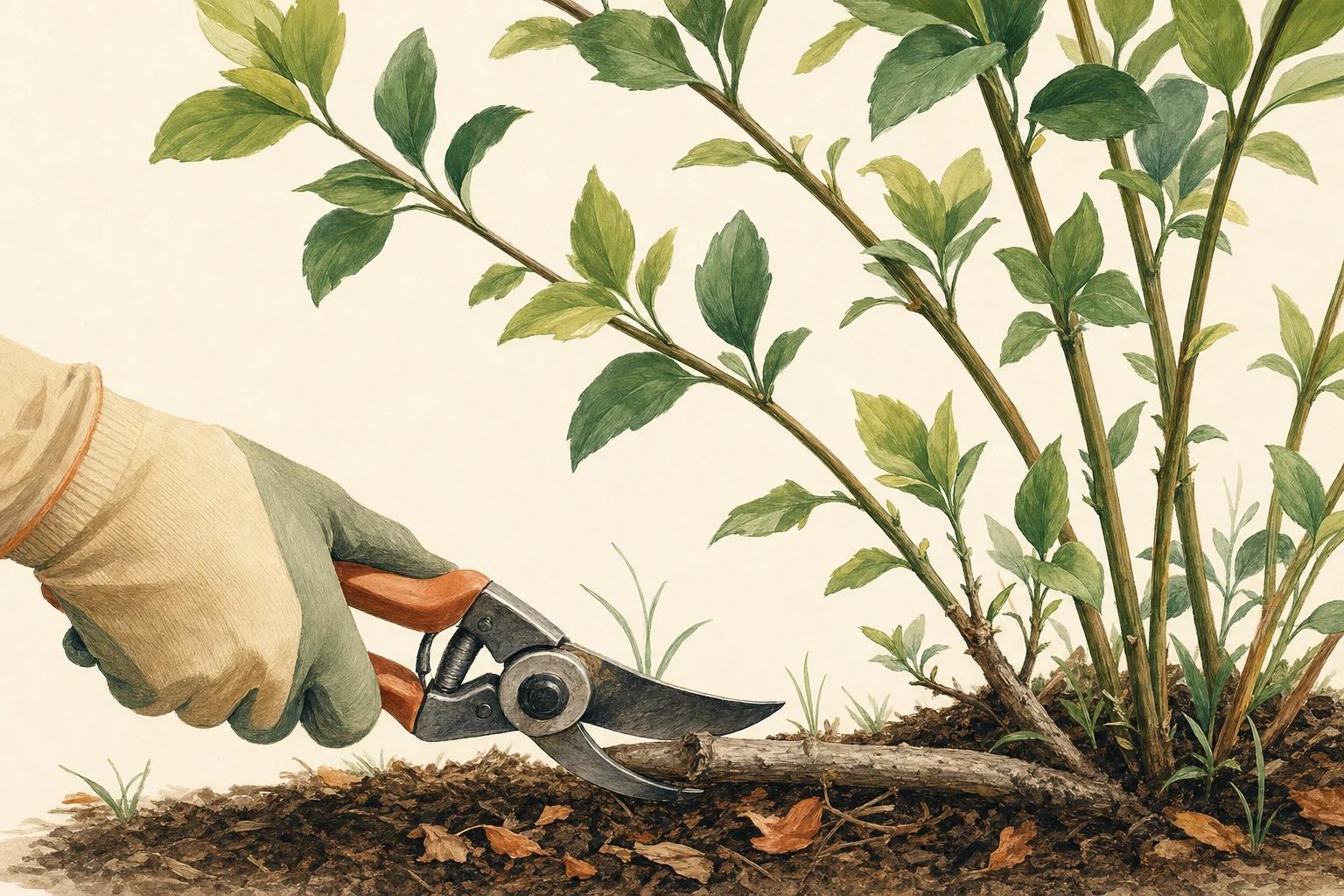
The yearly job is renewal pruning: right after bloom, remove up to one-third of the oldest, thickest canes at ground level, then lightly shape what remains. Taking whole canes out at the base keeps a steady supply of young stems coming, and young stems carry the most flowers.
- Wait for the flowers to drop. Start once most blooms have fallen and the leaves are opening, so you can see which stems flowered. Finish by mid-July.
- Take out dead, damaged and crossing wood. Cut these back to live wood or to the ground first. Throw away any branch with galls or cankers rather than composting it.
- Cut the oldest canes at the ground. Choose up to one-third of the stems, starting with the thickest, and cut them off at soil level. This pushes vigorous young canes from the base.
- Shorten overlong flowered shoots. Follow each long stem down to a strong shoot or bud facing up and outward, and cut about 1/4 inch (6 mm) above it on a slight angle. Cut each stem to a different height so the outline stays loose and arching.
- Thin the center. Remove weak, spindly and crowded shoots in the middle, keeping the sturdiest, best-placed young stems.
- Finish cleanly. Leave no stubs, since they close slowly and invite dieback. No wound dressing is needed.
The type of cut decides how the shrub responds. A thinning cut removes a stem where it starts, at the ground or at a fork, and the shrub stays open. A heading cut shortens a stem partway along, and the strongest regrowth comes from the 6 to 8 inches (15 to 20 cm) just below it. Head a dozen stems back to one height and you get a broom of shoots along that line, shading the interior. A forsythia should get mostly thinning cuts.
How much you take depends on the shrub. Up to one-third a year suits a mature, vigorous plant. A lighter rhythm also works: one-quarter to one-third of the oldest stems every other year once the shrub is established, or no more than one-fifth each year on a younger or smaller shrub.
If bare branches make the framework easier to read, you can take out old canes in early spring before the leaves emerge. Those canes will not flower that year, and every other cut still waits until after bloom.
How to rescue an overgrown forsythia
A tall, congested forsythia with bare stems at the base can be cut to within 3 to 4 inches (8 to 10 cm) of the ground. Do it in late winter or early spring, before new growth starts. You give up that spring's flowers, since they were on the wood you removed. You can also make the cut right after bloom, before mid-July: you keep this spring's flowers, and the new canes have the summer to grow before next year's buds form. Regrowth is fast: within one season the shrub looks like a fresh planting, and full bloom returns within about two years.
All at once or over three years
Cut a healthy shrub down in one go. If it is weak or stressed, spread the work over three years so it keeps some leaves and flowers throughout:
- Year one: remove one-third of the old stems at the ground.
- Year two: remove half of the old stems that remain, and shorten overlong new shoots.
- Year three: remove the last of the old wood.
Do not try to shrink an overgrown forsythia by heading every stem back to a lower height. The shrub answers with dense, twiggy growth at the cut line and never regains its natural shape. A full rejuvenation followed by yearly renewal cuts is the better route.
Timing in the South
In Georgia and similar climates, make a severe cut as spring growth begins: around mid-February in south Georgia and mid-March in north Georgia. A severe cut in late fall or midwinter can push out tender shoots that cold then damages.
After the cut, and when it fails
Expect a thicket of new shoots from the roots. Later in summer, thin them, keeping the strongest and best-spaced canes, then return to yearly renewal pruning. Plan on rejuvenating no more often than once every three to five years; a shrub that gets renewal cuts every year may never need it.
Rejuvenation may fail in three situations: shrubs mulched with rock over weed fabric, badly overgrown plants with a large woody base, and shrubs with more than a third of their branches already dead or leafless. A shrub that is mostly dead is usually better replaced.
Why shearing ruins forsythia, and how to prune a hedge
Shearing destroys the arching shape that is forsythia's main asset and cuts the number of flowers year after year. Each pass of the shears makes dozens of heading cuts, so a sheared shrub grows a dense skin of shoots that shades its interior. Over a few seasons the inside turns to bare wood and dead branches, and the remaining flowers sit in a thin outer shell. Shearing also does nothing to encourage the new canes from the base that future flowers depend on.
A forsythia that has already been sheared into a ball or box is a candidate for the rejuvenation cut above, followed by yearly renewal pruning.
Pruning a forsythia hedge
An informal hedge suits forsythia best, because each plant can be pruned by renewal and keeps its full bloom. Space plants up to 3 feet (90 cm) apart. Use the plant spacing calculator to work out how many you need for a given run.
A formal, clipped hedge needs closer spacing, 18 inches to 2 feet (45 to 60 cm), and gives up some flowers. Shear it once a year, right after bloom, and keep the base wider than the top. At the same session, cut a few of the oldest stems out at the ground so the hedge keeps renewing from below. Every extra shearing later in the season costs more flowers.
Compact and cold-hardy forsythias that need less pruning
If you are pruning hard every year just to keep a forsythia small, the real fix is a smaller plant. Border forsythia grows fast to 8 to 10 feet (2.4 to 3 m) tall and up to 12 feet (3.7 m) wide, and pruning is no substitute for choosing a plant that fits the space.
| Cultivar | Height and width | Zones | Pruning needed |
|---|---|---|---|
| Show Off Sugar Baby | 18 to 30 in (45 to 75 cm) tall, 2 to 3 ft (0.6 to 0.9 m) wide | 5 to 8 | No heavy pruning |
| Show Off Starlet | 2 to 3 ft (60 to 90 cm) tall and wide | 5 to 8 | Seldom |
| Gold Tide | About 20 in (50 cm) tall, to 4 ft (1.2 m) wide | 5 to 8 | Low and spreading; buds can be damaged in Zone 5 |
| Show Off | 5 to 6 ft (1.5 to 1.8 m) tall and wide | 5 to 8 | Little or none |
Mature sizes and USDA hardiness zones for compact forsythia cultivars.
In cold regions the cultivar matters for a second reason: a forsythia that will not flower may be losing its buds to cold rather than to the pruners. Flower-bud hardiness varies widely by cultivar. The first five below hold their buds through far colder winters than typical border forsythia; Spring Glory does not.
| Cultivar | Flower buds hardy to | Mature height |
|---|---|---|
| Meadowlark | -35°F (-37°C) | 7 to 15 ft (2.1 to 4.6 m), most often about 10 ft (3 m) |
| New Hampshire Gold | -33°F (-36°C) | About 5 ft (1.5 m) |
| Northern Gold | -30°F (-34°C) | 6 to 8 ft (1.8 to 2.4 m) |
| Northern Sun | -30°F (-34°C) | About 10 ft (3 m) |
| Sunrise | -20°F (-29°C) | 5 to 6 ft (1.5 to 1.8 m) |
| Spring Glory | -10°F (-23°C); poor for cold regions | 8 to 10 ft (2.4 to 3 m) |
| Typical border forsythia | About -5°F (-21°C) | Varies by cultivar |
Lowest winter temperature at which each cultivar's flower buds survive.
Even the hardiest of these can lose buds to a thaw in mid- or late winter, so an occasional thin year in the North is weather, not a pruning error.
Aftercare, spreading stems and what to expect
After a renewal cut, a forsythia puts its energy into new canes from the base, and by late summer you should see several vigorous new shoots. Those are next spring's best flowering stems, so keep the strongest and leave them unshortened; thin them only if they come up as a crowded thicket, as they do after a rejuvenation cut. Full sun gives the most and earliest flowers; in partial shade the shrub blooms less and grows straggly however well you prune it.
Rooting tips and suckers
Border forsythia can sucker from its roots, and its arching branches can root where they touch the soil. Weeping forsythia does this so readily that an untended planting can colonize the area around it. Neither is listed as invasive, but both need a yearly check: cut or lift rooted tips when you prune.
Those rooted tips are free plants. Dig a well-rooted stem, sever it from the parent, and replant it. To root one on purpose, pin a low, flexible stem to the soil with a wire loop in spring or fall and keep the spot moist. Cut it free once it has rooted firmly, which takes six months or more. Softwood cuttings taken in late spring or early summer, and semi-hardwood cuttings later in summer, also root easily.
Problems you may find while pruning
Round, knobby swellings on the stems are Phomopsis gall, and branches dying back from cankers in the bark may have Botryosphaeria canker. Cut affected branches back to healthy wood and throw them away. Leaf spot, crown gall and dieback also turn up. Flattened, fused-looking shoots are fasciation, an odd growth quirk that does the plant no harm.
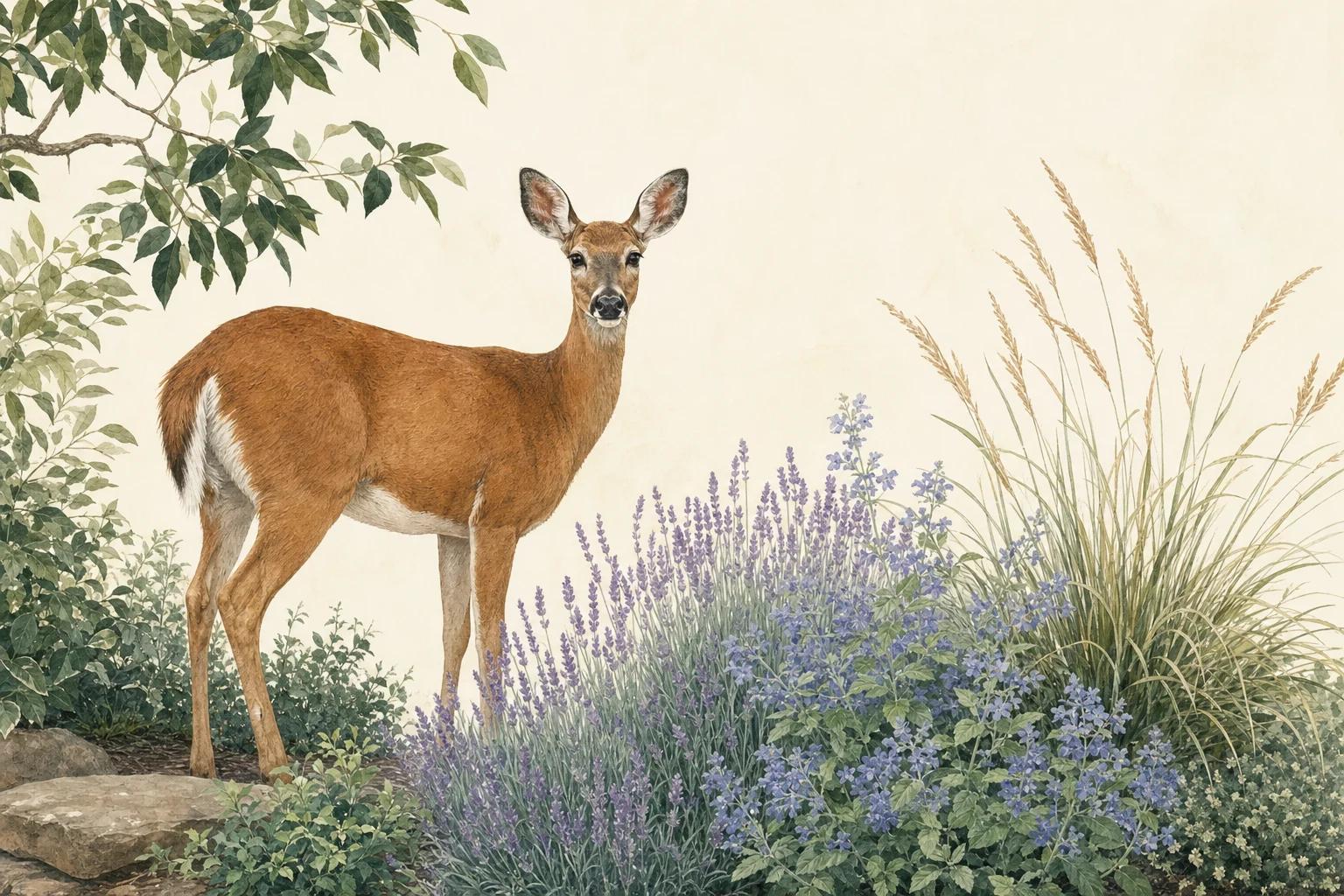
Deer tend to avoid forsythia, though they occasionally browse it, which earns it a place among deer-resistant shrubs and perennials.
Few or no flowers: finding the cause
When a forsythia flowers poorly, the pattern of the flowers usually points to the cause.
| What you see | Likely cause | What to do |
|---|---|---|
| No flowers after a fall or winter trim | Buds were cut off | Prune only after bloom, by mid-July |
| Flowers only near the ground | Cold killed buds above the snow line | Plant a bud-hardy cultivar |
| Flowers only at the top of a tall, bare shrub | No old canes removed for years | Start renewal cuts, or rejuvenate |
| Flowers in a thin outer layer | Years of shearing | Rejuvenate, then renew yearly |
| No flowers the spring after a hard cut | Expected after rejuvenation | Wait; bloom returns within two years |
| Sparse flowers, leggy growth | Too much shade | Move it, or accept lighter bloom |
Common flowering problems in forsythia and their fixes.
A few flowers opening after an unusually warm late autumn are fully formed buds responding to the weather, not a pruning problem. If you are planting a new forsythia, sketch it at full size in Sow's design studio first, so the shrub fits its space and the pruning stays light.
From the Sow catalog
Shrubs in the Sow catalog
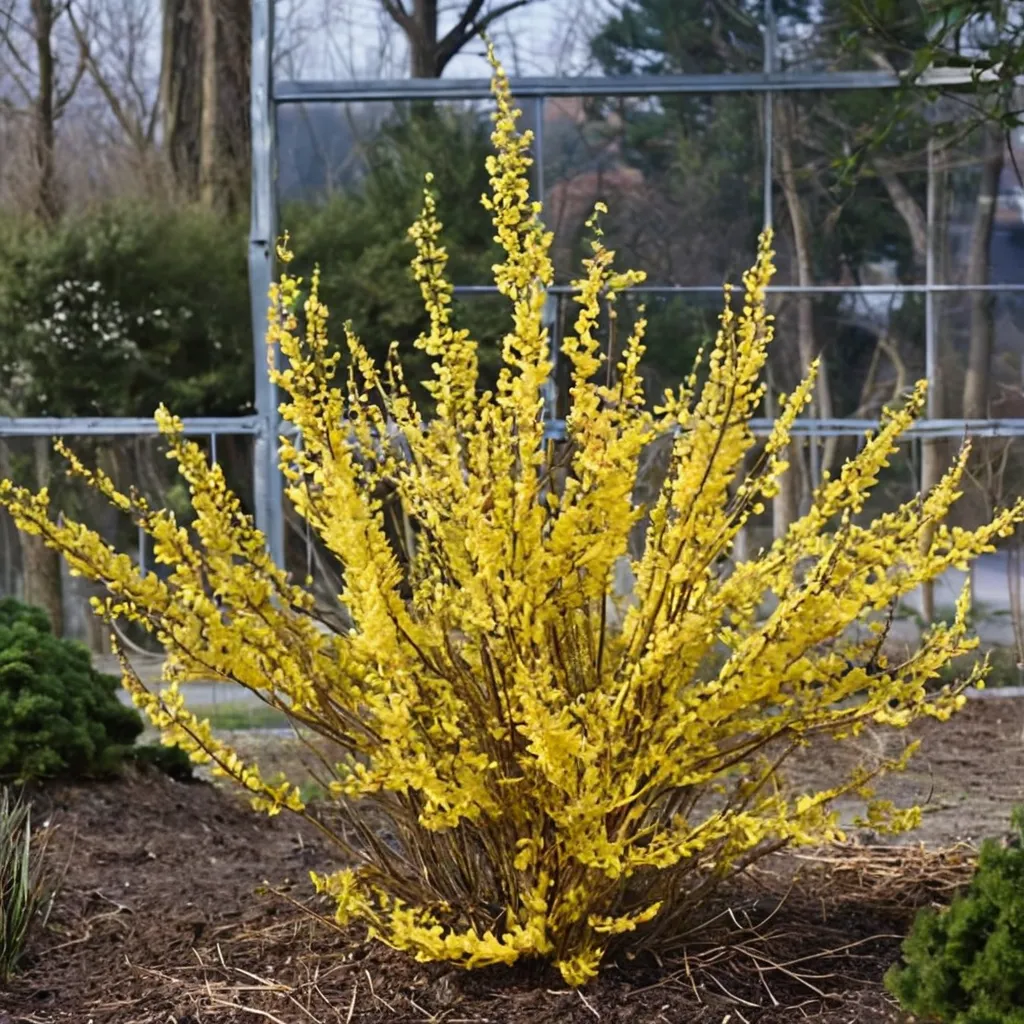
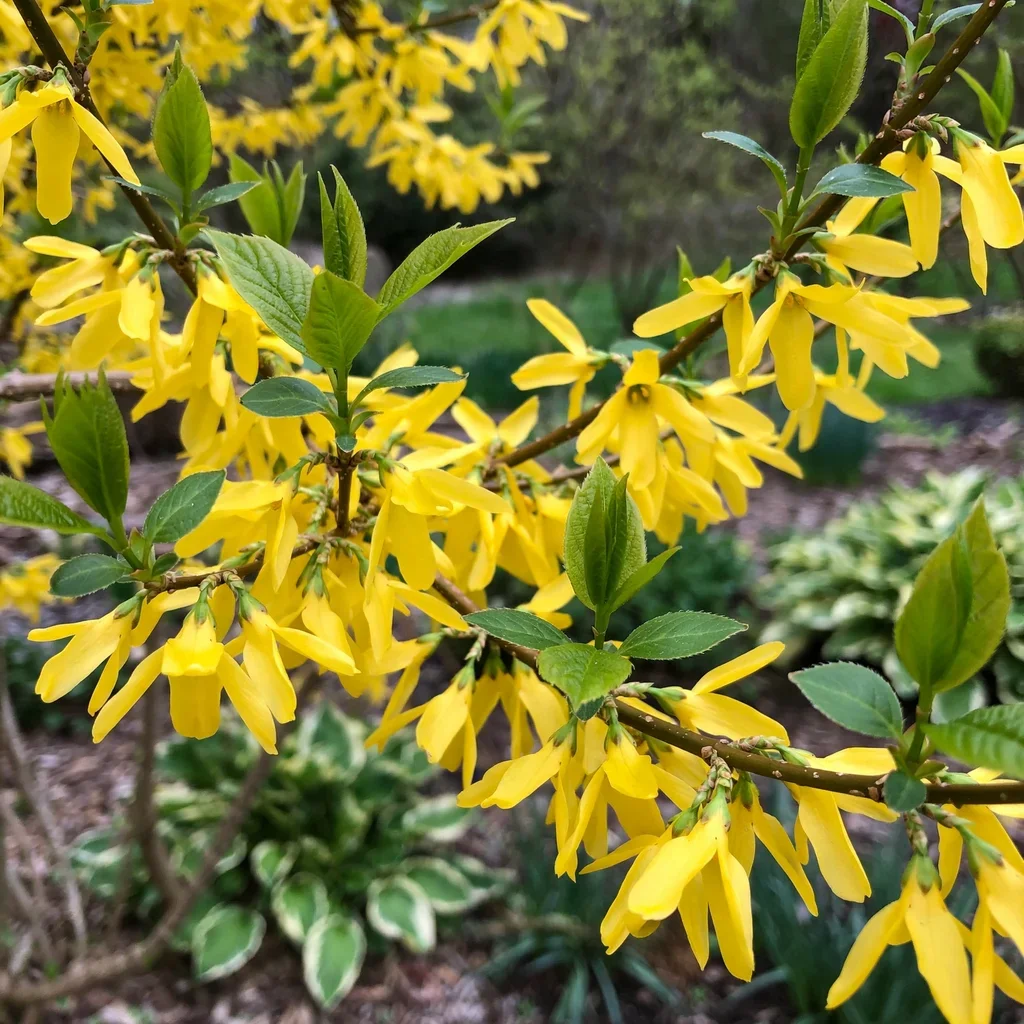
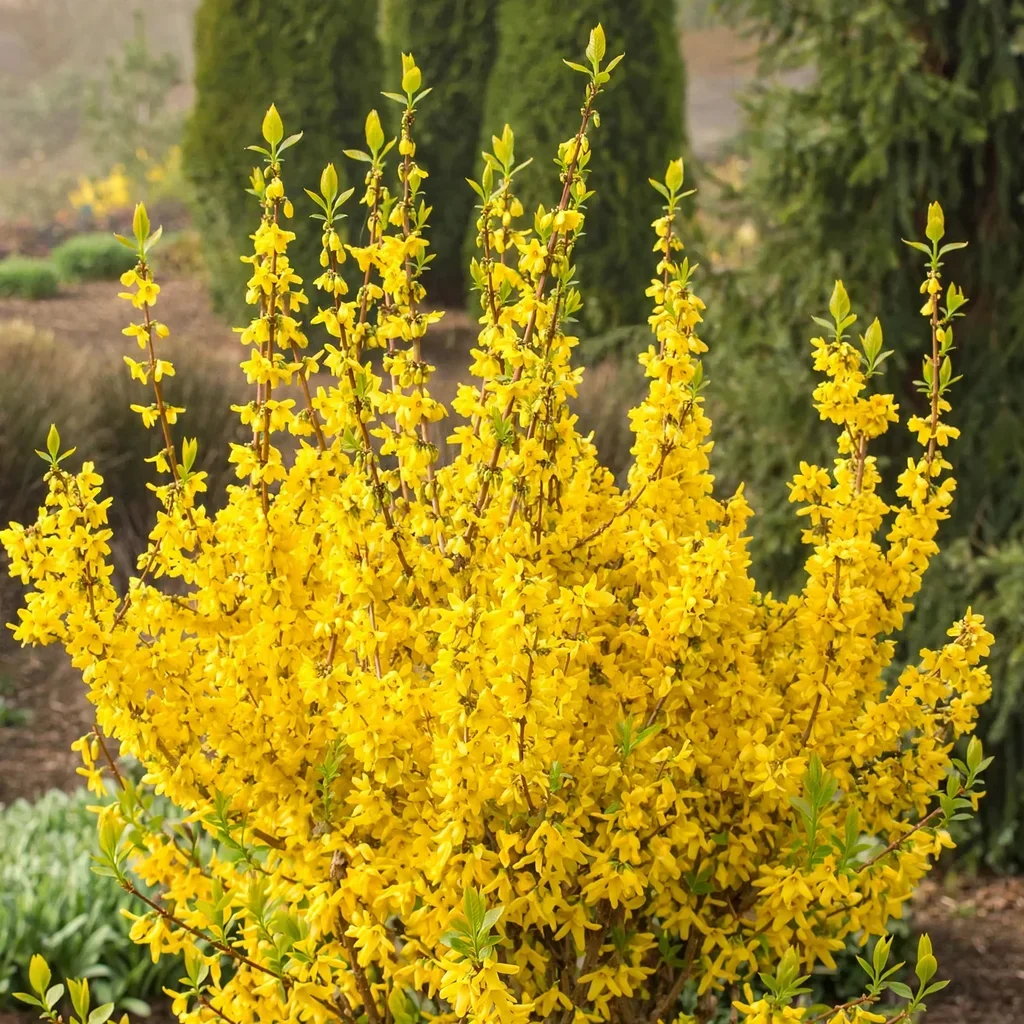
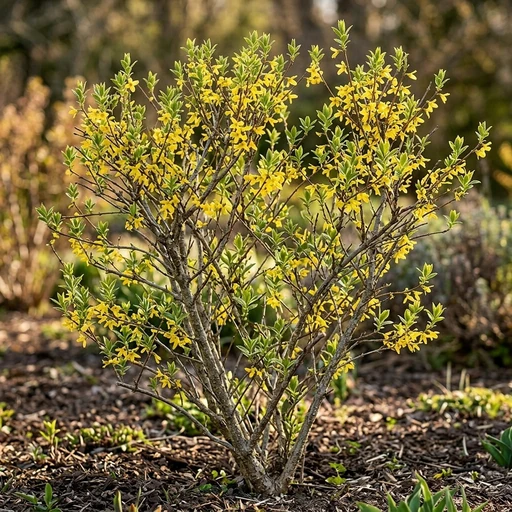
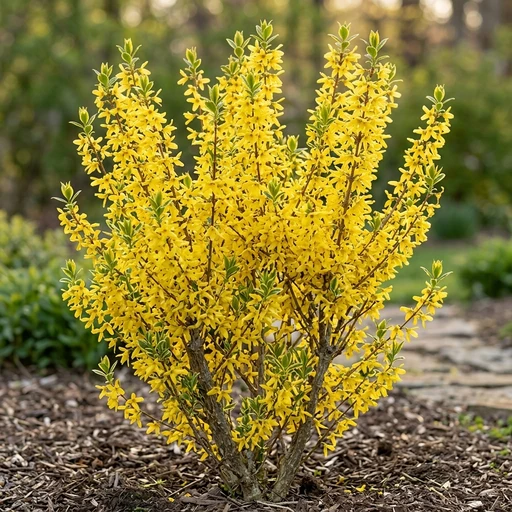
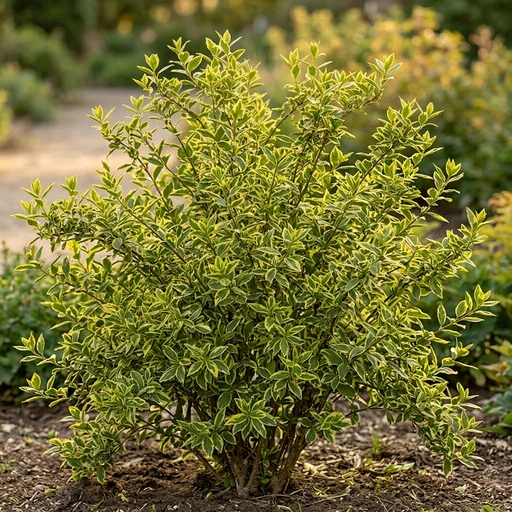
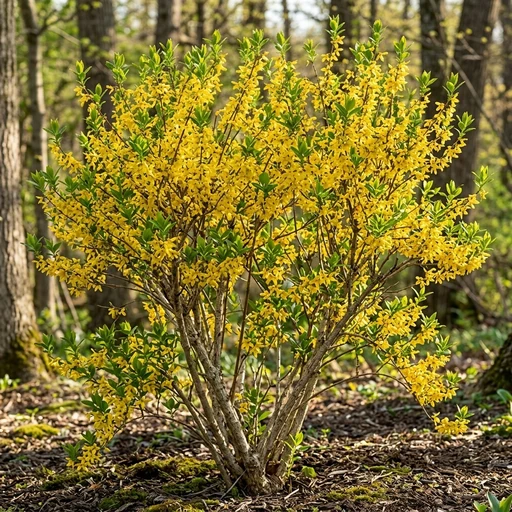
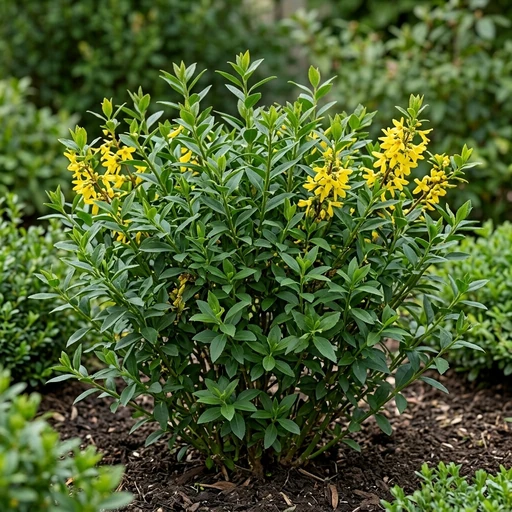
Sow tracks 22 Forsythia varieties, hardy across USDA Zones 4 to 8 between them. These are the 8 gardeners save most. Each one opens its own page with its zone range, sun, mature size and, where a nursery lists it, today's price.
Frequently asked questions
Does forsythia bloom on old wood?
Yes. Its flowers open singly or in clusters of two to six on stems one and two years old, so the young canes from the last two seasons carry most of the display. Those are the canes to keep. The oldest, thickest canes flower less, and they are the ones to take out at the base after bloom, which keeps a steady supply of young flowering wood coming up.
Can you cut forsythia back to the ground?
Yes, and it is the most reliable fix for a badly overgrown shrub. Cut every cane to within a few inches of the soil in late winter or early spring, or right after it blooms if you want to keep this year's flowers, and the roots send up a crowd of new shoots; flowering returns within about two years. The method can fail where the shrub sits in rock mulch over landscape fabric, or where more than a third of its branches are already dead.
What happens if you don't prune forsythia?
It keeps growing to 8 to 10 feet (2.4 to 3 m) tall and as much as 12 feet (3.7 m) wide, and turns into a congested thicket with bare stems at the base and most of its flowers up top. Low branches also root where they touch soil, so an unpruned shrub slowly widens. Removing a few of the oldest canes each year prevents all of this.
Can I prune forsythia in the fall?
Not if you want flowers next spring. By fall the buds for the coming season are already formed, so every branch you shorten loses them. Limit routine fall work to cutting out dead or broken wood. A full rejuvenation cut can be made from late fall through early spring, since that spring's flowers are lost either way; in the South, wait until spring growth begins, because a severe cut in late fall or midwinter can push tender growth that cold injures.
Are forsythia bushes deer resistant?
Mostly. Deer tend to avoid border forsythia, though they occasionally browse it, so treat it as resistant rather than deer proof. It also tolerates black walnut, wet sites and salt, which makes it useful along drives and roadsides where tougher shrubs are needed.
Is forsythia poisonous to dogs or cats?
No. Forsythia, also sold under the name golden bells, is non-toxic to dogs, cats and horses. Prunings left on the lawn are not a poisoning risk, and the shrub is a safe choice along a dog run or a pasture fence.
Is forsythia invasive?
It is not listed as invasive, but it does spread. Forsythia is not native to North America; weeping forsythia, one of the parents of the common border forsythia, comes from China. Border forsythia can sucker from the roots, and arching branches of both kinds root where they touch soil, so a neglected planting creeps outward. Lifting rooted tips each year keeps it in place.
Why does my forsythia only bloom at the bottom?
Winter cold killed the flower buds higher up. Buds on typical border forsythia die below about -5°F (-21°C), and only the ones insulated by snow survive, so the shrub flowers in a band near the ground. Pruning is not the cause. In cold regions, replace it with a bud-hardy cultivar such as Meadowlark, whose buds survive to -35°F (-37°C).
References
- NC State Extension Gardener Plant Toolbox. Forsythia x intermedia (Border Forsythia, Golden Bells). Accessed October 16, 2026.
- Missouri Botanical Garden Plant Finder. Forsythia x intermedia (border forsythia). Accessed October 16, 2026.
- Missouri Botanical Garden Plant Finder. Forsythia suspensa (weeping forsythia). Accessed October 16, 2026.
- Missouri Botanical Garden Plant Finder. Forsythia 'Courtasol' GOLD TIDE. Accessed October 16, 2026.
- Clemson Cooperative Extension Home & Garden Information Center. Forsythia. Accessed October 16, 2026.
- Clemson Cooperative Extension Home & Garden Information Center. Pruning Shrubs. Accessed October 16, 2026.
- University of Georgia Cooperative Extension. Pruning Ornamental Plants in the Landscape (Bulletin 961). Accessed October 16, 2026.
- The Morton Arboretum. Border forsythia. Accessed October 16, 2026.
- University of Wisconsin-Madison Extension. Forsythia, Forsythia spp.. Accessed October 16, 2026.
- University of Wisconsin-Madison Extension. Pruning Deciduous Shrubs. Accessed October 16, 2026.
- University of Minnesota Extension. Pruning trees and shrubs. Accessed October 16, 2026.
- University of Minnesota Extension. Forsythia. Accessed October 16, 2026.
- Penn State Extension. Pruning Flowering Shrubs. Accessed October 16, 2026.
- Colorado State University Extension. Pruning Flowering Shrubs (GardenNotes #616). Accessed October 16, 2026.
- Royal Horticultural Society. Forsythia: growing guide. Accessed October 16, 2026.
- ASPCA Animal Poison Control. Golden Bells. Accessed October 16, 2026.
- USDA NRCS PLANTS Database. Forsythia (FORSY) plant profile. Accessed October 16, 2026.
- Proven Winners. Show Off Forsythia x intermedia 'Mindor'. Accessed October 16, 2026.
- Proven Winners. Show Off Starlet Forsythia x 'Minfor6'. Accessed October 16, 2026.
- Proven Winners. Show Off Sugar Baby Forsythia x 'NIMBUS'. Accessed October 16, 2026.
Sow Editorial
Written by the Sow team from university extension services, botanical gardens, USDA and NOAA data and plant breeders. Every source is listed under References.