The Story
Plant Bio
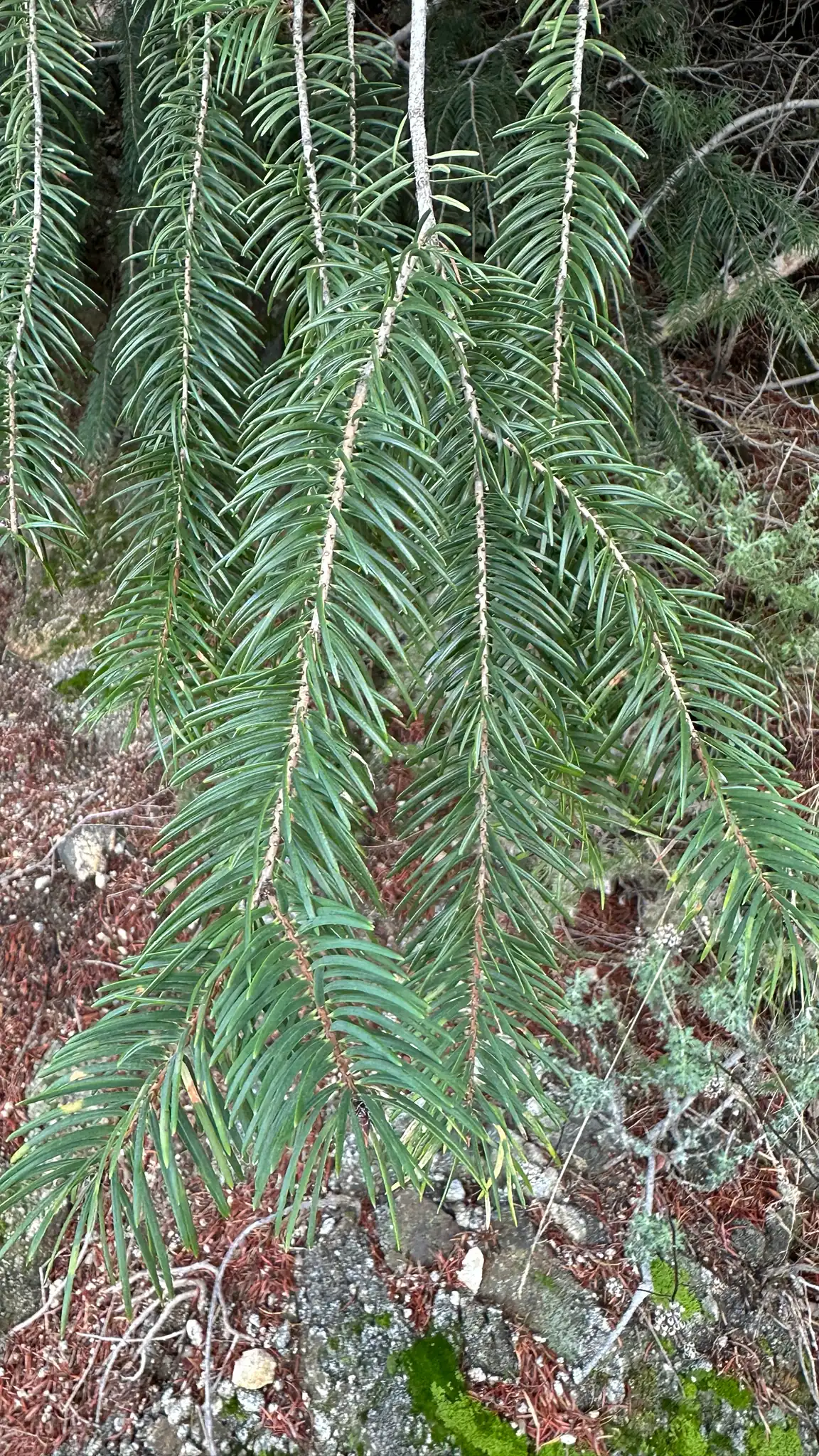
Pseudotsuga macrocarpa, known as the bigcone Douglas-fir, is a large evergreen conifer native to the mountain ranges of southern California, forming a broad, open crown with long, spreading lower branches. Its flat, blue-green to gray-green needles feature two pale stomatal bands beneath and surround thick-scaled seed cones.
Unlike the standard coast Douglas-fir, this species is highly adapted to arid Mediterranean mountain slopes and produces significantly larger, heavier seed cones with thick woody scales. Deep taproots and thick bark aid its survival through severe summer heat and seasonal drought.
Uses & Benefits:
Essentials
At a Glance
Plant Type
Tree
Height
984"
Width
354"
Light
Full Sun, Partial Sun
Zones
7, 8, 9
Water
Low
Humidity
Low to moderate
Lifespan
Perennial
Native To
North America (Southern California)
Toxicity
Non-toxic
Bloom period
Spring
In flower about 3 months of the year
Planting
How to Grow
- Select a full sun or lightly shaded site with deep, sharply draining, rocky or sandy soil.
- Dig a planting hole twice as wide as the container and set the root collar slightly above ground level.
- Water deeply during the first two summer seasons, letting the top several inches of soil dry completely between applications.
- Taper off supplementary watering once established, allowing the tree to rely on natural seasonal rainfall.
Pro Tip
Plant in fast-draining, rocky soil and strictly limit summer irrigation once established, as saturated roots rapidly trigger fatal Phytophthora rot.
Keep It Thriving
Care Guide
Do
- Plant in sharp, mineral-rich, well-draining soils.
- Provide deep, infrequent watering during the initial two-year establishment period.
- Protect young saplings from deer and rabbit browsing with sturdy cages.
Don't
- Do not irrigate frequently during hot summer months once established.
- Do not cut back into old, bare, leafless wood when pruning.
- Do not apply heavy doses of nitrogen fertilizer, which forces weak, succulent growth.
Seasonal Care Calendar
| Task | Jan | Feb | Mar | Apr | May | Jun | Jul | Aug | Sep | Oct | Nov | Dec |
|---|---|---|---|---|---|---|---|---|---|---|---|---|
| Fertilize | ||||||||||||
| Mulch | ||||||||||||
| Pest Check | ||||||||||||
| Plant | ||||||||||||
| Prune |
Watch Out For
Pests & Diseases
Common Pests
Common Diseases
In the Garden
Landscape Uses & Companions
Landscape Uses
Multiply
Propagation Methods
Good to Know
Common Questions
Bigcone Douglas-fir questions
What zones can Bigcone Douglas-fir grow in?
Bigcone Douglas-fir is hardy in USDA Zones 7–9: in that range it survives winter in the ground. Colder than Zone 7, winters are too cold for it to survive outdoors. Warmer than Zone 9, winter isn't the problem: it prefers colder winters, and summer heat can shorten its life.
Is Bigcone Douglas-fir deer resistant?
Not reliably. Deer may browse Bigcone Douglas-fir, especially tender spring growth — plan on repellents or fencing where pressure is high.
When does Bigcone Douglas-fir bloom?
Bigcone Douglas-fir typically blooms in spring. Exact timing shifts a week or two with your zone — Sow's bloom calendar maps it to your garden.
Does Bigcone Douglas-fir need full sun?
Bigcone Douglas-fir does best in full sun to part shade. In hot climates, afternoon shade keeps blooms fresher longer.
Is Bigcone Douglas-fir drought tolerant?
Yes — once established (usually after the first full season), Bigcone Douglas-fir handles dry spells with minimal watering. Water deeply its first year to build the root system that makes that possible.
More Pseudotsuga to compare
Keep exploring
Explore the genus
Hardy in your zone?
Grow Bigcone Douglas-fir with confidence
See it in a design of your actual yard, get zone-matched care reminders, and track it season by season in your garden journal.