The Story
Plant Bio
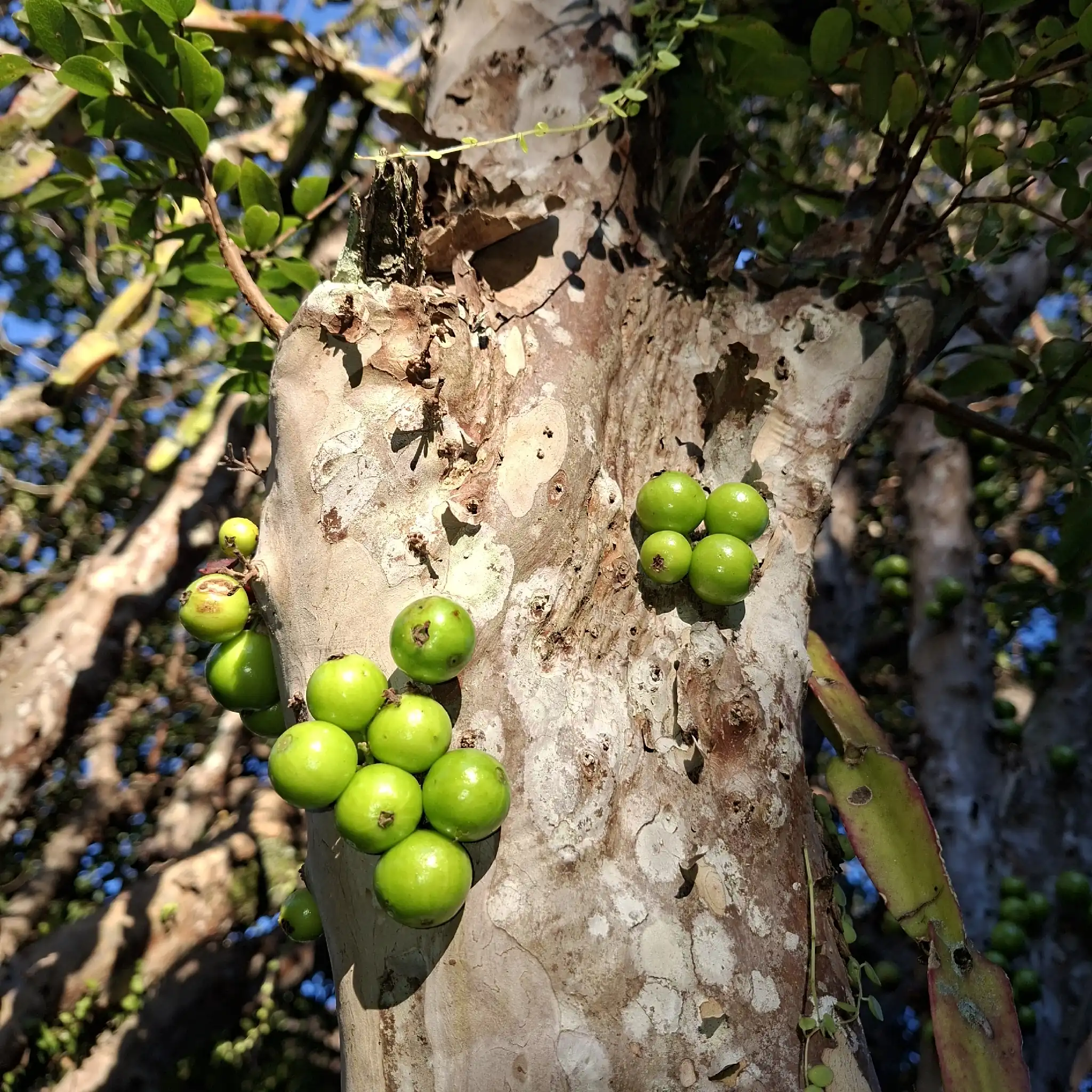
Plinia cauliflora is a slow-growing evergreen tree from eastern Bolivia and Brazil, forming a dense rounded crown 10 to 25 feet tall with opposite leathery dark green leaves 1 to 4 inches long. Small white to yellowish-white flowers less than an inch across open in clusters directly on the trunk and large limbs, followed by purple-black grape-like fruit with sweet white pulp.
The trunk-borne habit sets it apart: bloom and fruit pack the bark itself, so a mature tree carries successive crops through the warm months rather than a single canopy flush. Fruit reaches 1 to 3 inches across with thick tannic skin around gelatinous pulp eaten fresh or cooked, and crops are heaviest when two seedlings grow together for cross-pollination.
Uses & Benefits:
Essentials
At a Glance
Plant Type
Tree
Height
300"
Width
240"
Light
Full Sun, Partial Sun
Zones
9, 10
Water
Even moisture
Humidity
High
Lifespan
Long-lived tree
Native To
Eastern Bolivia and Brazil
Toxicity
Fruit edible, skin high in tannin
Bloom period
Spring – Fall
In flower about 9 months of the year
Marketplace
Where to Buy
Shipping costs Year-round shipping Free shipping
Planting
How to Grow
- Plant in full sun to light shade, with 6 or more hours of sun for best fruiting.
- Set in rich high-organic soil below pH 6.0 that stays moist but well drained.
- Water to hold even moisture; do not let the root zone dry out or sit waterlogged.
- Protect from frost; move container plants indoors to a bright frost-free spot before temperatures near 26F.
- Grow two seedlings together for cross-pollination for the heaviest trunk crop.
Pro Tip
Plant two seedlings for cross-pollination and hold the root zone evenly moist and acidic; seed-grown trees need eight to ten years to carry a full trunk crop.
Keep It Thriving
Care Guide
Do
- Keep soil evenly moist with mulch to hold moisture.
- Provide full sun to light shade in a frost-free spot.
- Grow in containers in cold zones to move indoors for winter.
Don't
- Do not expose to salt spray.
- Do not let the soil dry out completely.
- Do not expect quick fruit from seed; allow 8 to 10 years.
Seasonal Care Calendar
| Task | Jan | Feb | Mar | Apr | May | Jun | Jul | Aug | Sep | Oct | Nov | Dec |
|---|---|---|---|---|---|---|---|---|---|---|---|---|
| Harvest | ||||||||||||
| Mulch | ||||||||||||
| Pest Check | ||||||||||||
| Plant | ||||||||||||
| Winter Prep |
Watch Out For
Pests & Diseases
Common Pests
Common Diseases
In the Garden
Landscape Uses & Companions
Landscape Uses
Companion Plants
Multiply
Propagation Methods
Good to Know
Common Questions
Jaboticaba questions
What zones can Jaboticaba grow in?
Jaboticaba is hardy in USDA Zones 9–10: in that range it survives winter in the ground. Colder than Zone 9, winters are too cold for it to survive outdoors.
When does Jaboticaba bloom?
Jaboticaba typically blooms from spring to fall. Exact timing shifts a week or two with your zone — Sow's bloom calendar maps it to your garden.
Does Jaboticaba need full sun?
Jaboticaba does best in full sun to part shade. In hot climates, afternoon shade keeps blooms fresher longer.
More Plinia to compare
Keep exploring
Explore the genus
Hardy in your zone?
Grow Jaboticaba with confidence
See it in a design of your actual yard, get zone-matched care reminders, and track it season by season in your garden journal.