The Story
Plant Bio
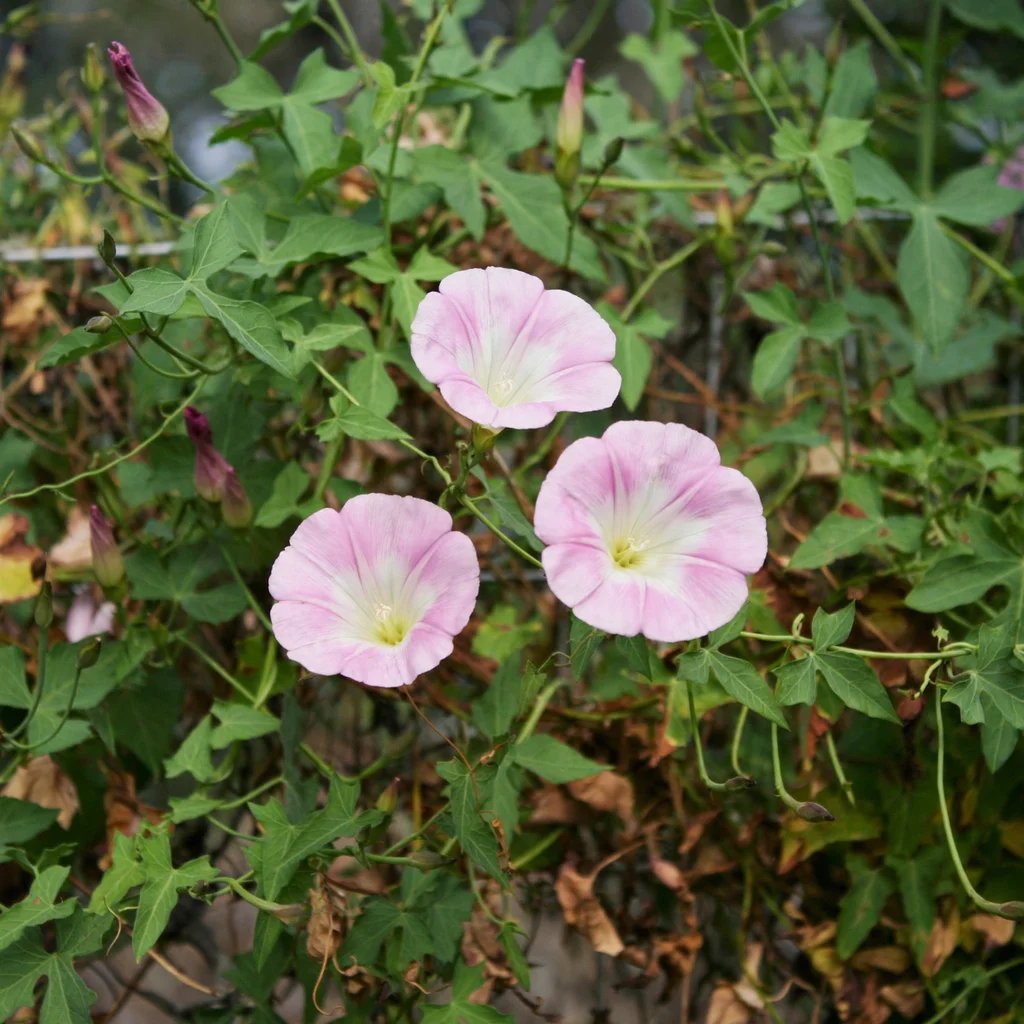
Calystegia purpurata is a perennial vine from a woody rootstock that spreads by rhizomes, with stems that trail along the ground or twine strongly upward when support is available. The leaves are hairless, triangular to ovate-triangular with spreading basal lobes, and each solitary morning-glory flower opens from narrow bracts set well below the sepals.
It is distinguished by smooth foliage and white to pale pink corollas, most with darker purple striping, about one to two inches across. Within the species the two subspecies separate on leaf sinus shape, with purpurata showing an open V-shaped sinus and pointed tip and saxicola a closed sinus with a rounded tip.
Uses & Benefits:
Essentials
At a Glance
Plant Type
Vine
Light
Full Sun, Partial Sun
Zones
9, 10
Water
Low to moderate
Humidity
Unknown
Lifespan
Perennial
Native To
California, USA
Toxicity
Unknown
Bloom period
Spring – Fall
In flower about 9 months of the year
Planting
How to Grow
- Plant in full sun in spring in adaptable garden soil that drains after watering.
- Set a trellis, fence, or arbor at planting and train young twining stems onto the support.
- Water weekly to biweekly the first season, then taper; established plants tolerate drought but bloom best with occasional deep water.
- Spread a light mulch layer while keeping the crown clear.
- Cut back wandering stems and rhizome shoots through the season to hold the vine within bounds.
Pro Tip
Give it a sturdy trellis set apart from small perennials and cut wandering stems back to the base; left unchecked the twining stems and rhizomes climb over neighboring plants.
Keep It Thriving
Care Guide
Do
- Do provide a sturdy trellis or fence for the twining stems to climb.
- Do water deeply every one to two weeks in dry weather for best bloom.
- Do leave flowers in place for bees, butterflies, moths, and hummingbirds.
Don't
- Do not plant beside small slow perennials it can overtop and smother.
- Do not assume any nursery plant labeled morning glory is this California endemic — confirm the botanical name.
- Do not leave new plantings unirrigated through their first hot summer.
Seasonal Care Calendar
| Task | Jan | Feb | Mar | Apr | May | Jun | Jul | Aug | Sep | Oct | Nov | Dec |
|---|---|---|---|---|---|---|---|---|---|---|---|---|
| Mulch | ||||||||||||
| Pest Check | ||||||||||||
| Plant | ||||||||||||
| Prune |
Watch Out For
Pests & Diseases
Common Pests
Common Diseases
In the Garden
Landscape Uses & Companions
Landscape Uses
Multiply
Propagation Methods
Good to Know
Common Questions
Pacific False Bindweed questions
What zones can Pacific False Bindweed grow in?
Pacific False Bindweed is hardy in USDA Zones 9–10: in that range it survives winter in the ground. Colder than Zone 9, grow it in a container you can move to shelter for the winter, or as an annual.
When does Pacific False Bindweed bloom?
Pacific False Bindweed typically blooms from spring to fall. Exact timing shifts a week or two with your zone — Sow's bloom calendar maps it to your garden.
Does Pacific False Bindweed need full sun?
Pacific False Bindweed does best in full sun to part shade. In hot climates, afternoon shade keeps blooms fresher longer.
Is Pacific False Bindweed drought tolerant?
Yes — once established (usually after the first full season), Pacific False Bindweed handles dry spells with minimal watering. Water deeply its first year to build the root system that makes that possible.
More Calystegia to compare
Keep exploring
Explore the genus
Hardy in your zone?
Grow Pacific False Bindweed with confidence
See it in a design of your actual yard, get zone-matched care reminders, and track it season by season in your garden journal.