The Story
Plant Bio
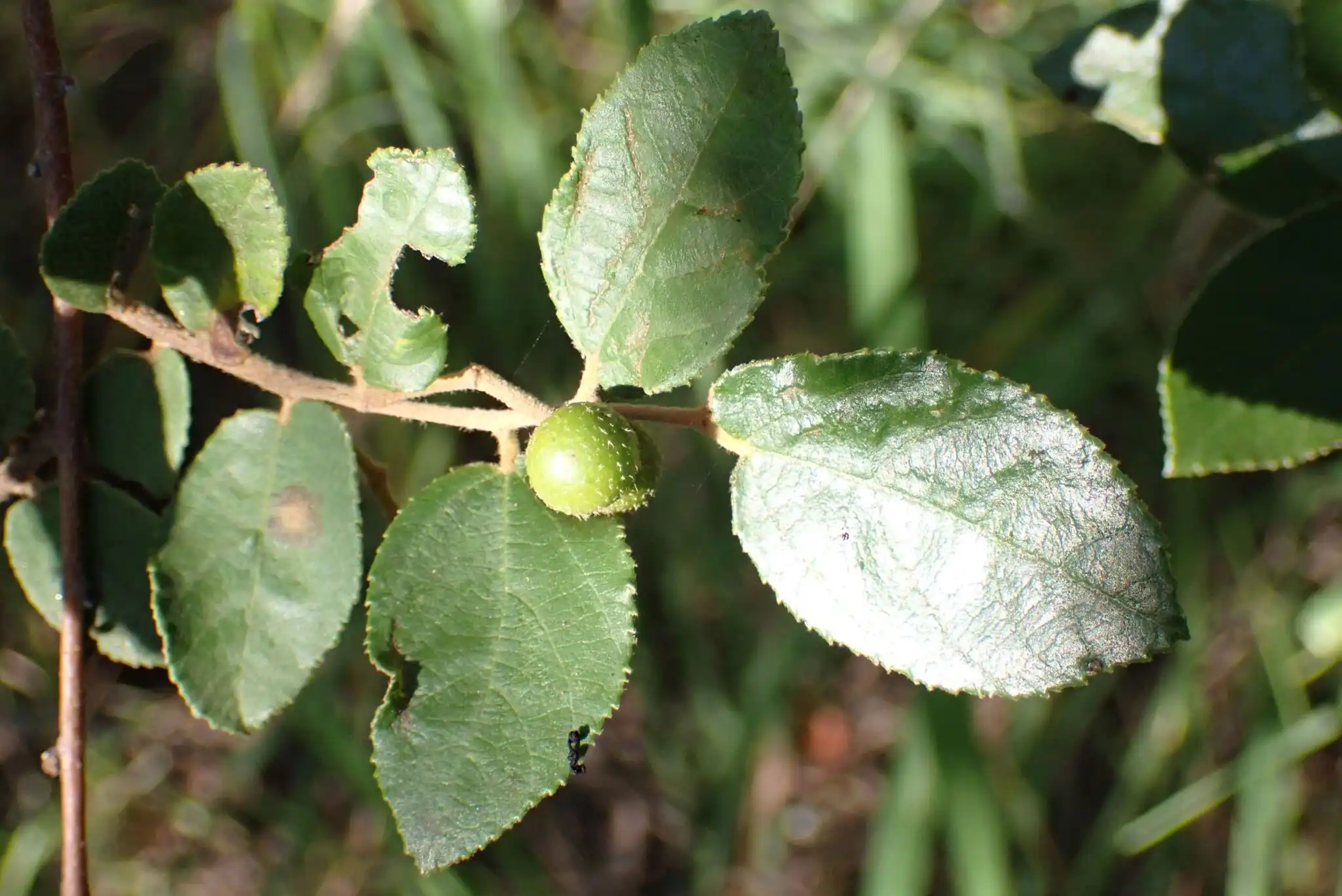
Grewia monticola, the grey raisin, is a much-branched spreading shrub or small tree reaching 16 to 33 feet in the wild with a crooked stem and rough grey-brown bark. The alternate leaves are obliquely elliptic to ovate with an asymmetric cordate base and coarsely serrate margin, wrinkled green to grey-green above and velvety silvery-white beneath.
Young branchlets are densely clothed in white to rusty-red stellate hairs, and new growth emerges pale and hairy before turning leathery. Bright yellow flowers about half an inch across with sepals longer than the petals crowd in axillary and terminal clusters at the branch ends, followed by acid pea-sized two-lobed fruits ripening yellow through orange to red.
Uses & Benefits:
Essentials
At a Glance
Plant Type
Shrub
Height
300"
Width
200"
Light
Full Sun, Partial Sun
Water
Moderate; drought tolerant once established
Humidity
Unknown; tolerates dry air
Lifespan
Long-lived shrub
Native To
Eastern and southern Africa
Toxicity
None known; fruit edible
Bloom period
Spring – Fall
In flower about 9 months of the year
Planting
How to Grow
- Plant in spring after last frost in full sun in clay to sandy soil with good drainage.
- Water regularly through the first summer to establish, then taper to moderate water.
- Mulch 2 to 3 inches deep, keeping mulch clear of the crooked stem.
- Tip-prune lightly after flowering to keep a dense spreading screen or bush clump.
- Protect young plants from hard frost until wood matures.
Pro Tip
Expect variable seedlings from nursery seed because it hybridizes freely — scarify hard seed and soak before sowing, as seed passed through birds or animals germinates most reliably.
Keep It Thriving
Care Guide
Do
- Give full sun and warm conditions with moderate water.
- Grow in clay to sand that drains freely.
- Leave fruit for birds if a wildlife planting is the goal.
Don't
- Do not plant in wet or waterlogged soil.
- Do not expect uniform foliage from seed-grown stock.
- Do not cut hard into old bare wood.
Seasonal Care Calendar
| Task | Jan | Feb | Mar | Apr | May | Jun | Jul | Aug | Sep | Oct | Nov | Dec |
|---|---|---|---|---|---|---|---|---|---|---|---|---|
| Harvest | ||||||||||||
| Mulch | ||||||||||||
| Pest Check | ||||||||||||
| Plant | ||||||||||||
| Prune |
Watch Out For
Pests & Diseases
Common Pests
Common Diseases
In the Garden
Landscape Uses & Companions
Landscape Uses
Multiply
Propagation Methods
Good to Know
Common Questions
Silver Raisin questions
Is Silver Raisin deer resistant?
Not reliably. Deer may browse Silver Raisin, especially tender spring growth — plan on repellents or fencing where pressure is high.
When does Silver Raisin bloom?
Silver Raisin typically blooms from spring to fall. Exact timing shifts a week or two with your zone — Sow's bloom calendar maps it to your garden.
Does Silver Raisin need full sun?
Silver Raisin does best in full sun to part shade. In hot climates, afternoon shade keeps blooms fresher longer.
Is Silver Raisin drought tolerant?
Yes — once established (usually after the first full season), Silver Raisin handles dry spells with minimal watering. Water deeply its first year to build the root system that makes that possible.
More Grewia to compare
Keep exploring
Explore the genus
Grow Silver Raisin with confidence
See it in a design of your actual yard, get zone-matched care reminders, and track it season by season in your garden journal.