The Story
Plant Bio
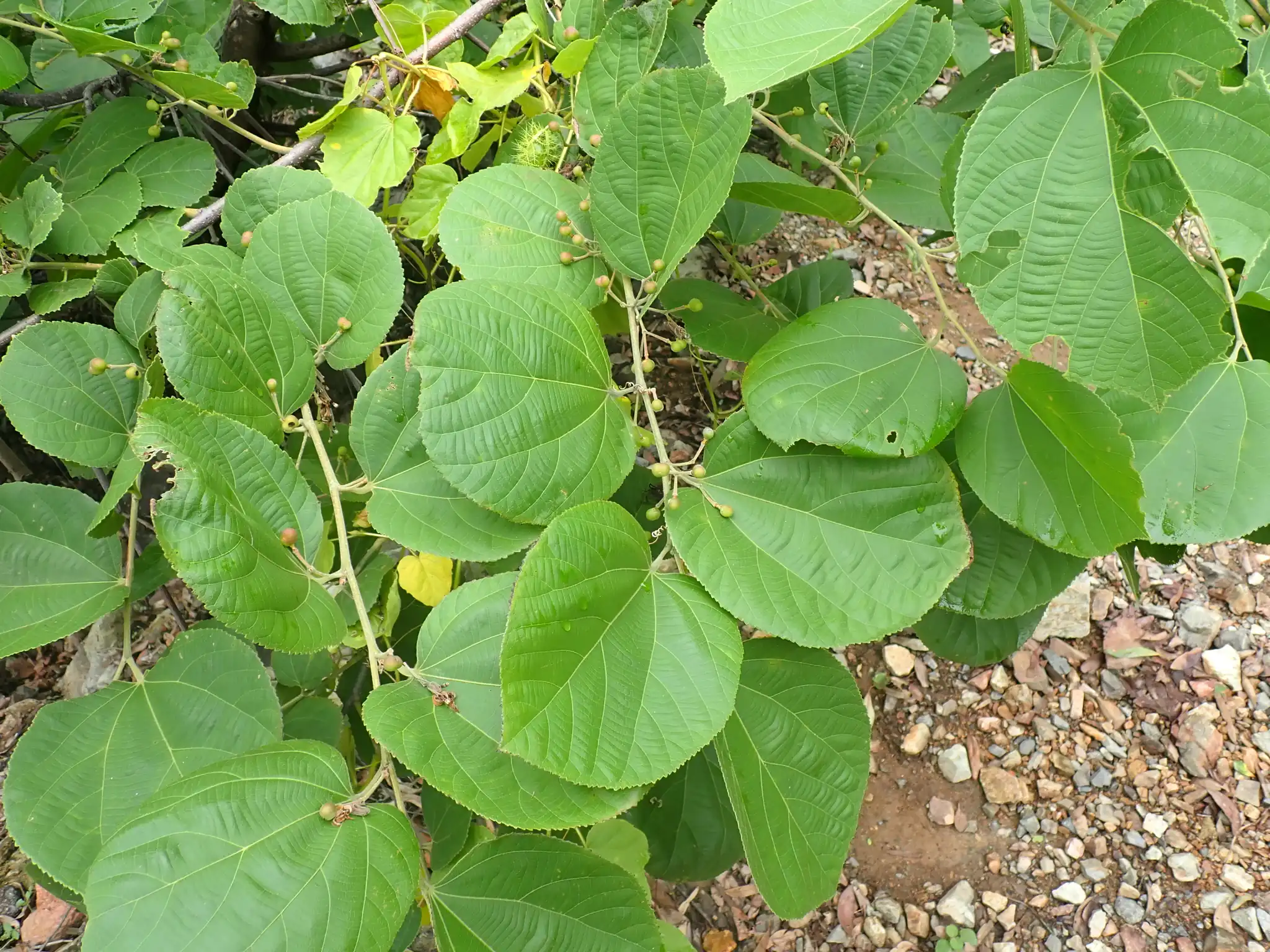
Grewia asiatica, the phalsa, is a deciduous spreading shrub to small tree reaching 13 to 15 feet in gardens when pruned, with long slender arching branchlets that are densely hairy when young. Leaves are alternate broadly heart-shaped to rounded, 4 to 8 inches long with coarsely toothed margins, dull green above and pale felted-white below with five palmate veins from the base.
Flowers are small orange-yellow, about 3/4 inch across with five sepals and five smaller petals around a brush of 50 to 100 stamens, borne in tight axillary clusters of 3 to 5. Fruit ripens unevenly through summer and keeps less than 24 hours off the plant, which is why it is grown as a dooryard pick-and-eat rather than a storage fruit.
Uses & Benefits:
Essentials
At a Glance
Plant Type
Shrub
Height
177"
Width
177"
Light
Full Sun, Partial Sun
Zones
9, 10
Water
Medium
Humidity
Low to moderate
Lifespan
Woody perennial, decades with annual pruning
Native To
Indian subcontinent to SE Asia
Toxicity
Non-toxic - fruit edible
Bloom period
Early summer – Late summer
In flower about 3 months of the year
Planting
How to Grow
- Plant in full sun in spring after frost, in moist well-drained sand, loam, clay or limestone at pH 6.0 to 8.5.
- Water deeply at planting and through the first summer, then water for yield; established plants take heat and drought but not waterlogging.
- Prune hard each late winter to 3 to 4 feet to force the current-season shoots that carry fruit.
- Fertilize for vigor in spring; nitrogen drives growth, phosphorus raises sugar and potassium raises acidity.
Pro Tip
Cut all stems back to 3 to 4 feet before spring growth; fruit forms only on current-season wood and unpruned plants turn scraggly and unproductive.
Keep It Thriving
Care Guide
Do
- Do prune hard every year before spring growth to renew fruiting wood.
- Do pick ripe fruit every few days through summer; ripening is uneven.
- Do give full sun, heat and good drainage with room to spread 6 to 15 feet.
Don't
- Don't let it go unpruned; it grows to 22 to 26 feet, scraggly and shy to fruit.
- Don't plant where water stands; it tolerates drought and brief freezing but not waterlogging.
- Don't expect stored fruit; eat or process within a day of picking.
Seasonal Care Calendar
| Task | Jan | Feb | Mar | Apr | May | Jun | Jul | Aug | Sep | Oct | Nov | Dec |
|---|---|---|---|---|---|---|---|---|---|---|---|---|
| Fertilize | ||||||||||||
| Harvest | ||||||||||||
| Mulch | ||||||||||||
| Plant | ||||||||||||
| Prune |
Watch Out For
Pests & Diseases
Common Pests
Common Diseases
In the Garden
Landscape Uses & Companions
Landscape Uses
Companion Plants
Multiply
Propagation Methods
Good to Know
Common Questions
Phalsa questions
What zones can Phalsa grow in?
Phalsa is hardy in USDA Zones 9–10: in that range it survives winter in the ground. Colder than Zone 9, grow it in a container you can move to shelter for the winter.
When does Phalsa bloom?
Phalsa typically blooms in summer. Exact timing shifts a week or two with your zone — Sow's bloom calendar maps it to your garden.
Does Phalsa need full sun?
Phalsa does best in full sun to part shade. In hot climates, afternoon shade keeps blooms fresher longer.
Is Phalsa drought tolerant?
Yes — once established (usually after the first full season), Phalsa handles dry spells with minimal watering. Water deeply its first year to build the root system that makes that possible.
More Grewia to compare
Keep exploring
Explore the genus
Hardy in your zone?
Grow Phalsa with confidence
See it in a design of your actual yard, get zone-matched care reminders, and track it season by season in your garden journal.