The Story
Plant Bio
Lophomyrtus ralphii is an evergreen, bushy shrub forming a dense, upright to rounded framework. Small, leathery, opposite leaves feature puckered surfaces and glands that release a soft fragrance when crushed.
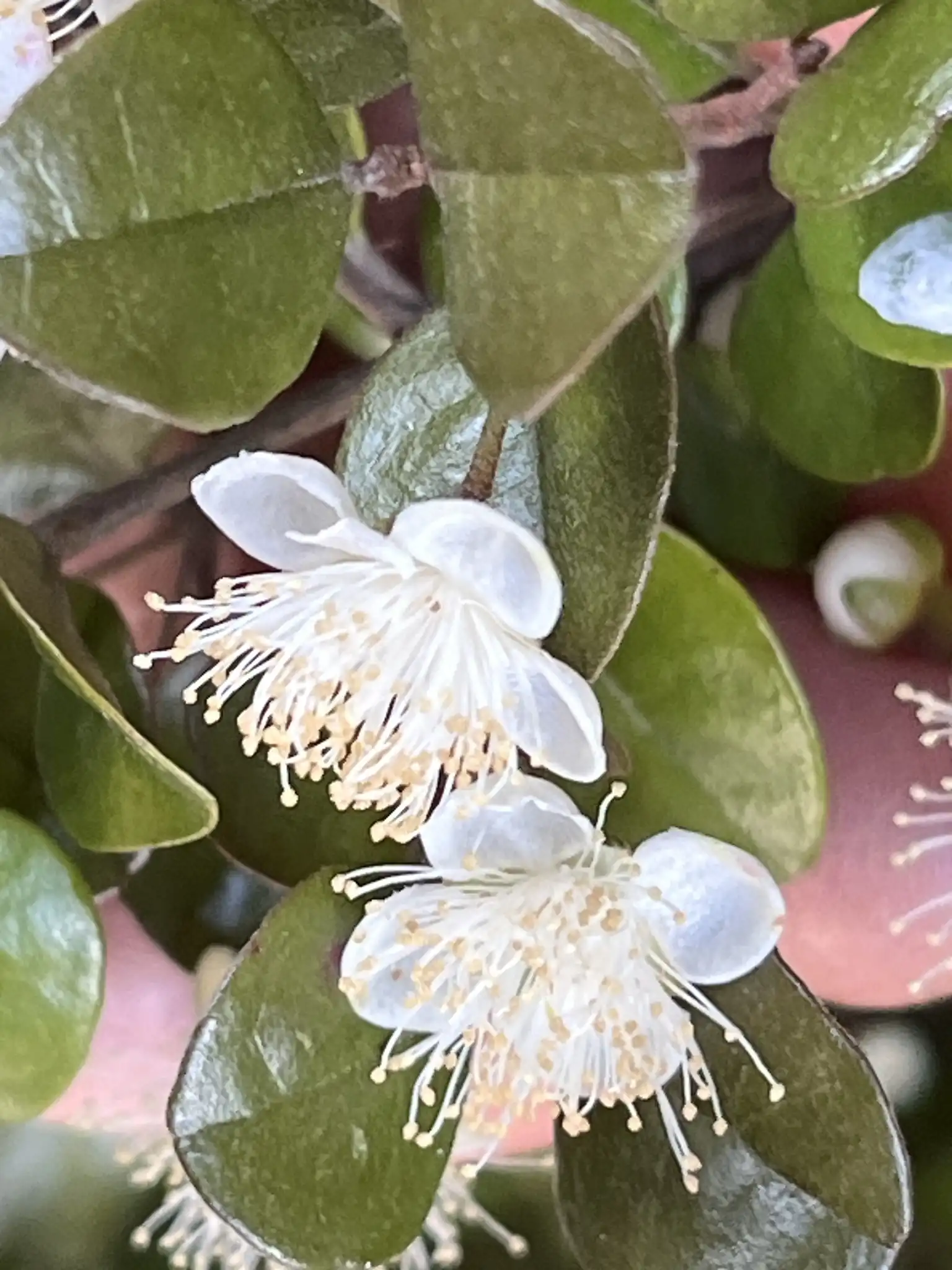
A naturally occurring hybrid between Lophomyrtus bullata and Lophomyrtus obcordata, it is grown for its crinkled foliage that shifts from deep bronze and maroon to lime green depending on exposure. In summer, small four-petaled white flowers with dense central stamens open across the branches, followed by dark red berries.
Uses & Benefits:
Essentials
At a Glance
Plant Type
Shrub
Height
118"
Width
98"
Light
Full Sun, Partial Sun
Zones
8, 9, 10
Water
Moderate
Humidity
Moderate
Lifespan
Perennial
Native To
New Zealand
Toxicity
Non-toxic
Bloom period
Summer
In flower about 3 months of the year
Planting
How to Grow
- Choose a sheltered location receiving full sun to partial shade with well-drained, humus-rich soil.
- Dig a hole twice as wide as the root ball and set the plant at the same depth it sat in the nursery container.
- Backfill with soil mixed with organic matter and water thoroughly to settle the root zone.
- Apply a two-inch layer of organic mulch around the base, keeping it clear of the main trunk.
Pro Tip
Maximize foliage coloration by planting in full sun with consistent root moisture, and restrict pruning to active green growth nodes rather than old bare wood.
Keep It Thriving
Care Guide
Do
- Keep soil consistently moist during dry spells.
- Plant in full sun to produce the richest foliage color.
- Tip-prune regularly in spring to encourage dense foliage.
Don't
- Do not cut back into old, leafless bare wood where reshooting is poor.
- Do not allow the soil to become waterlogged or poorly drained.
- Do not let young spring growth go unprotected during severe freezes.
Seasonal Care Calendar
| Task | Jan | Feb | Mar | Apr | May | Jun | Jul | Aug | Sep | Oct | Nov | Dec |
|---|---|---|---|---|---|---|---|---|---|---|---|---|
| Fertilize | ||||||||||||
| Mulch | ||||||||||||
| Pest Check | ||||||||||||
| Prune |
Watch Out For
Pests & Diseases
Common Pests
Common Diseases
In the Garden
Landscape Uses & Companions
Landscape Uses
Multiply
Propagation Methods
Good to Know
Common Questions
New Zealand Myrtle questions
What zones can New Zealand Myrtle grow in?
New Zealand Myrtle is hardy in USDA Zones 8–10: in that range it survives winter in the ground. Colder than Zone 8, grow it in a container you can move to shelter for the winter.
Is New Zealand Myrtle deer resistant?
Not reliably. Deer may browse New Zealand Myrtle, especially tender spring growth — plan on repellents or fencing where pressure is high.
When does New Zealand Myrtle bloom?
New Zealand Myrtle typically blooms in summer. Exact timing shifts a week or two with your zone — Sow's bloom calendar maps it to your garden.
Does New Zealand Myrtle need full sun?
New Zealand Myrtle does best in full sun to part shade. In hot climates, afternoon shade keeps blooms fresher longer.
More Lophomyrtus to compare
Keep exploring
Explore the genus
Hardy in your zone?
Grow New Zealand Myrtle with confidence
See it in a design of your actual yard, get zone-matched care reminders, and track it season by season in your garden journal.