Quick answer
Sow sweet corn directly from your median last spring frost to 3 weeks after it, once soil 4 inches (10 cm) down reads 55°F (13°C) for standard corn, 55–60°F (13–16°C) for sugary enhanced and 65°F (18°C) for supersweet. Make the last sowing of an early variety by early July in the North and Midwest, or by July 20 in middle Georgia.
Key facts
- Timing rule
- From the median last spring frost to 3 weeks after it
- Soil temperature
- At 4 in (10 cm): 55°F (13°C) standard, 55–60°F (13–16°C) sugary enhanced, 65°F (18°C) supersweet
- Days to maturity
- 60–100; early varieties under 70
- Last sowing
- Early variety: early July in the North and Midwest, July 20 in middle Georgia
- Depth and spacing
- About 1 in (2.5 cm) deep, 8–12 in (20–30 cm) apart, rows 30–36 in (75–90 cm)
- Pollination
- Plant a block of four short rows, three at the least
- Supersweet isolation
- 300–500 ft (91–152 m), or silking at least 12–14 days apart
- Frost tolerance
- None; young seedlings may regrow after a light frost
Sweet corn is sown straight into the garden, and its window opens on your median last spring frost and stays open for about 3 weeks. The soil thermometer has the final word. Standard (su) corn can go in once the soil 4 inches (10 cm) down reads 55°F (13°C) in the morning, and sugary enhanced (se) types at 55–60°F (13–16°C), depending on the variety. Supersweet (sh2) and untreated seed wait for 65°F (18°C), which in most springs puts them at the late end of the window.
For a steady supply, sow small blocks in succession through early summer. That makes the last sowing date as important as the first, and it varies by region more than frost dates alone suggest.
Corn planting dates by city
Each first-sowing window below opens on the city's median last frost and closes 21 days later; where soil warmth or a local calendar sets the date instead, the cell says so. The last-sowing column gives the regional cutoff for an early variety, taken from local planting calendars rather than counted back from the fall frost.
| City (USDA zone) | Median last frost | Median first frost | First sowing | Last sowing (early variety) |
|---|---|---|---|---|
| Fargo, ND (4a) | May 10 | Sep 30 | May 10 – May 31 | Early July |
| Minneapolis, MN (5a) | Apr 23 | Oct 18 | Apr 23 – May 14 | Early July |
| Chicago, IL (5b) | Apr 16 | Oct 28 | Apr 16 – May 7 | Early July |
| Denver, CO (6a) | May 5 | Oct 9 | May 5 – May 26 | Early July |
| Detroit, MI (6b) | Apr 20 | Oct 27 | Apr 20 – May 11 | Early July |
| Kansas City, MO (6b) | Apr 13 | Oct 24 | Apr 13 – May 4 | Jul 20 – Aug 1 |
| Boston, MA (7a) | Apr 4 | Nov 9 | When soil at 4 in holds 55°F (13°C) | Jul 15–25 |
| Salt Lake City, UT (7b) | Apr 8 | Oct 31 | Apr 8 – Apr 29 | Early July |
| New York, NY (7b) | Mar 30 | Nov 20 | When soil at 4 in holds 55°F (13°C) | Jul 15–25 |
| Nashville, TN (7b) | Mar 31 | Nov 3 | Mar 31 – Apr 21 | Mid- to late June |
| Raleigh, NC (8a) | Mar 31 | Nov 4 | Mid-Mar to May | End of May; no summer sowing |
| Atlanta, GA (8a) | Mar 15 | Nov 20 | From 2 weeks after frost into May | Early July |
| Dallas-Fort Worth, TX (8b) | Mar 8 | Nov 24 | 1–6 weeks after frost | 12–14 weeks before first freeze |
| Seattle, WA (9a) | Mar 2 | Nov 23 | Mid-May | Spring sowing only |
| Sacramento, CA (9b) | Feb 2 | Dec 2 | From March | By end of July |
| Houston, TX (9b) | Feb 13 | Dec 9 | March; April marginal | July (marginal) |
Frost dates are medians from NOAA 1991–2020 climate normals for each city's main weather station; in half of years the last frost falls later than the date shown.
For any other town, look up your own median last spring frost and add 0 to 21 days for the first sowing. A cold spring can keep the soil below 55°F (13°C) well into that window, so treat the first date as the earliest possible day, not a target. For the last sowing, use the regional cutoff closest to you in the tables on this page.
Boston and New York need the most care at the start. Their frost dates come from warm city stations, so a frost-based window can open before garden soil reaches 55°F (13°C); there, sow by soil temperature alone.
Soil temperature by sweet corn type
Corn seed sprouts reliably only in warm soil, and how warm depends on the sugar gene the variety carries.
| Type | Gene | Sow when soil at 4 in (10 cm) reads | Cold-soil tolerance |
|---|---|---|---|
| Standard | su | 55°F (13°C); 50°F (10°C) is the bare minimum | Best of the group |
| Sugary enhanced | se, se+ | 55–60°F (13–16°C), by variety | Moderate |
| Synergistic | sy | 55–65°F (13–18°C), by variety | Variable |
| Supersweet | sh2 | 65°F (18°C) | Poor |
| Untreated seed of any type | — | 65°F (18°C) | Lower than treated seed |
Take readings 4 inches (10 cm) deep at about 8 a.m., before the sun warms the surface.
Seed sown in soil below about 55°F (13°C) sprouts slowly, and the longer it lies there, the more of it rots or succumbs to seedling disease. Wet soil makes it worse, which is why a poorly drained bed in early spring loses so much seed.
The sweeter types suffer most. Supersweet seed is shrunken and takes up as much as twice the water of other corn before it sprouts, and it germinates poorly in cold, wet soil. Germination is best between about 60°F and 90°F (16–32°C), with 70–80°F (21–27°C) close to ideal, and warm-soil seed comes up in 5 to 10 days.
Warming the soil sooner
A clear plastic tunnel over the row lets you sow 3 to 4 weeks earlier and gives some frost protection. Black plastic mulch also warms the soil. Sandy, well-drained ground warms faster in spring than heavy clay, so give the earliest sowing your lightest soil.
Corn planting times by region
Across most of the country the first sowing falls in April or May; the South starts in March, and frost-free areas grow corn in their mild season instead.
| Region | Spring sowing | Last or second sowing |
|---|---|---|
| Minnesota | Around early May | — |
| Illinois | At or just before the frost-free date | First week of July |
| Eastern and central Kansas | Mid-April to early May | Succession |
| Missouri north / central / south | May 1 / Apr 25 / Apr 15 | Until Jul 20 / Aug 1 / Aug 15 |
| Central New York (Ithaca) | After the average last frost, about May 14 | Early varieties by Jul 15; midseason by Jun 30 |
| Pennsylvania south / north | Early–mid April / mid–late May | — |
| Utah | After the last frost | Early July |
| Central North Carolina | Mid-March to May | None in summer or fall |
| Middle Georgia | April, again 2–3 weeks later and in May | By Jul 20 |
| South Carolina Piedmont / coast | Mar 30–May 31 / Mar 1–Apr 15 | — |
| Texas (statewide) | 1–6 weeks after the frost-free date | 12–14 weeks before the first freeze |
| Houston (Harris County) | March; April marginal | July, marginal |
| Florida north / central / south | Mar–Apr / Jan–Apr / Oct–Mar | North: August |
| Arizona low desert | Feb 15–Apr 1 | Jul 15–Aug 15 |
| California interior valleys | March–July | — |
| California desert valleys | February–March | August |
| Washington (statewide calendar) | Mid-May | — |
Spring dates are the earliest sowing; standard corn can start them, supersweets follow once the soil reaches 65°F (18°C).
The North (Zones 4–6). Short, cool falls end the season early, so across the Upper Midwest, Great Lakes and Mountain West the last sowing of an early variety falls in early July. In central New York it is July 15, and 7 to 10 days earlier in the colder parts of the state. In New England, small sowings every 7 to 10 days keep ears coming without a glut.
Midwest and Plains. Standard corn can go in at, or just before, the frost-free date. On sandy, fast-warming soil, a week before the average last frost is as early as it is worth pushing. Eastern Kansas sows from mid-April to early May; Missouri starts between April 15 in the south and May 1 in the north. Southern Pennsylvania plants in early to mid-April once frosts of 24°F (−4°C) or colder are past and the soil holds 55°F (13°C).
Mountain West. In Colorado, sow around the average last frost once the soil reaches 50°F (10°C) at 8 a.m. Utah waits until after the frost-free date, when soil and air are both above 60°F (16°C).
Northeast coast. Where the fall is milder than in upstate New York, an early variety can go in a week to ten days after the July 15 upstate cutoff. That puts the last sowing for New York City and Boston between July 15 and 25.
Southeast. Georgia starts corn in April in the middle of the state, 1 to 3 weeks later in the north and up to 3 weeks earlier in the far south. Never sow sooner than 2 weeks after the average last frost. Repeat sowings follow 2 to 3 weeks apart and again in May. The last sowing is July 20 in middle Georgia and about 2 weeks earlier in north Georgia, which puts Atlanta's in early July. Tennessee's typical planting runs from April 15 to June 30 in the east of the state and to June 15 in the west, so Nashville stops in mid- to late June. Central North Carolina is stricter: its calendar runs from mid-March through May and schedules no summer or fall corn.
Texas. Sow 1 to 6 weeks after the frost-free date in spring, and for a fall crop, 12 to 14 weeks before the first freeze. Houston's county calendar rates March as the best month, with April and July as marginal. Corn that tassels in the hottest, driest weeks pollinates poorly, which is why the summer sowings there are the riskiest.
Florida and the low desert. These areas sow by season, not frost. Varieties suited to Florida include Silver Queen, How Sweet It Is and Early Sunglow. In the Arizona low desert and California's desert valleys, the late-summer sowing ripens in fall.
Pacific Coast. Seattle's median last frost is in early March, but warm-season crops struggle west of the Cascades, and Washington's calendar holds direct seeding until mid-May. Sacramento and the other interior valleys sow from March through July, and California's north coast from May.
How to plant corn: depth, spacing and blocks
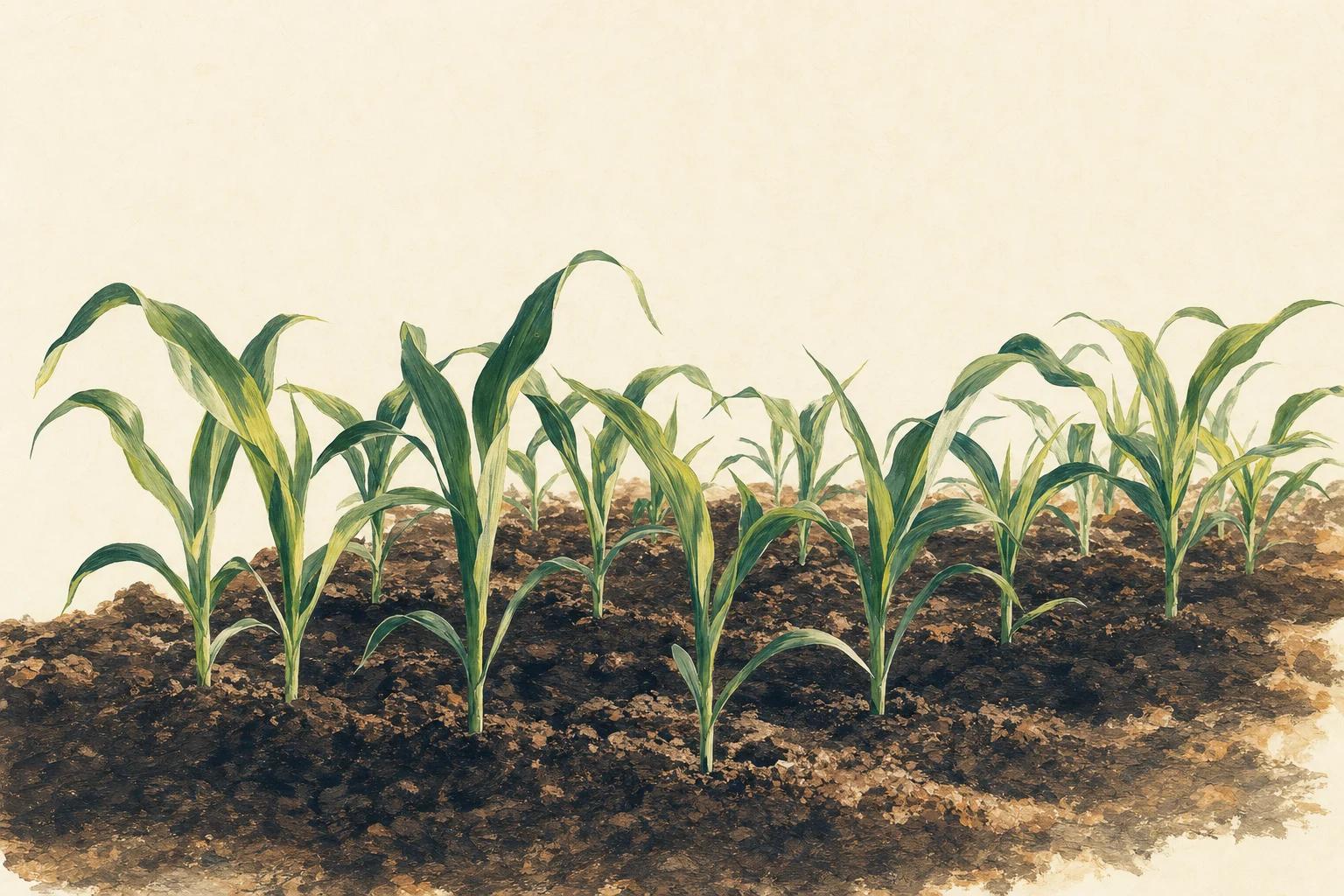
Sow corn about an inch deep in a block of short rows, never a single long one.
The block matters because corn is pollinated by wind. Pollen from the tassels has to land on the silks of nearby plants; in a single long row most of it blows clear of the ears, which then fill with missing kernels.
- Choose the spot. Put the block on the north side of the garden, where its shade will not fall across shorter vegetables.
- Lay out short rows. Mark four rows side by side (three at the very least), 30 to 36 inches (75–90 cm) apart.
- Set the depth by soil and season. Sow 1/2 inch (1.3 cm) deep in cool, moist spring soil. Later, in warm, dry soil, go 1 to 1.5 inches (2.5–4 cm) deep, or up to 2 inches (5 cm). Keep supersweet seed no deeper than 3/4 to 1 inch (2–2.5 cm), because it needs so much water to sprout.
- Space the seed. Drop seeds 8 to 12 inches (20–30 cm) apart in the row. The closer figure suits short, early varieties.
- Replant only large gaps. A seed sown late into a gap comes up in its neighbors' shade and rarely makes a good ear, so fill skips only where many seeds failed.
Keeping supersweet corn apart from other corn
Supersweet (sh2) corn must be isolated from every other kind of corn that sheds pollen at the same time, or its kernels turn starchy and tough.
Standard and sugary enhanced types can grow side by side without harm. Synergistic varieties such as Allure and Montauk are another matter: keep them apart from standard and supersweet corn. All sweet corn, whatever its type, needs distance from field corn and popcorn.
There are two ways to keep them apart:
- Distance. Separate the plantings by 300 to 500 feet (91–152 m), more if the supersweet block sits downwind. The strictest recommendation is 400 yards (366 m), which few home lots can manage.
- Time. Aim for silking at least 12 to 14 days apart. Varieties at least 14 days apart in days to maturity do this when sown together. Sowing dates alone are less reliable, because early sowings emerge slowly and later ones catch up, so leave a wide gap; the safest margin is a month's difference in maturity.
Succession sowing and the last sowing date
For a steady supply, sow a new block every 10 to 14 days, or when the previous block reaches 1 to 2 inches (2.5–5 cm) tall, until your regional last sowing date.
The alternative is to sow early, midseason and late varieties on the same day and let their different days to maturity spread the harvest. That suits gardeners who want one planting session and have room for three blocks at once.
The cutoffs in the tables above do not track frost dates closely. Upstate New York, with a first frost around October 1, stops early varieties on July 15, while Illinois, where frost comes later, stops in the first week of July. Use your regional date rather than a count back from the frost, and do not push past it: corn grows very little below about 48°F (9°C), so a crop still filling its ears in cool September nights slows down just as frost approaches.
For a sowing late in your window, choose the quickest variety you can find. An early variety can go in about two weeks after the last date for a midseason one.
Sweet corn varieties that change the timing
Days to maturity move your sowing dates more than anything else, from about 63 days for the earliest supersweet to more than 90 for a late white standard.
Varieties fall into three classes: early (under 70 days), midseason (70 to 84) and late (over 84). The gene type sets how early you can sow; the days set how late.
| Variety | Type | Days to maturity |
|---|---|---|
| Northern Xtra Sweet | Supersweet (sh2) | 63 |
| Quickie | Sugary enhanced (se) | 67 |
| Trinity | Sugary enhanced (se) | 68 |
| Sundance | Standard (su) | 69 |
| Sugar Buns | Sugary enhanced (se) | 70 |
| Bodacious | Sugary enhanced (se) | 75 |
| Ambrosia | Sugary enhanced (se) | 75 |
| Butter & Sugar | Standard (su) | 75 |
| Allure | Synergistic | 75 |
| Honey 'n Pearl | Supersweet bicolor | 76 |
| Montauk | Synergistic | 79–81 |
| Incredible | Sugary enhanced (se) | 83 |
| Kandy Korn | Sugary enhanced (se) | 83 |
| How Sweet It Is | Supersweet (sh2) | 87 |
| Silver Queen | Standard (su) | 92 |
Days run from direct sowing to harvest; expect a few days' difference between seed catalogs.
Early varieties earn their place at both ends of the season. Trinity tolerates 55°F (13°C) soil and matures in 68 days, so it suits the first sowing in the North and the last sowing of the summer. Late varieties such as Silver Queen belong in long seasons and in the first half of the sowing window, never at the end.
What happens if you plant too early or too late
Corn planted too early comes up slowly into weak stands, and corn planted too late may not fill its ears before fall frost.
Early sowing is the more common mistake. Seed that sits in cold, wet soil rots or picks up seedling disease, and the plants that emerge can be stunted or killed by a late frost. Supersweets are the first to fail.
Late sowing brings its own problems. High temperatures or drought while the tassels are shedding pollen leave ears with few kernels, and a crop that silks in September may not ripen before the first fall frost.
If a late frost threatens seedlings
Treat corn as fully tender. Before a forecast frost, cover the rows with a fabric row cover. Covers used to warm early sowings should come off after 3 to 4 weeks, or as soon as the air under them rises above 90°F (32°C) for 3 days in a row.
From silking to harvest
Sweet corn ears are ready about 17 to 24 days after the silks first appear, when the kernels are full and a thumbnail pressed into one releases milky juice.
Water decides how well the ears fill. Give the block about 1 inch (2.5 cm) of water a week, and up to 1.5 inches (4 cm) for a heavy crop, with the most care at pollination and ear fill. Leave any side shoots, or suckers, in place.
Unchilled, standard (su) ears can lose about half their sugar within 10 to 12 hours of picking at summer temperatures, so pick early in the morning and refrigerate at once. Supersweet ears hold their sweetness longest.
Once the last block is harvested, the bed is free for a cool-season crop; vegetable planting dates show what can follow, and tomato planting times cover corn's warm-season neighbors. To keep every corn sowing in one place, add your dates to Sow's garden calendar.
Frequently asked questions
What month should you plant corn?
April or May across most of the United States. Eastern Kansas sows from mid-April to early May, Missouri starts between April 15 in the south and May 1 in the north, Minnesota around early May and northern Pennsylvania in mid- to late May. Central North Carolina starts in mid-March and Houston does best in March. South Florida grows corn from October to March, and the Arizona low desert has a second window from mid-July to mid-August.
Does corn transplant well?
Only when the seedlings are moved very young. Corn grown in cells should go into the garden within about 10 to 14 days of sowing, because plants older than 12 to 18 days establish poorly. Set transplants out after the frost-free date, and plant them as a block just as you would seed. For most gardens, sowing seed where the corn will grow is simpler and just as quick.
Can I grow corn in a raised bed?
Yes, if you fill the bed with a square grid rather than a single line along one edge, so pollen from each tassel lands on nearby silks. At about 15 inches (38 cm) between plants each way, a 4 by 8 foot bed holds 3 rows of 6, or 18 plants. Give the bed about 1 inch (2.5 cm) of water a week, and keep supersweets out of it if a neighbor's corn grows close by.
What is the best sweet corn to plant?
For most home gardens, a sugary enhanced (se) variety such as Ambrosia, Bodacious or Sugar Buns is the easiest choice. It is tender and sweet, tolerates cooler soil than a supersweet and needs no separation from standard corn. Supersweets such as How Sweet It Is are the sweetest and hold sugar longest after picking, but they need 65°F (18°C) soil and isolation from other corn.
Is popcorn planted at the same time as sweet corn?
It starts at the same time, after the average last frost once the soil has warmed, but it needs a longer season. In central New York the last safe sowing for popcorn is June 10, five weeks before the July 15 cutoff for an early sweet corn. Keep popcorn and field corn well away from any sweet corn, or its kernels lose their sweetness and turn starchy.
What should not be planted near corn?
Keep supersweet corn away from any other corn that sheds pollen at the same time, including standard and sugary enhanced sweet corn, field corn and popcorn, or its kernels turn starchy and tough. Every type of sweet corn also needs distance from field corn and popcorn. Finally, put the block on the north side of the garden so it does not shade shorter, sun-hungry vegetables.
How long does sweet corn take to grow?
Between 60 and 100 days from sowing, depending on the variety. Early types such as Northern Xtra Sweet and Sundance need under 70 days, midseason types 70 to 84, and late types such as Silver Queen more than 84. Ears are ready about 17 to 24 days after the silks first appear, once the kernels are plump and milky.
Can I plant corn in July?
Yes in much of the country, but only with a fast variety, and the cutoff depends on where you live. Illinois and Utah stop in early July. Central New York stops at July 15 for early varieties, with a week to ten days more in milder parts of the state. Middle Georgia allows until July 20, Missouri until July 20 in the north and August 15 in the south, while central North Carolina schedules no summer sowings.
Will frost kill corn seedlings?
It can. Frost injures corn at every stage, and taller plants have no protection. Seedlings in their first few weeks often survive a light frost because the growing point is still at or below the soil surface. After a frost, wait a few days: if fresh leaves push up from the center, keep the planting, and if not, resow while there is still time before your last sowing date.
How does sweet corn get pollinated?
By wind. The tassel at the top of each stalk sheds pollen, which drifts down onto the silks of ears on the same and neighboring plants. Silks that catch no pollen leave gaps of missing kernels on the cob. Heat or drought while the tassels are shedding cuts pollination further, so time sowings so the corn does not tassel in the hottest, driest weeks of your summer.
References
- University of Minnesota Extension. Growing sweet corn in home gardens. Accessed October 16, 2026.
- Kansas State University Research and Extension. Sweet Corn (MF669). Accessed October 16, 2026.
- Clemson Cooperative Extension, Home & Garden Information Center. Sweet Corn (HGIC 1308). Accessed October 16, 2026.
- University of Georgia Cooperative Extension. Home Garden Sweet Corn (Circular 905). Accessed October 16, 2026.
- University of Georgia Cooperative Extension. Vegetable Garden Calendar (Circular 943). Accessed October 16, 2026.
- Cornell Cooperative Extension of Tompkins County. First and Last Seeding and Transplanting Dates for Vegetables in New York. Accessed October 16, 2026.
- NC State Extension. Central North Carolina Planting Calendar for Annual Vegetables, Fruits, and Herbs (AG-756-01). Accessed October 16, 2026.
- Texas A&M AgriLife Extension. Texas Home Vegetable Gardening Guide. Accessed October 16, 2026.
- Texas A&M AgriLife Extension, Harris County Office. Vegetable Planting Calendar for Harris County. Accessed October 16, 2026.
- Utah State University Extension. How to Grow Sweet Corn in Your Garden. Accessed October 16, 2026.
- Colorado State University Extension. Vegetable Planting Guide. Accessed October 16, 2026.
- UC Statewide IPM Program (UC ANR). Cultural Tips for Growing Corn. Accessed October 16, 2026.
- University of Arizona Cooperative Extension. Vegetable Planting Calendar for Maricopa County. Accessed October 16, 2026.
- UF/IFAS Extension. Florida Vegetable Gardening Guide (SP 103/VH021). Accessed October 16, 2026.
- Washington State University Extension. Home Vegetable Gardening in Washington (EM057E). Accessed October 16, 2026.
- Penn State Extension. Sweet Corn Production. Accessed October 16, 2026.
- University of Missouri Extension. Vegetable Planting Calendar (G6201). Accessed October 16, 2026.
- University of Illinois Extension. Corn (Home Vegetable Gardening). Accessed October 16, 2026.
- University of Tennessee Extension. Sweet Corn for the Tennessee Vegetable Garden (D 61). Accessed October 16, 2026.
- UNH Cooperative Extension. Growing Sweet Corn [fact sheet]. Accessed October 16, 2026.
- NOAA National Centers for Environmental Information. U.S. Climate Normals 1991–2020: Annual/Seasonal freeze data. Accessed October 16, 2026.
Sow Editorial
Written by the Sow team from university extension services, botanical gardens, USDA and NOAA data and plant breeders. Every source is listed under References.