Quick answer
Sow carrot seed directly in the garden from 3 weeks before your median last spring frost until 1 week after it, once the soil 4 inches (10 cm) down reads at least 40°F (4°C). In the South's Zone 8 and warmer, start 4 to 6 weeks before the frost; the West Coast keeps its own calendar. For a fall crop, sow 10 to 14 weeks before the median first fall frost.
Key facts
- Timing rule (Zones 3–7)
- 21 days before to 7 days after the median last spring frost
- Southern Zone 8 and warmer
- Start 4–6 weeks before the last frost; the mildest areas sow from fall into winter
- Soil temperature
- At least 40°F (4°C) at 4 in (10 cm); best germination at 55–75°F (13–24°C)
- Germination
- 1–3 weeks, slowest in cold soil; declines above 80°F (27°C) and fails at 90–95°F (32–35°C)
- Fall crop
- Sow 70–98 days (10–14 weeks) before the median first fall frost
- Days to maturity
- 50–80 days for most varieties; fall and winter crops take longer
- Depth and thinning
- 1/4–1/2 in (6–13 mm) deep; thin to 1–3 in (2.5–7.5 cm) apart
- Frost tolerance
- Takes light frost to 32°F (0°C); hard freezes damage the tops
In most of the country, carrot seed goes straight into the garden, never into a seed tray, from about 3 weeks before your median last spring frost until about a week after it. The reading that decides the day is soil temperature, and 40°F (4°C) at 4 inches (10 cm) deep is the floor. Above that, warmer soil brings seedlings up sooner, up to about 75°F (24°C). A second sowing in summer, 10 to 14 weeks before the first fall frost, gives a fall crop.
Carrots grow best when average temperatures sit around 60–65°F (16–18°C), with nights near 55°F (13°C) and days near 75°F (24°C). Every timing choice on this page comes down to fitting the 2 to 3 months a crop needs into that cool weather, before summer heat arrives or after it breaks. That is why southern gardens in Zone 8 and warmer sow earlier in spring, and the mildest of them sow from fall into winter.
Carrot planting dates by city
In Zones 4 to 7, and in Atlanta, each spring window opens 21 days before the city's median last frost and closes 7 days after it. Each fall window runs from 98 to 70 days before the median first fall frost. In Raleigh, Dallas-Fort Worth, Seattle, Sacramento and Houston, that frost rule misses the local season, so their spring cells give the local extension calendar instead, as do the fall cells for Seattle, Sacramento and Houston.
| City (USDA zone) | Median last frost | Median first frost | Spring sowing | Fall crop sowing |
|---|---|---|---|---|
| Fargo, ND (4a) | May 10 | Sep 30 | Apr 19 – May 17 | Jun 24 – Jul 22 |
| Minneapolis, MN (5a) | Apr 23 | Oct 18 | Apr 2 – Apr 30 | Jul 12 – Aug 9 |
| Chicago, IL (5b) | Apr 16 | Oct 28 | Mar 26 – Apr 23 | Jul 22 – Aug 19 |
| Denver, CO (6a) | May 5 | Oct 9 | Apr 14 – May 12 | Jul 3 – Jul 31 |
| Detroit, MI (6b) | Apr 20 | Oct 27 | Mar 30 – Apr 27 | Jul 21 – Aug 18 |
| Kansas City, MO (6b) | Apr 13 | Oct 24 | Mar 23 – Apr 20 | Jul 18 – Aug 15 |
| Boston, MA (7a) | Apr 4 | Nov 9 | Mar 14 – Apr 11 | Aug 3 – Aug 31 |
| Salt Lake City, UT (7b) | Apr 8 | Oct 31 | Mar 18 – Apr 15 | Jul 25 – Aug 22 |
| New York, NY (7b) | Mar 30 | Nov 20 | Mar 9 – Apr 6 | Aug 14 – Sep 11 |
| Nashville, TN (7b) | Mar 31 | Nov 3 | Mar 10 – Apr 7 | Jul 28 – Aug 25 |
| Raleigh, NC (8a) | Mar 31 | Nov 4 | Feb – Mar | Jul 29 – Aug 26 |
| Atlanta, GA (8a) | Mar 15 | Nov 20 | Feb 22 – Mar 22 | Aug 14 – Sep 11 |
| Dallas-Fort Worth, TX (8b) | Mar 8 | Nov 24 | Late Jan – early Feb | Aug 18 – Sep 15 |
| Seattle, WA (9a) | Mar 2 | Nov 23 | Mid-Apr – mid-Jul | Mid-Aug |
| Sacramento, CA (9b) | Feb 2 | Dec 2 | Feb – Aug | Aug – Sep |
| Houston, TX (9b) | Feb 13 | Dec 9 | Jan – Feb | Sep – Nov |
Frost dates are medians from NOAA 1991–2020 climate normals for each city's main weather station; in half of years the last frost falls later than the date shown. USDA zones from the 2023 map.
For any other town in Zones 3 to 7, look up the median last and first frost dates for your nearest weather station. Count back 3 weeks and forward 1 week from the spring date, and back 14 and 10 weeks from the fall date. In the South's Zone 8 and warmer, start spring sowing earlier, 4 to 6 weeks before the last frost. On the West Coast, use the California and Pacific Northwest notes below instead. Inside that window, the soil thermometer picks the day.
How the rule plays out by region
Where winters are mild, in the Deep South, the Gulf Coast, the low desert and coastal California, carrots shift from a spring-and-fall crop to a fall-to-spring one.
North and Upper Midwest (Zones 3–5)
In Fargo, Minneapolis and Chicago, the first sowing goes in as soon as the soil can be worked and has reached 40°F (4°C). Summers here are mild enough to keep sowing a short row every 4 weeks into midsummer, ending with the fall crop, which in Fargo goes in as early as late June.
Lower Midwest, Mid-Atlantic and Mountain West (Zones 6–7)
In north Missouri, around Kansas City, carrots go in from March 25 to April 10 and again from July 20 to 30. Central Missouri sows from March 15 to April 5 and July 25 to 30, and the south of the state from March 5 to 25 and August 1 to 15. In Colorado, sowing starts as early as 0 to 2 weeks before the last frost, 1 to 3 weeks later than Denver's row opens, while Utah gardens sow 2 to 3 weeks ahead of the last frost.
Southeast (Zones 7–8)
The season slides earlier toward the coast. In central North Carolina, around Raleigh, spring sowing runs through February and March, and fall sowing from mid-June to mid-September. The South Carolina Piedmont sows March 1 to 15 and again through July, and the central part of the state February 10 to 28 and August 1 to 15. The South Carolina coast sows from December 15 to January 30, with a fall crop from August 1 to 20. Spring crops must go in early enough to be dug before early summer heat.
Texas and the Gulf Coast (Zones 8–9)
Across most of Texas, spring carrots go in 4 to 6 weeks before the last frost, which puts Dallas-Fort Worth in late January and early February. The fall crop is sown 12 to 14 weeks before the first freeze, the first half of Dallas-Fort Worth's fall row. Around Houston, the best sowing months are October and November; September, January and February also work, but less reliably, and December is skipped. South Texas can sow at any point from July through February and grows carrots straight through the winter.
Florida (Zones 8b–11)
Florida carrots are one long cool-season crop rather than two. North and South Florida sow from September through March, Central Florida from August through March. Allow 70 to 120 days, and grow them in raised beds if you can.
Low desert
Phoenix sows from January through April and again from August through December. The Coachella and Imperial valleys sow from September to mid-December. Neither sows from May through July, when hot soil defeats germination.
California
Coastal California sows over most of the year: the South Coast from January through September, and Northern California and the North Coast from January to May and again in July and August. The Central Valley, Sacramento included, sows from February through August and again in August and September. Roots hold in the ground through winter wherever the soil does not freeze.
Pacific Northwest
Washington State University's statewide calendar sows summer carrots once a month from mid-April to mid-July, later than the southern Zone 8 rule, and Seattle's spring row follows it. West of the Cascades, carrots sown in mid-August overwinter in the ground and are dug from mid-February to mid-June.
How to tell the soil is ready
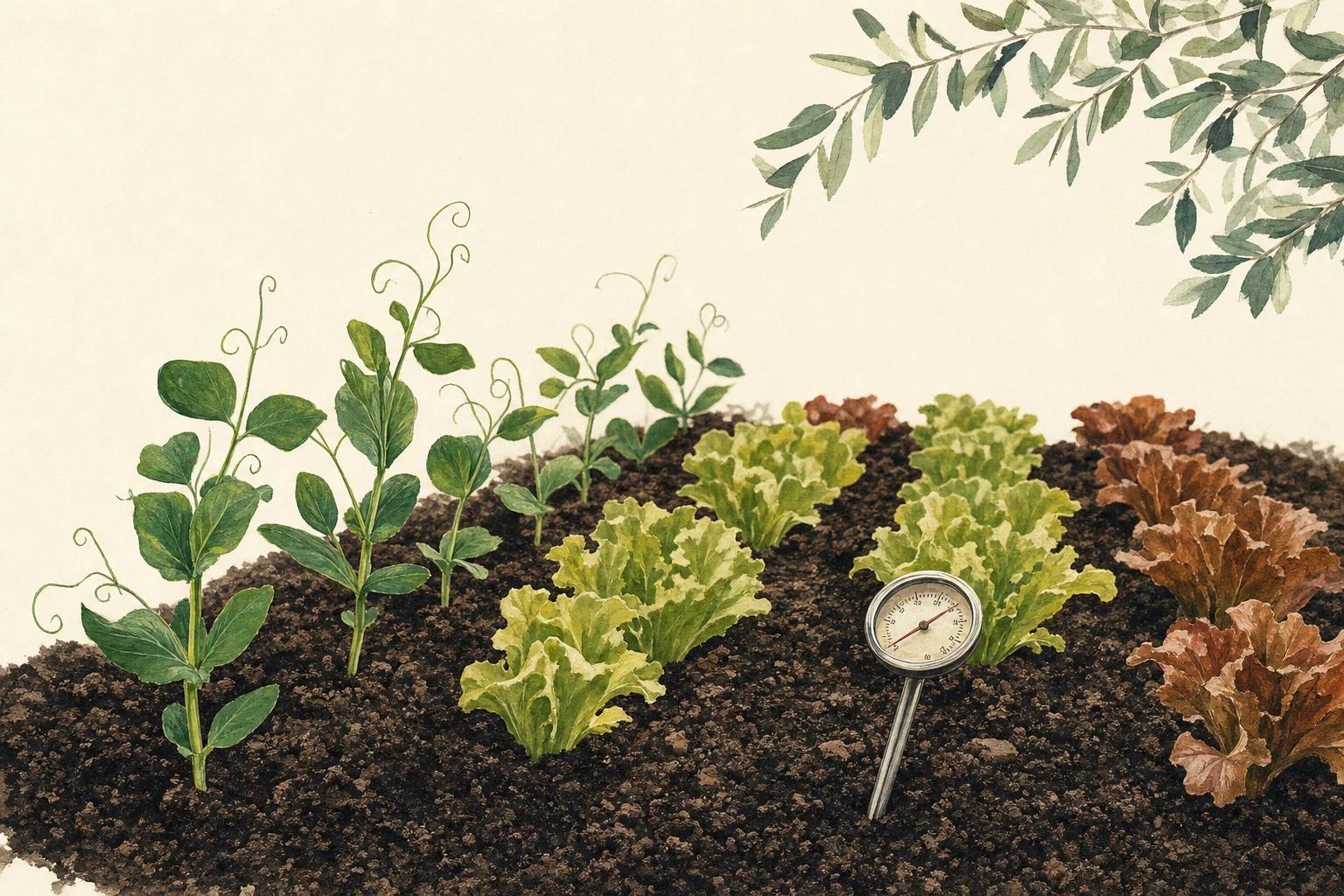
Sow when a soil thermometer pushed 4 inches (10 cm) into the bed reads 40°F (4°C) or higher at 8 a.m., the coolest point of the day. 45°F (7°C) is the more cautious threshold, and germination is best from 55 to 75°F (13–24°C).
| Soil at 4 in (10 cm) | What carrot seed does |
|---|---|
| Below 40°F (4°C) | Too cold to sow |
| 40–55°F (4–13°C) | Germinates slowly and unevenly |
| 55–65°F (13–18°C) | Emerges in about 14–21 days |
| Around 72°F (22°C) | Emerges in about 6–14 days |
| Above 80°F (27°C) | Germination declines |
| 90–95°F (32–35°C) and up | Seed fails to germinate |
Emergence times are approximate and stretch when the surface dries or crusts.
Because carrots are never transplanted, outdoor soil sets the whole schedule; there is no indoor head start to plan around.
How to sow carrot seed
Carrots need a deep, loose, stone-free bed and a seed surface that never dries out until the seedlings are up.
Work the soil 8 to 9 inches (20–23 cm) deep and pick out stones and clods, which fork and stunt the roots. In heavy clay or shallow soil, a raised bed gives long roots the room they need. Choose your sunniest spot, with at least 6 hours of direct light and ideally 8 to 10, and base any fertilizer on a soil test, aiming for a pH of 6.0 to 6.5.
- Mark shallow rows. Draw furrows 12 to 18 inches (30–45 cm) apart, which leaves room to weed between rows.
- Sow thinly. Mix the seed with a pinch of dry sand and trickle it at 2 to 3 seeds per inch (2.5 cm). Sand spreads tiny seed evenly, which means less thinning later.
- Cover lightly. Keep early spring sowings 1/4 to 1/2 inch (6–13 mm) deep; sowings into warm, dry soil later in the year can go down to 3/4 inch (19 mm). Covering with 1/8 inch (3 mm) of vermiculite, sawdust or potting mix instead of garden soil prevents a crust.
- Keep the surface moist. Water gently whenever the top starts to dry, for the 1 to 3 weeks the seed needs. Seedlings are too weak to push through a dry crust.
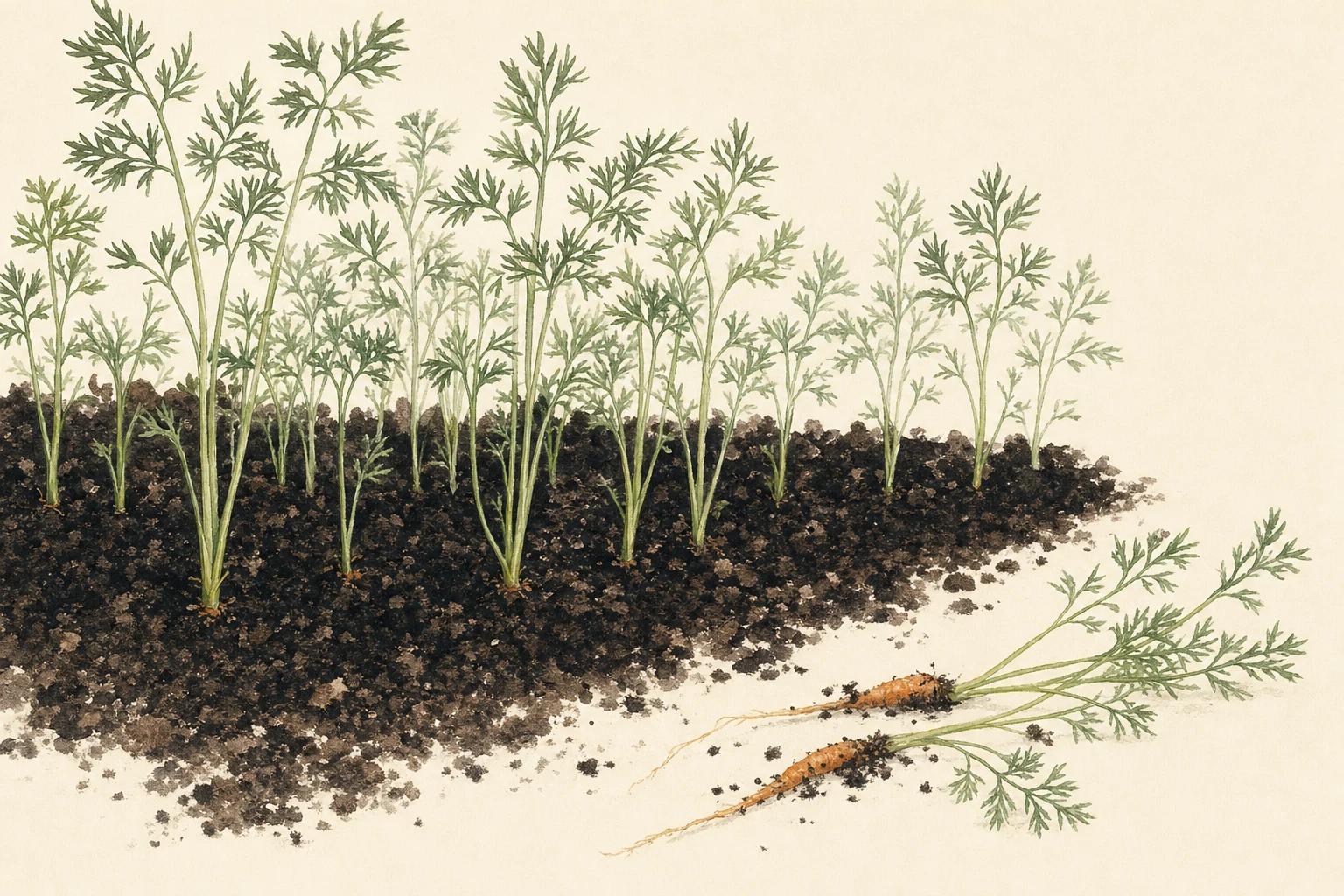
- Thin in two passes. At 1 to 2 inches (2.5–5 cm) tall, snip the extras at soil level with scissors so the survivors' roots are not disturbed. A few weeks later, thin again to a final 1 to 3 inches (2.5–7.5 cm), closer for baby types.
- Feed, water evenly and hill. Side-dress with nitrogen once plants reach 3 to 4 inches (7.5–10 cm). Keep moisture steady, since dry spells followed by a soaking crack roots and sharpen their flavor, and pull soil over exposed shoulders so the crowns do not turn green and bitter.
Sow a radish seed every few inches along the carrot row. The radishes come up well ahead of the carrots, mark the row for weeding and break the soil crust. Pull them before they start to crowd the carrots; radish sowing dates overlap the spring carrot window. For other neighbors, see Sow's companion planting guide.
Carrot types and how they change the timing
A carrot's type sets how many days it needs and what soil it tolerates, and both decide how much of your sowing window you can use.
| Type | Example variety | Days to maturity | Root | Best for |
|---|---|---|---|---|
| Amsterdam | Mokum | 54 (36 as baby) | 5.5–6.5 in (14–17 cm), slender | Early sowings, short seasons |
| Early Nantes | Napoli | 58 | Up to 7 in (18 cm) | Fall sowing; overwintering where mild |
| Danvers | Danvers 126 | 70 | 6–7 in (15–18 cm), broad shoulders | Heavy soil, storage |
| Chantenay | Red Core Chantenay | 75 | Short, wide, stump-rooted | Heavy or shallow soil |
Days to maturity are seed-company figures for full-size roots from direct sowing; cool fall and winter weather lengthens them.
A fast Amsterdam type such as Mokum is the one to use when a late spring leaves little time before heat, and it keeps its sweet taste in warm weather. Napoli, an early Nantes, suits fall sowing and, where winters are mild or under row cover, overwintering; it turns sweet when it matures in cold weather.
Long Imperator types need deep, loose, sandy ground; in heavy soil they fork, so grow Danvers 126, Red Core Chantenay or a small round type instead. Danvers 126 also resists splitting and stores well, which makes it a sound choice for a fall crop meant for the cellar.
Fall, winter and succession sowings
A fall crop sown 10 to 14 weeks before the median first frost finishes in cool weather, and roots that mature in cool fall weather are sweet and tender.
Use the long end of that range, about 100 days before frost, for storage carrots and slower varieties, and the short end for fast types. Midsummer seed goes into warm soil, where heat and crusting are the risks rather than cold, so the vermiculite cover and steady moisture from the sowing steps matter twice as much now.
In cool-summer regions, short rows sown every 4 weeks from spring through midsummer give a steady harvest instead of one glut. In hotter regions, skip the summer sowings and wait for the fall window. Where carrot rust fly is a problem, a sowing delayed until June can miss the pest's first generation.
Once fall carrots are full size, they keep in the ground under a thick straw or shredded-leaf mulch, and you can dig them until the soil freezes. A spring carrot bed cleared by midsummer is a natural spot for fall-planted garlic.
What goes wrong when you sow too early or too late
Sowing well ahead of the window costs more than it gains, and sowing after it trades sweetness for bitterness.
Too early. In cold, wet soil, germination drags on past 3 weeks, the surface crusts and weeds race ahead of the seedlings. Long cold spells after the seedlings emerge can push plants to flower instead of forming roots. Wait for 40°F (4°C) soil instead of the calendar.
Too late in spring. Carrots grow best at 75°F (24°C) or below. Roots that are still sizing up in hot summer soil come out poorly colored, coarse, fibrous and strong-flavored. If the spring window has passed, switch to a fast variety or wait for the fall sowing.
Too hot. Midsummer sowings in hot regions often fail, because germination declines once soil passes 80°F (27°C) and fails at 90–95°F (32–35°C), and a baked crust seals in whatever seed did sprout. Where July sowing is the norm, as in the South Carolina Piedmont, give the row some shade and keep the surface constantly moist until the seedlings are up.
Too late in fall. A sowing made after the fall window has too few mild weeks left for the roots to reach full size. If you are running late, sow a fast type such as Mokum or harvest the crop as baby carrots.
Frost, harvest and storage
Carrots are semi-hardy: light frost and temperatures down to 32°F (0°C) cause no serious damage, but heavy frosts and hard freezes injure the tops.
Harvest when roots are at least 3/4 to 1 inch (2–2.5 cm) across at the shoulder, or wait until they reach 1 to 1.5 inches (2.5–4 cm) for a full-size crop. Loosen the soil with a garden fork before lifting rather than pulling by the tops. Do not let roots sit long past maturity: overgrown carrots turn tough and woody, and some crack.
For storage, cut off the tops and keep the roots at 32–33°F (0–1°C) with 90–95% humidity, where they last 4 to 6 months. To line up your carrot sowings with the rest of the vegetable year, compare planting dates for other vegetables and put the windows on Sow's garden calendar.
Frequently asked questions
What month should carrots be planted?
It depends on your frost dates. Northern gardens sow in April or May and again between late June and mid-August. The lower Midwest and Mid-Atlantic sow in March or early April and again from late July to early September. The Southeast sows in February or March and again from July to September. Florida, South Texas and the low desert sow from late summer into winter, Phoenix again from January through April, and California's South Coast from January through September.
How do you thin carrot seedlings?
Thin when seedlings are 1 to 2 inches (2.5–5 cm) tall, cutting the extras at soil level with small scissors rather than pulling them, which loosens the roots you want to keep. Do it in two rounds a few weeks apart. Leave about 1 inch (2.5 cm) between baby carrots and 2 to 3 inches (5–7.5 cm) between full-size ones.
What fertilizer is best for carrots?
Start with a soil test and aim for a pH of 6.0 to 6.5. Without a test, work in about 3 pounds of 5-10-10 per 100 square feet (1.4 kg per 9.3 m²), or 1 cup of 10-10-10 per 10 feet (240 mL per 3 m) of row, before sowing. Side-dress lightly with nitrogen when plants reach 3 to 4 inches (7.5–10 cm), and keep compost to about 1 inch (2.5 cm) worked into the bed.
Do carrots need sun or shade to grow?
Carrots want full sun: at least 6 hours of direct light a day, and 8 to 10 hours is better. They will still produce a crop in some shade, so a partly shaded plot is not ruled out, but give them your sunniest bed if you have the choice.
Can you start carrots indoors and transplant them?
No. Carrots should always be sown where they will grow, because moving a seedling damages the taproot that becomes the carrot. If you want an earlier harvest, choose a fast type such as Mokum, ready in about 54 days, and sow it at the start of your spring window instead.
How long do carrot seeds take to germinate?
Expect 1 to 3 weeks. Near 72°F (22°C) soil, seedlings can appear in 6 to 14 days; in early spring soil around 55–65°F (13–18°C) they take 2 to 3 weeks, and colder soil is slower still. Emergence is often patchy, so give a row the full 3 weeks before deciding to resow the gaps.
Can you leave carrots in the ground over winter?
Yes, as long as the soil does not freeze solid. Cover a mature fall crop with a thick layer of straw or shredded leaves and dig as needed until the ground freezes. Where winters are mild, carrots hold in the ground all winter, and a mid-August sowing in western Washington is harvested from mid-February into June.
When are carrots ready to harvest?
Most varieties are ready 50 to 80 days after sowing, once roots are at least 3/4 to 1 inch (2–2.5 cm) across at the shoulder. Brush the soil aside to check. Loosen the row with a garden fork before lifting rather than pulling by the tops, and do not leave spring carrots in hot soil for long, because they turn woody, crack or taste strong.
References
- Utah State University Extension. How to Grow Carrots in Your Garden. Accessed October 16, 2026.
- Colorado State University Extension. Vegetable Planting Guide (CMG GardenNotes #720). Accessed October 16, 2026.
- University of Maryland Extension. Growing Carrots in a Home Garden. Accessed October 16, 2026.
- University of Illinois Extension. Carrots (Home Vegetable Gardening). Accessed October 16, 2026.
- University of Missouri Extension. Vegetable Planting Calendar (G6201), recommended varieties and planting dates. Accessed October 16, 2026.
- Clemson Cooperative Extension Home & Garden Information Center. Carrot, Beet, Radish & Parsnip (HGIC 1305). Accessed October 16, 2026.
- NC State Extension. Central North Carolina Planting Calendar for Annual Vegetables, Fruits, and Herbs (AG-756-01). Accessed October 16, 2026.
- Texas A&M AgriLife Extension. Carrots. Accessed October 16, 2026.
- Texas A&M AgriLife Extension. Texas Home Vegetable Gardening Guide (EHT-077). Accessed October 16, 2026.
- Texas A&M AgriLife Extension, Harris County. Vegetable Planting Calendar for Harris County. Accessed October 16, 2026.
- University of Florida IFAS Extension. Florida Vegetable Gardening Guide (SP 103/VH021). Accessed October 16, 2026.
- Washington State University Extension. Home Vegetable Gardening in Washington (EM057E). Accessed October 16, 2026.
- University of Arizona Cooperative Extension. Vegetable Planting Calendar for Maricopa County (az1005). Accessed October 16, 2026.
- University of California Statewide IPM Program (UC ANR). Cultural Tips for Growing Carrot. Accessed October 16, 2026.
- Johnny's Selected Seeds. Carrot Growing Information: How to Plant, Grow & Harvest. Accessed October 16, 2026.
- Johnny's Selected Seeds. Mokum (F1) Carrot Seed. Accessed October 16, 2026.
- Johnny's Selected Seeds. Napoli (F1) Carrot Seed. Accessed October 16, 2026.
- High Mowing Organic Seeds. Danvers 126 Carrot. Accessed October 16, 2026.
- Baker Creek Heirloom Seeds. Chantenay Red Core Carrot. Accessed October 16, 2026.
- NOAA National Centers for Environmental Information. U.S. Climate Normals 1991–2020: Annual/Seasonal freeze data. Accessed October 16, 2026.
Sow Editorial
Written by the Sow team from university extension services, botanical gardens, USDA and NOAA data and plant breeders. Every source is listed under References.