Quick answer
Plant vegetables by your frost dates and soil temperature, not the month. Peas, lettuce and onions can go in from 4 weeks before your median last spring frost and broccoli transplants from 3 weeks before, in soil of about 40°F (4°C). Tomatoes, beans, cucumbers and zucchini wait until at least the 1-in-10 last-frost date and 60°F (16°C) soil. Fall crops count back from the first frost.
Key facts
- Hardy crops (peas, lettuce, onions)
- From 4 weeks before the median last frost
- Broccoli and cabbage transplants
- 3 weeks to 1 week before the median last frost
- Tomatoes and green beans
- From the 1-in-10 last-frost date, in 60°F (16°C) soil
- Watermelon and sweet potatoes
- Soil of at least 65°F (18°C)
- Measure soil temperature
- 4 inches (10 cm) deep at about 8 a.m.
- Last fall planting
- Harvest date minus days to maturity minus 14 days
- Zones 9b–11 and low desert
- Main season runs fall through spring
Plant each vegetable by two dates and one reading: your median last spring frost, your median first fall frost and the temperature of the soil. Hardy crops such as peas and lettuce can go in a month before the last frost. Tender crops such as tomatoes and beans wait until the chance of a later frost has dropped to about 1 in 10, and fall crops are counted backward from the first frost. A month on its own means little: early April is pea time in Kansas City and tomato time in middle Georgia.
The two master tables below give the rule for 17 vegetables, matched to each crop's own planting page, followed by a worked example for one city and a month-by-month guide for six US regions. In Zones 9b to 11 and the low desert the year turns over: summer heat, not frost, ends the season, and the main garden runs from fall into spring.
Plant by frost dates and soil temperature, not the calendar
Your local frost dates set the planting window, and a soil thermometer picks the day inside it.
What the average last frost date means
The "average" last frost date is a median, so in half of all years a frost still arrives after it. At the St. Paul campus weather station in Minnesota, for example, the median last spring freeze at 32°F (0°C) is April 28. In 1 year in 10 a freeze comes after May 14, and a light frost of 36°F (2°C) after May 24.
That gap is why tender crops wait. The tables on this page use two spring anchors: the median last frost for hardy crops, which shrug off a late frost, and the 1-in-10 last-frost date for tender crops, which do not. At St. Paul, Kansas City and Denver the 1-in-10 date falls about two weeks after the median, and at Seattle three weeks after it.
The median first fall frost works the same way in reverse: by that date, half of all years have already had a frost. Crops that frost kills must be harvested before it.
How to find your frost dates
Look up the 1991–2020 freeze data for the weather station nearest you; national climate normals cover thousands of US stations. Each table lists the dates with a 10, 50 and 90 percent chance of a later spring freeze, or an earlier fall one, at 36°F (2°C), 32°F (0°C) and 28°F (−2°C). Use the 32°F (0°C) row: its 50 percent column is your median frost date and its 10 percent spring column is your 1-in-10 date.
Then adjust for your own yard. Frost risk changes within a single neighborhood with elevation, wind, buildings and nearby water, so treat the station's dates as a starting point and watch the forecast in the weeks around them.
Your hardiness zone is not a planting date
A USDA hardiness zone (2023 map) is based on the average coldest night of winter, in 10°F (5.6°C) steps, and says nothing about when spring frost ends. Denver and Kansas City are both in Zone 6, yet Denver's median last frost is May 5 and Kansas City's is April 13, more than three weeks apart. The tables below use zones only for broad limits, such as where a crop switches to a fall-to-winter season.
Cool-season and warm-season vegetables
How much cold a crop tolerates decides how early it can go into the ground.
| Group | Vegetables | Cold tolerance | Earliest planting |
|---|---|---|---|
| Hardy | Peas, lettuce, onions, radishes, broccoli, cabbage | Grows in days as cool as 40°F (4°C); survives light frost | 3 to 4 weeks before the median last frost |
| Semi-hardy | Carrots, potatoes | Needs days of 40 to 50°F (4 to 10°C); takes frost less well | 3 weeks before the median last frost |
| Tender | Corn, green beans, cucumbers, zucchini | Needs days above 55°F (13°C); no frost tolerance | Median last frost (corn) to a week after the 1-in-10 date |
| Very tender | Tomatoes, pumpkins, watermelon | Needs days above 60°F (16°C); a week of days below 55°F (13°C) can stunt it | 1-in-10 date (tomatoes) to a week after it (pumpkins, watermelon) |
Frost-tolerance groups for the vegetables on this page; the earliest planting column is where each crop's window opens in the master tables.
Cool-season crops grow best below 70°F (21°C), in early spring and again in fall. Warm-season crops do best above 70°F (21°C) and go in only after the last frost. In the South, a warm spring can push broccoli and cabbage to bolt and turn bitter, so fall is the better season for the cabbage family there.
Two crops sit outside the groups. Garlic is planted in fall and spends the winter in the ground. Sweet potatoes share the highest soil minimum of the 17 with watermelon, 65°F (18°C), and are planted last of all.
Master planting tables for 17 vegetables
Each row gives the same rule as the crop's own planting page. It covers indoor seed starting, the outdoor window counted from your frost dates, the minimum soil temperature and the fall or last sowing.
Cool-season vegetables
| Crop | Start indoors | Spring, from median last frost | Soil minimum | Fall, before median first frost |
|---|---|---|---|---|
| Peas | No, direct sow | 4 weeks before to the frost date | 40°F (4°C) | Sow 12 to 9 weeks before |
| Lettuce | Optional, 4–6 weeks ahead | 4 weeks before to 4 weeks after | 40°F (4°C) | Sow 12 to 8 weeks before |
| Onions | 8–12 weeks before setting out | 4 weeks before to 2 weeks after | 35°F (2°C) | Short-day types, Zone 8 and up: 60 to 21 days before |
| Radishes | No, direct sow | 3 weeks before to 2 weeks after | 40°F (4°C) | Sow 10 to 6 weeks before |
| Broccoli | 5–7 weeks before transplanting | Transplant 3 weeks to 1 week before | 40°F (4°C) | Transplant 100 to 70 days before |
| Cabbage | 4–7 weeks before transplanting | Transplant 3 weeks to 1 week before | 40°F (4°C) | Transplant 105 to 75 days before |
| Carrots | No, direct sow only | 3 weeks before to 1 week after | 40°F (4°C) | Sow 14 to 10 weeks before |
| Potatoes | No, plant seed pieces | 3 weeks before to the frost date | 45°F (7°C) | Texas, Georgia and California valleys: mid-July to August |
| Garlic | No, plant cloves | Not a spring crop | None set | Zones 3–5: frost date to 2 weeks after; Zones 6–10: 5 weeks before to 1 week after |
Spring windows count from the median last spring frost and fall windows from the median first fall frost; soil temperature is read 4 inches (10 cm) deep at about 8 a.m.
Warm-season vegetables
| Crop | Start indoors | Spring outdoors | Soil minimum | Fall or last sowing |
|---|---|---|---|---|
| Corn | No, direct sow | Median last frost to 3 weeks after | 55°F (13°C) | Last sowing set by region |
| Green beans | No, direct sow | 1-in-10 date to 3 weeks after | 60°F (16°C) | Sow 100 to 80 days before first frost |
| Tomatoes | 6–8 weeks before transplanting | 1-in-10 date to 3 weeks after | 60°F (16°C) | Midsummer, in the South and low desert |
| Cucumbers | Optional, 3–4 weeks before transplanting | 1 to 5 weeks after the 1-in-10 date | 60°F (16°C) | Sow 95 to 90 days before first frost |
| Zucchini | Optional, 3–4 weeks before transplanting | 1 to 4 weeks after the 1-in-10 date | 60°F (16°C) | Sow 115 to 90 days before first frost |
| Pumpkins | Optional, 3–4 weeks before planting out | 1 to 4 weeks after the 1-in-10 date | 60°F (16°C) | For Halloween: late May to mid-June (Zones 3–6), mid-June to mid-July (Zones 7–8) |
| Watermelon | 3–4 weeks before planting out | 1 to 2 weeks after the 1-in-10 date | 65°F (18°C) | Early varieties: 128 to 121 days before first frost (Zones 3–6) |
| Sweet potatoes | Sprout roots 6–8 weeks ahead, or buy slips | 3 to 6 weeks after the 1-in-10 date | 65°F (18°C) | No fall crop |
"1-in-10 date" is the date after which the chance of a spring frost falls to 1 in 10; "first frost" is the median first fall frost; soil for beans is read 6 inches (15 cm) deep, for the rest 4 inches (10 cm).
Where the frost rule changes
Warm winters and cool summers bend a few of these rules, and each crop page gives the local dates.
- Broccoli and cabbage: the frost-based windows run through Zone 9 for broccoli and Zone 8 for cabbage. Warmer gardens grow both from fall through winter, with broccoli transplanted from October to January in Zones 10 and 11.
- Peas and radishes: the spring rule runs through Zone 9 for peas and Zone 8 for radishes, and the fall rule through Zone 8 for both. In warmer gardens both are sown through one long cool season from fall into winter.
- Potatoes: the frost rule runs through Zone 8 and into Zone 9 in Texas, which puts Houston's planting in late January to mid-February. California's interior valleys plant in February and March and western Washington in mid-April. The Carolinas and Washington skip the fall crop.
- Corn: the frost rule runs through Zone 7. In Zone 8 and up, sow on regional dates: March around Houston, and from 2 weeks after the last frost into May in middle Georgia.
- Onions: in Zones 10 and 11 and the low desert, grow short-day varieties through the winter.
- Warm-season crops in the warmest zones: sow beans and zucchini in Zone 9 and up, and cucumbers in Zone 10 and up, once the soil reaches 60°F (16°C). Watermelon follows the frost rule through Zone 8 and pumpkins through Zone 9; in warmer gardens watermelon goes by soil temperature and pumpkins by regional dates, such as an early-August sowing in South Florida. Watermelon's last sowing in Zones 7 and 8 is mid- to late June. Sweet potatoes follow the frost rule through Zone 8a, and warmer gardens plant them once the soil holds 65°F (18°C).
Worked example: Kansas City
To turn the rules into dates, plug in your three frost dates. Kansas City, Missouri (Zone 6b) has a median last frost of April 13, a 1-in-10 last-frost date of April 29 and a median first frost of October 24.
| Crop | Spring planting | Fall planting or last sowing |
|---|---|---|
| Peas | Mar 16 – Apr 13 | Aug 1 – Aug 22 |
| Lettuce | Mar 16 – May 11 | Aug 1 – Aug 29 |
| Onions | Mar 16 – Apr 27 | Spring only |
| Broccoli (transplants) | Mar 23 – Apr 6 | Jul 16 – Aug 15 |
| Cabbage (transplants) | Mar 23 – Apr 6 | Jul 11 – Aug 10 |
| Carrots | Mar 23 – Apr 20 | Jul 18 – Aug 15 |
| Radishes | Mar 23 – Apr 27 | Aug 15 – Sep 12 |
| Potatoes | Mar 23 – Apr 13 | Spring only |
| Corn | Apr 13 – May 4 | Last sowing Jul 20 – Aug 1 |
| Green beans | Apr 29 – May 20 | Jul 16 – Aug 5 |
| Tomatoes (transplants) | Apr 29 – May 20 | — |
| Cucumbers | May 6 – Jun 3 | Jul 21 – Jul 26 |
| Zucchini | May 6 – May 27 | Jul 1 – Jul 26 |
| Pumpkins | May 6 – May 27 | For Halloween, late May to mid-June |
| Watermelon | May 6 – May 13 | Early varieties by Jun 18 – Jun 25 |
| Sweet potatoes (slips) | May 20 – Jun 10 | — |
| Garlic | — | Sep 19 – Oct 31 |
Dates computed from NOAA 1991–2020 normals for Kansas City International Airport; plant within each window once the soil reaches the crop's minimum.
Read down the spring column and the season unfolds: peas, lettuce and onions from mid-March, then transplants and roots, sweet corn at the median frost date, the frost-tender crops from the end of April and sweet potatoes last. The fall column runs the other way. Frost-tender crops have the earliest deadlines, from mid-June for Halloween pumpkins to August 5 for green beans, while radishes can be sown until September 12 and garlic goes in through October.
Counting back to start seeds indoors
Count indoor sowing back from the day you plan to set plants out, not from the frost date. Kansas City's tomato window opens on April 29, so tomato seed goes in between March 4 and March 18. Broccoli needs 5 to 7 weeks before its transplant date, cabbage 4 to 7 weeks and onions 8 to 12 weeks. Cucumbers, zucchini, pumpkins and watermelon need only 3 to 4 weeks, so start them last.
How to read soil temperature
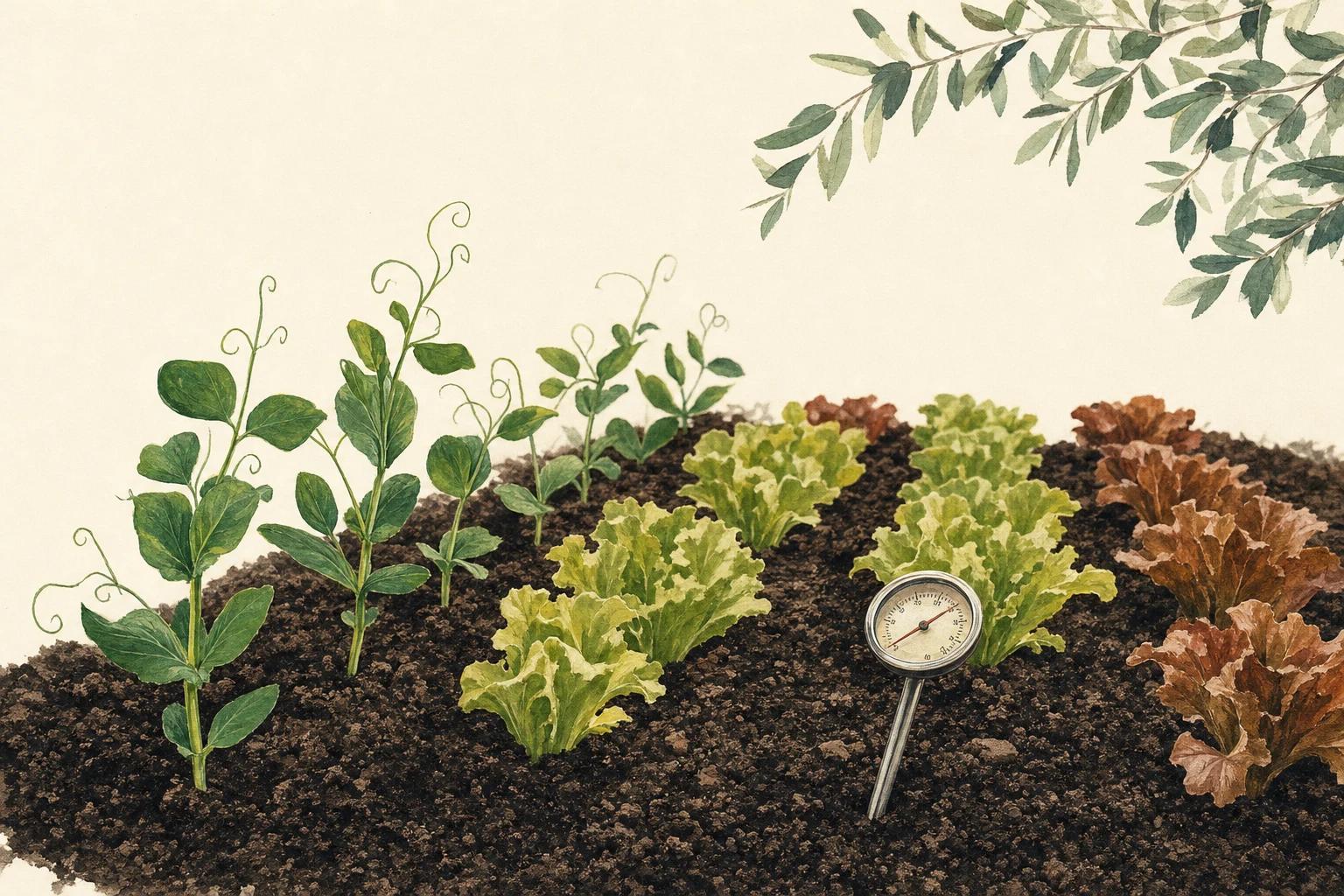
Push a soil thermometer 4 inches (10 cm) into the bed at about 8 a.m., when the soil is coolest, and compare the reading with the crop's minimum. Measure beans at 6 inches (15 cm). Check several spots, and wait for the reading to hold over several mornings rather than one warm day. A kitchen meat thermometer works if you keep it for garden use only.
The minimums in the master tables sit above the bare germination figures for some crops. Corn and tomato seed can sprout at 50°F (10°C) and snap beans at 55°F (13°C), but cool, wet soil slows germination and encourages rot, and tomato and pepper transplants root poorly in cold ground. Planting corn at 55°F (13°C) and beans, tomatoes and cucumbers at 60°F (16°C) gives them a fast, even start.
Wet soil warms slowly, because the water in it has to heat up too. Beds that drain well warm faster in spring, which is one reason a raised garden bed lets you plant earlier. Black plastic laid over the bed raises soil temperature by about 5°F (3°C), and clear plastic by up to 14°F (8°C). Hold off on straw or other organic mulch around warm-season crops until the soil has warmed, because it keeps cold soil cold.
What to plant month by month in six US regions
Outdoor planting starts about two months later in the North than in the South: from mid-April in the North, mid-March in the middle states and February in the South, while warm-winter gardens do their main planting from fall into spring. Read your region's months alongside your own frost dates.
North: Zones 3 to 5
St. Paul's median last frost is April 28, but across much of Minnesota frost can return into mid- to late May, so tender crops wait until then. The freeze-free season around St. Paul runs about 162 days.
- February: sow onion seed indoors early in the month.
- March: start cauliflower and head lettuce indoors in early March, and peppers and eggplant in mid-March.
- April: start tomatoes, broccoli and cabbage indoors early in the month. From mid-April, plant peas, spinach, onions, lettuce, radishes, carrots, beets and potatoes.
- May: broccoli and cabbage transplants go out; tomatoes, squash, pumpkins, melons, sweet corn and snap beans from mid-May; cucumbers in late May once the soil holds 60°F (16°C), or early May under hot caps.
- June: peppers, eggplant and sweet potatoes in early June; corn sowings continue to mid-June and beans into early July.
- August: sow leaf lettuce, radishes, spinach, kohlrabi and turnips early in the month for fall.
- October: plant garlic from the first fall frost to two weeks after it, early to late October around St. Paul.
Middle: Zones 6 and 7
A central Maryland garden plans around an April 15 last frost and an October 25 first frost. Across Maryland alone the frost-free season runs from 155 days in the far western counties to 230 days on the Lower Eastern Shore. Southern Maryland, the Eastern Shore and Baltimore plant 1 to 2 weeks earlier than the central dates.
- February: sow onion seed indoors; start cabbage seed from mid-February.
- March: sow peas and spinach from mid-March.
- April: set out broccoli and cauliflower transplants in early April and sow carrots from mid-April; sweet corn from late April into May once the soil holds 55°F (13°C).
- May: snap beans, cucumbers, melons, sweet corn and okra, plus tomato and pepper transplants; peppers continue to mid-June.
- June: set out sweet potato slips in early June and make second sowings of beans, carrots, corn and squash.
- July: start fall cabbage-family seed in a nursery bed in mid-July; set fall cabbage transplants out from mid-July to mid-August; sow kale and turnips from the second week.
- August: fall broccoli transplants go out late July to early August, with cole crops in by mid-August; sow spinach from August into early September.
- September to November: shallots late September to mid-October, garlic mid-October to mid-November.
From mid-November to late January, days in Maryland are shorter than 10 hours and growth almost stops. Hardy crops planted in fall hold in place through that stretch rather than size up.
South: Zones 8 and 9
Middle Georgia is the reference for this region. South Georgia plants 2 to 3 weeks earlier in spring and up to 2 weeks later in fall; north Georgia plants 1 to 3 weeks later in spring and about 2 weeks earlier in fall.
- February: plant potatoes, carrots, lettuce, spinach, radishes, turnips, English peas and collards. Start tomatoes indoors about 6 weeks before setting out and peppers and eggplant about 8 weeks.
- Late March to April: set tomatoes out from late March to early April, then sow beans, sweet corn, cucumbers, squash, cantaloupe and watermelon and plant peppers, eggplant and southern peas in April.
- June: plant sweet potatoes.
- July: the last date for fall tomatoes and pole beans in middle Georgia is about July 20. In Texas's Zone 8 region, fall tomatoes go in around July 1.
- August: the main fall planting month across North Carolina; start broccoli, cabbage, collards and kale in partial shade for fall.
- September: set out broccoli, cabbage, cauliflower and onion plants and sow carrots, lettuce, spinach, radishes and turnips. In Texas's Zone 8 region, fall broccoli and cabbage go in from September 1, with September 20 the last good date.
In western North Carolina, fall planting dates run 10 to 20 days earlier than the piedmont, and on the coastal plain 7 to 14 days later.
Gulf Coast, Florida and the low desert: Zones 9b to 11
Here the garden has two seasons with a hot summer gap between them. Around Houston the average last freeze falls between February 8 and March 1 and the first between November 30 and December 20, depending on which side of the metro area you garden in.
- Houston: cabbage-family transplants from mid-January into late February, potatoes from late January to mid-February, corn and tomatoes from March to mid-April, and okra and southern peas from April into June. In fall, potatoes go in from mid- to late August, broccoli and cabbage from mid-September to mid-October, kale and collards through October, and other greens and root crops in October and November.
- Phoenix: sow broccoli and cabbage seed on August 15 and September 1, then set transplants out from September 15 to December 15 and again January 1 to 15. Plant tomatoes from February 15 to March 15 and again from July 15 to August 1. Many vegetables want soil between 65 and 85°F (18 and 29°C). Hold fall planting until whitefly numbers drop, and choose fast-maturing varieties.
Florida splits into three planting zones.
| Crop | North Florida | Central Florida | South Florida |
|---|---|---|---|
| Broccoli | Sep–Feb | Sep–Feb | Oct–Jan |
| Cabbage | Sep–Feb | Sep–Feb | Sep–Jan |
| Carrots | Sep–Mar | Aug–Mar | Sep–Mar |
| Potatoes | Jan–Mar | Nov–Feb | Oct–Jan |
| English peas | Jan–Mar | Nov–Feb | Nov–Feb |
| Watermelon | Late Mar–Apr | Jan–Mar | Dec–Mar |
| Sweet potatoes | Mid-Mar–Jun | Feb–Jun | Dec–Sep |
| Pumpkins | Early Jul | Mid-Jul | Early Aug |
Florida planting windows; North is north of State Road 40, Central is between SR 40 and SR 70, and South is south of SR 70. Watermelon shows the spring window only.
Florida sowings made in August and September are exposed to heat-loving insects and diseases.
Pacific Northwest, west of the Cascades
Frost ends early here, with Seattle's median last frost on March 2, but soil and nights stay cool into May, so warm-season crops wait for soil rather than frost.
- April: plant potatoes in mid-April and cabbage from April into late May.
- May: sow sweet corn and beans in mid- to late May once the soil reaches their minimums, and set out summer broccoli late in the month. Western Oregon's valleys plant tomatoes in May.
- Late May to early June: set out peppers, eggplant, cucumbers, squash and melon transplants, with watermelon in early June.
- July to September: sow kale from mid-July to early August, winter carrots and overwintering onions from mid-August, and winter lettuce, spinach and arugula in early September.
Heat-loving crops do best here with black plastic, row covers and raised beds. Tomato seed germinates best in soil of 70 to 85°F (21 to 29°C) and cucumber seed in 70 to 95°F (21 to 35°C), well above their minimums.
California valleys
In the Interior Valleys (Sacramento and San Joaquin), winter is a growing season and frost, not cold soil, is the main risk.
- Warm season: sweet corn from March through July, and tomatoes, eggplant and snap beans in April and May. Peppers follow in May. Summer squash runs from April to July and melons and watermelon from April to June, while sweet potatoes wait until the soil holds 65°F (18°C).
- Cool season: potatoes in February and March and again in August; peas from September through February; garlic from October to December; bulb onions from November to March.
The Imperial and Coachella desert valleys flip the year again: tomatoes go in from December through March.
Succession planting: keep the harvest coming
Sow small amounts often, rather than one big planting, and crops ripen in a steady stream instead of all at once.
Re-sow fast crops such as lettuce, radishes and bush beans every two weeks while their window is open. Kansas City's lettuce window, mid-March to mid-May, has room for four or five sowings. You can also plant early, midseason and late varieties of one crop on the same day, or replant a variety at intervals about equal to its harvest period.
When a crop finishes, put another in its place. Swiss chard can follow early lettuce or broccoli, spinach or snow peas can follow early sweet corn, carrots can follow lettuce and kale can follow tomatoes. In the North, leaf lettuce, radishes and kohlrabi sown in mid-April can be sown again in early August for fall.
Succession works best when each sowing is sized to what you can eat in two weeks. Sow in short rows and use the plant spacing calculator to work out how many plants each sowing needs.
When it is too late to plant
A sowing is too late once the crop's days to maturity, plus about two extra weeks, no longer fit before your harvest deadline.
For fall crops, take the date you want to harvest by, subtract the days to maturity on the seed packet, then subtract 14 more days. A 60-day crop that must be ready by Kansas City's October 24 first frost goes in around August 11. The extra two weeks cover slower growth in fall, when days shorten and cool nights hold plants back. Fall gardens fail most often because they went in too late, and crops that form heads or pods suffer most.
The harvest deadline depends on the crop. Frost-tender crops such as beans, cucumbers and zucchini must finish before the median first frost, which is why their last sowings fall 80 to 115 days ahead of it. Broccoli, cabbage, kale, spinach and lettuce survive a hard frost, and carrots, beets and chard tolerate a light one, so their harvest can run past the first frost.
Spring has a deadline too, set by heat rather than frost. Lettuce and spinach seed germinates poorly in soil above 70°F (21°C), and spinach bolts as the days lengthen and warm. That is why the cool-season windows in the master table close a few weeks after the last frost.
Protect early and late plantings
Row covers, low tunnels and cold frames add protection at both ends of the season, as long as you pick the right weight and vent them on sunny days.
Row covers. Medium-weight fabric guards against a light frost and lets through 75 to 85 percent of the light. Heavy fabric protects hardy crops down to about 20°F (−7°C) but blocks 40 to 50 percent of the light, so use it only for short cold spells. Lightweight fabric passes over 90 percent of the light and keeps out insects but gives no frost protection. For tomatoes, squash and other tender crops, a cover protects plants already in the ground on a frosty night; it is not a reason to plant them weeks early. Most gardeners leave covers on for a month or less.
Low tunnels. Bend hoops of 9- or 10-gauge wire over the bed about every 3 feet (90 cm) and stretch fabric or plastic over them. Solid plastic holds the most heat overnight but must be opened on warm, sunny days.
Cold frames. An unheated box with a hinged clear lid hardens off seedlings in spring and keeps lettuce and spinach growing into winter. Face it south, give it at least half a day of direct sun and set the front edge about 6 inches (15 cm) into the ground. Add blankets or straw bales around it in a sudden cold snap.
At the end of the season, mild weather often follows the first killing frost. Covering tomatoes, peppers and cucumbers on those first cold nights can extend the harvest by several weeks, and frost-tolerant carrots, cabbage, lettuce, spinach and kale can keep going into winter under fabric.
Planting calendars for flowers, fruit and lawns
The same frost-date logic times the rest of the yard, and each of these has its own calendar page.
- Fall bulbs: when to plant tulip bulbs and when to plant daffodil bulbs, both counted from the first fall frost.
- Shrubs: when to plant roses, bare-root in early spring and in containers from the last frost into summer, and when to plant hydrangeas, in spring or fall.
- Fruit: when to plant strawberries, as dormant crowns in spring or plugs in fall.
- Meadows and lawns: when to sow wildflower seeds, after the first hard freeze, and when to plant grass seed, with cool-season lawns sown in late summer.
Keep your own planting dates in one place with Sow's garden calendar.
Frequently asked questions
What month is the best month to plant vegetables?
No single month works everywhere, because frost dates differ by weeks across the country. In Zones 3 to 5 most planting falls between April and June. Zones 6 and 7 plant from March to May, then again in July and August for fall. Zones 8 and 9 plant from February to April and again from August to October, and Florida, the Gulf Coast and the low desert grow their main garden from September through March.
What vegetables should I start planting now?
Find the current month under your region in the month-by-month section, then check it against your own frost dates. In fall that means garlic in Zones 3 to 7, cabbage-family transplants with lettuce, spinach and radishes in the South, and the start of the main cool-season garden in Florida, along the Gulf Coast and in the low desert. In late winter and spring, hardy crops come first and frost-tender crops follow the 1-in-10 date.
Are there any vegetables that can be planted in July?
Yes, July is the start of the fall garden in much of the country. With a late-October first frost, as in Kansas City, fall broccoli and cabbage transplants, carrots, green beans, cucumbers, zucchini and a last sowing of sweet corn all go in during July. In middle Georgia, fall tomatoes go in by July 20, and around Phoenix they are set out from July 15 to August 1.
When should I plant vegetable seeds this year?
The dates do not change from year to year: your frost dates and soil temperature set them. Sow hardy crops outdoors from 3 to 4 weeks before your median last frost, and frost-tender crops such as tomatoes and beans from the 1-in-10 date. Count indoor sowing back from the transplant date. With an April 29 transplant date, as in Kansas City, sow tomato seed indoors in the first half of March.
Should I soak my vegetable seeds in water before planting?
Most vegetable seed does not need soaking. Okra is the usual exception: soak it for about 6 hours in warm water before sowing. In spring, more seed is lost by sowing into chilly, soggy ground, where it sits and rots instead of sprouting, so a soil thermometer does more good than soaking. Beans and cucumbers need soil of at least 60°F (16°C), and watermelon 65°F (18°C).
What is the easiest vegetable to grow for beginners?
Leaf lettuce is one of the easiest, and beets and zucchini are also easy to grow. Lettuce has a long, flexible window, from 4 weeks before the median last frost to 4 weeks after it, so a late start still works. Keep the first garden small: new gardeners often plant more than they can weed, water and harvest.
Does my hardiness zone tell me when to plant vegetables?
Not on its own. The 2023 USDA zone map measures how cold winter gets, not how long the frost season lasts, so two cities in the same zone can have last frosts three weeks apart. Time your planting by frost dates and soil temperature, and use the zone only to see where a crop moves to a different season, such as broccoli and cabbage becoming fall-to-winter crops in the warmest zones.
Can I plant before the last frost if I cover my plants?
Hardy crops such as peas, lettuce and onions do not need cover, because their windows already open weeks before the last frost. Tender crops are another matter. A cover buys them protection from a light frost only, so use it to shield tomatoes, squash and beans already in the ground on a cold night, not to set them out weeks early. They also need warm soil, so keep to their windows and check the thermometer.
How late can I plant a fall vegetable garden?
Late enough that the crop still matures before its harvest deadline, allowing about two extra weeks for slow fall growth. For frost-tender crops such as beans and cucumbers, the deadline is the median first fall frost. With Kansas City's first frost on October 24, the last green bean sowing falls around August 5; the worked Kansas City table lists the other crops. Hardy crops such as kale and spinach keep growing after a frost, so they can go in later.
References
- Colorado State University Extension. Vegetable Planting Guide (CMG GardenNotes #720). Accessed October 16, 2026.
- Colorado State University Extension, PlantTalk Colorado. Soil Temperatures, Frosts and Planting Dates. Accessed October 16, 2026.
- University of Minnesota Extension. Planting the vegetable garden. Accessed October 16, 2026.
- University of Minnesota Extension. Extending the growing season. Accessed October 16, 2026.
- University of Minnesota Extension. Growing broccoli in home gardens. Accessed October 16, 2026.
- University of Minnesota Extension. Growing cabbage in home gardens. Accessed October 16, 2026.
- University of Maryland Extension. When to Plant Vegetables (vegetable planting calendar). Accessed October 16, 2026.
- University of Maryland Extension. Fall Vegetable Gardening. Accessed October 16, 2026.
- NOAA National Centers for Environmental Information (hosted by Minnesota DNR). 1991–2020 Summary of Annual Normals, St. Paul (USC00218450): freeze data. Accessed October 16, 2026.
- NOAA National Centers for Environmental Information. U.S. Climate Normals (1991–2020). Accessed October 16, 2026.
- NOAA National Centers for Environmental Information. 1991–2020 Annual/Seasonal Normals station files (freeze probabilities): Kansas City Intl AP (USW00003947), Denver Intl AP (USW00003017), Seattle-Tacoma Intl AP (USW00024233). Accessed October 16, 2026.
- USDA Agricultural Research Service. USDA Plant Hardiness Zone Map (2023). Accessed October 16, 2026.
- University of Kentucky Cooperative Extension Service. Home Vegetable Gardening in Kentucky (ID-128). Accessed October 16, 2026.
- University of Georgia Cooperative Extension. Vegetable Garden Calendar (Circular 943). Accessed October 16, 2026.
- NC State Extension. Extension Gardener Handbook, Chapter 16: Vegetable Gardening. Accessed October 16, 2026.
- Texas A&M AgriLife Extension. Fall Vegetable Gardening Guide for Texas. Accessed October 16, 2026.
- Texas A&M AgriLife Extension. Easy Gardening: Irish Potatoes (EHT-068). Accessed October 16, 2026.
- Clemson Cooperative Extension Home & Garden Information Center. Potato (HGIC 1317). Accessed October 16, 2026.
- NC State Extension. Central North Carolina Planting Calendar for Annual Vegetables, Fruits, and Herbs (AG-756-01). Accessed October 16, 2026.
- Texas A&M AgriLife Extension, Harris County. Vegetable Garden Planting Dates for Harris County. Accessed October 16, 2026.
- UF/IFAS Extension. Florida Vegetable Gardening Guide (SP 103 / VH021). Accessed October 16, 2026.
- University of Arizona Cooperative Extension. Vegetable Planting Calendar for Maricopa County (AZ1005). Accessed October 16, 2026.
- Oregon State University Extension Service. Vegetable Gardening in Oregon (EC 871). Accessed October 16, 2026.
- Washington State University Extension. Home Vegetable Gardening in Washington (EM057E). Accessed October 16, 2026.
- UC Agriculture and Natural Resources. Table 14.2 Vegetable gardening at a glance (California Master Gardener Handbook). Accessed October 16, 2026.
Sow Editorial
Written by the Sow team from university extension services, botanical gardens, USDA and NOAA data and plant breeders. Every source is listed under References.
The plants Sow gardeners save most