Quick answer
Plant garlic in fall. In Zones 6 to 10, set cloves out from about five weeks before your first fall frost to a week after it: October across most of the North, late September to November in the South, and into December on the Gulf Coast. In Zones 3 to 5, plant within two weeks after the first fall frost; North Dakota waits for the first hard freeze.
Key facts
- Zones 3–5
- Within 2 weeks after the first fall frost; in North Dakota, 1–2 weeks after the first hard freeze of 28°F (−2°C)
- Zones 6–10
- From 5 weeks before to 1 week after the first fall frost
- Soil temperature
- Not used; time planting by frost, before the ground freezes. Cloves then need 6–8 weeks below 40°F (4°C)
- Days to maturity
- Fall-planted: 140–150 days in Texas, 180–220 in Tennessee, 250–270 in Maryland
- Planting depth
- 1–1½ inches (2.5–4 cm) in the South to 4 inches (10 cm) in the Northern Plains
- Spacing
- 4–6 inches (10–15 cm) apart; 3–5 inches (7.5–13 cm) is common in the Southeast
- Harvest
- Late spring to early summer in the South; June to August in the North, when about half the leaves are brown
Plant garlic in fall. Across most of the country, Zones 6 to 10 on the 2023 USDA map, set cloves out from about five weeks before your median first fall frost to a week after it. In the far north and Upper Midwest, Zones 3 to 5, wait for the first frost and plant within two weeks of it; North Dakota waits for the first hard freeze and plants one to two weeks later. Either way, roots grow for several weeks before the ground locks up, while most of the shoot stays underground until spring.
The bulb you dig next summer is built from the roots and leaves made between fall planting and late spring. A clove planted in fall also gets the winter chill garlic needs to form a full bulb. A spring clove gets neither, which is why spring planting is the fallback rather than the plan.
Garlic planting dates by city
Minneapolis and Chicago follow the Zones 3 to 5 rule, and Fargo follows North Dakota's hard-freeze timing. Every other city follows the Zones 6 to 10 rule, except that Houston's window runs to the end of December, the month Texas lists for Zone 9b.
| City (USDA zone) | Median last frost | Median first frost | Plant cloves (Zones 3–5) | Plant cloves (Zones 6–10) |
|---|---|---|---|---|
| Fargo, ND (4a) | May 10 | Sep 30 | Oct 17 – Oct 24 | See Zones 3–5 column |
| Minneapolis, MN (5a) | Apr 23 | Oct 18 | Oct 18 – Nov 1 | See Zones 3–5 column |
| Chicago, IL (5b) | Apr 16 | Oct 28 | Oct 28 – Nov 11 | See Zones 3–5 column |
| Denver, CO (6a) | May 5 | Oct 9 | See Zones 6–10 column | Sep 4 – Oct 16 |
| Detroit, MI (6b) | Apr 20 | Oct 27 | See Zones 6–10 column | Sep 22 – Nov 3 |
| Kansas City, MO (6b) | Apr 13 | Oct 24 | See Zones 6–10 column | Sep 19 – Oct 31 |
| Boston, MA (7a) | Apr 4 | Nov 9 | See Zones 6–10 column | Oct 5 – Nov 16 |
| Salt Lake City, UT (7b) | Apr 8 | Oct 31 | See Zones 6–10 column | Sep 26 – Nov 7 |
| New York, NY (7b) | Mar 30 | Nov 20 | See Zones 6–10 column | Oct 16 – Nov 27 |
| Nashville, TN (7b) | Mar 31 | Nov 3 | See Zones 6–10 column | Sep 29 – Nov 10 |
| Raleigh, NC (8a) | Mar 31 | Nov 4 | See Zones 6–10 column | Sep 30 – Nov 11 |
| Atlanta, GA (8a) | Mar 15 | Nov 20 | See Zones 6–10 column | Oct 16 – Nov 27 |
| Dallas-Fort Worth, TX (8b) | Mar 8 | Nov 24 | See Zones 6–10 column | Oct 20 – Dec 1 |
| Seattle, WA (9a) | Mar 2 | Nov 23 | See Zones 6–10 column | Oct 19 – Nov 30 |
| Sacramento, CA (9b) | Feb 2 | Dec 2 | See Zones 6–10 column | Oct 28 – Dec 9 |
| Houston, TX (9b) | Feb 13 | Dec 9 | See Zones 6–10 column | Nov 4 – Dec 31 |
Frost dates are medians from NOAA 1991–2020 climate normals for each city's main weather station; in half of years the first frost comes earlier than the date shown.
For any other town, look up the median frost dates for your nearest weather station. In Zones 6 to 10, count back five weeks from the median first frost (32°F, 0°C) and forward one week: a first frost of October 20 gives a window of September 15 to October 27. In Zones 3 to 5, plant from the median first frost to two weeks after it. In North Dakota, use the median first hard freeze (28°F, −2°C) instead and plant one to two weeks after it; in Fargo that freeze falls on October 10. If you are not sure which zone you garden in, look up your hardiness zone first.
The two rules meet different risks. Where fall turns cold fast, waiting until after the first frost keeps cloves from pushing shoots before winter. Farther south the ground stays open long after the first frost, so planting in the weeks around it still leaves the six to eight weeks of rooting time cloves want before the ground freezes, or the whole winter where it never does.
Garlic planting months by zone
Colder gardens within a zone plant toward the start of each range; gardens near the coast, where the first frost comes later, plant toward the end.
| USDA zone (2023 map) | Typical planting months |
|---|---|
| 3–4 | Late September to October; mid to late October in North Dakota |
| 5 | Mid-October to early November |
| 6 | Late September to October |
| 7 | October to early November |
| 8 | Late September to November |
| 9 | November to December on the Gulf Coast; September to November in the Pacific Northwest |
| 10–11 | Late fall into early winter |
Months combine state extension planting calendars; your own frost date sets the exact window.
Why garlic goes in the ground in fall
Garlic needs a cold spell to form a proper bulb. After planting, cloves need about 6 to 8 weeks below 40°F (4°C), or roughly two months between 32 and 50°F (0 and 10°C), before the bulb will swell. Without that chill most varieties make weak shoots and poorly formed bulbs. Hardneck types depend on it most.
The second reason is leaf area. Bulbing starts when the days turn long and warm in late spring, and from that point the plant makes no new leaves. Every leaf present on that date feeds the bulb, so large tops at bulbing mean large bulbs at harvest. A fall clove has roots in place by winter and grows quickly as soon as the soil thaws. A spring clove starts months behind and reaches the bulbing date with far less foliage.
Fall timing in cold climates balances two risks. Planted too soon, cloves push leaves well above the soil before hard cold. Planted too late, they have too few roots when the ground freezes.
In the South, cold is rarely the limit; time is. Cloves planted late make too little leaf growth before spring bulbing begins, so Southern gardeners plant earlier in the season relative to their frost date.
Garlic planting times by region
Every region plants in fall; what changes is the month.
| Region | When to plant |
|---|---|
| Northern Plains (ND) | One to two weeks after the first hard freeze |
| Upper Midwest (WI) | Within two weeks after the first killing frost |
| New England (NH) | October in the north, November in the south |
| New Jersey | October, three to eight weeks before the first frost |
| Maryland | Mid to late October |
| Tennessee | Sept 1 to Nov 1 in the east; Sept 15 to Nov 15 in the west |
| Central North Carolina | Mid-September through November |
| Georgia | Late September through November |
| Intermountain West (UT) | Late September to November |
| Pacific Northwest (OR) | September to November |
| New Mexico | September–October in the north, October–November in the south |
| Texas | October in Zone 8, November in Zone 9a, December in Zone 9b |
| Florida | Late fall to early winter |
Windows are the state recommendations for home gardens; your own frost date fine-tunes them.
Cold-winter gardens
Across the northern states, hardneck garlic is the safer choice because it survives long, hard winters better than softneck. Most of the North plants in October. Gardens near the coast, where the first frost comes later, plant into November.
The South and Gulf Coast
Fall planting is the only way to get full-size bulbs in the Southeast. Texas plants four to six weeks before the first freeze and does not recommend spring planting at all. Choose Artichoke softnecks or Creole types; Rocambole hardnecks do poorly in warm climates. Tennessee sits on the transition, and gardeners there can grow hardnecks, softnecks or both.
The Pacific Northwest
Plant from September through November, about 2 inches (5 cm) deep. Unlike the South, the region grows hardnecks well: 'Music', 'Chesnok Red', 'German Red' and 'Spanish Roja' are standard choices there, alongside softnecks such as 'Inchelium Red' and 'California Early'.
Mild-winter and frost-free gardens
In Florida and other Zone 10 and 11 gardens, plant from late fall into early winter and grow Artichoke softnecks or Creole types. Where winters do not stay reliably below 40 to 50°F (4 to 10°C), hardnecks will not get enough natural chill.
Hardneck or softneck: the type that suits your winter
Pick the type to match your winter: it decides how much cold the cloves need, how hardy they are and how long the harvest keeps.
| Trait | Hardneck | Softneck |
|---|---|---|
| Flower stalk (scape) | Yes; edible | Rarely |
| Cloves | About 4–12, large, in one ring | 10–40, in layers |
| Storage | About 3–6 months, by variety | 6–8 months or more |
| Winter hardiness | Higher; suits long, cold winters | Lower; suits mild winters and long seasons |
| Neck | Stiff, from the flower stalk | Soft; can be braided |
Clove counts and storage life vary by variety within each group.
Hardnecks for cold winters
- 'Music' (porcelain): large bulbs with a strong flavor, and a reliable performer in northern New England.
- 'German Extra Hardy' (porcelain): four to seven big, spicy white cloves, also proven in northern New England.
- 'Chesnok Red' (purple stripe): 8 to 12 cloves that keep their shape and flavor when cooked.
- 'Spanish Roja', 'German Red' and 'Russian Red' (rocambole): proven cold-climate choices. The first two are grown in North Dakota and the third did well in northern New England. 'Spanish Roja' keeps four to six months and 'Russian Red' about six; both have easy-peel cloves.
Softnecks and Creoles for mild winters and spring planting
- 'Inchelium Red' (Artichoke): vigorous and mild, with 10 to 20 cloves and bulbs that can top 3 inches (7.5 cm) across.
- 'California Early' and 'California White': recommended for Texas. Grown in cold climates, California types adapt poorly and turn very hot in flavor.
- 'Italian Late' (Artichoke) and 'Silver Rose' (silverskin): long keepers, at six to nine months and up to eight months, and both tolerate spring planting.
- Creole types such as 'Burgundy' and 'Ajo Rojo': easy to grow in the South, tolerant of rough weather, 8 to 12 cloves, and seven to eight months in storage. Creoles are classed with the softnecks by some growers and with the hardnecks by others.
Artichoke softnecks are the most adaptable group and need the least winter cold. They are also the first to mature, followed by hardnecks and then silverskins, so planting a mix spreads the harvest out.
Elephant garlic is a leek grown like garlic, with a few very large, mild cloves. It does well in the South. Plant it on the same schedule, 2 to 2.5 inches (5 to 6 cm) deep and about 6 inches (15 cm) apart.
How to tell the bed is ready
Garlic is timed by frost, not by a soil-temperature reading. The only hard limit is frozen ground, and cloves can go in any time the soil can still be dug.
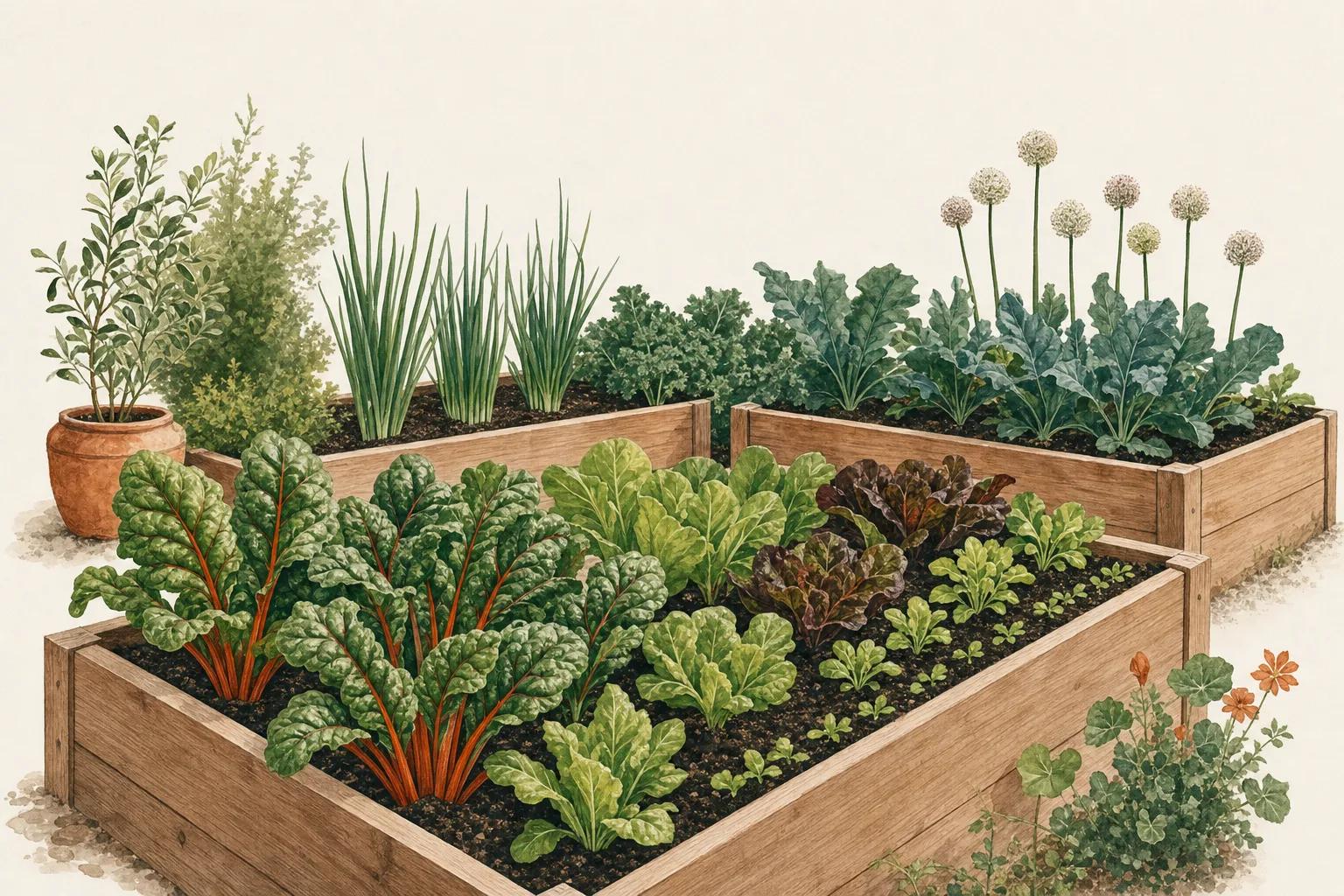
What matters more is drainage. Choose a spot in full sun with loose soil rich in organic matter and a pH of about 6.0 to 7.0, with 6.2 to 6.5 ideal. Poorly drained soil rots bulbs, so on heavy clay or wet ground, plant in a raised bed. Keep cloves at least 6 inches (15 cm) in from the frame, because soil along the edges freezes harder, or run a single row down the middle of a narrow bed.
Garlic is a heavy feeder and competes poorly with weeds, so the bed needs both fertility and a clean start.
How to plant garlic
- Buy seed garlic. Order from a seed company, garden center or local farm rather than the supermarket.
- Prepare the bed. Clear the weeds, loosen the soil, and mix in compost and fertilizer so the cloves root into rich ground.
- Split the bulbs on planting day. Separate the cloves only when you are ready to plant, leave the papery skin on, and plant the largest outer cloves. Big cloves grow big bulbs, so keep the small ones for the kitchen.
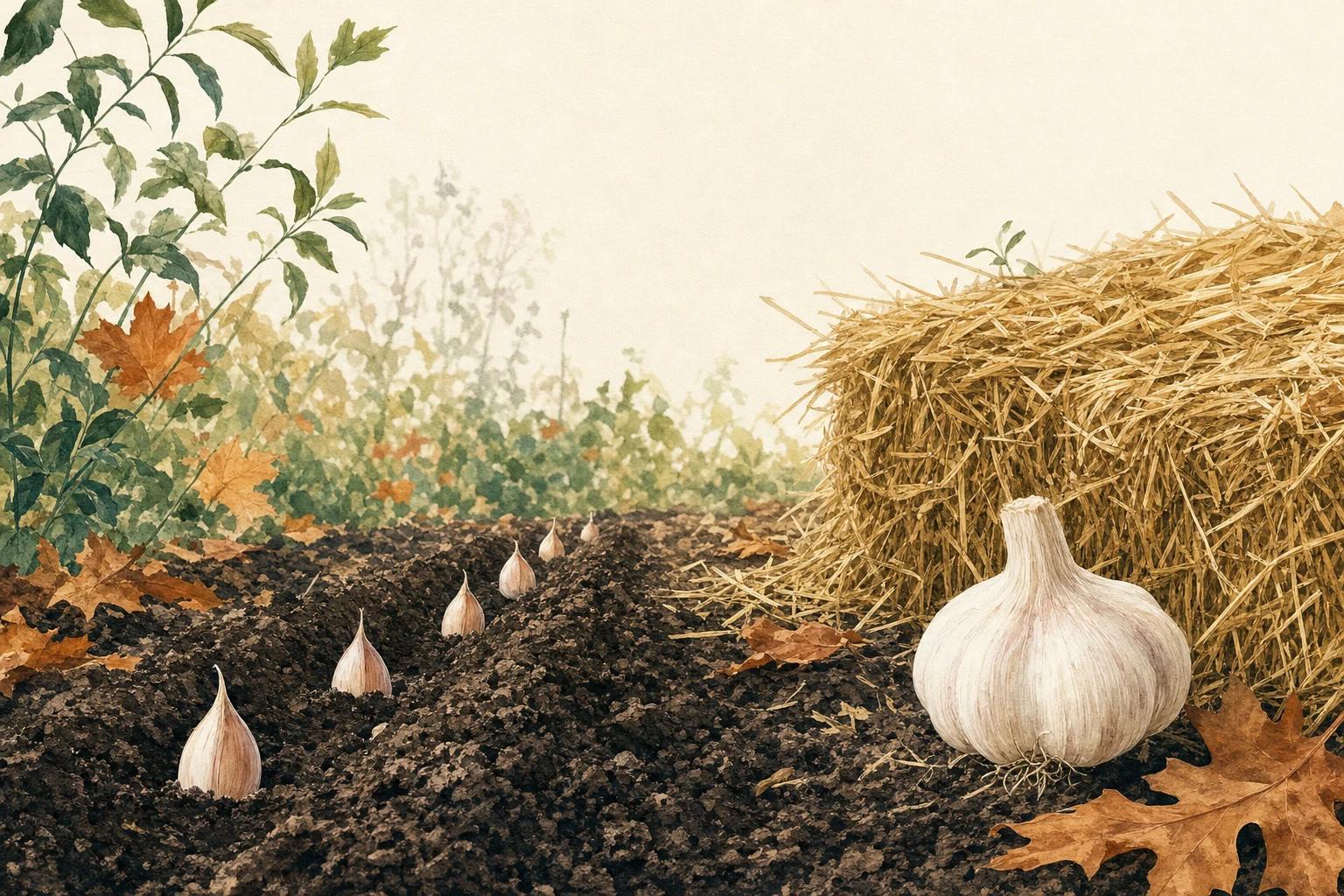
- Plant pointed end up. Set each clove with its flat root end down, at the depth for your climate in the table below, 4 to 6 inches (10 to 15 cm) apart; 3 to 5 inches (7.5 to 13 cm) is common in the Southeast. Rows can sit anywhere from 6 to 24 inches (15 to 60 cm) apart; closer spacing shrinks bulbs unless water and fertilizer are generous.
- Water in. If the soil is dry, water after planting so the cloves begin to root.
- Mulch in cold climates. Spread 3 to 6 inches (7.5 to 15 cm) of clean straw or shredded leaves over the bed to even out soil temperature. Some growers mulch right after planting; others wait until the ground starts to freeze, because mulch laid early can encourage sprouting. On the Northern Plains, where snow cover is thin, 4 inches (10 cm) of straw is the norm.
| Climate | Soil over the clove |
|---|---|
| Southeast and Deep South | 1–1½ inches (2.5–4 cm) |
| Mid-Atlantic and Pacific Northwest | 1–2 inches (2.5–5 cm) |
| Midwest, Northeast and Intermountain West | 2–3 inches (5–7.5 cm) |
| Northern Plains and other very cold areas | 3–4 inches (7.5–10 cm) |
Plant toward the deeper figure in colder gardens; shallow cloves are more easily hurt in winter and early spring.
The plant spacing calculator works out how many cloves a bed holds, and the mulch calculator how much straw covers it.
If you plant too early, too late or in spring
Garlic is hardy, so most timing mistakes show up as smaller bulbs rather than lost plants.
Too early
Cloves planted well before the first frost, or into a warm spell of 50 to 60°F (10 to 16°C), often send up a few inches of green before winter. This does little harm: the shoots tolerate cold unless the winter turns extreme, and you can leave them alone. Mulch helps protect them. Next year, plant later in your window.
Too late
Late cloves go into winter with few roots, and in the South they reach spring bulbing with too few leaves. In cold areas, plant anyway as long as the ground is still workable, then mulch at once rather than waiting. In the South, move planting earlier the following fall.
Spring planting as a fallback
If fall slipped by, plant as soon as the soil can be worked in spring and accept smaller bulbs. Texas does not recommend spring planting at all.
Winter care, spring growth and harvest
Pull the winter mulch back in spring once the danger of hard freezes has passed; until then it shields early shoots from cold snaps. You can lay it back down between the rows once shoots are about 6 inches (15 cm) tall to hold down weeds. Avoid heavy mulch that keeps the soil cold and wet in spring.
When shoots reach 4 to 6 inches (10 to 15 cm), side-dress with nitrogen. Keep the bed weeded and evenly moist while bulbs swell.
Cut hardneck scapes
Snap or cut the scapes once they start to curl. Left on, scapes can cut bulb size by as much as 30 percent. The loss is far smaller, under 5 percent, in well-fertilized soil, so removing them pays most in lean beds. The scapes are good to eat.
Read the leaves for harvest
Dig when about half the leaves have turned brown; a garlic plant has about six. Dig too early and the bulbs are small and keep poorly; too late and the bulbs split and the cloves pull out of their wrappers.
Harvest comes earlier the farther south you garden:
- Mid-May to mid-June in Tennessee, late May to mid-July in Georgia, and early summer in South Carolina
- June to early July in New Mexico, and June or July in New Jersey
- Around July 1 in central Maryland
- Mid-July in Pennsylvania and Oregon
- Mid to late August in North Dakota
From fall planting, that is about 140 to 150 days in Texas, 180 to 220 days in Tennessee and 250 to 270 days in Maryland.
Cure and store
Cure whole plants for two to three weeks in a warm, shady spot with good airflow, until the necks are dry and the skins papery. Store the cured bulbs somewhere dry and airy: room temperature works, 45 to 55°F (7 to 13°C) at 50 to 60 percent humidity is better, and long-term storage near 32°F (0°C) also works. The household refrigerator is the poor middle ground, cool and damp enough to set cloves sprouting. Never keep garlic in oil at room temperature, because it can carry botulism spores; refrigerate garlic-in-oil and use it within a week.
To line garlic up with the rest of the year's crops, see when to plant vegetables and when to plant onions, and add your planting window to Sow's garden calendar.
Frequently asked questions
What month do you plant garlic?
October in most of the northern US; on the Northern Plains that means mid to late October, a week or two after the first hard freeze. Zone 7 gardens plant from October into early November. The Southeast plants from late September through November, the Pacific Northwest and Utah from September through November, and the Gulf Coast and Florida from November into December.
Can I grow garlic in Zone 8?
Yes. Zone 8 gardens plant from late September through November, and in Texas the target is October, four to six weeks before the first freeze. Bulbs are ready in late spring or early summer. Artichoke softnecks and Creole types do best because they need less winter cold, while Rocambole hardnecks such as 'Spanish Roja' and 'German Red' struggle in warm Southern winters.
Can you plant garlic in spring?
Yes, as soon as the soil can be worked, but expect smaller bulbs, and Texas advises against it entirely. Because spring cloves miss the winter chill, give hardneck cloves a spell in the refrigerator before planting so they still form proper bulbs. Artichoke softnecks need the least cold, and 'Italian Late' and the silverskin 'Silver Rose' both tolerate spring planting.
How do you harvest garlic?
Test before you dig the whole bed. When the lower leaves start browning, lift one bulb and cut it across: it is ready when the cloves are plump and clearly segmented under a tight, dry, papery skin. Tennessee gardens start checking in mid-May and Oregon gardens in late June. Lift the rest with a spading fork rather than pulling by the stems, which can tear the bulbs.
What does a garlic plant look like?
Garlic grows as a clump of flat, strap-shaped leaves about 15 to 18 inches (38 to 46 cm) tall, unlike the round, hollow leaves of an onion. In late spring hardneck types send up a stiff flower stalk, the scape, which coils as it grows and can reach 2 to 3 feet (60 to 90 cm), ending in a pod of tiny bulbils.
How do you grow garlic in pots?
Plant at the same fall time as garden garlic, in a pot with drainage holes set in full sun. Space cloves about 5 inches (13 cm) apart each way, the spacing used for container and square-foot plantings, so a pot 15 inches (38 cm) across holds about seven. Keep the mix evenly moist but never soggy, because wet soil rots the bulbs.
Is garlic better in pots or in the ground?
In the ground, or a raised bed, where winters are cold. Garden soil holds its temperature, while soil near any exposed edge freezes harder, which is why garlic in a raised bed should sit at least 6 inches (15 cm) in from the sides. Wherever it grows, garlic wants full sun and soil that drains freely, because soggy soil rots the bulbs.
Can I plant garlic from the grocery store?
It is a poor bet. Supermarket bulbs may be types suited only to mild climates, may have been treated to stop sprouting, and can carry disease into your soil. Seed garlic from a seed company, garden center or local farm is chosen for planting and is more likely to suit your winters.
Is it too late to plant garlic in December?
Not always. In cold-winter areas you can still plant as long as the ground is not frozen, though late cloves make fewer roots before winter and the bulbs may be smaller. In Zone 9b Texas, December is the normal planting month, and Florida gardeners plant from late fall into early winter.
References
- Penn State Extension. Garlic Production. Accessed October 16, 2026.
- University of Wisconsin-Madison Extension (Wisconsin Horticulture). Garlic, Allium sativum. Accessed October 16, 2026.
- University of Minnesota Extension. Growing Garlic in Home Gardens. Accessed October 16, 2026.
- NDSU Extension. From Garden to Table: Garlic! (H1409). Accessed October 16, 2026.
- UNH Extension. Fall Gardening for Rewards Next Year: Bulbs, Garlic and Lawns. Accessed October 16, 2026.
- Rutgers New Jersey Agricultural Experiment Station. Growing Garlic in the Home Garden (FS1233). Accessed October 16, 2026.
- University of Maryland Extension. Growing Garlic in a Home Garden. Accessed October 16, 2026.
- University of Tennessee Extension. Garlic for the Tennessee Vegetable Garden (D 75). Accessed October 16, 2026.
- NC State Extension. Central North Carolina Planting Calendar for Annual Vegetables, Fruits, and Herbs (AG-756-01). Accessed October 16, 2026.
- University of Georgia Cooperative Extension. Garlic Production for the Gardener (C 854). Accessed October 16, 2026.
- Clemson Cooperative Extension Home & Garden Information Center. Onion, Leek, Shallot, & Garlic (HGIC 1314). Accessed October 16, 2026.
- UF/IFAS Gardening Solutions. Garlic. Accessed October 16, 2026.
- Texas A&M AgriLife Extension. Fall Vegetable Gardening Guide for Texas. Accessed October 16, 2026.
- Texas A&M AgriLife Extension. Texas Home Vegetable Gardening Guide (EHT-077). Accessed October 16, 2026.
- Utah State University Extension. How to Grow Garlic in Your Garden. Accessed October 16, 2026.
- Oregon State University Extension Service. Fall is the best time to plant garlic in Oregon. Accessed October 16, 2026.
- New Mexico State University Cooperative Extension. Garlic Production in New Mexico (Guide H-234). Accessed October 16, 2026.
- Johnny's Selected Seeds. Garlic Key Growing Information. Accessed October 16, 2026.
- ASPCA Animal Poison Control. Toxic and Non-toxic Plants: Garlic. Accessed October 16, 2026.
- NOAA National Centers for Environmental Information. U.S. Climate Normals 1991–2020: Annual/Seasonal freeze data. Accessed October 16, 2026.
- USDA Agricultural Research Service. USDA Plant Hardiness Zone Map (2023). Accessed October 16, 2026.
Sow Editorial
Written by the Sow team from university extension services, botanical gardens, USDA and NOAA data and plant breeders. Every source is listed under References.