Quick answer
In the North, plant onion sets and transplants as soon as the soil can be worked, from about four weeks before your median last frost to two weeks after it; onions shrug off frost. In the Southeast, Texas and the Gulf Coast, short-day onions go in from fall through February: seed and sets in fall, transplants from late December to February.
Key facts
- North (long- and intermediate-day)
- From 4 weeks before to 2 weeks after the median last frost, once the soil is workable
- South (Southeast, Texas, Gulf)
- Seed and sets mid-September to mid-November (seed into December in Texas); transplants late December to February
- Pacific Northwest
- Long-day types March to May; overwintering types sown mid-August to early September
- Soil temperature
- At least 35°F (2°C) at 4 inches (10 cm); growth is much stronger above 50°F (10°C)
- Day-length type
- Long-day in the North, intermediate in the middle latitudes, short-day in the South
- Days to maturity
- 100–120 from spring seed, 10–15 fewer from transplants; green onions 50–70
- Start seed indoors
- 8–12 weeks before setting plants out
- Depth and spacing
- Sets 1 inch (2.5 cm) deep, 3–6 inches (8–15 cm) apart, rows 12–18 inches (30–45 cm)
Across most of the country, plant onion sets and transplants in early spring, as soon as the soil has dried enough to work, from about four weeks before your median last frost to about two weeks after it. Onions are hardy: sets and transplants come through heavy spring frosts, so an early start costs little and buys weeks of leaf growth before lengthening days switch on bulbing.
The South runs on a different calendar. In the Southeast, Texas and the Gulf Coast, short-day onions go in twice: seed and sets in fall, then transplants from late December through February, and both bulb as the days lengthen in spring. Wherever you garden, the variety's day-length type has to suit your latitude, or no planting date will rescue the crop.
Onion planting dates by city
In long- and intermediate-day regions, each city's window runs from four weeks before its median last frost to two weeks after it. For the short-day cities of the Southeast and Texas, the spring cell gives the late-winter transplant season and the fall cell runs from 60 to 21 days before the median first frost. Seattle and Sacramento follow their regional calendars, explained below the table.
| City (USDA zone) | Median last frost | Median first frost | Late winter or spring planting | Fall planting (short-day types) |
|---|---|---|---|---|
| Fargo, ND (4a) | May 10 | Sep 30 | Apr 12 – May 24 | Not recommended |
| Minneapolis, MN (5a) | Apr 23 | Oct 18 | Mar 26 – May 7 | Not recommended |
| Chicago, IL (5b) | Apr 16 | Oct 28 | Mar 19 – Apr 30 | Not recommended |
| Denver, CO (6a) | May 5 | Oct 9 | Apr 7 – May 19 | Not recommended |
| Detroit, MI (6b) | Apr 20 | Oct 27 | Mar 23 – May 4 | Not recommended |
| Kansas City, MO (6b) | Apr 13 | Oct 24 | Mar 16 – Apr 27 | Not recommended |
| Boston, MA (7a) | Apr 4 | Nov 9 | Mar 7 – Apr 18 | Not recommended |
| Salt Lake City, UT (7b) | Apr 8 | Oct 31 | Mar 11 – Apr 22 | Not recommended |
| New York, NY (7b) | Mar 30 | Nov 20 | Mar 2 – Apr 13 | Not recommended |
| Nashville, TN (7b) | Mar 31 | Nov 3 | Mar 3 – Apr 14 | Not recommended |
| Raleigh, NC (8a) | Mar 31 | Nov 4 | Transplants late Dec – Feb; seed Jan 15 – Feb 25 | Sep 5 – Oct 14 |
| Atlanta, GA (8a) | Mar 15 | Nov 20 | Transplants late Dec – Feb | Sep 21 – Oct 30 |
| Dallas-Fort Worth, TX (8b) | Mar 8 | Nov 24 | Transplants Jan – Feb | Sep 25 – Nov 3 |
| Seattle, WA (9a) | Mar 2 | Nov 23 | Mar – May (long-day types) | Overwintering types: sow mid-Aug – early Sep |
| Sacramento, CA (9b) | Feb 2 | Dec 2 | Through Mar (season runs Nov – Mar) | From Nov (season runs Nov – Mar) |
| Houston, TX (9b) | Feb 13 | Dec 9 | Transplants Jan – Feb | Oct 10 – Nov 18 |
Frost dates are medians from NOAA 1991–2020 climate normals for each city's main weather station; in half of years the last frost falls later than the date shown.
For a town not listed, start with your region. Outside the short-day South and the Pacific coast, find the median last-frost date for your nearest weather station. Count back four weeks and forward two: a last frost of April 20 gives a window of March 23 to May 4. Across the short-day South, plant fall seed or sets between 60 and 21 days before the median first frost, so a first frost of November 15 gives September 16 to October 25. Transplants follow from late December through February. In the Pacific Northwest lowlands, plant long-day types from March to May. Sow's plant hardiness checker will confirm your zone.
Several cells need local judgment:
- Fargo, Minneapolis and Denver. The window can open before the ground has thawed and dried. Workable soil sets the start, not the calendar.
- Raleigh and Atlanta. The spring cells give the short-day transplant season. Sets can also go in during late winter, from February 15 to March 30 in the South Carolina Piedmont.
- Dallas-Fort Worth and Houston. The fall cell is a seeding window and the spring cell is the transplant season. Both crops are harvested from May to July.
- Seattle. It sits in Zone 9a by winter lows, but its latitude calls for long-day or day-neutral onions, so short-day fall planting does not fit. The spring cell follows the dates for the Pacific Northwest's western valleys, and the fall cell is for hardy overwintering varieties, covered below.
- Sacramento. Bulb onions in California's interior valleys go in from November through March, so the two cells are one continuous season.
- The "Not recommended" cities. That label rules out fall-planted short-day onions, not every overwintered crop: in Utah, overwintering types are sown in mid to late August.
Match the day-length type to your latitude
Choose an onion by its day-length type first and its color or flavor second, because the type decides when the bulb starts to form.
An onion begins bulbing once daylight reaches a threshold: about 10 to 12 hours for short-day types, 12 to 14 hours for intermediate types and 14 to 16 hours for long-day types. Summer days grow longer from south to north, so each type fits a band of latitude. Temperature has to agree as well. No bulbs form below 50 to 60°F (10 to 16°C) whatever the day length, and bulbing goes best at 70 to 80°F (21 to 27°C).
| Type | Starts bulbing at | Where it fits | Varieties to look for |
|---|---|---|---|
| Short-day | 10–12 hours of daylight | The South: Texas, Florida, the Southeast; fall or winter planting | Granex (the Vidalia type), Texas 1015Y, Legend, Early Grano 502 |
| Intermediate-day | 12–14 hours | Middle latitudes, including Upstate South Carolina and the Mid-Atlantic | Candy, Cimarron, Sierra Blanca, Alabaster |
| Long-day | 14–16 hours | The North, the Mountain West and the Pacific Northwest | Yellow Sweet Spanish, Southport Red Globe, Sterling |
Thresholds are approximate and vary a little by variety; Candy is sold as intermediate but is sometimes classed as long-day.
Many named varieties also carry a rated latitude range, which is the finer guide. Walla Walla is rated for 35 to 55 degrees north, and Candy does best between 33 and 40 degrees when overwintered.
Sets deserve a closer look. Most onion sets sold in Minnesota are short-day types, and short-day onions grown there make small bulbs. Short-day sets can still give usable onions in the North when planted very early, but named long-day transplants or seed are the better bet. In the Southeast the problem runs the other way: long-day types do not succeed there, while short-day types suit all of South Carolina and intermediate types also do well in the Upstate. In Maryland, long-day and intermediate types do best.
Why early planting grows bigger bulbs
Early planting wins because bulb size depends on how many leaves the plant has grown by the time bulbing begins.
Each leaf corresponds to one ring of the bulb. Onions do their early growing best in cool weather, around a mean of 60°F (16°C). A plant set out four weeks before the last frost gets a month more of that weather than one planted on the frost date. When the days reach the trigger length, both start bulbing on the same schedule, and the early one has more leaf to fill out a bigger bulb.
Lateness costs size gradually: the later the planting, the fewer leaves the plant carries when bulbing starts and the smaller the bulb. A plant set out very late may make leaves without ever forming a proper bulb.
Frost is not the hazard it is for tender crops. Onions tolerate temperatures well below freezing, and young plants come through heavy spring frosts. The real limit on planting early is bolting, explained under seed, sets or transplants below.
Onion planting times by region
The frost-date rule holds across the North; what changes from region to region is the onion type and the season.
North and Upper Midwest
Grow long-day onions only, planted the moment the soil is workable. In Illinois that means late March or early April in the main growing areas. In Minnesota, seed is direct-sown as soon as the ground can be worked, and transplants go out once temperatures reach about 50°F (10°C).
Lower Midwest and Mid-Atlantic
In south Missouri, sets and plants go in from March 10 to 30; in central Missouri, March 15 to April 15; in the north, March 25 to April 15. In Maryland, transplants give most home gardeners their best bulbs.
Mountain West
In Utah, sow seed in late March or early April and plant sets and transplants in April. Storage onions go in during late April, two to three weeks after Salt Lake City's median last frost, because later plantings are less prone to bolting. In Oregon, high-elevation gardens plant in May and June, and the Columbia and Snake River valleys from February to April.
Southeast, Texas and Florida
Short-day onions are the standard here, and most gardens get two chances a year, one in fall and one in late winter. In North Carolina, seed goes in from about September 10 to October 15 or from January 15 to February 25, depending on location.
In the South Carolina Piedmont, sets go in from February 15 to March 30, and sets or transplants from September 15 to October 15; seed is not recommended there. On the South Carolina coast, sets go in from February 1 to March 15 and again from September 15 to November 15, seed from September 15 to October 30, and fall transplants from October 1 to November 15.
In Texas, bulb onions are seeded from October through December or transplanted in January and February, and either way they are harvested from May to July. Florida plants from September through December. Granex, the onion behind Georgia's Vidalia, is the classic short-day choice.
California and the desert Southwest
California's bulb onion season shifts by region. Plant from January to March on the North and North Coast, February to March on the South Coast, November to March in the Sacramento and San Joaquin valleys, and October to November in the desert valleys. Around Phoenix, seed goes in from October 1 to November 15 and sets from December 1 to February 1, with no summer planting. In California, seed or transplants beat sets, which are prone to bolting.
Pacific Northwest
Grow long-day or day-neutral varieties despite the mild winters. In western Oregon, plant from January to May on the coast and from March to May in the valleys from Portland to Roseburg; Seattle's table cell follows the valley dates.
Seed, sets or transplants
Transplants are the most reliable route to big bulbs, sets are the easiest start, and seed gives the widest choice of varieties but needs the longest lead time.
Whichever you choose, size at planting matters, because onions bolt in response to cold, not day length. A plant that has reached pencil thickness and then sits through a long spell in the low to mid 40s°F (about 4 to 7°C) is primed to send up a seed stalk. The chilling adds up over time. Bolted onions make small bulbs that keep poorly, so use them first.
Transplants
Bare-root transplants come in bundles of about 60 to 80 plants. Look for plants about 6 inches (15 cm) tall and no thicker than a pencil; in the South, half a pencil's thickness is ideal. Plant them within three weeks of buying.
Sets
The small "onion bulbs" sold in bags each spring are sets; plant them on the dates in the table and the regional notes above. For dry bulbs, choose sets smaller than a dime: sets over 5/8 inch (16 mm) across bolt more readily, and those over 1 inch (2.5 cm) are likely to. Sort the bag before planting and use the big ones for green onions. Extremely cold weather soon after planting can make even small sets flower.
Seed, sown direct or started indoors
Direct-sown seed goes in as soon as the soil can be worked and takes from about a week to three weeks to come up, longest in cold soil. For transplants of your own, sow indoors 8 to 12 weeks before your set-out date. Grow the seedlings at 60 to 65°F (16 to 18°C) by day and 55 to 60°F (13 to 16°C) at night. A Chicago gardener aiming to plant out around April 1 would sow between early January and early February. Some growers use a shorter lead, sowing 6 to 8 weeks before the last frost.
Fall planting and overwintering
Across the Southeast, Texas, Florida and the low desert, fall is the main onion season: short-day types planted in the fall window grow through winter and bulb as days lengthen in spring.
The fall window is narrow at both ends. Plant too early and the onions grow thick enough to bolt after the coldest weeks; heavy nitrogen in fall makes that more likely. Plant too late and the small plants go into winter more prone to freeze injury. For direct seeding, wait until the soil at seed depth has cooled below 95°F (35°C). In the low desert, fall-seeded onions take 7 to 8 months to mature and sets planted in early winter about 4 to 5; Florida's fall plantings are ready in 4 to 5 months.
Overwintering farther north
Gardens north of the short-day belt can overwinter onions too, using hardy varieties. Sow them from mid-August to early September, cover them with row cover where winters drop below freezing, and mulch late in the year; they mature the following June and July. Fall-sown Walla Walla does well in the Northwest where normal winter lows stay above -10°F (-23°C) and makes very large, mild bulbs the next early summer; plant it in spring where winters are colder. Candy and the overwintering variety Buffalo also suit fall sowing. An overwintered crop takes about 290 to 300 days, against roughly 110 to 125 for the same varieties sown in spring.
Shallots and multipliers
Shallots and multiplier onions can also go in during fall in the Mid-Atlantic. In Maryland they are planted from late September to mid-October under a mulch of shredded leaves or straw, or else in late March and April. If you are already planting cloves, see when to plant garlic for the matching fall window.
How to plant onions
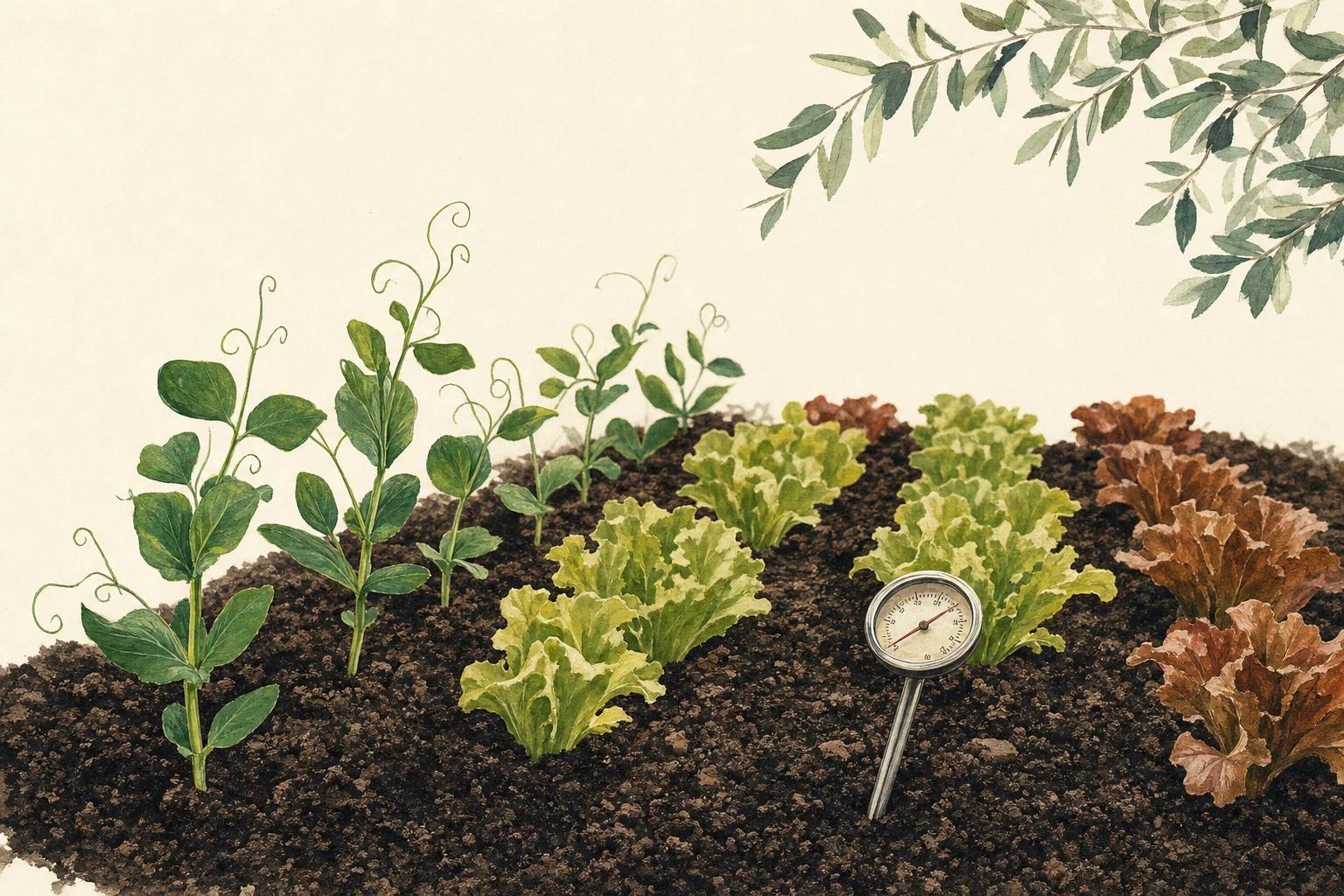
Plant onions into loose soil that has dried enough to crumble and reads at least 35°F (2°C), preferably 50°F (10°C), at 4 inches (10 cm) deep.
Take the reading at 8 a.m. with a soil thermometer pushed to that depth. Seed germinates best near 80°F (27°C); avoid sowing when the soil at seed depth is above 90 to 95°F (32 to 35°C). For spring plantings the 50-degree mark matters more, because plants establish far faster once the root zone passes it.
- Fertilize the bed. Before planting, work in 2 to 3 pounds of 10-10-10 per 100 square feet (0.9 to 1.4 kg per 9.3 square meters). The feed is then in place for the weeks of leaf growth that follow.
- Trim transplants. Cut the roots back to about 1/2 inch (13 mm) and the tops to about 4 inches (10 cm), which makes bundled plants easier to set upright.
- Plant shallow. Push sets in pointed end up so about 1 inch (2.5 cm) of soil covers them. Set transplants 3/4 to 1.5 inches (2 to 4 cm) deep. Sow seed 1/4 to 1/2 inch (6 to 13 mm) deep and thin later, eating the thinnings as green onions.
- Space for the bulb size you want. Allow 3 to 6 inches (8 to 15 cm) between plants in rows 12 to 18 inches (30 to 45 cm) apart. About 4 inches (10 cm) gives moderate bulbs and 8 inches (20 cm) the largest; closer spacing shrinks them.
- Water and feed. Give about 1 inch (2.5 cm) of water a week and keep the soil evenly moist. Side-dress with nitrogen when plants have 5 to 6 leaves, to keep new leaves coming until bulbing starts.
In a raised bed, skip the rows and plant on a grid 2 to 4 inches (5 to 10 cm) apart each way. Sow's plant spacing calculator works out how many sets or transplants a bed will hold.
Green onions and succession sowing
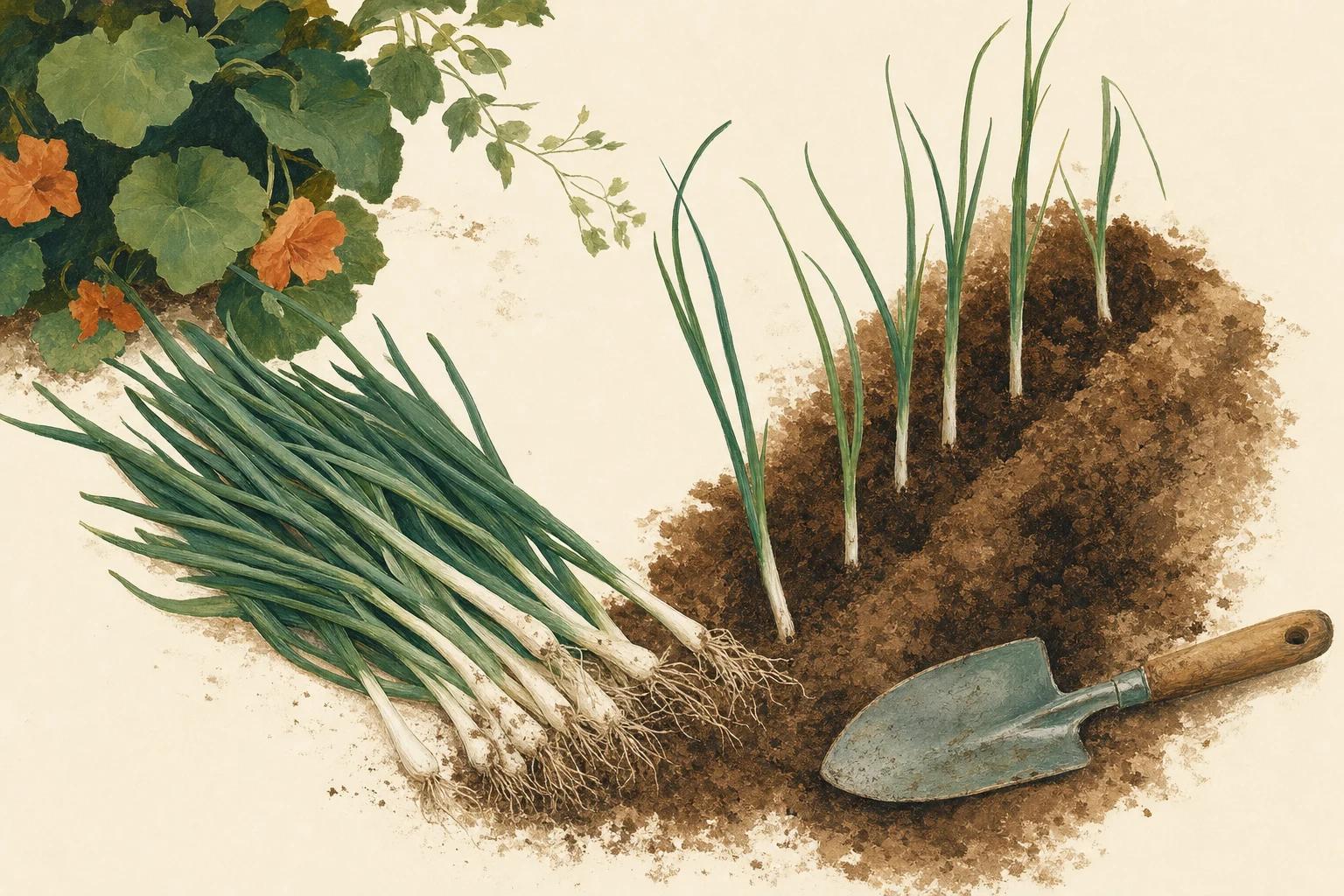
For green onions, plant sets about 1.5 inches (4 cm) deep and almost touching, or sow seed and thin to about 2 inches (5 cm). Sets give pulling-size onions in 6 to 8 weeks and seed in 50 to 70 days; pull them when the tops are 6 to 8 inches (15 to 20 cm) tall. Bunching onions such as Evergreen Bunching, Beltsville Bunching and Ishikura are grown for this. The crop is quick and does not depend on bulbing, so you can keep sowing through a long window. In California that runs April to July in the north of the state, August to December in the interior valleys, and year-round on the South Coast.
Timing mistakes and late frosts
Onions forgive early planting more readily than late planting, and a spring frost after planting is rarely a problem.
Planted too early
Hardiness is not the issue; bolting is, through the cold-and-size effect described under seed, sets or transplants. Plant small sets and slim transplants, and where you are growing onions for storage, lean toward the later half of your window.
Planted too late
A late planting bulbs with few leaves and stays small, for the reason explained under why early planting grows bigger bulbs. In the North, each week past the window in the table costs bulb size; once it has closed, plant sets for green onions instead. In the South, finish transplanting by the end of February, and keep fall plantings inside the window, since plants that go into winter small are more prone to freeze injury.
A late frost after planting
Leave established onions alone through a spring frost; they withstand heavy frosts. Young transplants do benefit from row cover while nights stay below 50°F (10°C).
From planting to harvest
Expect bulb onions 100 to 120 days after a spring sowing, 10 to 15 days fewer from transplants, and 85 to 95 days from transplants in Texas.
Stop watering when the tops begin to fall over. Harvest once half to three-quarters of the tops are down, and let them fall on their own; bending them over early gives smaller bulbs that store poorly. In the North that falls from late July into early August.
Cure the bulbs for 2 to 4 weeks somewhere shaded and airy at 75 to 90°F (24 to 32°C), until the necks are dry. Store them at 32°F (0°C) and 65 to 70 percent humidity for up to 6 or 7 months; above 40°F (4°C) they start to sprout. Walla Walla does not store and is for eating fresh. Move onions and their relatives to a different bed each year, returning to the same spot only after three years.
To fit onions into the rest of the spring schedule, see when to plant vegetables and when to plant potatoes, then add your onion window to Sow's garden calendar.
Frequently asked questions
When should I plant onion seeds in Zone 8b?
In the Southeast and Texas, sow short-day onion seed in fall, from mid-September in the Carolinas and from October into December in Texas, so the plants grow through the mild winter and bulb as days lengthen. Seeding too early lets plants grow thick enough to bolt after a cold spell. If you miss fall, set out transplants from late December through February. In the Pacific Northwest's Zone 8b, sow overwintering long-day or intermediate types from mid-August to early September instead.
How late is too late to plant onions?
In the North, aim to finish by about two weeks after your median last frost. Onions start bulbing when the days reach a set length, however many leaves the plant has, so each week of delay means a smaller bulb, and very late plants may make leaves and no bulb at all. After that, plant sets for green onions, which are ready in 6 to 8 weeks. In the South, finish transplanting by the end of February.
Can you overwinter onions?
Yes, with the right type. Across the South, short-day onions planted in fall grow through winter and are pulled in late spring. Farther north, sow overwintering varieties such as Walla Walla, Candy and Buffalo from mid-August to early September, cover them with row cover and harvest the next June or July. Fall-sown Walla Walla does well where normal winter lows stay above -10°F (-23°C); where winters are colder, plant it in spring.
Can I just bury an onion in the ground?
You can, but do not count on a new storage bulb. Treat a whole onion like an oversized set: sets over 1 inch (2.5 cm) across are likely to bolt, sending up a flower stalk instead of swelling. Use a sprouting kitchen onion as a source of green leaves to snip, and buy small sets or transplants of a named variety, matched to your latitude, when you want bulbs.
How do you grow onions from seed?
Sow indoors 8 to 12 weeks before you plan to set plants out, 1/4 to 1/2 inch (6 to 13 mm) deep, and grow the seedlings at 60 to 65°F (16 to 18°C) by day. In the North, set them out from about four weeks before the last frost, roughly 4 inches (10 cm) apart. In the South, sow short-day seed from mid-September to mid-October and set the plants out 6 to 8 weeks later.
When are onions ready to harvest?
When half to three-quarters of the tops have flopped over on their own. Stop watering as they begin to fall, then pull the bulbs and cure them in a shaded, airy spot at 75 to 90°F (24 to 32°C) for 2 to 4 weeks until the necks are dry. Do not bend the tops over early to hurry them along; that gives smaller bulbs that keep poorly.
What onions should I plant in my area?
Choose by day length before color or flavor. Long-day onions such as Yellow Sweet Spanish, Southport Red Globe and Sterling need 14 to 16 hours of daylight to bulb and suit northern gardens. Short-day onions such as Granex and Texas 1015Y bulb at about 10 to 12 hours and suit Texas, Florida and the Southeast. Intermediate types such as Candy, Cimarron and Alabaster fit the middle latitudes in between.
Why are my onions so small?
Check the type and the timing first. A short-day variety grown in the North starts bulbing in late spring while it still has few leaves, and a late planting has the same problem, because bulbing follows day length, not plant size. Crowding shrinks bulbs too. Next season, buy a day-length type that suits your latitude, plant as soon as the soil can be worked and give each plant about 4 inches (10 cm).
Why are my onions flowering?
They have bolted, which onions do in response to cold, not day length. A plant that has reached pencil thickness and then sits through a long spell in the low to mid 40s°F (about 4 to 7°C) is likely to send up a seed stalk. Large sets and overgrown transplants are most at risk. Use bolted onions first, and next year plant sets smaller than a dime and pencil-thin transplants.
References
- University of Minnesota Extension. Growing onions in home gardens. Accessed October 16, 2026.
- University of Illinois Extension. Onion (Watch Your Garden Grow). Accessed October 16, 2026.
- University of Maryland Extension. Growing Onions in a Home Garden. Accessed October 16, 2026.
- University of Missouri Extension. Vegetable Planting Calendar (G6201), Table 2. Accessed October 16, 2026.
- Clemson Cooperative Extension Home & Garden Information Center. Onion, Leek, Shallot, & Garlic (HGIC 1314). Accessed October 16, 2026.
- NC State Extension. Bulb Onions. Accessed October 16, 2026.
- UF/IFAS Gardening Solutions. Onions and Shallots. Accessed October 16, 2026.
- Texas A&M AgriLife Extension. Onions (Easy Gardening). Accessed October 16, 2026.
- Texas AgriLife Extension Service. Onion (Commercial and Specialty Crop Guides). Accessed October 16, 2026.
- Colorado State University Extension. Vegetable Planting Guide (CMG GardenNotes #720). Accessed October 16, 2026.
- Utah State University Extension. How to Grow Onions in Your Garden. Accessed October 16, 2026.
- Oregon State University Extension Service. Vegetable Gardening in Oregon (EC 871). Accessed October 16, 2026.
- UC Statewide IPM Program (UC Agriculture and Natural Resources). Cultural Tips for Growing Onions and Garlic. Accessed October 16, 2026.
- University of Arizona Cooperative Extension. Vegetable Planting Calendar for Maricopa County (AZ1005). Accessed October 16, 2026.
- NC State Extension. Extension Gardener Handbook, Ch. 16 Vegetable Gardening. Accessed October 16, 2026.
- Johnny's Selected Seeds. Pelleted Onions: Key Growing Information. Accessed October 16, 2026.
- Johnny's Selected Seeds. Candy (F1) Onion Seed. Accessed October 16, 2026.
- Johnny's Selected Seeds. Walla Walla Sweet Onion Seed. Accessed October 16, 2026.
- ASPCA Animal Poison Control Center. Onion (Toxic and Non-Toxic Plants). Accessed October 16, 2026.
- NOAA National Centers for Environmental Information. U.S. Climate Normals 1991–2020: Annual/Seasonal freeze data. Accessed October 16, 2026.
Sow Editorial
Written by the Sow team from university extension services, botanical gardens, USDA and NOAA data and plant breeders. Every source is listed under References.