Quick answer
Plant seed potatoes in the 3 weeks before your median last spring frost, once the soil 4 inches (10 cm) down reads at least 45°F (7°C), ideally 50°F (10°C). That means January in Florida and the low desert, February to early March in most of Texas, March in the Mid-South, mid-March to April in the Mid-Atlantic, early April around Minneapolis and May in the far North.
Key facts
- Timing rule
- From 3 weeks before your median last spring frost up to the frost date
- Soil temperature
- At least 45°F (7°C) at 4 in (10 cm); 50°F (10°C) is better
- Days to maturity
- New potatoes 6–8 weeks; full-size tubers 90–120 days
- Depth and spacing
- 3–5 in (7.5–13 cm) deep, 10–12 in (25–30 cm) apart
- Frost tolerance
- Shoots take a light frost; a hard freeze kills the tops
- Fall crop (Texas, Georgia, California)
- Mid-July to August (June to August on the California south coast); about 110 days before first frost in Texas
- Seed
- Certified seed potatoes cut into 1.5–2 oz (43–57 g) pieces
Seed potatoes go into the ground during the 3 weeks leading up to your median last spring frost, on the first day the soil 4 inches (10 cm) down holds 45°F (7°C) or warmer. Aim for 50°F (10°C) if you can wait for it. Shoots take 2 to 3 weeks to break the surface, so they usually appear around or just after the median last frost, when a light frost is still possible. The tops shrug off a light frost; a hard freeze kills them back.
Your frost date sets the week and a soil thermometer sets the day. In the cool Pacific Northwest and California's interior valleys, soil warmth rather than frost decides the date, and in Texas, Georgia and California a second crop can go in during summer.
Potato planting dates by city
In Zones 4 to 8 and in Houston, each spring window opens 3 weeks before the city's median last spring frost and closes on that date. Seattle and Sacramento follow their regional calendars instead. In the fall column, Dallas-Fort Worth and Houston count back about 110 days from the median first frost. Atlanta uses the North Georgia dates, Sacramento the interior-valley dates, and the other cities plant in spring only.
| City (USDA zone) | Median last frost | Median first frost | Plant seed potatoes | Fall crop (optional) |
|---|---|---|---|---|
| Fargo, ND (4a) | May 10 | Sep 30 | Apr 19 – May 10 | Spring crop only |
| Minneapolis, MN (5a) | Apr 23 | Oct 18 | Apr 2 – Apr 23 | Spring crop only |
| Chicago, IL (5b) | Apr 16 | Oct 28 | Mar 26 – Apr 16 | Spring crop only |
| Denver, CO (6a) | May 5 | Oct 9 | Apr 14 – May 5 | Spring crop only |
| Detroit, MI (6b) | Apr 20 | Oct 27 | Mar 30 – Apr 20 | Spring crop only |
| Kansas City, MO (6b) | Apr 13 | Oct 24 | Mar 23 – Apr 13 | Spring crop only |
| Boston, MA (7a) | Apr 4 | Nov 9 | Mar 14 – Apr 4 | Spring crop only |
| Salt Lake City, UT (7b) | Apr 8 | Oct 31 | Mar 18 – Apr 8 | Spring crop only |
| New York, NY (7b) | Mar 30 | Nov 20 | Mar 9 – Mar 30 | Spring crop only |
| Nashville, TN (7b) | Mar 31 | Nov 3 | Mar 10 – Mar 31 | Spring crop only |
| Raleigh, NC (8a) | Mar 31 | Nov 4 | Mar 10 – Mar 31 | Spring crop only |
| Atlanta, GA (8a) | Mar 15 | Nov 20 | Feb 22 – Mar 15 | Mid- to late Jul (North Georgia) |
| Dallas-Fort Worth, TX (8b) | Mar 8 | Nov 24 | Feb 15 – Mar 8 | Early to mid-Aug |
| Seattle, WA (9a) | Mar 2 | Nov 23 | Mid-Apr | Spring crop only |
| Sacramento, CA (9b) | Feb 2 | Dec 2 | Feb – Mar | August |
| Houston, TX (9b) | Feb 13 | Dec 9 | Jan 23 – Feb 13 | Mid- to late Aug |
Frost dates are medians from NOAA 1991–2020 climate normals for each city's main weather station; in half of years the last frost falls later than the date shown. Zones are from the 2023 USDA map.
For any other town in Zones 3 to 8, or a Zone 9 town in Texas, find your median last frost date and count back 3 weeks to open the window; the frost date itself closes it. For a fall crop in Texas, count back about 110 days from your median first fall frost. Georgia and California use regional fall dates instead, covered in the fall section below.
Seattle and Sacramento show why the thermometer outranks the calendar. Their median last frosts fall in early March and early February, yet Washington potatoes go in about mid-April, and Sacramento and the rest of California's interior valleys plant in February and March.
Planting months by region
Potato planting runs from December in the low desert to May near the Canadian border.
| Region | Spring planting | Fall or winter crop |
|---|---|---|
| Northern Minnesota | May | None |
| Twin Cities, MN | Early April | None |
| Maryland and Mid-Atlantic | Mar 15 – May 1 | None |
| Central North Carolina | Feb 15 – Mar 31 | None |
| South Carolina coast / Piedmont | Feb 1 – Mar 31 / Mar 15 – Apr 30 | Not recommended |
| Middle Georgia | Jan 15 – Mar 1 | Aug 1 – 15 |
| Most of Texas | February to early March | Mid-August |
| Florida | January; into February in North and Central FL | South FL: Oct – Jan |
| California interior valleys | February – March | August |
| California south coast | February – May | June – August |
| Phoenix area / California desert valleys | Jan 1 – Mar 1 / Dec – Feb | None |
| Washington | Mid-April | None |
Typical extension-recommended windows; your soil temperature picks the day.
The Intermountain West splits the window. Utah plants 2 to 3 weeks before the last frost, and only into soil of at least 50°F (10°C). Colorado plants later, from 2 weeks before the frost date up to the date itself, once soil reaches 45°F (7°C). In Maine, a 50°F (10°C) soil reading is the signal rather than a calendar date.
In Zone 10 South Florida and the low desert, potatoes are a winter crop. South Florida plants from October to January, and the crop comes out before spring heat shuts down tuber growth.
How to tell the soil is ready
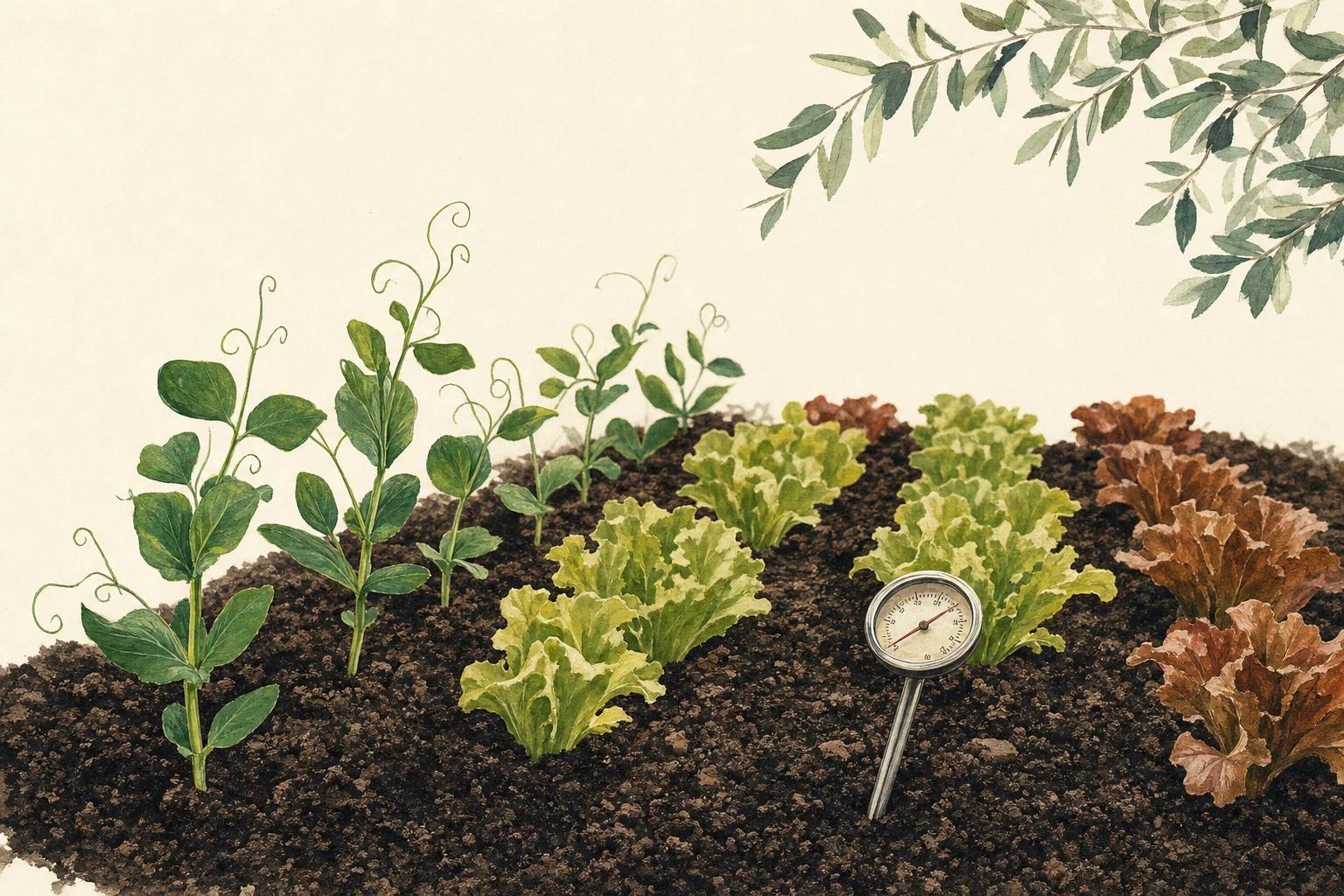
The soil is ready when it reads at least 45°F (7°C) 4 inches (10 cm) down at 8 a.m. 50°F (10°C) is better still, in ground that is moist but not waterlogged.
Take the reading in the early morning so a sunny afternoon does not flatter the number, and repeat it over a few days before you commit. Temperature is only half the test. Seed pieces sitting in cold, saturated soil languish for weeks and often rot before they emerge.
If the thermometer says yes but the bed is still sodden from snowmelt or spring rain, wait. A week's delay costs far less than replanting rotted seed. Heavy, slow-draining ground is a good candidate for a raised bed, where you can control the soil mix from the start.
Choosing and preparing seed potatoes
Start from certified seed potatoes, cut the larger tubers into blocky pieces that each carry an eye, and let the cut faces heal before planting.
Certified seed is grown to be free of disease and is not treated to stay dormant, so it sprouts on schedule. Supermarket potatoes often carry a sprout inhibitor, which is why they make poor seed.
Keep seed cool, around 38–40°F (3–4°C), until about 2 weeks before planting, then bring it up to room temperature. Start green sprouting (chitting) at the same time if you like: lay whole tubers in a single layer in bright light at about 70°F (21°C) with high humidity. Plant once the sprouts are short, green and under 1 inch (2.5 cm) long. Sprouts like these come up faster and start tubers sooner than unsprouted seed, which counts most where the season is short.
Cutting and healing
Each piece should weigh 1.5 to 2 ounces (43–57 g), about the size of a medium hen's egg, and carry at least one healthy eye, though two or three is safer. A 6-ounce (170 g) tuber yields about four pieces, and 1 pound (0.45 kg) of seed gives 9 or 10. Plant tubers under 2 inches (5 cm) across whole. Budget 8 to 12 pounds (3.6–5.4 kg) of seed for each 100 feet (30 m) of row.
Let the cut pieces heal somewhere airy at 60–70°F (16–21°C). Recommended healing times run from 1 to 3 days at room temperature to 5 or 6 days. Give the longer end when your soil is cool and damp, because a sealed cut resists rot. If planting is delayed after cutting, hold the pieces at 55–60°F (13–16°C).
How deep and how far apart to plant potatoes
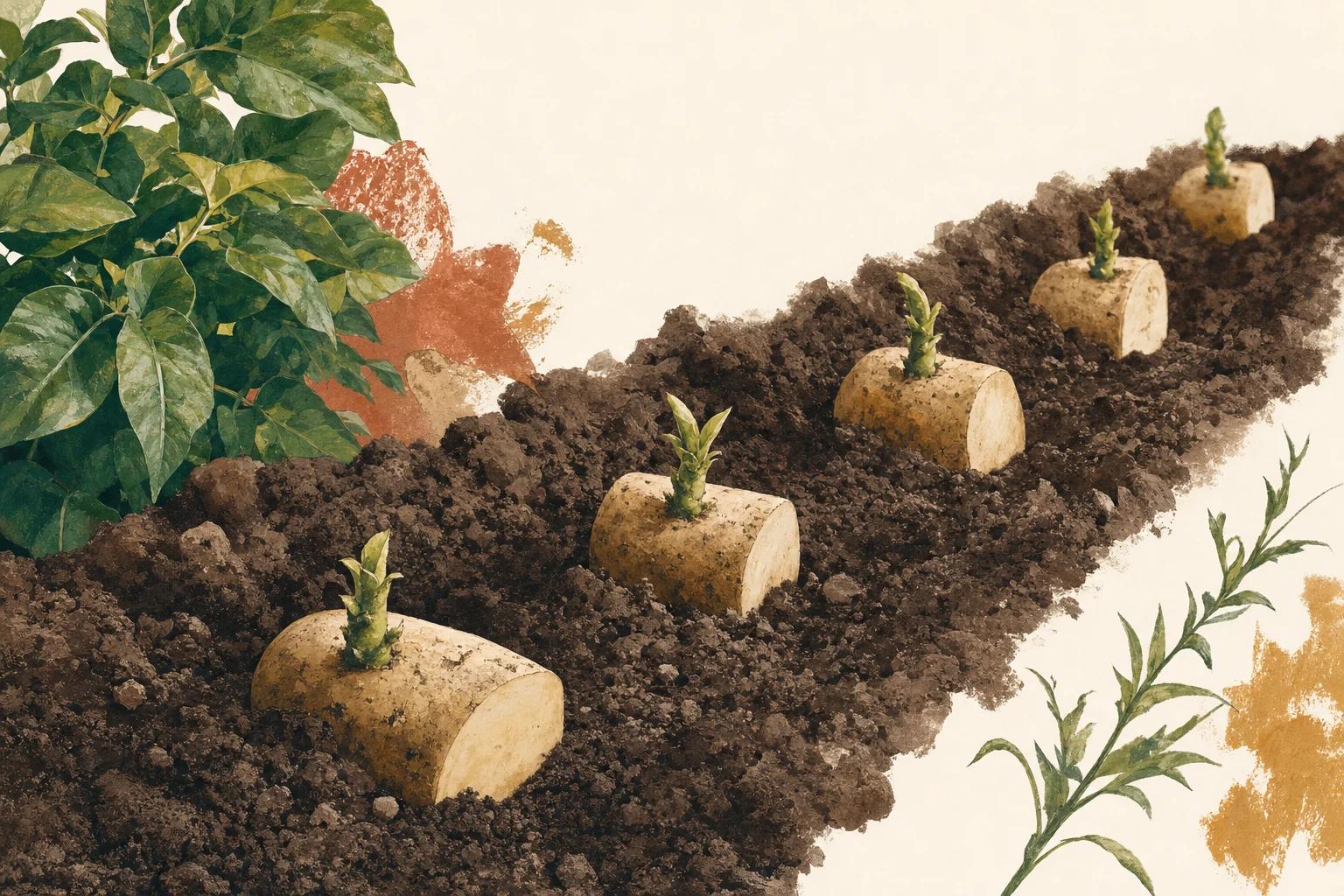
Bury seed pieces 3 to 5 inches (7.5–13 cm) deep and 10 to 12 inches (25–30 cm) apart. Leave 30 to 36 inches (75–90 cm) between rows and hill the stems as they grow.
Choose a sunny bed that has gone 3 to 4 years without tomatoes, peppers, eggplant or tomatillos, because diseases that build up in the soil under those crops also attack potatoes.
- Open a furrow. Make it deep enough that the seed ends up under that much soil once you backfill.
- Space the seed pieces. Lay them cut side down at that spacing. Close the gap to 8 to 10 inches (20–25 cm) for small new potatoes, and give large bakers more room.
- Cover and wait for shoots. Backfill and expect shoots in 2 to 3 weeks. Seed buried deeper than about 5 inches (13 cm) in spring emerges slowly and is more prone to disease and decay; save 5 to 6 inches (13–15 cm) for later plantings in warm soil.
- Hill at 6 to 8 inches. When stems reach 6 to 8 inches (15–20 cm), draw soil up around them, leaving about the top 4 inches (10 cm) of leaves in the light. New tubers form above the seed piece, so this layer is where the crop grows.
- Hill two or three more times. Repeat every 2 to 3 weeks until the ridge stands 6 to 12 inches (15–30 cm) high. Any tuber that pushes into daylight turns green and bitter.
Straw or pine needles can stand in for soil. Cover the seed with 1 to 2 inches (2.5–5 cm) of soil, then build up a thick mulch layer as the plants grow so the tubers form under it.
Early, midseason and late varieties
Maturity class decides when you dig, and early varieties stretch the planting window because they finish before heat or a short season catches them.
| Class | Varieties | What to expect |
|---|---|---|
| Early | Dark Red Norland, Irish Cobbler, Caribe, Norchip, Keuka Gold | First to dig; new potatoes from about 7 to 8 weeks |
| Early to midseason | Yukon Gold | Follows the earlies; a dependable all-purpose yellow |
| Midseason | Kennebec, Red Pontiac, Agria, Gold Rush | Main-crop harvest |
| Late | German Butterball, Red LaSoda | Longest season; dig last |
Full-size tubers of every class take about 90 to 120 days.
In the Southeast, thinner-skinned Yukon Gold, Kennebec and Red Pontiac are the dependable choices, and Texas gardens lean on Dark Red Norland and Red LaSoda. Early types are the safer bet wherever spring turns hot fast, because tubers must size up before the soil warms past the point where they stop forming.
In the North, a late variety such as German Butterball makes use of the whole frost-free season, while an early variety is the one to reach for when planting runs late.
Fall potatoes in Texas, Georgia and California
Fall potatoes go in between mid-July and late August in Texas, Georgia and California's interior valleys, and from June to August on the California south coast.
In Texas, plant about 110 days before your median first fall frost, which puts planting in mid-August across most of the state. The count gives early to mid-August around Dallas-Fort Worth and mid- to late August around Houston, where the first frost comes about 2 weeks later.
Use small whole tubers about 1.5 inches (4 cm) across rather than cut pieces, which rot in hot soil. Seed is easier to find in spring, so many gardeners buy extra then and keep it cool over summer. Fall seed may still be in its rest period, so hold it warm and damp for 2 weeks before planting; it should carry small sprouts when it goes in.
Middle Georgia, the belt from Columbus through Macon to Augusta, plants fall potatoes from August 1 to 15, and South Georgia can plant somewhat later. North of that belt, including Atlanta, plant about 2 weeks earlier, in mid- to late July. California's interior valleys, including Sacramento, plant in August and the south coast from June to August. North Carolina grows potatoes as a spring crop only, pest and disease pressure makes fall potatoes a poor bet in South Carolina, and around Seattle potatoes go in once, in mid-April.
Dig the fall crop before a severe frost, since frozen tubers will not keep.
What happens if you plant too early or too late
Too early, the seed stalls or rots in cold, wet soil and emerged shoots can freeze. Too late, the plants meet soil above 80°F (27°C), which suppresses tuber formation.
Early planting shows up as gaps in the row where pieces rotted before they emerged. Late planting shows up at harvest: soil near 90°F (32°C) halts tuber set, and what does form is small and misshapen.
If a frost hits after the shoots are up
Potatoes are half-hardy, and seed 3 to 5 inches (7.5–13 cm) down is well insulated before it emerges. Emerged shoots tolerate a light frost, which may leave dead, crinkled leaves, but a hard frost or freeze kills the tops and sets the plant back. A plant frozen to the ground recovers only if its seed piece is sound, so well-healed seed planted into soil that drains is the best insurance.
Harvest, storage and safety
Dig new potatoes 6 to 8 weeks after planting, around the time the first flowers open, and leave storage potatoes in the ground for 2 weeks after the vines die so their skins set.
For keepers, cure freshly dug tubers in the dark at 55–65°F (13–18°C) for 10 days to 3 weeks, then store them dark at 38–45°F (3–7°C). Keep them away from apples and pears, which give off ethylene that pushes potatoes to sprout.
Green skin, sprouts, leaves and stems contain solanine, a glycoalkaloid toxic to people and to dogs, cats and horses. Cut away every green patch and sprout before cooking, and keep pets away from the foliage.
An early crop clears the row by midsummer, leaving space for a later sowing; check vegetable planting dates and when to plant garlic for what can follow. To put your potato window on a schedule with the rest of the garden, add it to Sow's garden calendar.
Frequently asked questions
What month is best to plant potatoes?
The month follows your last frost date. Florida and the low desert plant in January, most of Texas in February to early March, Middle Georgia from mid-January to March 1, North Carolina from mid-February through March, Maryland from mid-March to May 1, the Twin Cities in early April and the far North in May. Around Seattle, planting waits until about mid-April.
Do potatoes need to sprout before planting?
No. Unsprouted certified seed grows well. Green sprouting is an optional head start that pays off most in short northern seasons, because short green sprouts emerge faster and start tubers sooner. Seed for a southern fall crop is the exception: it may still be dormant in summer, so it needs 2 weeks of warm, damp storage until small sprouts show.
Can you plant potatoes from the grocery store?
It is a poor gamble. Grocery potatoes are often treated with a sprout inhibitor and are not certified free of disease, and the thick-skinned russets common in stores grow poorly in southern gardens. Buy certified seed instead. Tubers from your own crop can be replanted for one more season, but saving seed year after year lets virus diseases build up and cuts yields.
What should you not plant potatoes after or next to?
Do not follow tomatoes, peppers, eggplant or tomatillos within 3 to 4 years, because they share soilborne diseases with potatoes. Texas growers also keep okra out of the rotation. In the Pacific Northwest, where Verticillium wilt and Phytophthora root rot linger in the soil, stretch the gap between potato crops to 5 to 7 years.
How do you grow potatoes in containers?
Choose a container at least 10 inches (25 cm) deep with drainage holes, set seed pieces cut side down and keep the mix evenly moist. A light mix such as perlite works, with seed pieces about 1 inch (2.5 cm) below the surface and soluble fertilizer once shoots appear. Tall stacked potato towers usually disappoint, so put the effort into depth and even watering instead.
How do I plant red potatoes?
Exactly like any other potato: egg-sized pieces of certified seed, buried 3 to 5 inches (7.5–13 cm) deep with 10 to 12 inches (25–30 cm) between them, during the 3 weeks before the last frost. Reds span the seasons, from early Dark Red Norland through midseason Red Pontiac to late Red LaSoda, so pick by when you want to dig.
Will potatoes survive a frost?
Unemerged seed pieces are safe below ground. Emerged tops take a light frost, but a hard freeze kills them back. Tubers are vulnerable too: frozen potatoes develop gray or reddish-brown flesh that turns watery and will not keep, so dig a fall crop before a severe frost rather than leaving it in the ground.
How long do potatoes take to grow?
Shoots appear 2 to 3 weeks after planting. New potatoes can be dug from 6 to 8 weeks, once the plants begin to flower. Full-size tubers take about 90 to 120 days, with late varieties such as German Butterball at the long end. For keeping, wait until 2 weeks after the vines die so the skins toughen.
What should you avoid when planting potatoes?
Five mistakes cost the most. Grocery potatoes may carry a sprout inhibitor or disease, so buy certified seed. Cold, waterlogged soil rots seed pieces, so wait for 45°F (7°C) at 4 inches. Planting deeper than 5 inches (13 cm) in cold spring soil delays emergence. Skipped hilling lets tubers turn green and bitter in daylight. Following tomatoes, peppers or eggplant within 3 to 4 years invites shared soilborne diseases.
How late can you plant potatoes?
In the Mid-Atlantic, early varieties can still go in as late as June 1. The real limit is soil heat: above 80°F (27°C) tubers form poorly, and near 90°F (32°C) they stop setting, so a late planting needs to size up before midsummer. If you are running late, choose an early variety and plant 5 to 6 inches (13–15 cm) deep.
References
- University of Minnesota Extension. Growing potatoes in home gardens. Accessed October 16, 2026.
- Texas A&M AgriLife Extension. Easy Gardening: Irish Potatoes (EHT-068). Accessed October 16, 2026.
- Clemson Cooperative Extension Home & Garden Information Center. Potato (HGIC 1317). Accessed October 16, 2026.
- Utah State University Extension. Potatoes in the Garden. Accessed October 16, 2026.
- University of Florida IFAS Extension. Potatoes (Gardening Solutions). Accessed October 16, 2026.
- NC State Extension. Solanum tuberosum (Extension Gardener Plant Toolbox). Accessed October 16, 2026.
- NC State Extension. Central North Carolina Planting Calendar for Annual Vegetables, Fruits, and Herbs (AG-756-01). Accessed October 16, 2026.
- Colorado State University Extension. Vegetable Planting Guide (CMG GardenNotes #720). Accessed October 16, 2026.
- University of Arizona Cooperative Extension. Vegetable Planting Calendar for Maricopa County (az1005). Accessed October 16, 2026.
- Washington State University Extension. Home Vegetable Gardening in Washington (EM057E). Accessed October 16, 2026.
- UC Statewide IPM Program (University of California Agriculture and Natural Resources). Cultural Tips for Growing Potato. Accessed October 16, 2026.
- UC Statewide IPM Program (University of California Agriculture and Natural Resources). Frost on Potatoes. Accessed October 16, 2026.
- University of Maryland Extension. Potatoes. Accessed October 16, 2026.
- University of Maine Cooperative Extension. Bulletin #2077, Potato Facts: Growing Potatoes in the Home Garden. Accessed October 16, 2026.
- University of Georgia Cooperative Extension. Home Garden Potatoes (Circular 1011). Accessed October 16, 2026.
- University of Georgia Cooperative Extension. Home Gardening (Bulletin 577). Accessed October 16, 2026.
- University of Georgia Cooperative Extension. Vegetable Garden Calendar (Circular 943). Accessed October 16, 2026.
- Johnny's Selected Seeds. Potatoes: Key Growing Information. Accessed October 16, 2026.
- Johnny's Selected Seeds. Potato Comparison Chart (PDF) and variety pages. Accessed October 16, 2026.
- NOAA National Centers for Environmental Information. U.S. Climate Normals 1991–2020: Annual/Seasonal freeze data. Accessed October 16, 2026.
- USDA Agricultural Research Service. 2023 USDA Plant Hardiness Zone Map. Accessed October 16, 2026.
Sow Editorial
Written by the Sow team from university extension services, botanical gardens, USDA and NOAA data and plant breeders. Every source is listed under References.