Quick answer
Plant sweet potato slips 3 to 6 weeks after frost danger has passed, once the soil 4 inches (10 cm) down holds at least 65°F (18°C). That is mid-May to late June in the North and Midwest, May to June in the upper South, and April to June around Houston. Start slips from roots 6 to 8 weeks ahead, and allow 90 to 120 frost-free days.
Key facts
- Timing rule
- 3–6 weeks after the 1-in-10 last-frost date, in soil of 65°F (18°C) or more
- Soil temperature
- At least 65°F (18°C) at 4 in (10 cm), ideally 4 days running
- Days to maturity
- 90–120 from planting for most varieties; longer in hot Southern guides
- Start slips
- 6–8 weeks before planting out, at 75–80°F (24–27°C)
- Depth and spacing
- 3–4 in (8–10 cm) deep, 12 in (30 cm) apart, rows 3–4 ft (90–120 cm)
- Frost tolerance
- None for new slips; plants are damaged below 50°F (10°C)
- Curing
- 80–85°F (27–29°C) at 85–90% humidity for about a week
- Storage
- 55–60°F (13–16°C); never below 50°F (10°C) or in the refrigerator
Plant sweet potato slips outdoors 3 to 6 weeks after frost danger has passed, on a day when the soil 4 inches (10 cm) down holds 65°F (18°C) or warmer. Across the North and Midwest that lands between mid-May and late June. The upper South plants in May and June, the Houston area from April through June, and South Florida and the Arizona low desert plant over many months.
The soil thermometer has the final say, not the calendar. Slips set into cold, wet ground can rot, and the survivors may sit for up to a month before they start to grow. At the other end of the season, the roots need 90 to 120 frost-free days to size up, so northern gardens also have to plant early enough to dig before fall cold returns.
Sweet potato planting dates by city
Planting opens in late March in Dallas-Fort Worth and not until mid-June in Fargo, and in every city the soil test decides the day.
| City (USDA zone) | Median last frost | Median first frost | Plant slips outdoors |
|---|---|---|---|
| Fargo, ND (4a) | May 10 | Sep 30 | Mid-June; 90-day varieties only |
| Minneapolis, MN (5a) | Apr 23 | Oct 18 | May 28 – Jun 18 |
| Chicago, IL (5b) | Apr 16 | Oct 28 | May 22 – Jun 12 |
| Denver, CO (6a) | May 5 | Oct 9 | Jun 9 – Jun 30 |
| Detroit, MI (6b) | Apr 20 | Oct 27 | May 29 – Jun 19 |
| Kansas City, MO (6b) | Apr 13 | Oct 24 | May 20 – Jun 10 |
| Boston, MA (7a) | Apr 4 | Nov 9 | When soil at 4 in holds 65°F (18°C) |
| Salt Lake City, UT (7b) | Apr 8 | Oct 31 | May 21 – Jun 11 |
| New York, NY (7b) | Mar 30 | Nov 20 | When soil at 4 in holds 65°F (18°C) |
| Nashville, TN (7b) | Mar 31 | Nov 3 | May – June |
| Raleigh, NC (8a) | Mar 31 | Nov 4 | May 1 – Jul 15 |
| Atlanta, GA (8a) | Mar 15 | Nov 20 | Early May – mid-June |
| Dallas-Fort Worth, TX (8b) | Mar 8 | Nov 24 | Mar 22 – May 3 |
| Seattle, WA (9a) | Mar 2 | Nov 23 | Mid-May – early Jul (black plastic) |
| Sacramento, CA (9b) | Feb 2 | Dec 2 | About mid-May, when soil reaches 65–70°F (18–21°C) |
| Houston, TX (9b) | Feb 13 | Dec 9 | Apr – Jun |
Frost dates are medians from NOAA 1991–2020 climate normals for each city's main weather station; in half of years the last frost falls later than the date shown.
For the Midwest and Mountain cities, the table counts 3 to 6 weeks from each city's 1-in-10 last-frost date, the day after which a spring frost arrives only one year in ten, so the window opens about 5 to 6 weeks after the median shown. For a town in those regions, find your own 1-in-10 date, or add about 1½ to 3 weeks to your median, and count forward 3 to 6 weeks. Plant on the first day in that span when the soil passes the 65°F (18°C) test described below.
Fargo's window is short because its season is. A slip set out around June 13 has 109 days before the median first frost on September 30, and one set out on June 22 has 100, little more than the fastest varieties need. Plant through black plastic and pick one of the 90-day varieties. Denver's window leaves 101 to 122 days, enough for a 90- to 100-day variety planted promptly.
Boston's frost dates come from Logan Airport on the harbor and New York's from Central Park, so a garden in the suburbs or inland can run later. Plant there by the soil thermometer rather than a date. Farther north in New England the soil warms later still: in Durham, New Hampshire, ground under black plastic reaches 65°F (18°C) around June 1, and bare ground 1 to 2 weeks after that.
The upper South starts in May. West Tennessee plants May 1 to June 15 and East Tennessee May 15 to June 30, with Nashville between the two. Around Raleigh, slips can go in from May 1 until July 15. In the Georgia and South Carolina Piedmont, the soil reaches 70°F (21°C) in early May and planting runs to mid-June.
Texas's statewide guide plants 2 to 8 weeks after the median last frost, which gives Dallas-Fort Worth late March to early May; within that span, wait for 65°F (18°C) soil. Houston follows Harris County's own planting chart, which runs from April through June.
Around Seattle, slips go in under black plastic between mid-May and early July, depending on how quickly the site warms. In the Sacramento Valley, slips go out about mid-May, once the soil reaches 65 to 70°F (18–21°C).
Planting times by region
The later your soil warms, the later you plant: from February in central Florida to June in northern New England.
| Region | Plant slips | Note |
|---|---|---|
| Durham, New Hampshire | About Jun 1 under black plastic | Bare soil 1–2 weeks later |
| Iowa | Mid-May to early June | After frost, in warm soil |
| Kentucky | West May 1–Jun 15; central May 10–Jun 10; east May 20–Jun 1 | Earlier start and later finish in the west |
| Tennessee | West May 1–Jun 15; east May 15–Jun 30 | Needs 4–5 frost-free months |
| South Carolina | Coast Apr 15–Jun 15; Piedmont May 1–Jun 15 | No fall crop |
| Texas | 2–8 weeks after the median last frost | No fall crop |
| Florida | North mid-Mar–Jun; Central Feb–Jun; South Dec–Sep | 85–130 days to harvest |
| Maricopa County, Arizona | Mar 1–Jun 15 | 120–160 days to harvest |
| Western Washington | Mid-May to early July | Through black plastic |
| Sacramento Valley, California | About mid-May | Soil at 65–70°F (18–21°C) |
Dates are for setting slips in the garden; within any window, wait for a day when the soil is warm.
North and Northeast (Zones 3–6). Black plastic is close to essential here. Good yields on bare New England soil are hard to get, while raised beds covered with black plastic give bigger crops.
Midwest and Plains. Iowa plants from mid-May into early June, once frost is past and the soil is warm. A cold May pushes every date back; ridges and black plastic help here too, and the crop has to be dug before the first fall frost.
Mid-South and Southeast. Kentucky's planting season opens about three weeks later in the east than in the west and closes two weeks sooner, so use the dates for your end of the state. The sweet potato weevil is a serious pest across the South, so buy certified slips and move the crop to a different bed each year.
Texas and the Gulf Coast. Texas allows 100 to 130 days from planting to harvest. Around Houston, the county planting chart sets slips out from April through June, with the first week of April marginal.
Florida, the low desert and other frost-free areas. Frost dates do not apply in South Florida or the Arizona low desert, so let soil warmth and the season set the date instead.
California. Sweet potatoes crop well only in the warm parts of the state, such as the Sacramento Valley. Quarantine rules against the sweet potato weevil stop many mail-order nurseries from shipping slips into California, so check that a supplier can ship to you, or buy certified slips from a local garden center.
Pacific Northwest. West of the Cascades, plant from mid-May to early July as your site warms, through black plastic, and choose a 90-day variety. Oregon's own planting table does not recommend the crop for the coast or the western valleys. It lists sweet potatoes only for the Columbia and Snake River valleys, planted in May.
Intermountain West. In Utah, roots take 4 to 5 months to mature, longer than the 90 to 120 days most guides give. Plant on the first day after frost danger that the soil holds 65°F (18°C), and keep floating row cover on hand for cold snaps.
How to tell the soil is ready
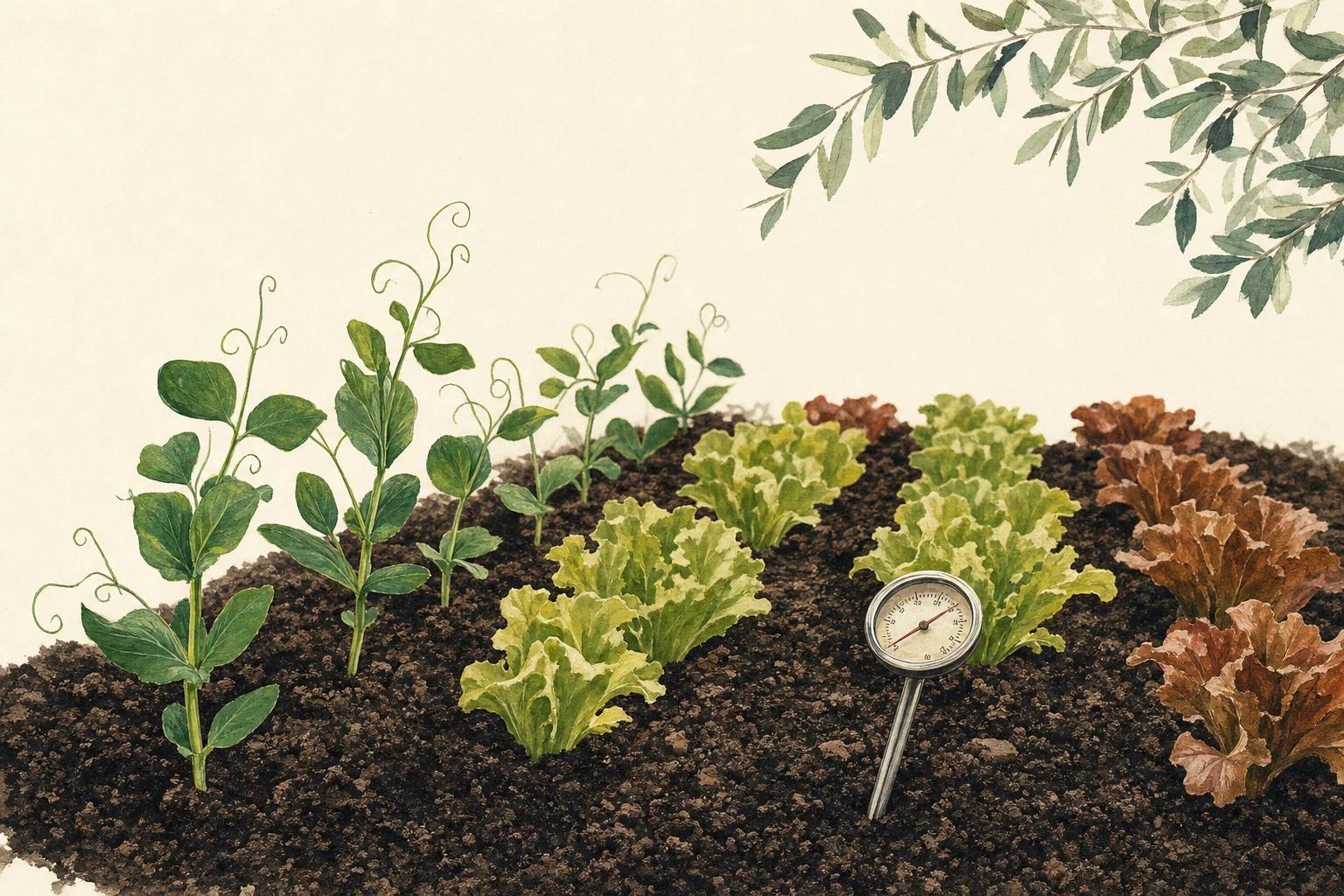
The soil is ready when a thermometer pushed 4 inches (10 cm) into the bed reads 65°F (18°C) or more for 4 days in a row. No frost should remain in the forecast either.
Cold soil does real harm rather than just slowing things down. Cool or poorly drained ground can damage young sweet potato plants and rot the slips outright. Soil below 55°F (13°C) is harmful to the crop, and below 50°F (10°C) roots and plants suffer chilling injury.
Watch the air as well as the soil. Plants are damaged when the temperature drops below 50°F (10°C), so wait until forecast night lows stay above that. Some growers plant into soil of 60–65°F (16–18°C), but 65°F (18°C) is the safer figure, and Georgia gardeners wait for 70°F (21°C).
Warming the bed with black plastic
Black plastic mulch lengthens a short season by a few weeks. Through black plastic you can plant up to 10 days earlier than in bare soil. Lay it on the ridges once they are shaped so the soil has time to warm, then set slips through slits cut in the plastic. Raised ridges help too; their height is covered under planting depth and spacing.
Starting slips from roots
Bed roots 6 to 8 weeks before your planting date, which in most of the North falls a few weeks before your median last frost. Kentucky's calendar starts earlier, in mid-March, well ahead of its May and June planting.
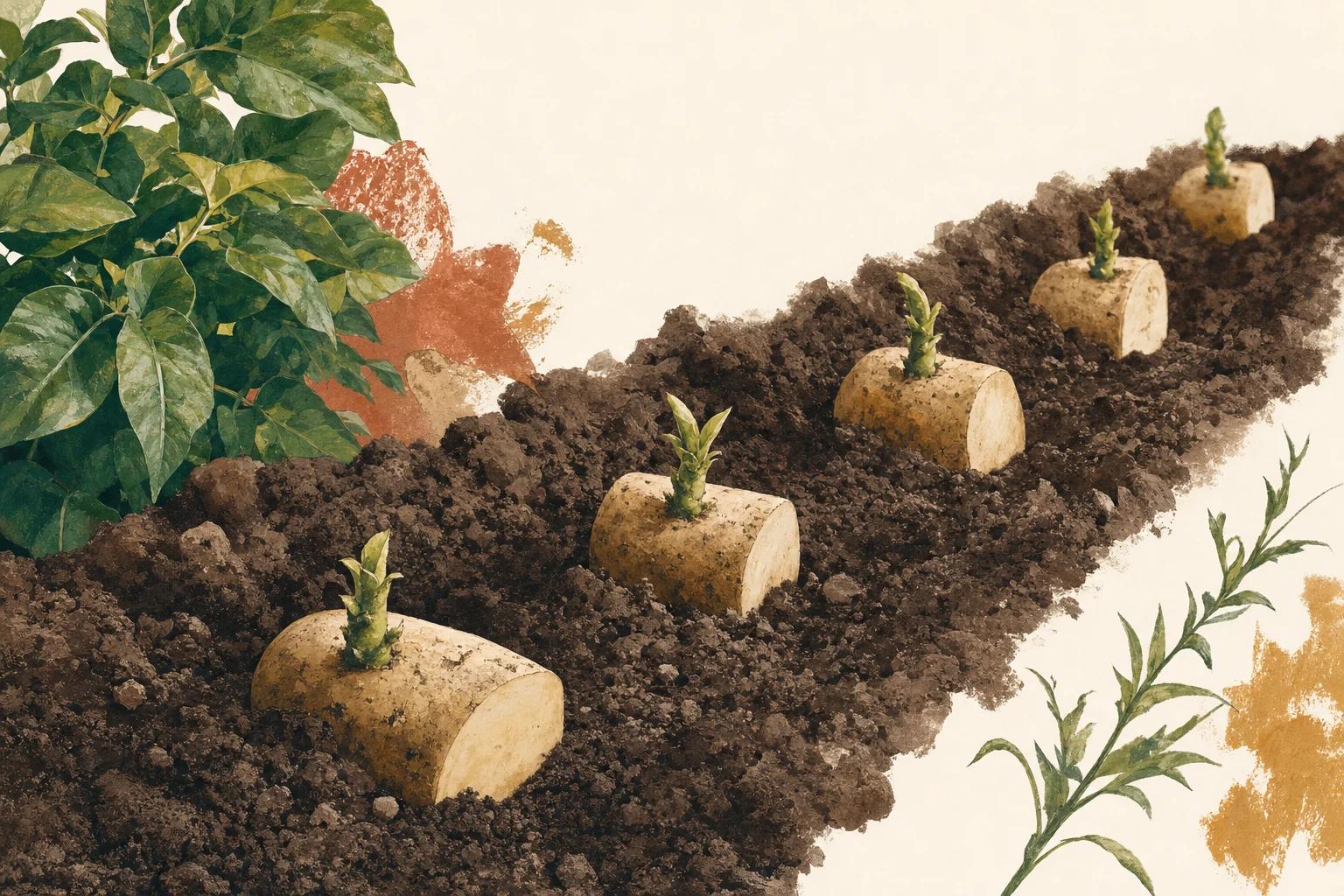
Unlike ordinary potatoes, sweet potatoes are not grown from cut pieces of root. They are grown from slips, the leafy sprouts a root sends up, and both rooted and unrooted slips take hold in warm soil.
- Choose the roots. Use firm, home-grown or organic roots of a named variety. Many grocery-store roots are treated to stop sprouting and carry no variety name.
- Bed them 6 to 8 weeks ahead. Count back from your planting date, lay the roots on their sides in a tray, and cover them with 2 inches (5 cm) of moist sand or mix. Each root gives several slips.
- Keep them warm and lit. Hold the tray at 75–80°F (24–27°C) under a plastic cover. Once sprouts appear, give them 14 to 16 hours of light a day.
- Pull the slips. When sprouts are 4 to 6 inches (10–15 cm) long, pull them gently from the root. They need not have roots of their own to take in warm soil.
- Hold slips warm until planting. Keep pulled slips above 60°F (16°C) until they go into the garden, since slips are as sensitive to cold as the growing plants.
Buying certified disease-free slips skips all of this and keeps weevils and disease out of the garden. If you order by mail, pick a ship date that lands inside your planting window.
Planting depth and spacing
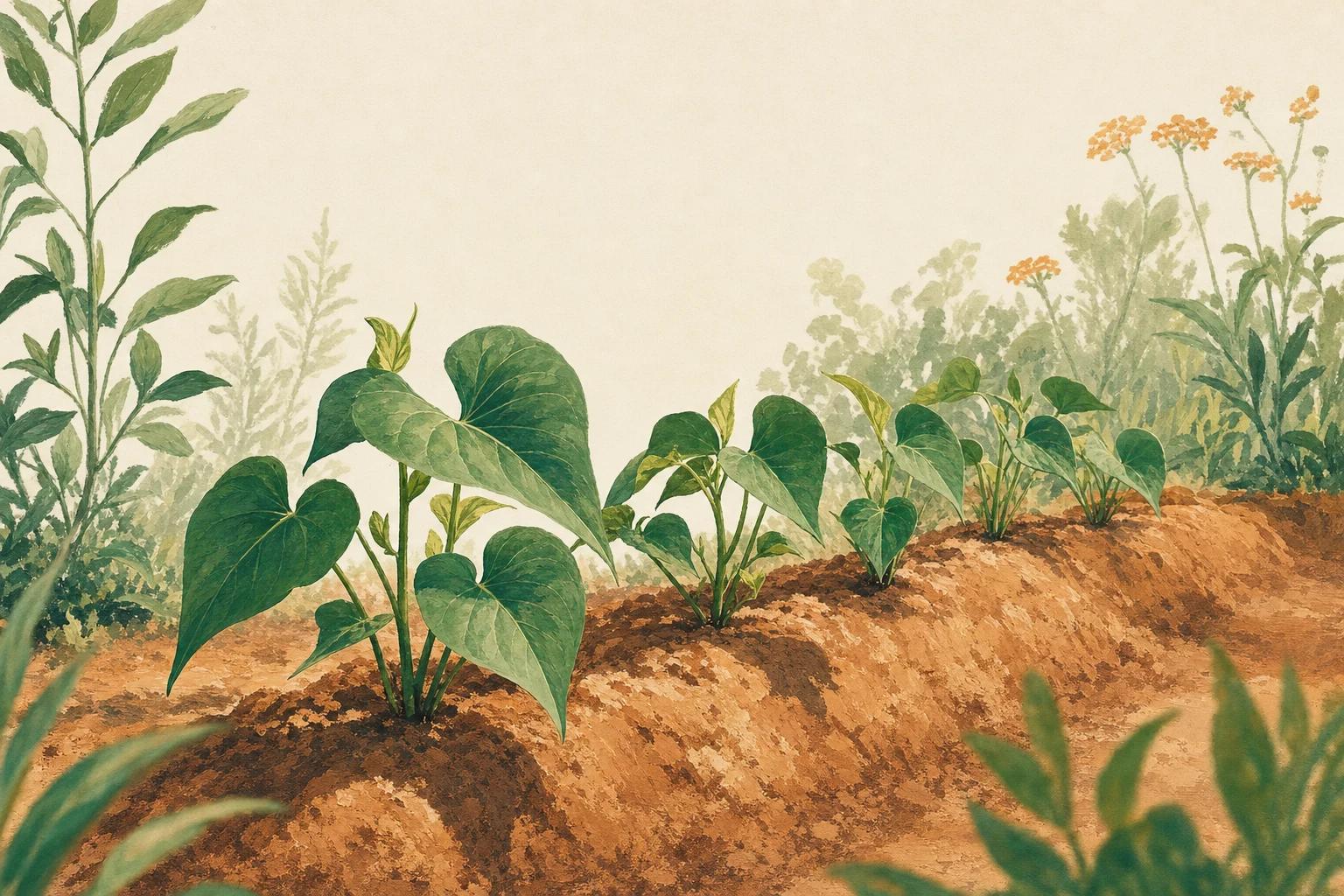
Set each slip 3 to 4 inches (8–10 cm) deep, 12 inches (30 cm) apart, on ridges in rows 3 to 4 feet (90–120 cm) apart.
Build ridges 8 to 12 inches (20–30 cm) high before planting. A ridge warms sooner in spring and drains better, which matters for a crop that rots in cold, wet ground. Bury 2 to 4 leaf joints (nodes) on each slip, because roots form at the buried nodes, and leave the growing tip and top leaves above the soil. Some guides plant as deep as 5 inches (13 cm); the aim in every case is buried nodes and exposed leaves.
Spacing runs from 8 to 18 inches (20–45 cm) in different guides, with 12 inches (30 cm) the common choice for sweet potato plants.
Water each slip in well. On hot, windy days, plant in the late afternoon or under cloud so the slips do not wilt before they root, and keep the soil evenly moist while they take hold.
Choose light, well-drained soil, ideally a sandy loam. Heavy clay gives misshapen roots, and where your ground is heavy, a raised bed helps with both drainage and warmth. Go easy on feeding: too much nitrogen fertilizer or heavy dressings of fresh manure produce long, spindly roots and a mass of vines.
As the vines run, they root wherever their joints touch soil, and those extra roots divert growth from the main crop. Lift and move the vines now and then to stop them taking hold. Deer will graze the foliage to the ground, so fence the bed where they visit; voles feed on the roots underground.
Varieties that change the timing
Days to maturity run from about 90 for Mahon Yam and Centennial to 120 or more for Jewel, so in a short season the variety matters as much as the planting date.
| Variety | Days from planting | Notes |
|---|---|---|
| Beauregard | 90–110 | Early; high yields |
| Covington | 95–110 | Rated better-flavored than Beauregard in New Hampshire |
| Centennial | 90–110 | Tolerates clay; disease resistant |
| Georgia Jet | 90–100 | Somewhat cold tolerant; prone to cracking and storage losses |
| Mahon Yam | 90 | Among the fastest |
| Murasaki | 100–120 | Among the slower varieties |
| Vardaman | 100–110 | Bush type; small, slender roots |
| Bush Porto Rico | 110 | Bush type with compact vines |
| Jewel | 100–135 | Slowest; most guides give 120–135 |
Days count from setting slips in the garden. Guides disagree by 10 to 20 days for some varieties, so plan on the longer figure in cool regions.
In Zones 3 to 6, choose a 90- to 100-day variety such as Mahon Yam, Centennial or Georgia Jet, and save the fastest for a planting late in the window. Jewel, at 120 to 135 days, and Murasaki, at up to 120, belong where the season is long.
Bush types such as Vardaman and Bush Porto Rico suit small gardens where a vining sweet potato would spill into the paths, though Vardaman gives smaller roots and a lower yield.
What happens if you plant too early or too late
Planted too early, slips rot or stall in cold soil. Planted too late, the season ends before the roots reach full size.
An early planting rarely saves time. Sweet potatoes do little until the soil reaches 65°F (18°C), and in cool, overcast weather in central Maine new plants can take up to a month to start growing. Roots that do form in chilled soil can carry chilling injury, which shows up later as off flavor.
A late planting runs out of warmth before the roots fill out, and cooling soil at the end of the season lowers their quality even before frost arrives. In the North, the roots should be out of the ground before the soil drops below 60°F (16°C). If you are planting late, choose a 90-day variety.
If a late frost threatens new slips
Cover the rows with floating row cover in the evening before a cold night and take it off the next morning. Use the cover for any night forecast below 50°F (10°C), not only for frost, because that much cold already damages young plants.
Harvest, curing and storage
Dig sweet potatoes when the roots reach a useful size, before the first fall frost, then cure them warm and store them cool.
Check one plant 80 to 85 days after planting. The crop is ready when about a third of the roots are wider than 3.5 inches (9 cm), or when most weigh 6 to 8 ounces (170–230 g). Roots left too long can split. Cut back watering 2 to 4 weeks before digging to avoid cracked roots. Lift them with a spading fork pushed in 8 to 10 inches (20–25 cm) from the crown, so the tines miss the roots.
If frost blackens the vines before you dig, harvest at once or cut the vines away at soil level, because decay moves from the dead vines into the roots. Expect around 6 to 15 pounds (3–7 kg) from a 10-foot (3 m) row.
Cure freshly dug roots at 80–85°F (27–29°C) with 85–90% humidity for about a week. Little curing happens below 70°F (21°C), and in an ordinary warm room it takes about two weeks. Skipped or rushed curing leaves roots less sweet and more prone to rot.
After curing, store the roots at 55–60°F (13–16°C) and about 85% humidity. Wait 3 to 4 weeks before eating them: sugar content can more than double in the first three weeks of storage.
Never store sweet potatoes in the refrigerator or anywhere below 50°F (10°C). Cold storage causes chilling injury, off flavors and rot.
The cleared bed is free for a fall crop; see garlic planting times for what can follow. To line up slip-starting and planting dates with the rest of your warm-season crops, including tomato planting times and vegetable planting dates, add them to Sow's garden calendar.
Frequently asked questions
What month is best to plant sweet potatoes?
May or June in most of the country, on a day when frost is past and the soil holds 65°F (18°C). Iowa plants mid-May to early June, Kentucky May 1 to June 15 depending on region, and Tennessee in May and June. The South starts sooner: coastal South Carolina on April 15, North Florida from mid-March, Central Florida from February and Houston from April. South Florida can plant from December through September.
How long do sweet potatoes take to grow?
Most varieties need 90 to 120 days from the day slips go into the garden. Mahon Yam sits at the fast end at about 90 days; Beauregard, Centennial and Covington take roughly 90 to 110, and Jewel 120 to 135. Hot-climate guides run longer: 100 to 130 days in Texas and 120 to 160 in the Arizona low desert. Starting your own slips adds another 6 to 8 weeks before that.
Can I just plant a sweet potato in the ground and it will grow?
Not reliably. Sweet potatoes are grown from slips, the leafy sprouts a root sends up, rather than from whole roots or cut pieces. Bed a root in warm, moist sand indoors 6 to 8 weeks before planting time, then pull the sprouts when they reach 4 to 6 inches (10–15 cm) and plant those. Roots from the grocery store are often treated so they will not sprout.
How many sweet potatoes will you get from one plant?
Expect roughly half a pound to a pound and a half (0.3–0.7 kg) per plant. A 10-foot (3 m) row set at 12 inches (30 cm) yields about 6 to 15 pounds (3–7 kg). Heavy clay pushes the figure toward the low end, because it cuts both yield and root quality. For a household, plan on 5 to 10 plants per person.
Should I water sweet potatoes every day?
No. Water slips in well at planting and keep the soil evenly moist, not soaked, for the first 4 to 6 weeks while roots form. Once the vines cover the ground, the crop is fairly drought tolerant and needs only moderate watering in dry spells. Cut back 2 to 4 weeks before digging, because heavy late watering cracks roots.
What cannot be planted next to sweet potatoes?
No neighboring vegetable is a proven problem; space and rotation matter more. The vines run along the ground and root at their joints, so give each plant 12 inches (30 cm) in rows 3 to 4 feet (90–120 cm) apart and keep low crops out of their path. In the South, move the crop to a different bed each year, because the sweet potato weevil is a serious pest there.
Can sweet potato slips survive a frost?
Not reliably. Frost kills the leaves and stems, so treat a new planting as having no frost tolerance and cover it on any frosty night. Established vines can come through a light frost, but dig the roots before a hard freeze. Slips waiting to be planted are just as tender, so keep a mail-order delivery above 60°F (16°C) until planting day.
Can you plant sweet potatoes in the fall?
Not in most of the country. Fall planting is not recommended in the Carolinas or most of Texas, and farther north the crop needs the whole frost-free season from a spring start. South Florida is the exception, planting from December through September, and Florida gardeners can also root vine-tip cuttings for a second crop.
Why do sweet potatoes need curing?
Curing heals scrapes and bruises on the thin skin so the roots resist rot in storage, and the weeks that follow turn starch to sugar. Without a curing room, set a small heater in a pantry or closet at about 85°F (29°C) with a bucket of water for humidity, and stack the roots above it in ventilated boxes; a week is enough. Keep the heater clear of anything that can burn.
References
- University of Maryland Extension. Growing Sweet Potatoes in a Home Garden. Accessed October 16, 2026.
- Clemson Cooperative Extension Home & Garden Information Center. Sweet Potato (HGIC). Accessed October 16, 2026.
- UMass Amherst Center for Agriculture, Food, and the Environment. Sweet Potato (Vegetable Fact Sheet). Accessed October 16, 2026.
- UNH Extension (University of New Hampshire). Growing Sweetpotatoes in New Hampshire [fact sheet]. Accessed October 16, 2026.
- Nebraska Extension in Lancaster County (University of Nebraska-Lincoln). Sweet Potato: Grow Your Own for Next Year's Holiday Table. Accessed October 16, 2026.
- Iowa State University Extension and Outreach. Growing Sweet Potatoes in Iowa. Accessed October 16, 2026.
- University of Kentucky Cooperative Extension Service. Home Vegetable Gardening in Kentucky (ID-128). Accessed October 16, 2026.
- University of Tennessee Extension. Sweetpotatoes for the Tennessee Vegetable Garden (D 71). Accessed October 16, 2026.
- N.C. Cooperative Extension, Franklin County Center (NC State Extension). Sweetpotatoes in the Home Garden. Accessed October 16, 2026.
- University of Georgia Cooperative Extension. Home Garden Sweet Potatoes (C 1014). Accessed October 16, 2026.
- Texas A&M AgriLife Extension Service. Texas Home Vegetable Gardening Guide (EHT-077). Accessed October 16, 2026.
- UF/IFAS Gardening Solutions (University of Florida). Sweet Potatoes. Accessed October 16, 2026.
- UF/IFAS Extension (University of Florida). Florida Vegetable Gardening Guide (SP 103/VH021). Accessed October 16, 2026.
- University of Arizona Cooperative Extension. Vegetable Planting Calendar for Maricopa County (az1005). Accessed October 16, 2026.
- UC Cooperative Extension Sacramento County (UC Agriculture and Natural Resources). Growing Sweet Potatoes in the Sacramento Area (EHN 102). Accessed October 16, 2026.
- Washington State University Vegetable Research and Extension. Sweetpotato Production Practices. Accessed October 16, 2026.
- Oregon State University Extension Service. Vegetable Gardening in Oregon (EC 871). Accessed October 16, 2026.
- Utah State University Extension. Sweet Potatoes in the Garden. Accessed October 16, 2026.
- Johnny's Selected Seeds. Starting Tips for Your Sweet Potato Slips. Accessed October 16, 2026.
- NOAA National Centers for Environmental Information. U.S. Climate Normals 1991–2020: Annual/Seasonal freeze data. Accessed October 16, 2026.
- Texas A&M AgriLife Extension, Harris County. Vegetable Garden Planting Dates for Harris County. Accessed October 16, 2026.
Sow Editorial
Written by the Sow team from university extension services, botanical gardens, USDA and NOAA data and plant breeders. Every source is listed under References.