The Story
Plant Bio
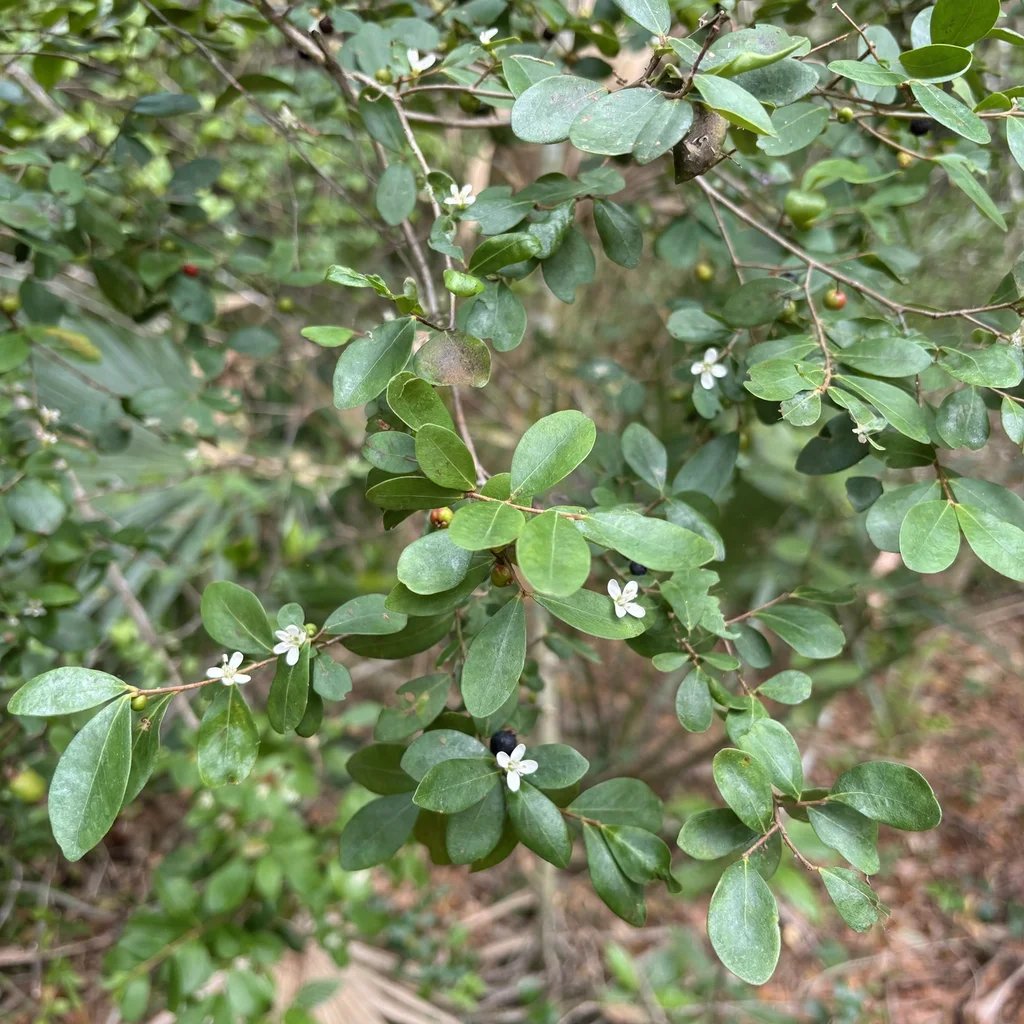
Eugenia foetida is an evergreen large shrub or small tree of southern Florida hammocks and coastal thickets, reaching about fifteen feet tall with a dense narrow-rounded canopy. The small rounded evergreen leaves clothe the stems closely, and small four-petaled white flowers give way to green berries that ripen through red to black.
It bears the smallest solitary flowers and fruits of the Florida stoppers, semi-showy white blooms valued at close range rather than for mass display. The tight small-leaf canopy holds its shape and prunes cleanly to a rounded foundation or specimen form for coastal and hammock plantings.
Uses & Benefits:
Essentials
At a Glance
Plant Type
Shrub
Height
180"
Width
120"
Light
Full Sun, Partial Sun, Shade
Zones
10
Water
Low
Humidity
Tolerant of coastal humidity
Lifespan
Long-lived evergreen shrub
Native To
Southern Florida, Mexico, Central America and Caribbean
Toxicity
Unknown
Bloom period
Spring – Summer
In flower about 6 months of the year
Planting
How to Grow
- Plant in full sun to partial shade in zones 10B through 11 after spring warming.
- Set at nursery depth in hammock or sandy coastal soil and water in deeply.
- Mulch to hold moisture and keep equipment off the dense stems.
- Prune lightly after flowering and fruiting to maintain a rounded canopy.
Pro Tip
Prune after fruiting to hold a rounded outline; plants are slow to refill if cut hard into leafless interior wood.
Keep It Thriving
Care Guide
Do
- Plant in full sun to partial shade with room for an 8 to 15 foot spread.
- Water to establish, then reduce to low supplemental water.
- Prune to a rounded form for foundation or specimen use.
Don't
- Do not expect a showy floral display across the garden.
- Do not cut hard into old leafless wood.
- Do not plant where hard frost occurs.
Seasonal Care Calendar
| Task | Jan | Feb | Mar | Apr | May | Jun | Jul | Aug | Sep | Oct | Nov | Dec |
|---|---|---|---|---|---|---|---|---|---|---|---|---|
| Mulch | ||||||||||||
| Pest Check | ||||||||||||
| Plant | ||||||||||||
| Prune |
Watch Out For
Pests & Diseases
Common Pests
Common Diseases
In the Garden
Landscape Uses & Companions
Landscape Uses
Multiply
Propagation Methods
Good to Know
Common Questions
Spanish Stopper questions
What zones can Spanish Stopper grow in?
Spanish Stopper is hardy in USDA Zone 10: in that range it survives winter in the ground. Colder than Zone 10, grow it in a container you can move to shelter for the winter.
When does Spanish Stopper bloom?
Spanish Stopper typically blooms from spring to summer. Exact timing shifts a week or two with your zone — Sow's bloom calendar maps it to your garden.
Does Spanish Stopper need full sun?
Spanish Stopper does best in full sun to part shade. In hot climates, afternoon shade keeps blooms fresher longer.
Is Spanish Stopper drought tolerant?
Yes — once established (usually after the first full season), Spanish Stopper handles dry spells with minimal watering. Water deeply its first year to build the root system that makes that possible.
More Eugenia to compare
Keep exploring
Explore the genus
Hardy in your zone?
Grow Spanish Stopper with confidence
See it in a design of your actual yard, get zone-matched care reminders, and track it season by season in your garden journal.