Quick answer
Plant bare-root roses while dormant, from about 4 weeks to 10 days before your median last spring frost, once the soil has thawed and drained enough to dig. Plant container roses from the last frost into midsummer. Where winters are mild, bare-root season moves to winter: January to mid-February in Texas, January and February in California, December and January in Florida.
Key facts
- Bare-root, Zones 3–8a
- 4 weeks to 10 days before the median last frost, while dormant
- Container, Zones 3–8a
- From the median last frost to about 11 weeks after
- Texas and Gulf Coast
- Bare-root January to mid-February, before bud break; containers fall to spring
- California
- Bare-root January and February
- Florida
- Bare-root December to January; containers any time
- Low desert
- Bare-root mid-December to February; containers best in spring or fall
- Soil
- Thawed, drained and workable; about 40°F (4°C) is a useful guide
- Graft (bud union) depth
- 2–4 in (5–10 cm) below soil in Zones 3–6; level with it in Zones 7–11
Plant bare-root roses while they are still dormant, in the four weeks to ten days before your median last spring frost, as soon as the ground has thawed and drained enough to dig. Plant container roses from the last frost into midsummer. Where winters are mild, from Texas and California to Florida and the low desert, the calendar turns around: bare-root roses go in during winter, and container roses do best from fall to spring.
How the rose is sold sets the date more than its variety does. A dormant bare-root plant has no soft shoots for frost to kill, so it goes in early and starts rooting before it leafs out; a potted rose in full leaf has to wait until the frosts are over. The table puts that rule on a calendar for 16 cities, and the sections after it cover the regions where winter, not frost, sets the date.
Rose planting dates by city
In Zones 3 to 8a, the bare-root window opens four weeks before each city's median last frost and closes ten days before it. The container window runs from that frost date to about 11 weeks later. In Zones 8b and 9, dormancy and summer heat set the season instead, so those cells give the local calendar.
| City (USDA zone) | Median last frost | Median first frost | Bare-root roses | Container roses |
|---|---|---|---|---|
| Fargo, ND (4a) | May 10 | Sep 30 | Apr 12 – Apr 30 | May 10 – Jul 24 |
| Minneapolis, MN (5a) | Apr 23 | Oct 18 | Mar 26 – Apr 13 | Apr 23 – Jul 7 |
| Chicago, IL (5b) | Apr 16 | Oct 28 | Mar 19 – Apr 6 | Apr 16 – Jun 30 |
| Denver, CO (6a) | May 5 | Oct 9 | Early to mid-Apr | May 5 – Jul 19 |
| Detroit, MI (6b) | Apr 20 | Oct 27 | Mar 23 – Apr 10 | Apr 20 – Jul 4 |
| Kansas City, MO (6b) | Apr 13 | Oct 24 | Mar 16 – Apr 3 | Apr 13 – Jun 27 |
| Boston, MA (7a) | Apr 4 | Nov 9 | Mar 7 – Mar 25 | Apr 4 – Jun 18 |
| Salt Lake City, UT (7b) | Apr 8 | Oct 31 | Mar 11 – Mar 29 | Apr 8 – Jun 22 |
| New York, NY (7b) | Mar 30 | Nov 20 | Mar 2 – Mar 20 | Mar 30 – Jun 13 |
| Nashville, TN (7b) | Mar 31 | Nov 3 | Mar 3 – Mar 21 | Mar 31 – Jun 14 |
| Raleigh, NC (8a) | Mar 31 | Nov 4 | Mar 3 – Mar 21 | Mar 31 – Jun 14 |
| Atlanta, GA (8a) | Mar 15 | Nov 20 | Feb 15 – Mar 5 | Mar 15 – May 29 |
| Dallas-Fort Worth, TX (8b) | Mar 8 | Nov 24 | Jan – mid-Feb, before bud break | Fall to spring; avoid midsummer |
| Seattle, WA (9a) | Mar 2 | Nov 23 | Mid-Feb – Mar (March best) | Spring to early summer |
| Sacramento, CA (9b) | Feb 2 | Dec 2 | Jan – Feb, while dormant | Fall to spring; avoid midsummer |
| Houston, TX (9b) | Feb 13 | Dec 9 | Jan – mid-Feb, before bud break | Fall to spring; avoid midsummer |
Frost dates are medians from NOAA 1991–2020 climate normals for each city's main weather station; in half of years the last frost falls later than the date shown.
For a town in Zones 3 to 8a that is not listed, apply the same rule to your own median last frost date. Count back 28 days and 10 days for the bare-root window; container roses start on the frost date and run for about 11 weeks. Sow's plant hardiness checker confirms your USDA zone, which decides graft depth and how risky fall planting is.
Read the table with two adjustments. In the Southeast, the bare-root column shows the late-winter window, but dormant roses can also go in during late fall. And in the North the container column stops at midsummer only because an early start gives a potted rose more time to root before winter. It can still go in later in the growing season if you keep it watered.
Bare-root or container: why the format sets the date
Bare-root roses go in early because they are dormant, while container roses wait for frost to pass because they are already growing.
A bare-root rose is sold leafless, with no soil around its roots. A dormant cane shrugs off frost that would kill tender new shoots. That is why a bare-root plant can go into cold ground weeks before the last frost, and why it should go in before it starts to grow. Plant when the soil has thawed and is no longer waterlogged; about 40°F (4°C) is a useful guide to soil warm enough for roots to start growing.
Buy and plant close together. Bare-root roses kept in a warm store push premature, weak shoots, so buy them soon after they arrive and time mail orders to your planting window. Good stock has plump, smooth, green canes and feels heavy for its size; a plant that feels light, with brittle twigs, has dried out. In the low desert, pass over wax-coated roses, because strong sun burns the coated canes. Elsewhere the wax can stay on.
If planting day slips. Keep bare-root roses at about 40°F (4°C), with roots and canes damp, for up to two weeks. For a longer wait, lay them in a shallow trench and cover the roots with soil until you are ready.
Container roses. A potted rose is a growing plant, so in cold regions it goes in after the last killing frost. From then on it can be planted at any point in the growing season, though in the North spring and early summer give it the longest run of root growth before winter. Where summers are hot, the same logic runs the other way: plant in fall, winter or early spring so the roots are established before the heat.
When to plant roses by region and zone
Cold regions plant bare-root roses from late March to early May, the Southeast in late fall or late winter, and Texas, California, Florida and the low desert in midwinter.
| Region | Bare-root | Container | Watch for |
|---|---|---|---|
| Zones 3–4, northern Plains and Upper Midwest | Mid-April to early May | Last frost to midsummer | Only hardy types for fall |
| Zones 5–6, Midwest and Rockies | Late March to mid-April | Last frost to midsummer | Finish bare-root by mid-April |
| Southeast, Zones 7–8 | Late fall, or late winter to early spring | Spring | Graft at or just above soil |
| Texas and Gulf Coast | January to mid-February | Early fall to early spring | Roots before summer heat |
| Pacific Northwest, west of the Cascades | Mid-February to March | Spring to early summer | Soil still cold and wet |
| Low desert | Mid-December to February | Any time; spring or fall best | Summer heat |
| Florida | December to January | Any time | Fortuniana rootstock |
Planting seasons by region; within each window, choose a day when the soil is thawed and not soggy.
North and Upper Midwest. In Zones 3 and 4, bare-root planting runs from mid-April into early May; in Zones 5 and 6 it moves to late March through mid-April. Iowa gardeners, for example, plant bare-root roses from late March to mid-April and container roses from May through midsummer.
Rockies. In Colorado, spring beats fall for bare-root roses, and planting should be finished by mid-April at lower elevations, which is why Denver's cell ends there rather than at its late median frost. Container roses wait for the last killing frost.
Northeast and mid-Atlantic coast. Boston and New York sit in Zone 7, where the frost rule lands bare-root planting in March. Treat those dates as the earliest start. If the ground is still frozen or soggy, wait until it can be worked, holding the dormant roses cool and damp for up to two weeks.
Southeast. Dormancy, not the calendar, is the limit: bare-root roses can go in during late fall, late winter or early spring, while the plants are leafless. Container roses go in later in spring, after the bare-root season.
Texas and the Gulf Coast. Plant bare-root roses before their buds break, which usually happens by mid-February and, in an especially mild winter, as early as January. Container roses can go in most of the year with irrigation, but early fall through early spring is the best window, because a rose needs to root before summer heat arrives.
California. In the mild-winter valleys and along the coast, January and February are the main bare-root months. Where summers run hot, as in the Central Valley, container roses follow the same fall-to-spring pattern as Texas.
Pacific Northwest. West of the Cascades, bare-root planting runs from mid-February through March, and March is the best month for most of the region, once soil has drained enough to work. Potted roses can follow through spring and into early summer, before midsummer heat.
Low desert. Bare-root roses go in from mid-December through February. Container roses can be planted any month, but spring and fall are best and summer is the hardest season to start one. Roses kept permanently in pots need afternoon shade in summer.
Florida. Plant bare-root roses in December or January; container roses go in at any time of year.
Fall planting: where it works and where it is a gamble
Fall is a good planting season where winters are mild and a calculated risk where the ground freezes hard.
In the Southeast, late fall opens the bare-root season for dormant roses. From Central Texas to the low desert, fall ranks with early spring as the best time to set out container roses, because the roots grow through the cool months and are ready before summer.
In Zones 3 to 5, spring is the dependable default, and bare-root roses should wait for it. In Fargo the median first frost falls at the end of September, so a fall-planted rose there gets very little rooting time. If you do plant in fall in these zones, choose a hardy shrub rose or a climber rated for hard winters. Plant as early as you can while the soil is still warm, water deeply, and mulch after the first hard frost. In Zone 5, an October planting beats a November one.
In Zone 6, fall planting of potted roses is more forgiving. Plant early, mound soil over the base of each new plant before winter, and choose the less tender varieties. A rugosa rose or another species rose suits a fall start far better than a hybrid tea.
Choosing the site and checking the soil
Pick a spot with at least 6 hours of direct sun and soil that drains well, then plant when that soil is thawed and workable.
Sun. Six to eight hours of direct sun is the target, and five hours is the bare minimum. Morning sun is worth more than afternoon sun because it dries dew from the leaves sooner. Where summers run hot, light afternoon shade helps the flowers last longer. In the desert, an eastern exposure is best, and light-colored south or west walls reflect too much heat.
Drainage. Roses die in waterlogged soil, so test before you plant. Dig a hole 18 inches (45 cm) deep and fill it with water: if it empties within 5 to 6 hours, the drainage is fine. If water lingers, build a raised bed or improve the soil across the whole bed, mixing roughly 1 part organic matter into 2 parts soil.
Soil pH and timing. Aim for a pH of 6.0 to 7.0, and send a soil test off several weeks before planting day so there is time to correct it.
Competition and air. Keep roses away from the roots and canopy of trees and large shrubs, which take water and nutrients and cast shade. If the plan also includes flowering trees, give the roses their own open bed. Skip cramped, walled-in corners where air barely moves.
How to plant a rose: graft depth, steps and spacing
Set the graft deep in cold zones and level or high in warm ones, backfill with the native soil, and water it in rather than tamping.
| Climate | Where the graft goes | Why |
|---|---|---|
| Zones 3–6, cold winters | 2–4 in (5–10 cm) below the soil | Shields the union from winter cold |
| Zones 7–11, mild winters | Level with the soil or just above | Little winter cold to guard against |
| Low desert | About 2 in (5 cm) above the soil | Lowers disease risk |
| Own-root roses, any zone | Crown 1–2 in (2.5–5 cm) below the soil | No graft to protect |
Graft (bud union) placement by climate; some cold-climate guidance sets the union shallower, 1–2 in (2.5–5 cm) deep.
The bud union is the knobby joint where the named rose was grafted onto its rootstock. In cold zones it goes below ground, where the soil shields it and the cane bases around it from harsh winter weather. In warm climates, burying the union buys no winter benefit, and in the low desert a raised union lowers the risk of disease.
- Soak bare roots. Stand a bare-root rose in a bucket of water for several hours or overnight, but never more than 24 hours. Then cut off any damaged or diseased roots. Keep the roots covered and damp until they go in the hole.
- Dig a wide hole. For bare-root roses, dig 18 to 24 inches (45–60 cm) wide and about 18 inches (45 cm) deep; go wider in compacted soil. For a container rose, dig twice the pot's width and only as deep as the root ball.
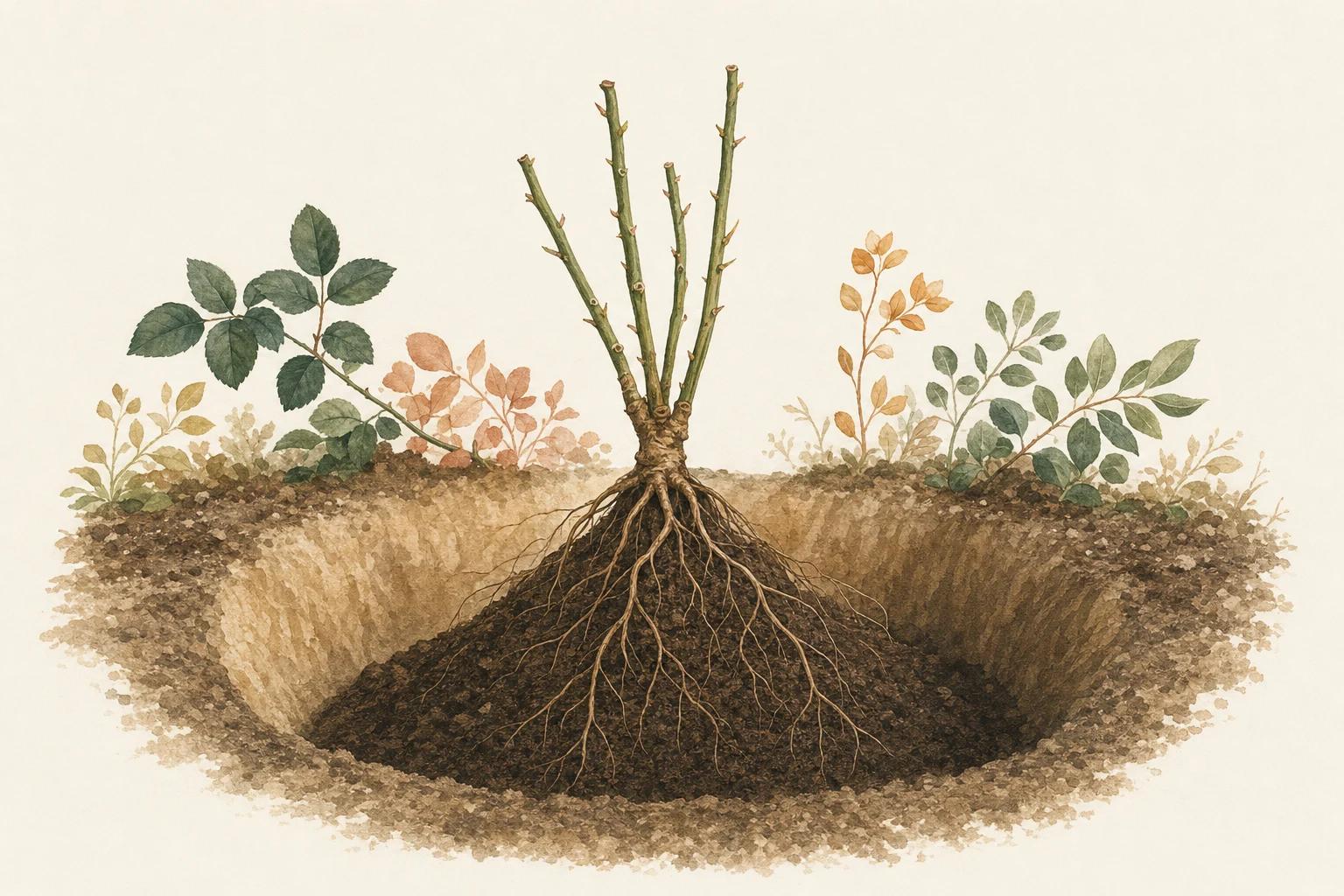
- Spread or loosen the roots. Build a cone of soil in the bottom and drape bare roots over it so they angle down and out. On a container rose, tease out or cut roots that circle the pot, and set the top of the root ball level with the surrounding ground.
- Set the graft for your climate. Use the depth in the table above for your zone. Loose backfill settles, so a union set level with the surface in the North sinks to 1 to 2 inches (2.5–5 cm) below it as the soil firms.
- Backfill and water, without tamping. Refill two-thirds of the hole with the soil you dug out, water to settle it, then finish filling. Tamping packs the soil and wrecks its structure, so let water do the firming.
- Prune bare-root canes. Keep three to five strong canes and shorten each to three to five buds, cutting about 1/4 inch (6 mm) above a bud that faces outward. Remove any cane thinner than a pencil.
- Mound the canes. Pile 4 to 10 inches (10–25 cm) of soil, compost or moist mulch over a bare-root rose to stop the canes drying out while roots start. After 2 to 3 weeks, once new shoots appear, wash the mound away gently with a hose.
- Mulch the bed. Spread 2 to 3 inches (5–8 cm) of mulch over the bed, leaving a 6-inch (15 cm) bare ring around the canes. The mulch calculator works out how much a bed needs.
Never cover a mounded rose with plastic. Heat builds up under it on a sunny day and can kill the plant. Use soil, compost or moist mulch instead.
Spacing
Space most bush roses 2 to 3 feet (60–90 cm) apart in cold-winter gardens, and wider where a long, hot season lets them grow larger.
| Rose type | Cold-winter gardens | Low desert |
|---|---|---|
| Miniature | 2–2.5 ft (60–75 cm) | 1–2 ft (30–60 cm) |
| Hybrid tea and grandiflora | 2.5–3 ft (75–90 cm) | 3–5 ft (0.9–1.5 m) |
| Floribunda | 2.5–3 ft (75–90 cm) | 3 ft (90 cm) |
| Shrub | Use the label's mature width | 2–4 ft (0.6–1.2 m) |
| Climber | Use the label's mature width | 6–10 ft (1.8–3 m) |
Spacing between plant centers. Cold-winter figures are for short-season gardens such as central Oregon; old garden roses in the low desert grow larger than catalogs say, so add about 2 feet (60 cm) to their listed width.
A simple rule covers types not in the table: space roses about two-thirds of their mature height apart, so air can move between them. The plant spacing calculator turns a spacing figure into a planting count for a bed or hedge.
Rose types that change the timing
Hardiness, not flower form, decides how much timing risk a rose can take in cold zones. Tender types belong in spring, and the hardy shrub and species roses are the ones to try in fall.
Hybrid tea, grandiflora and floribunda roses, along with some miniatures, polyanthas and climbers, are not reliably winter-hardy in Iowa winters and colder, and need winter protection there. Most shrub, landscape, species and old garden roses are hardy without it. These hardy groups are the roses to choose if you want to plant in fall in Zones 3 to 5.
Grafted or own-root. Hybrid teas are usually grafted, so the graft-depth table applies to them. Most old garden roses and miniature roses are grown from cuttings on their own roots instead, and the table's own-root row covers them in every zone. A miniature still needs winter protection in cold zones, so being own-root does not make it a fall candidate there.
Rootstock in Florida. A grafted rose for Florida gardens should be on Fortuniana rootstock, so check the label before you buy, whatever the planting month.
Planting too early or too late, and late frost
Planting too early puts a leafed-out rose in the path of frost, and planting too late leaves too little root-growing time before winter or summer heat.
Too early. A container rose in full leaf cannot take a freeze, so wait until after the last killing frost. The table's container dates start on the median frost, which a later frost beats in half of years, so check the forecast before planting a leafy rose in the first week of the window.
Too late for bare-root. A bare-root rose is meant to root before it leafs out. Do not buy one whose canes have already started to leaf out or look spindly, and once the bare-root window in the table has closed, buy a container rose instead. In warm regions, a late start also leaves too little time for roots to grow before summer heat.
Late frost after planting. Leave the mound on a bare-root rose until the new shoots are showing, since it shields the buds as well as the canes. For a container rose, the defense is the calendar: hold it in its pot until the forecast is clear.
The first season after planting
Expect new shoots within 2 to 3 weeks of spring planting and the first flowers 8 to 12 weeks after planting.
Water. Give about 1 inch (2.5 cm) of water a week through the growing season, more for a new plant while its roots spread. A soaker hose puts the water on the soil and keeps the leaves dry.
Mulch. Check through the season that mulch has not drifted back against the canes, and keep the 6-inch (15 cm) bare ring open.
Hold the fertilizer. Wait until new growth is well established, about 8 to 12 weeks after planting or after the first flush of flowers. Early fertilizer can burn the new roots of a bare-root plant. In cold zones, stop feeding by early to mid-August, as early as August 1 in Minnesota, so new shoots harden before frost.
Let it slow down in fall. In cold zones, stop removing spent flowers between mid-September and October 1 so the plant forms hips and slows toward dormancy.
First winter in cold zones. In late fall, mound 10 to 12 inches (25–30 cm) of well-drained soil over the base of hybrid teas, grandifloras and floribundas. Bring the soil in from outside the bed rather than scraping it from around the new roots.
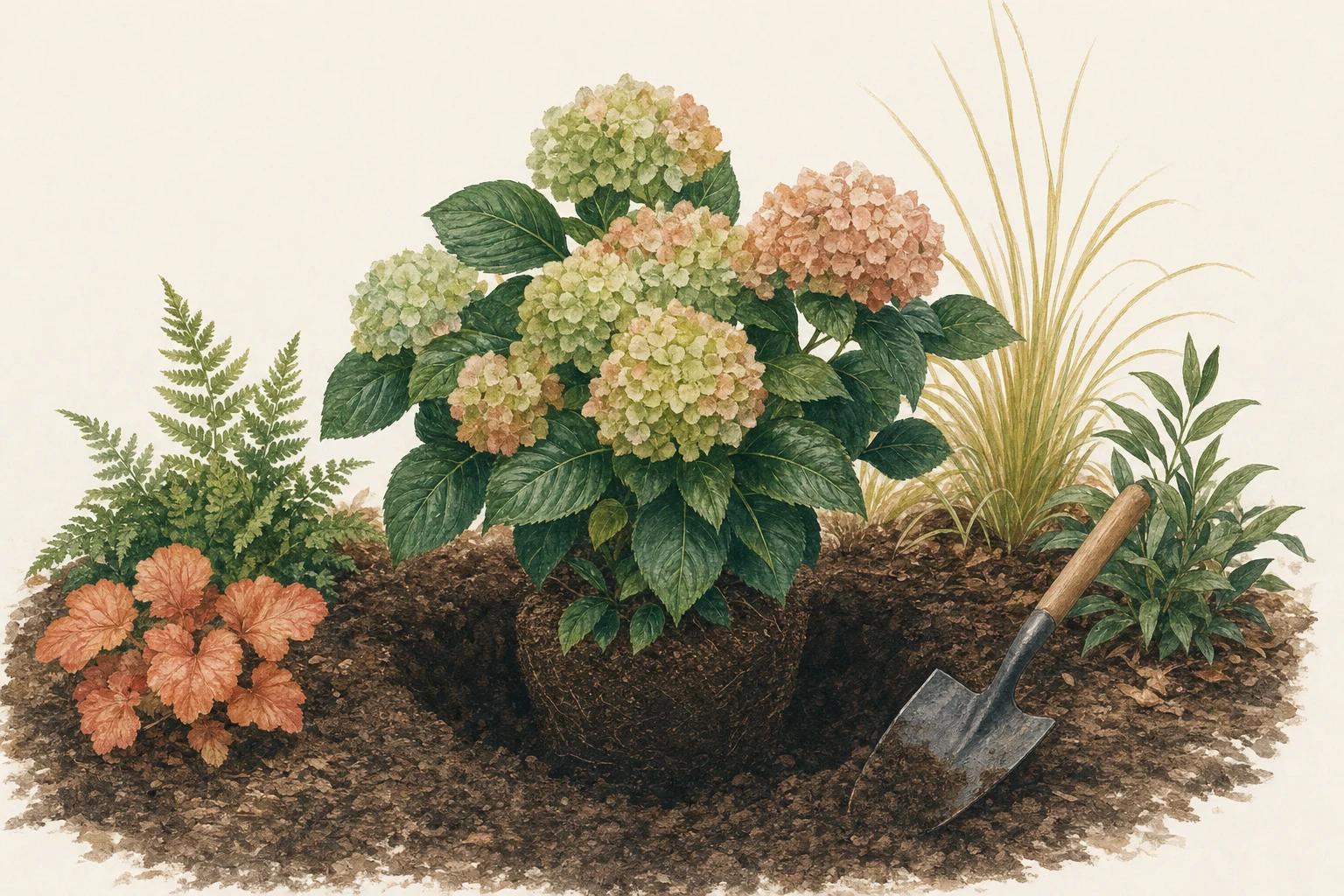
For pruning, feeding and disease control in the years that follow, the rose growing guide picks up where this page stops. If you are planting a mixed bed this year, when to plant hydrangeas gives the dates for the shrubs that often share it. To see where a new rose bed fits among existing trees and beds before you dig, sketch it in Sow's garden design studio.
Frequently asked questions
How do you plant a rose bush?
Dig a hole about 18 to 24 inches (45–60 cm) wide, spread the roots of a bare-root rose over a cone of soil or set a container rose level with the ground, and place the graft at the depth your climate needs. Backfill with the soil you removed, water it in instead of tamping, then mound soil over bare-root canes for 2 to 3 weeks and mulch the bed.
Can you plant roses in the fall?
Yes where winters are mild. In the Southeast, dormant bare-root roses can go in during late fall, and from Texas to the low desert fall is one of the best seasons for container roses. In Zones 3 to 5, spring is the safer choice. If you do plant there in fall, use a hardy shrub rose, plant early, water deeply and mulch after the first hard frost. In Zone 6, mound soil over the base of each new rose before winter.
Is it too late to plant roses in summer?
Not for container roses in cold and temperate zones, which can go in through midsummer and later in the growing season if you keep them watered. Bare-root roses are finished by late spring, so buy potted plants instead. Where summers are hot, from Texas to the low desert, summer is the hardest season to establish a rose: wait for fall, when the roots have time to grow before the next summer.
Do roses like full sun or shade?
Full sun. Roses need at least 6 hours of direct sun a day, 6 to 8 hours is the target, and 5 hours is the bare minimum. Morning light counts for more than late-day light because it dries the leaves sooner. In very hot regions, light afternoon shade helps the flowers last, and desert roses do best on the east side of a house.
Where should you not plant roses?
Avoid low spots where water stands after rain, because roses die in waterlogged soil. Keep them out of the root zone and canopy of trees and large shrubs, which take water and nutrients and cast shade, and out of cramped corners where air barely moves. In the desert, also keep roses off light-colored south and west walls that bounce heat back at them.
How do you deadhead roses?
Cut each faded flower about 1/4 inch (6 mm) above an outward-facing bud, back to a leaf with five leaflets, and leave at least two five-leaflet leaves on the shoot. On a rose in its first season, cut just above the top three-leaflet leaf instead, so the young plant keeps most of its foliage for making food. In cold zones, stop between mid-September and October 1 so the plant can slow down for winter.
When should I fertilize a newly planted rose?
Wait until new growth is well established, about 8 to 12 weeks after planting or after the first flush of flowers. After that, repeat bloomers do well on a balanced 10-10-10 fertilizer in spring, again in mid-June and once more in mid-July. In cold zones, stop feeding by early to mid-August, because late feeding produces soft shoots that cannot harden before winter.
What do coffee grounds do for roses?
Very little. Brewed grounds hold only about 1 to 2 percent nitrogen and sit close to neutral, around pH 6.5 to 6.8, so they neither feed a rose much nor acidify its soil. Raw grounds can also tie up nitrogen while they break down. Compost them instead, keeping them under a fifth of the pile, or work no more than 1/2 inch (13 mm) into the top 4 inches (10 cm) of soil.
When is the best time to transplant a rose?
Move an established rose while it is dormant, before it leafs out. That means late March to mid-April in cold-winter states like Iowa, before bud break in mid-February in Central Texas, and December through March in the low desert. Cut the top back by a third to a half, dig as much root as you can, keep a soil ball on larger plants, and replant at once.
Are roses safe for dogs and cats?
Yes. Roses are non-toxic to dogs, cats and horses, so a chewed leaf or petal is not a poisoning concern. The prickly canes are the problem for people handling them: wear heavy gloves and long sleeves when you unpack bare-root plants and prune at planting time, and set thorny varieties back from paths where pets and children run.
References
- Oregon State University Extension Service. Planting bare root roses in spring (EM 9474). Accessed October 16, 2026.
- Oregon State University Extension Service. Roses: Planting and Care in Central Oregon (EC 1624). Accessed October 16, 2026.
- Oregon State University Extension Service. Coffee grounds boost soil health, help control slugs. Accessed October 16, 2026.
- Washington State University Extension. Growing Roses in Washington: Rose Care Calendar (FS164E). Accessed October 16, 2026.
- University of Illinois Extension. Roses: Planting. Accessed October 16, 2026.
- University of Illinois Extension. Roses: Selecting rose plants. Accessed October 16, 2026.
- University of Illinois Extension. Roses: Preparing the site. Accessed October 16, 2026.
- University of Illinois Extension. Roses: Care. Accessed October 16, 2026.
- Iowa State University Extension and Outreach. How to Plant and Transplant Roses. Accessed October 16, 2026.
- Iowa State University Extension and Outreach. Growing Roses in Iowa. Accessed October 16, 2026.
- Iowa State University Extension and Outreach. What is the proper way to deadhead roses?. Accessed October 16, 2026.
- Colorado State University Extension. Selecting and Planting Roses. Accessed October 16, 2026.
- Clemson Cooperative Extension Home & Garden Information Center. Growing Roses (HGIC 1172). Accessed October 16, 2026.
- Texas A&M AgriLife Extension Service, Travis County. Maintaining Roses. Accessed October 16, 2026.
- UC Master Gardeners of Santa Clara County, University of California Agriculture and Natural Resources. January Tips. Accessed October 16, 2026.
- UF/IFAS Gardening Solutions. Roses. Accessed October 16, 2026.
- University of Arizona Cooperative Extension. Rose Selection and Planting in the Low Desert (AZ1304). Accessed October 16, 2026.
- University of Minnesota Extension. Autumn rose care in Minnesota. Accessed October 16, 2026.
- ASPCA Animal Poison Control. Rose. Accessed October 16, 2026.
- NOAA National Centers for Environmental Information. U.S. Climate Normals 1991–2020: Annual/Seasonal freeze data. Accessed October 16, 2026.
Sow Editorial
Written by the Sow team from university extension services, botanical gardens, USDA and NOAA data and plant breeders. Every source is listed under References.