Quick answer
The best flowering trees for yards in Zones 3 to 9 stay 15 to 30 feet (4.5 to 9 m) tall: eastern redbud, flowering and kousa dogwood, serviceberry, star magnolia and disease-resistant crabapples such as 'Prairifire'. Japanese tree lilac handles Zone 3, and crape myrtle carries summer bloom where winters are mild (Zones 7 to 9). Skip Callery (Bradford) pear, mimosa and empress tree, which are invasive.
Key facts
- Small and reliable
- Star magnolia, serviceberry, white fringetree, 'Adirondack' crabapple
- Longest bloom
- Desert willow, April to October; crape myrtle, July to September
- Coldest yards (Zone 3)
- Japanese tree lilac, pagoda dogwood, white fringetree
- Invasive, do not plant
- Callery (Bradford) pear, mimosa, empress tree
- Distance from the house
- Ideally the tree's mature spread; 6 ft (1.8 m) is the absolute minimum for small trees
- Under power lines
- Only trees that mature at 20 ft (6 m) or less
- Toxic to pets and horses
- Red buckeye; crabapple and cherry leaves, stems and seeds
- Best planting time
- Fall after leaf drop or early spring before bud break
The best flowering trees for a typical front yard top out between 15 and 30 feet (4.5 and 9 m). They also resist the diseases common where you live and bloom in a month when the rest of the garden is quiet. Eastern redbud, flowering and kousa dogwood, serviceberry, star magnolia and a rated crabapple such as 'Prairifire' cover most of the country. Japanese tree lilac and pagoda dogwood take Zone 3 winters, and crape myrtle and desert willow carry color through Southern and Southwestern summers.
Choose by mature size and bloom month first, flower color last. A March magnolia, an April redbud, a June kousa and an August crape myrtle or sourwood keep something in flower from late winter into fall. Three trees still sold in many garden centers, Callery (Bradford) pear, mimosa and empress tree, are invasive and belong on no planting list.
How these trees were chosen
Every pick had to clear five bars:
- Hardiness across a useful range of USDA zones.
- A mature size that suits a home lot. A few larger trees made the list because nothing else does what they do, and their size is flagged.
- No state invasive listing in any record checked. The one pick known to seed into nearby woods, Japanese snowbell, carries that warning.
- Documented disease resistance in the groups most troubled by disease: dogwoods, crabapples and crape myrtles.
- A bloom time that adds to the season rather than piling onto April.
Sizes are mature height and spread on a good site, and real trees run larger or smaller with climate and cultivar, so treat them as planning figures. Zone ranges are for the species unless a cultivar is named. Check yours with the plant hardiness checker before you shop.
| Tree | Bloom | Zones | Height × spread (ft) | Best for |
|---|---|---|---|---|
| Star magnolia | Mar, white | 4–8 | 15–20 × 10–15 | Small yards, earliest bloom |
| Saucer magnolia | Late Mar–Apr, pink-white | 4–9 | 20–25 × 20–25 | Big early flowers |
| 'Jane' magnolia | Apr–May, red-purple | 4–8 | 20–25 × 15–20 | Late-frost areas |
| Eastern redbud | Apr, rose-pink | 4–8 | 20–30 × 25–35 | Native color, clay |
| Serviceberry | Apr, white | 4–9 | 15–25 × 15–25 | Four seasons, berries |
| 'Okame' cherry | Mar–Apr, pink | 6–8 | 15–25 × 15–20 | Early pink, warm zones |
| Yoshino cherry | Mar–Apr, white | 5–8 | 30–40 × 30–40 | Large lots only |
| Weeping Higan cherry | Apr, pink to white | 4–8 | 20–30 × 15–25 | Weeping focal point |
| Cornelian cherry dogwood | Mar, yellow | 4–8 | 15–25 × 15–20 | Earliest color, low disease |
| Mexican plum | Feb–Apr, white | Native s. Ohio to Texas | Up to 35 tall | Texas and the Plains |
| Flowering dogwood | Apr–May, white or pink | 5–9 | 15–30 × 15–30 | Native, light shade |
| Rated crabapples | Apr–May, white to red | 4–8 | 15–20 × 10–22 | Sun, winter fruit |
| Carolina silverbell | Apr, white | 4–8 | 30–40 × 20–35 | Woodland edges |
| Red buckeye | Apr–May, red | 4–8 | 12–15 × 12–15 | Hummingbirds |
| Kousa dogwood | May–Jun, white | 5–8 | 15–30 × 15–30 | Disease resistance |
| Sweetbay magnolia | May–Jun, cream | 5–10 | 10–35 × 10–35 | Wet or clay soil |
| White fringetree | May–Jun, white | 3–9 | 12–20 × 12–20 | Native, city lots |
| Japanese snowbell | May–Jun, white | 5–9 | 20–30 × 20–30 | Patios, viewed from below |
| Pagoda dogwood | May–Jun, cream | 3–7 | 15–25 × 20–32 | Cold, cool-summer shade |
| 'Winter King' hawthorn | May, white | 4–7 | 25–35 × 25–35 | Winter fruit |
| Japanese tree lilac | Jun, cream | 3–7 | 20–30 × 15–20 | Zone 3, late bloom |
| American yellowwood | May, white | 4–8 | 30–50 × 40–55 | Large lots, fragrance |
| Sourwood | Jun–Jul, white | 5–9 | 20–25 tall | Summer bloom, red fall color |
| Japanese stewartia | Jun–Jul, white | 5–8 | 20–40 × 15–30 | Bark, fall color |
| Crape myrtle | Jul–Sep, many colors | 6–9 (tree form 7–9) | 6–30 by cultivar | Long summer bloom |
| Desert willow | Apr–Oct, white to purple | 7–9 | 10–30 × 15–20 | Hot, dry yards |
| Franklin tree | Jul–Sep, white | 5–8 | 10–20 × 6–15 | Late-summer fragrance |
| Seven-son flower | Sep, white | 5–9 | 15–20 × 8–10 | Fall bloom, narrow spots |
Mature size and USDA zone range by tree. Multiply feet by 0.3 for meters; bloom months are typical and shift later as you go north.
Early spring: March and April bloomers
The earliest flowering trees open on bare branches in March and April, which makes them the most visible from the street and the most exposed to late frost.
Star magnolia
Star magnolia is the first deciduous magnolia to flower, opening white, strap-petaled blooms with 12 to 18 tepals in March, and it starts blooming at only 2 to 3 years old. It grows 15 to 20 feet (4.5 to 6 m) tall and 10 to 15 feet (3 to 4.5 m) wide in Zones 4 to 8, small enough for a narrow front yard. Full sun gives the heaviest bloom. The caution is frost: keep it off warm south-facing walls, where the heat opens buds early and a cold night then browns the flowers, and out of windy corners and soil that stays very wet or very dry.
Saucer magnolia
The most widely grown deciduous magnolia, saucer magnolia carries 8-inch (20 cm) pink-and-white flowers on bare wood from late March to mid-April in St. Louis. It reaches 20 to 25 feet (6 to 7.5 m) in both height and spread, up to 30 feet (9 m) with age, is hardy in Zones 4 to 9 and is often sold multi-trunked. It shares star magnolia's frost risk and adds leaf spot and canker, so give it the room a 25-foot (7.5 m) tree needs.
'Jane' magnolia
'Jane' belongs to the Little Girl series of hybrids from the US National Arboretum, which flower 2 to 4 weeks after star and saucer magnolias and so lose far fewer blooms to frost. The flowers are reddish purple outside and white inside, in April and May. Hardy in Zones 4 to 8, it grows 20 to 25 feet (6 to 7.5 m) tall and 15 to 20 feet (4.5 to 6 m) wide. Leaf spots, anthracnose, canker and powdery mildew can appear.
Eastern redbud
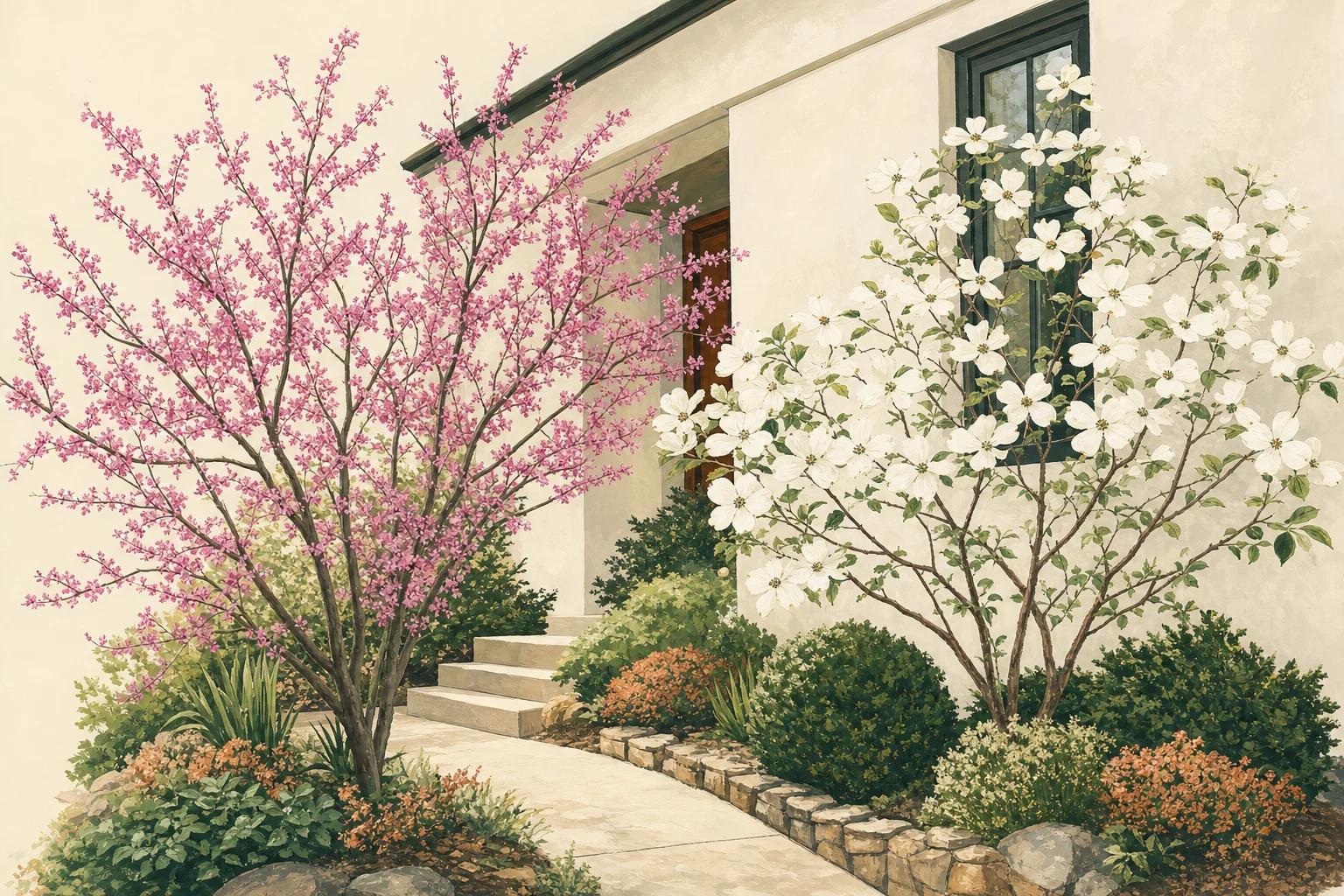
Eastern redbud is a native that lines its bare branches with rose-pink to magenta pea-shaped flowers in April (late March to early May, depending on latitude) and turns yellow in fall. Expect 20 to 30 feet (6 to 9 m) of height and a wider spread of 25 to 35 feet (7.5 to 10.5 m) in Zones 4 to 8. In Zone 4, give it a sheltered spot, because extreme winters can kill back the branches. It takes sun or part shade and tolerates clay. It transplants poorly, so buy a young tree and leave it where you put it. Expect a short life for a tree: canker and verticillium wilt often bring decline after about 20 years, and few live past 75. 'Forest Pansy' adds purple leaves but is more prone to verticillium. Texas redbud (var. texensis), 10 to 20 feet (3 to 6 m) for Zones 6 to 9, takes more heat and less cold.
Serviceberry
Serviceberry gives four seasons from one tree: white flowers in April, edible blue-black berries in June if the birds leave any, orange-red fall color and smooth gray bark. 'Autumn Brilliance', hardy in Zones 4 to 9, makes a crown 15 to 25 feet (4.5 to 7.5 m) high and across and has a reputation for excellent disease resistance. The native Allegheny serviceberry, often multi-trunked, is similar in size, hardy in Zones 4 to 8, with bronze new leaves. Both send up root suckers, and rust, leaf spot and fire blight can appear.
'Okame' cherry
'Okame' was bred to carry the hot pink of Taiwan cherry into colder gardens, and it flowers in March and April. It stays 15 to 25 feet (4.5 to 7.5 m) tall and 15 to 20 feet (4.5 to 6 m) wide, needs full sun and good drainage, and colors bronze to orange-red in fall. It is hardy only in Zones 6 to 8, and it carries the full cherry pest list: leaf spot, dieback, leaf curl, powdery mildew, borers and aphids.
Yoshino cherry
Yoshino cherry is the main cherry planted in Washington, D.C., with fragrant white blossoms, sometimes blushed pink, in March and April and yellow-bronze fall leaves. It needs more room than most front yards offer: 30 to 40 feet (9 to 12 m) tall and as wide, in Zones 5 to 8. Deer damage it often, and borers, scale, leaf spot, dieback and viral and fungal diseases are common.
Weeping Higan cherry
Often sold grafted on top of a straight trunk, weeping Higan cherry makes a fountain of pink to white flowers in April and takes heat and cold better than most flowering cherries. The species is hardy in Zones 4 to 8, and weeping forms run about 20 to 30 feet (6 to 9 m) tall and 15 to 25 feet (4.5 to 7.5 m) wide. Plants sold under the 'Pendula' name vary widely, so ask for the mature size of the exact plant. 'Autumnalis Rosea' adds a sparse second bloom in fall.
Cornelian cherry dogwood
Cornelian cherry dogwood covers its bare branches in small yellow flowers in March, weeks before the other dogwoods. In Zones 4 to 8 it reaches 15 to 25 feet (4.5 to 7.5 m) tall and 15 to 20 feet (4.5 to 6 m) wide. It has excellent resistance to dogwood anthracnose and borers. Its sour red fruit, ripe in midsummer, is edible. Remove root suckers as soon as they appear, and do not expect much fall color.
Mexican plum
For Texas, Oklahoma and the south-central states, Mexican plum (Prunus mexicana) is a native, single-trunk plum that does not sucker, flowering white to pale pink between February and April. It can reach about 35 feet (10.5 m) but often stays shorter, in sun or part shade, across a native range from southern Ohio to Texas. Deer browse it. Reliable zone ratings for it are scarce, so buy from a nursery that grows natives for your region.
Mid-spring: April and May bloomers
Mid-spring is when disease resistance matters most, because dogwoods and crabapples, the two most popular trees in this window, both carry serious leaf and twig diseases.
Flowering dogwood
Flowering dogwood is the native classic: tiers of white or pink bracts (the showy parts are bracts, not petals) in April and May, red fall color and fruit that birds eat into winter. Hardy in Zones 5 to 9, it grows 15 to 30 feet (4.5 to 9 m) tall with an equal spread and wants acidic, moist soil rich in organic matter. Its roots run shallow, so keep the root zone mulched and watered in dry spells, and in the South give it afternoon shade. Dogwood anthracnose is the serious threat, worst in cool, moist, shady sites and at higher elevations. Where it is present, choose 'Appalachian Spring', which resists it, or plant kousa instead. For powdery mildew, 'Appalachian Blush', 'Appalachian Joy', 'Appalachian Mist' and 'Appalachian Snow' are highly resistant.
Disease-resistant crabapples
A rated crabapple gives as much spring color as any tree on this list, plus fruit that feeds birds into winter. Buy only a named cultivar with proven resistance to scab, rust, powdery mildew and fire blight. Crabapples flower white to deep pinkish red in April and May, carry fruit under 2 inches (5 cm) across, and most mature at 15 to 25 feet (4.5 to 7.5 m) in Zones 4 to 8. 'Prairifire' is the deep-colored choice, and 'Adirondack' has the narrowest crown for a tight spot.
| Cultivar | Flower | Height × spread | Scab, rust, mildew | Fire blight |
|---|---|---|---|---|
| 'Adirondack' | White | 18 × 10 ft (5.5 × 3 m) | Excellent | Excellent |
| 'Prairifire' | Dark pinkish red | 20 × 20 ft (6 × 6 m) | Excellent | Good |
| 'Sugar Tyme' | White, red fruit | 18 × 15 ft (5.5 × 4.5 m) | Excellent scab and mildew, good rust | Good |
| 'Profusion' | Deep pink | 15–20 × 20 ft (4.5–6 × 6 m) | Excellent scab and mildew, good rust | Good to excellent |
| 'Donald Wyman' | White, red fruit | 20 × 20 ft (6 × 6 m) | Good overall | Good overall |
Southeastern disease ratings (Clemson Extension; 'Donald Wyman' from Missouri Botanical Garden). Resistance shifts with local disease pressure.
Prune crabapples in late winter before the buds break; spring cuts and heavy fertilizing both invite fire blight. Deer browse crabapples hard, so fence young trees until they are tall enough to outgrow the damage, or choose from deer-resistant plants for exposed spots.
Carolina silverbell
Carolina silverbell hangs white bells along its branches in April, a native understory tree that can also be grown as a multi-stem shrub. It is the largest tree in this group, 30 to 40 feet (9 to 12 m) tall and 20 to 35 feet (6 to 10.5 m) wide in Zones 4 to 8. That size suits a woodland edge better than a small front yard. The wood is soft and weak, so plant it out of the wind, and keep it away from alkaline soil (where its leaves yellow), drought, road salt and compacted ground.
Red buckeye
Red buckeye sends up 4- to 10-inch (10 to 25 cm) spikes of red tubular flowers in April and May that draw hummingbirds. It is a native, clump-forming small tree of 12 to 15 feet (3.7 to 4.5 m), occasionally 20 feet (6 m), for Zones 4 to 8. In dry summers the leaves scorch and look ragged by August, and leaf blotch is common, so plant it among shrubs or perennials that carry the late-summer show.
Red buckeye seeds and other parts are toxic to dogs, cats and horses, and the seeds are poisonous to people; symptoms include severe vomiting, diarrhea and possible seizures. Crabapple, cherry and plum leaves, stems and seeds contain cyanogenic glycosides that are also toxic to pets and horses, with wilted leaves the most dangerous. Keep these trees away from paddocks and pick up fallen buckeye seeds where children and dogs play.
Late spring and early summer: May and June bloomers
Trees that flower in May and June fill the gap after the spring rush. Most bloom with their leaves already out, so the flowers read against green rather than bare wood.
Kousa dogwood
Kousa dogwood flowers about a month after the native dogwood, in May and June, once its leaves are out. It is more drought tolerant, hardier and far more resistant to anthracnose than flowering dogwood, which makes it the better replacement where native dogwoods have died. Mottled, flaking bark and reddish-purple to scarlet fall color carry it through the year, and 'National' and 'Milky Way' are rated generally resistant to powdery mildew. It reaches 15 to 30 feet (4.5 to 9 m) in Zones 5 to 8, depending on climate and cultivar. The raspberry-like fruit is edible but seedy and drops in a mess, so keep it back from decks and patios, and expect yellowing leaves in alkaline soil.
Sweetbay magnolia
Sweetbay magnolia is the flowering tree for wet ground, tolerating soggy and heavy clay soil. Creamy, lemon-scented flowers open in May and June, then keep appearing here and there all summer. Height depends on climate: 15 to 20 feet (4.5 to 6 m) in the North, up to 60 feet (18 m) in the far South. It is hardy in Zones 5 to 10 and keeps its leaves through winter in warm areas. Give it a sheltered spot in Zone 5, and expect yellow leaves in alkaline soil.
White fringetree
White fringetree covers itself in fleecy, 4- to 6-inch (10 to 15 cm) strands of creamy-white flowers in May and June, then turns yellow in fall. Hardy in Zones 3 to 9, it usually stays 12 to 15 feet (3.7 to 4.5 m) in home landscapes (20 feet, 6 m, at most) and tolerates clay, city conditions and black walnut. Males and females are separate plants, and males flower more showily. It dislikes long droughts, when scale and borers move in. Chinese fringetree, for Zones 5 to 9, blooms 2 to 3 weeks earlier but is sold without its sex identified.
Japanese snowbell
Japanese snowbell hangs its white bells beneath horizontal branches in May and June, so the flowers are best seen from below, which makes it a natural tree to sit under on a patio. Hardy in Zones 5 to 9, it matures at 20 to 30 feet (6 to 9 m) in each direction and has no serious pests. It needs acidic soil rich in organic matter, and its fall color is minor. It self-seeds, and seedlings can escape into nearby woods, so pull volunteers and skip it beside natural areas.
Pagoda dogwood
Pagoda dogwood is a native whose branches spread in flat, horizontal layers, topped by yellowish-white flower clusters in May and June. Hardy from Zone 3 to Zone 7, it grows 15 to 25 feet (4.5 to 7.5 m) tall and spreads 20 to 32 feet (6 to 9.7 m). It does best where summers are cool; in hot regions it needs afternoon shade and steady moisture, and twig blight and canker can strike. For underplanting its shade, see plants for shade.
'Winter King' hawthorn
'Winter King' is one of the most disease-resistant hawthorns, with white flowers in May and red fruit that ripens in September and hangs on into winter. In Zones 4 to 7 it forms a crown 25 to 35 feet (7.5 to 10.5 m) high and just as wide, and it needs full sun. It is mostly thornless, but thorns up to 1.5 inches (4 cm) long can occur, so keep it back from paths and wear eye protection when pruning. Cedar-hawthorn rust and fire blight remain possible.
Japanese tree lilac
Japanese tree lilac blooms in June, later than other lilacs, with creamy-white panicles up to 12 inches (30 cm) long. Hardy in Zones 3 to 7, it grows 20 to 30 feet (6 to 9 m) tall and 15 to 20 feet (4.5 to 6 m) wide and resists powdery mildew, scale and borers. The scent is closer to privet than to lilac, and some people dislike it. It has no fall color, and a late frost can damage the flower buds.
American yellowwood
American yellowwood hangs fragrant white, wisteria-like flower chains in May and turns yellow in fall. It is a native shade tree, though, 30 to 50 feet (9 to 15 m) tall and 40 to 55 feet (12 to 17 m) wide in Zones 4 to 8. It rewards patience: young trees may not flower for 8 to 10 years, and heavy bloom often comes only every second or third year. The branching is fragile, and pruning belongs in summer, because spring cuts bleed sap.
Summer and fall bloomers
Six trees carry bloom from June into fall: sourwood, stewartia, crape myrtle, desert willow, Franklin tree and seven-son flower.
Sourwood
Sourwood flowers in June and July with drooping sprays of white bells like lily of the valley, then turns crimson in fall. It grows 20 to 25 feet (6 to 7.5 m) tall in gardens in Zones 5 to 9. The catch is soil: it needs acidic, moist ground, struggles in alkaline soil, cannot take drought and resents being transplanted.
Japanese stewartia
Japanese stewartia (Stewartia pseudocamellia) offers four seasons on one slow-growing tree: 2.5-inch (6 cm) white, camellia-like flowers with orange-yellow anthers in June and July, orange-red to burgundy fall color and bark that peels in patches. It is hardy in Zones 5 to 8 and eventually reaches 20 to 40 feet (6 to 12 m). Give it evenly moist, acidic, well-drained soil and afternoon shade where summers are hot and humid; it fails in heavy clay and in dry soil.
Crape myrtle
Crape myrtle flowers on the current year's growth from July into September, and in the Southeast from early summer into fall. It grows as a tree in Zones 7 to 9. In Zone 6, and Zone 5 in a protected spot, the stems often die to the ground in winter and regrow as a shrub that still flowers, because bloom comes on new wood. It needs full sun, and powdery mildew is its main disease. Size runs from 6-foot (1.8 m) shrubs to 30-foot (9 m) trees, so choose by the tag. Two tree-sized, mildew-resistant National Arboretum hybrids lead the list. 'Natchez' is white, 21 to 25 feet (6.4 to 7.6 m) tall, with exceptional peeling bark; 'Muskogee' is light lavender-pink, 21 by 15 feet (6.4 by 4.5 m). For small spaces, 'Seminole' stops near 8 feet (2.4 m) and 'Acoma' at 10 feet (3 m). Crapemyrtle bark scale, a pest from Asia found in South Carolina since 2019, shows as a white to gray waxy crust on stems and trunks. It may not kill the plant, but it cuts vigor and the number and size of flower clusters. The tree has also naturalized from Virginia to Texas and Florida.
Desert willow
Desert willow is the flowering tree for hot, dry yards in the Southwest and Texas. Its trumpet flowers, white to rose-purple, appear from April to October, heaviest in May and June and again after rain, and hummingbirds visit them. It grows 10 to 30 feet (3 to 9 m) tall and 15 to 20 feet (4.5 to 6 m) wide in Zones 7 to 9 and survives cold to about 10°F (−12°C). Deer resistance is moderate. It needs full sun and sharp drainage, because soil that stays wet rots the roots.
Franklin tree
Franklin tree opens fragrant, 3-inch (7.5 cm) white flowers from July into early fall, then colors orange, red and purple. It stays 10 to 20 feet (3 to 6 m) tall and 6 to 15 feet (1.8 to 4.5 m) wide in Zones 5 to 8. It has a reputation for being hard to keep, because wilt and root rot can kill it, so plant it only in soil with excellent drainage.
Seven-son flower
Seven-son flower blooms in September with fragrant white flowers, after which the calyces turn rose-pink and stay showy into late fall, and its peeling bark carries winter. It grows 15 to 20 feet (4.5 to 6 m) tall but only 8 to 10 feet (2.4 to 3 m) wide in Zones 5 to 9, a good fit for a narrow side yard. It has no serious pests and does not seed around aggressively. Left alone it grows as a multi-stem shrub, so train it to one trunk while young if you want a tree.
Best flowering trees by region
Winter cold narrows the list first and summer heat second, so start from your zone and then check how hot and humid your summers run.
| Region | Reliable picks | Watch for |
|---|---|---|
| Upper Midwest and far North (Zones 3–4) | Japanese tree lilac, pagoda dogwood, white fringetree (all to Zone 3); serviceberry, rated crabapples, Cornelian cherry, star magnolia (Zone 4) | 'Okame' cherry and crape myrtle are not hardy; frost on magnolia flowers |
| Northeast, Mid-Atlantic, Ohio Valley (Zones 5–7) | Nearly the whole list: magnolias, both dogwoods, redbud, serviceberry, snowbell, stewartia, sourwood, cherries | Anthracnose on flowering dogwood; Callery pear banned in Ohio |
| Southeast and Gulf Coast (Zones 7–9) | Crape myrtle, flowering dogwood in afternoon shade, sweetbay magnolia, Carolina silverbell, sourwood, Franklin tree | Crapemyrtle bark scale; mimosa and Callery pear seedlings |
| Texas, Oklahoma, Southwest | Texas redbud, Mexican plum, desert willow, crape myrtle | Wet soil kills desert willow; deer browse Mexican plum |
| Mountain West | Rated crabapples, serviceberry, Japanese tree lilac, pagoda dogwood | Deer on crabapples; trees under wires must stay 20 ft (6 m) or less |
| Western Oregon and the Pacific Northwest | Kousa dogwood (often 15–18 ft there), Japanese stewartia, eastern redbud | Stewartia wants light shade in the hottest part of summer |
Regional starting points. Zone limits for each tree are in the summary table above. Frost-free Zone 10 and 11 gardens in Florida and coastal California need a subtropical list instead.
In the Mountain West, flowering crabapples bloom in April and May and grow up to about 8,000 feet (2,400 m). Cultivars with high overall disease resistance there include 'Adams', 'Centurion', 'Robinson', 'Louisa' and 'Profusion', a different list from the Southeastern ratings above, so buy from ratings made for your region.
Invasive flowering trees to avoid
Do not plant Callery pear (including 'Bradford'), mimosa or empress tree: all three escape yards by seed and are listed as invasive in parts of the US.
Callery (Bradford) pear
Callery pear sells on fast growth and early white bloom, but its cultivars cross-pollinate one another and set viable fruit, and birds carry the seed into fields and woods, where seedlings grow into thorny thickets. Ohio made it illegal to sell, grow or plant Callery pear from January 1, 2023, though existing trees may stay. South Carolina banned nursery sales of Callery pear and pears grafted on Callery rootstock from October 1, 2024, and North Carolina lists it as invasive. 'Bradford' fails as a yard tree too: narrow branch angles make limbs split under their own weight after 15 to 20 years, storms break it apart, and the flowers smell unpleasant. For the same early white bloom, plant serviceberry, eastern redbud, flowering dogwood or American plum.
Mimosa
Mimosa, or silktree, has pink powder-puff flowers in summer and spreads by seed carried by wind, water and animals. It is listed as invasive in North Carolina and treated as invasive across the Southeast. It is a poor investment anywhere: weak limbs, a life of about 30 years, and 20 to 40 feet (6 to 12 m) of height with a spread up to 50 feet (15 m). If you want the look, 'Merlot Majik' is sold as a sterile selection; otherwise choose a native summer bloomer such as sourwood.
Empress tree
Empress or princess tree (Paulownia tomentosa) carries big lavender flower clusters in spring, and young trees and root sprouts can shoot up 7 to 15 feet (2 to 4.5 m) in a season. Thousands of tiny winged seeds have made it invasive from Pennsylvania south to Georgia and west to Missouri, cut trees resprout from the roots, and the wood is weak. Yard trees reach 30 to 50 feet (9 to 15 m), and occasionally far more in the wild.
Two more deserve caution. Chaste tree, an 8- to 10-foot (2.4 to 3 m) summer bloomer, has the potential to become invasive in southern areas. Goldenrain tree, a 30- to 40-foot (9 to 12 m) yellow-flowered tree, escapes cultivation and is listed as invasive in the Mid-Atlantic. Size disqualifies a third: southern magnolia reaches 60 to 80 feet (18 to 24 m) and is reliably hardy only in Zones 7 to 9. Several of these are fast growers, and the fast-growing trees guide covers the rest of the speedy trees to skip.
How far to plant from the house and power lines
Ideally, plant a flowering tree as far from the house as its mature spread. Under power lines, plant only trees that stay 20 feet (6 m) or shorter.
A tree that matures 20 feet (6 m) tall and 15 feet (4.5 m) wide goes at least 15 feet from the foundation. The absolute minimums are 6 feet (1.8 m) for small trees, spaced about 20 feet (6 m) apart, 15 feet (4.5 m) for medium trees and 20 feet (6 m) or more for large ones. A flowering dogwood set 6 feet out will spread 15 to 30 feet, so you will prune its house side for good.
Overhead distribution lines divide the yard into three zones:
| Zone | Distance from the wires | Mature height allowed |
|---|---|---|
| Low | Within 15 ft (4.5 m) either side | 20 ft (6 m) or less |
| Medium | 15 to 50 ft (4.5 to 15 m) out | 40 ft (12 m) or less |
| Tall | 50 ft (15 m) or more out | Any height |
Planting zones beside overhead distribution lines (International Society of Arboriculture).
In the dry Mountain West, trees under and within 20 feet (6 m) of electric lines should mature at 20 feet or less. Serviceberry, Japanese tree lilac, pagoda dogwood, 'Princess Kay' plum and thornless cockspur hawthorn are standard choices there.
Call 811 to have buried lines marked before you dig, as the law often requires: digging a planting hole is the greatest danger to buried utilities, and a strike can cause injury or death. Gas pipeline operators often keep 10 feet (3 m) on each side of the line free of trees. Never prune near energized wires yourself; call the utility.
Planting, pruning and what to expect
Plant while the tree is dormant with its trunk flare at the soil surface, prune each tree on its own schedule, and never top a crape myrtle.
How to plant
Plant while the tree is dormant, in a hole 2 to 3 times as wide as the root ball and no deeper, with the trunk flare at the surface. Then mulch 2 to 3 inches (5 to 7.5 cm) deep and water weekly through the first season. The full step-by-step method, from calling 811 to staking, is in the fast-growing trees guide.
Pruning
Prune star magnolia and Japanese tree lilac right after flowering, crabapples in late winter, yellowwood in summer and crape myrtle in late winter.
Topping, cutting the main trunks back to stubs every winter, is common on crape myrtles and unnecessary. It removes 50 to 100 percent of a tree's leafy crown, which can starve it, exposes bark to sunburn, opens wounds to cankers and decay, and forces clusters of weakly attached shoots. It does not improve flowering either: crape myrtle blooms on new growth, so an unpruned tree still flowers heavily, and light pruning only enlarges individual flower clusters. Prune in late winter or early spring by keeping the 3 to 5 strongest trunks, removing lower limbs up to one-third to one-half of the tree's height, and cutting out crossing branches. Topping is defensible only as a last resort for an old specimen wedged into a tight space; the real fix is a cultivar whose mature size fits.
What to expect
Time to first flower varies widely: a star magnolia can bloom at 2 to 3 years old, while a yellowwood may take 8 to 10. Flowering dogwood, sourwood and stewartia all dislike dry soil, so the first summer's weekly soaking matters most for them. To see how a 15-foot redbud and a 25-foot crape myrtle will sit against your house at full size, sketch them into Sow's design studio before you buy.
Frequently asked questions
What are some types of flowering trees?
Sort them by bloom season. Early spring brings star and saucer magnolia, eastern redbud, serviceberry and the flowering cherries. Flowering dogwood, crabapples and red buckeye follow in April and May. Kousa dogwood, fringetree, Japanese snowbell and Japanese tree lilac carry late spring into June, and sourwood, stewartia, crape myrtle, desert willow and seven-son flower cover summer into fall. Most stay 15 to 30 feet (4.5 to 9 m) tall.
What is the most beautiful flowering tree?
Among native trees, flowering dogwood has the strongest claim, with eastern redbud close behind; among imports, star and saucer magnolia. Beauty fades fast on a sick tree, though, so weigh disease resistance as heavily as looks. Kousa dogwood and a rated crabapple such as 'Prairifire' give a similar spring show while shrugging off the anthracnose, scab and mildew that disfigure less resistant trees.
What flowering tree stays in bloom the longest?
Desert willow, where summers are hot and dry: it flowers from spring into fall and puts out a fresh flush after summer rain. Where it is too cold or too wet for desert willow, crape myrtle also runs long, from July into September and from early summer into fall in the Southeast. Sweetbay magnolia adds scattered flowers all summer after its main flush, and seven-son flower carries pink calyces into late fall.
What trees stay colorful all year round?
No flowering tree is in color all year, but four-season trees come close by stacking flowers, fruit, fall leaves and bark. Kousa dogwood, serviceberry, Japanese stewartia, sourwood and crape myrtle are the strongest examples, and crabapples such as 'Donald Wyman' and 'Sugar Tyme' hold red fruit into winter. Pair them with evergreen shrubs to keep structure in the garden once the leaves fall.
What is the best small flowering tree for a front yard?
For most front yards, star magnolia: it stays under 20 feet (6 m) and opens first, in March. For a narrow strip beside a drive, 'Adirondack' crabapple spreads only 10 feet (3 m) and carries top disease ratings, and seven-son flower is just 8 to 10 feet (2.4 to 3 m) across. In Zone 3, choose white fringetree, which seldom grows past 15 feet (4.5 m) in gardens.
Can I plant a flowering tree under power lines?
Yes, if it matures at 20 feet (6 m) or less. From this list, star magnolia (15 to 20 ft), red buckeye (12 to 15 ft), white fringetree (12 to 20 ft), Franklin tree (10 to 20 ft), seven-son flower (15 to 20 ft) and the 18-foot crabapples 'Adirondack' and 'Sugar Tyme' all fit. Redbud, kousa dogwood and Yoshino cherry can all pass 20 feet, so keep them at least 15 feet (4.5 m) to the side of the wires.
Why shouldn't I plant a Bradford pear?
Because it seeds into wild land and splits apart within 15 to 20 years. If you are replacing one, three natives give the same April show at a similar size: eastern redbud at 20 to 30 feet (6 to 9 m), serviceberry at 15 to 25 feet (4.5 to 7.5 m) and flowering dogwood at 15 to 30 feet (4.5 to 9 m). Ohio does not require removing existing trees, but it encourages removal to protect native forests.
Are flowering trees safe for dogs and cats?
Not all of them. Crape myrtle is the safe pick here, rated non-toxic to dogs, cats and horses, so it suits a dog run or paddock edge. If a pet chews buckeye seeds or cherry, plum or crabapple leaves, call the ASPCA Animal Poison Control Center at (888) 426-4435 (a consultation fee may apply). Watch for vomiting, diarrhea, dilated pupils, wobbling or seizures.
When is the best time to plant a flowering tree?
Fall after leaf drop or early spring before bud break is ideal, because cool weather lets roots settle before summer heat pushes new growth. Healthy container-grown and balled-and-burlapped trees can still go in during the growing season if you keep them watered. In frost-free climates any month works when water is available. Skip fertilizer at planting, and hold off on corrective pruning until the tree has grown for a full season.
References
- Missouri Botanical Garden. Plant Finder (profiles for Cercis, Cornus, Magnolia, Amelanchier, Malus, Prunus, Chionanthus, Lagerstroemia, Halesia, Syringa, Oxydendrum, Stewartia, Cladrastis, Aesculus, Heptacodium, Styrax, Crataegus, Franklinia and Chilopsis). Accessed October 16, 2026.
- NC State Extension. Plant Toolbox (Cercis canadensis, Cornus florida, Cornus kousa, Magnolia stellata, Prunus x yedoensis, Lagerstroemia indica, Halesia, Styrax japonicus, Oxydendrum, Cladrastis, Heptacodium, Pyrus calleryana, Albizia julibrissin, Paulownia tomentosa, Vitex, Koelreuteria). Accessed October 16, 2026.
- Clemson Cooperative Extension, Home and Garden Information Center. Crabapple (HGIC 1007). Accessed October 16, 2026.
- Clemson Cooperative Extension, Home and Garden Information Center. Dogwood Diseases and Insect Pests in South Carolina. Accessed October 16, 2026.
- Clemson Cooperative Extension, Home and Garden Information Center. Crape Myrtle. Accessed October 16, 2026.
- Clemson Cooperative Extension, Home and Garden Information Center. Crape Myrtle Pruning (HGIC 1009). Accessed October 16, 2026.
- Clemson Cooperative Extension, Home and Garden Information Center. Redbud (HGIC 1021). Accessed October 16, 2026.
- University of New Hampshire Extension. What are the best flowering trees for a small yard?. Accessed October 16, 2026.
- University of Missouri Extension. Tree Placement on Home Grounds (G6900). Accessed October 16, 2026.
- Colorado State University Extension. Small Trees and Utility Lines (PlantTalk 1716). Accessed October 16, 2026.
- Colorado State University Extension. Flowering Crabapple (PlantTalk 1747). Accessed October 16, 2026.
- Lady Bird Johnson Wildflower Center, University of Texas at Austin. Native Plants Database (Cercis canadensis var. texensis, Chilopsis linearis, Prunus mexicana). Accessed October 16, 2026.
- International Society of Arboriculture (TreesAreGood.org). Avoiding Tree and Utility Conflicts. Accessed October 16, 2026.
- International Society of Arboriculture (TreesAreGood.org). New Tree Planting. Accessed October 16, 2026.
- International Society of Arboriculture (TreesAreGood.org). Why Topping Hurts Trees. Accessed October 16, 2026.
- USDA National Invasive Species Information Center. Callery Pear. Accessed October 16, 2026.
- Oregon State University. Landscape Plants (Cornus kousa, Stewartia pseudocamellia, Cercis canadensis). Accessed October 16, 2026.
- University of Georgia Center for Invasive Species and Ecosystem Health. Invasive Plant Atlas of the United States (mimosa and princesstree species pages). Accessed October 16, 2026.
- USDA Forest Service. Paulownia tomentosa (princesstree), Fire Effects Information System. Accessed October 16, 2026.
- ASPCA Animal Poison Control Center. Toxic and Non-toxic Plants (buckeye, plum, apple, crape myrtle). Accessed October 16, 2026.
Sow Editorial
Written by the Sow team from university extension services, botanical gardens, USDA and NOAA data and plant breeders. Every source is listed under References.