Quick answer
Sow radish seed in the garden from 3 weeks before your median last spring frost to 2 weeks after it, once the soil at 4 inches (10 cm) reads at least 40°F (4°C). Sow again for fall 10 to 6 weeks before the median first fall frost. Round spring radishes are ready in 3 to 5 weeks. Florida, the Gulf Coast, California's valleys and the low desert grow them from fall to spring.
Key facts
- Timing rule
- Zones 3–8: 21 days before to 14 days after the median last spring frost
- Soil temperature
- At least 40°F (4°C) at 4 in (10 cm); best germination at 55–75°F (13–24°C)
- Days to maturity
- 21–30 days for round and French types; about 50 for compact Korean daikons such as Mini Mak and for Red Meat watermelon radish; full-size daikons take longer
- Fall crop
- Sow 70–42 days (10–6 weeks) before the median first fall frost
- Heat limit
- Above 80°F (27°C), bolting becomes common and roots are more often deformed, hot or woody
- Depth and spacing
- 1/2 in (13 mm) deep; thin to 2–3 in (5–7.5 cm), daikon 4–6 in (10–15 cm)
- Succession
- A short row every 7–14 days while the weather stays cool
- Indoor starting
- None: radishes are sown where they will grow
Sow radish seed straight into the garden from about 3 weeks before your median last spring frost until 2 weeks after it. Frost does not hurt radishes; heat does. A crop that matures in hot weather often bolts and comes out hot, woody or hollow, so the spring season is a race to pull the roots before summer settles in.
The best radishes therefore come from two short seasons rather than one long one: a run of spring sowings that finish before the heat, and a second run in late summer that matures as fall cools. Round spring types need only 3 to 5 weeks, so each window has room for several sowings.
Radish planting dates by city
In Zones 3–8, each spring window opens 21 days before the city's median last frost and closes 14 days after it, and each fall window runs from 70 to 42 days before the median first fall frost. The Zone 9 rows give the local sowing season instead, which runs without a break.
| City (USDA zone) | Median last frost | Median first frost | Spring sowing | Fall sowing |
|---|---|---|---|---|
| Fargo, ND (4a) | May 10 | Sep 30 | Apr 19 – May 24 | Jul 22 – Aug 19 |
| Minneapolis, MN (5a) | Apr 23 | Oct 18 | Apr 2 – May 7 | Aug 9 – Sep 6 |
| Chicago, IL (5b) | Apr 16 | Oct 28 | Mar 26 – Apr 30 | Aug 19 – Sep 16 |
| Denver, CO (6a) | May 5 | Oct 9 | Apr 14 – May 19 | Jul 31 – Aug 28 |
| Detroit, MI (6b) | Apr 20 | Oct 27 | Mar 30 – May 4 | Aug 18 – Sep 15 |
| Kansas City, MO (6b) | Apr 13 | Oct 24 | Mar 23 – Apr 27 | Aug 15 – Sep 12 |
| Boston, MA (7a) | Apr 4 | Nov 9 | Mar 14 – Apr 18 | Aug 31 – Sep 28 |
| Salt Lake City, UT (7b) | Apr 8 | Oct 31 | Mar 18 – Apr 22 | Aug 22 – Sep 19 |
| New York, NY (7b) | Mar 30 | Nov 20 | Mar 9 – Apr 13 | Sep 11 – Oct 9 |
| Nashville, TN (7b) | Mar 31 | Nov 3 | Mar 10 – Apr 14 | Aug 25 – Sep 22 |
| Raleigh, NC (8a) | Mar 31 | Nov 4 | Mar 10 – Apr 14 | Aug 26 – Sep 23 |
| Atlanta, GA (8a) | Mar 15 | Nov 20 | Feb 22 – Mar 29 | Sep 11 – Oct 9 |
| Dallas-Fort Worth, TX (8b) | Mar 8 | Nov 24 | Feb 15 – Mar 22 | Sep 15 – Oct 13 |
| Seattle, WA (9a) | Mar 2 | Nov 23 | Mar – Sep, one season | Same season |
| Sacramento, CA (9b) | Feb 2 | Dec 2 | Sep – Apr, one season | Same season |
| Houston, TX (9b) | Feb 13 | Dec 9 | Oct – Mar, one season | Same season |
Frost dates are medians from NOAA 1991–2020 climate normals for each city's main weather station, and zones are from the 2023 USDA map; in half of years the last frost falls later than the date shown.
For any other town in Zones 3–8, look up the median last and first frost dates for your nearest weather station. Count back 3 weeks and forward 2 weeks from the spring date, and back 10 to 6 weeks from the fall date; inside that span, the soil thermometer picks the day.
How the timing shifts by region
The farther south and the closer to a mild coast you garden, the more radishes shift from a spring-and-fall crop to one that grows straight through the winter.
| Region | Spring sowing | Fall sowing |
|---|---|---|
| Minnesota | Early April – early May | Aug 1 – Sep 1 |
| North Missouri | Mar 25 – May 1 | Aug 1 – Aug 20 |
| South Missouri | Mar 10 – May 10 | Aug 1 – Aug 30 |
| Utah | 2–3 weeks before last frost | Mid to late August |
| South Carolina Piedmont | Feb 15 – Mar 15 | Sep 1 – Sep 30 |
| Central South Carolina | Feb 1 – Feb 28 | Sep 1 – Oct 25 |
| Coastal South Carolina | Jan 1 – Mar 1 | Sep 1 – Nov 1 |
| North and Central Florida | One season, Sep – Mar | Same season |
| South Florida | One season, Oct – Mar | Same season |
| Phoenix area | Jan 1 – Apr 15 | Sep 1 – Dec 15 |
| California interior valleys | One season, Sep – Apr | Same season |
| California desert valleys | One season, Oct – Mar | Same season |
| Western Oregon valleys | One season, Mar – Sep | Same season |
| California and Oregon coasts | All year | All year |
Windows from state planting calendars; "one season" means sowing continues without a summer or winter break.
North and Upper Midwest (Zones 3–5)
In Minnesota, spring sowing runs from early April to early May and fall sowing from August 1 to September 1, within about a week of the Minneapolis row in the table. A typical summer there is hot enough to send radishes to flower and make the roots woody and fiery, so stop spring sowings when the window closes and pick up again in August. Fargo's fall window opens in late July because frost arrives by the end of September.
Midwest, Mid-Atlantic and Mountain West (Zones 6–7)
Missouri's calendar closes fall sowing between August 20 in the north and August 30 in the south, two to three weeks before the Kansas City row ends, so aim for the earlier dates there. In Utah, fall sowing starts in mid to late August. In Colorado, the first sowing can go in as much as 2 to 4 weeks before the last frost. In Maryland and similar climates, start as soon as the soil can be worked and keep a short row going in as often as every 5 days.
Southeast (Zones 7–9)
On the South Carolina coast the spring window opens about six weeks earlier than in the Piedmont (January 1 against February 15) and runs about twice as long. Late-spring sowings in this climate are the ones that bolt, so the spring season ends sooner than in the North. Fall sowing is the more forgiving run, because the roots size up as the weather cools; in central South Carolina it lasts nearly 8 weeks against 4 in spring.
Texas and the Gulf Coast
Texas sowings can run from 6 weeks before to 4 weeks after the last frost in spring, and from 8 weeks to 1 week before the first freeze in fall, a longer span than the Dallas-Fort Worth row. Average fall planting dates move from September 1 in the northernmost region to mid-December in Zone 9b, so around Houston the fall and spring runs meet in winter. Early fall can still be hot there: wait for a cooler spell if the soil is baking, because seed will not sprout in soil above 95°F (35°C).
Florida and the low desert (Zones 9–11)
Radishes here grow in a single cool season and are not sown in the hottest months; around Phoenix, nothing goes in from May through August. Sow every two weeks through each desert window and allow 30 to 60 days to harvest.
California and the Pacific Northwest
Sacramento's row follows the Central Valley season, which runs from September to April without a break. Coastal California and the Oregon coast can sow every month. West of the Cascades, radishes can be sown from March through September; a 40°F (4°C) soil reading decides the first sowing.
How to tell the soil is ready
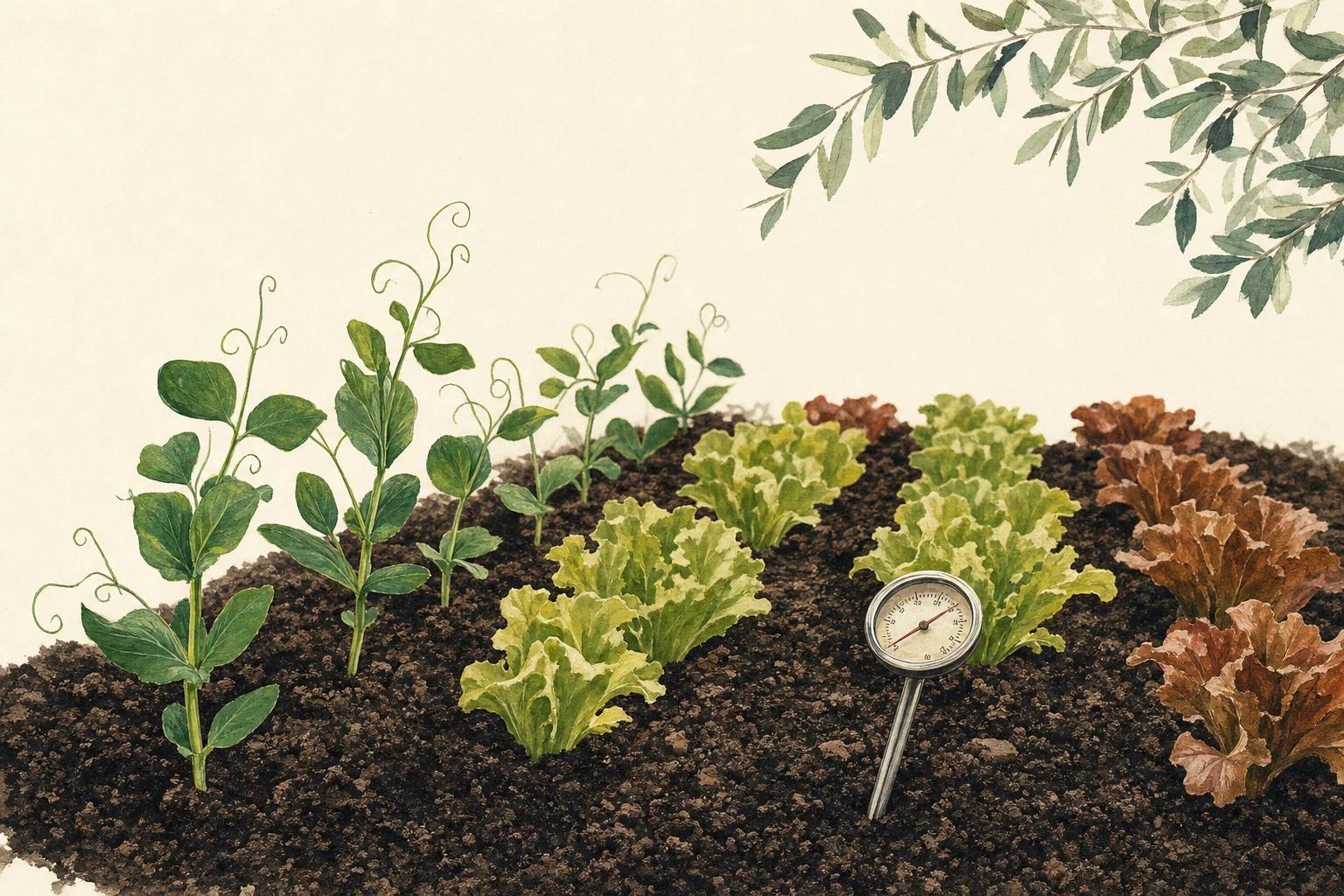
Sow when a soil thermometer pushed 4 inches (10 cm) into the bed reads at least 40°F (4°C) at 8 a.m., before the sun warms the bed. The soil should also crumble in your hand rather than smear.
| Soil at 4 in (10 cm) | What radish seed does |
|---|---|
| Below 40°F (4°C) | Too cold to sow; growth stalls |
| 40–45°F (4–7°C) | Minimum for sowing; slow start |
| 45–85°F (7–29°C) | Germinates reliably |
| 55–75°F (13–24°C) | Best germination |
| Above 95°F (35°C) | Seed will not germinate |
In workable soil, seedlings appear in 3 to 10 days; keep the seedbed damp and uncrusted until they are up.
There is no indoor head start to plan for. The root is the crop, and moving a seedling sets it back, so radishes are always sown where they will grow. For an earlier spring harvest, sow into a cold frame, window box or container in a sheltered spot in late winter instead.
How to sow radish seed
Radishes want loose soil, modest fertility, at least 6 hours of direct sun (8 to 10 is better) and steady moisture; they tolerate partial shade.
- Loosen the bed. Fork the soil at least 6 inches (15 cm) deep for round radishes and about 12 inches (30 cm) for long daikon types, then rake it fine. In heavy clay, a raised bed gives the roots loose soil to swell in.
- Keep fertility low. Excess nitrogen builds big leaves over small roots, so skip the manure and fertilize lightly, or only as a soil test directs. Aim for a pH of 6.0 to 7.0.
- Sow shallow and thin. Cover seed 1/4 to 1/2 inch (6–13 mm) deep, or up to 1 inch (2.5 cm) for large daikons. Space seeds about 1 inch (2.5 cm) apart in rows 10 to 24 inches (25–60 cm) apart, which means less thinning later.
- Cover the row. Lay floating row cover over the row on sowing day so flea beetles and cabbage root maggots cannot reach the seedlings.
- Thin at two true leaves. Pull or snip extras so round and French types stand 2 to 3 inches (5–7.5 cm) apart and daikons 4 to 6 inches (10–15 cm). Crowded radishes make small, misshapen roots or none at all.
- Water evenly. Give about 1 inch (2.5 cm) a week, and more often on sand. Dry spells followed by a soaking crack the roots, and a radish that grows slowly for lack of water turns hot and pithy.
Sprinkle a few radish seeds along the rows of slow crops such as carrots, beets, lettuce and kohlrabi. The radishes sprout within days, mark the row for weeding, and are pulled before the slower crop needs the room.
Radish types and how they change the timing
A variety's speed and heat tolerance decide how much of each window you can use, and the large Asian types belong to late summer rather than spring.
| Variety | Type | Days to maturity | Notes | Best sowing |
|---|---|---|---|---|
| Rover | Round red hybrid | 21 | Tolerates heat stress | Spring and fall |
| French Breakfast | Long French | 21 | Handles warmth better than most | Spring to early summer, fall |
| Mini Mak | Korean daikon hybrid | About 50 | Root 4–5 in (10–13 cm) long; bolt tolerant | Spring and summer |
| Red Meat | Watermelon | 50 | 2–4 in (5–10 cm) across, pink flesh | Summer to fall |
Days to maturity are seed-company figures from direct sowing to harvest.
Rover, listed at 21 days, suits a short northern spring. Cherry Belle is a small, scarlet round grown in most regions, and in the Southeast Scarlet Globe and Cherriette are good red rounds too. When the spring window is nearly over, switch to French Breakfast, the white Icicle type or Rover, which cope with rising temperatures better than other early radishes. Radishes grow best in relatively short days of 10 to 12 hours and temperatures of 50 to 70°F (10–21°C). Late spring brings long days and rising heat together, which is where ordinary varieties fail, while a fall sowing matures as the days shorten and cool.
Daikon and other winter radishes take far longer and grow far bigger: a daikon can reach 18 inches (45 cm) long and 5 to 6 pounds (2.3–2.7 kg). Sow most of them from midsummer into late summer so they size up in fall, and treat watermelon radishes the same way, since Red Meat is likely to bolt if sown in spring. Small Korean hybrids such as Mini Mak are the exception, with enough bolt tolerance for spring and summer sowings.
Succession and fall sowings
Sow a short row every 7 to 14 days through each window instead of one long row, because radishes go pithy within days of reaching full size.
Match the row length to what your household eats in a week or so. Three sowings 10 to 14 days apart fill the 5-week spring window. Stop when the window closes, not when the seed packet runs out.
The fall window opens 10 weeks before the median first fall frost and closes 6 weeks before it. Fall radishes start in warm soil and finish in cool air, the reverse of spring, so the roots size up as temperatures drop into the range they prefer. Sow daikons and watermelon radishes at the start of the window, since they need far longer than round types.
Winter types also keep. Pulled before the ground freezes, winter radishes and daikons keep for up to several months in moist, cold storage near 32°F (0°C), but only a week or two in a fridge crisper; Red Meat lasts 6 to 10 weeks at 32°F (0°C). When the last fall radishes come out, the bed is free for fall-planted garlic.
What goes wrong when you sow too early or too late
Sowing too early mostly wastes seed, while sowing too late wastes the crop.
Too early. Below 40°F (4°C), radish barely grows, so seed sown into frozen or cold, wet ground is slow to come up, and the early start buys little. Frost on the seedlings is not the risk; cold soil is. Wait for the soil reading rather than the calendar.
Too late in spring. A crop that matures above 80°F (27°C) often bolts, and the roots are more often deformed, woody, hollow or fiery. Stress in the first 6 weeks, from heat or dry soil, can also push plants to flower early. If the window has closed, sow Mini Mak or wait for the late-summer sowing.
Too hot in late summer. In the South and the deserts, seed sown into soil above 95°F (35°C) will not sprout. Hold off until the heat breaks.
Too late in fall. A sowing made after the window closes grows slowly as the soil cools toward 40°F (4°C), and the roots may still be small when a hard freeze arrives.
Left too long. Even a well-timed crop fails if it stays in the ground. Mature roots crack, go pithy and turn hot within days, which is why small, frequent sowings beat one big one.
Frost, harvest and what to expect
Radishes are hardy: heavy frosts in spring and fall do them no real damage, so a late cold snap is no reason to resow, and no frost protection is needed; leave the insect cover in place.
The one exception is a hard freeze on a mature crop: pull fall roots before the ground freezes hard.
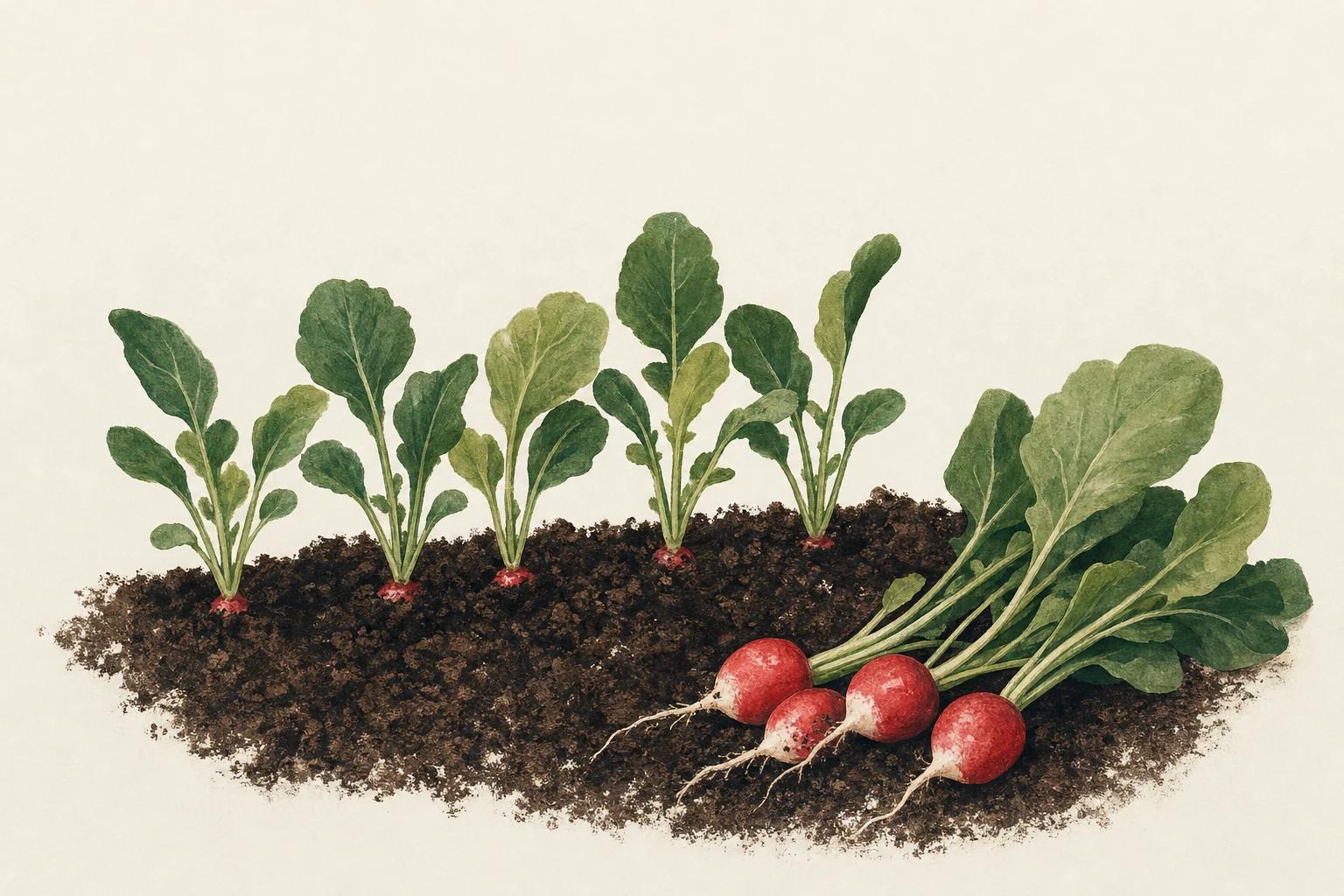
Expect seedlings in 3 to 10 days and the first round radishes 3 to 4 weeks after sowing. Brush the soil from the shoulder of a root to check its size, and pull red radishes before they pass about 1 inch (2.5 cm) across and white ones before about 3/4 inch (2 cm). Roots left past that point lose their crispness quickly.
To fit radishes around the rest of your spring and fall crops, compare the planting dates for other vegetables and add your sowing windows to Sow's garden calendar.
Frequently asked questions
Do radishes transplant well?
No, not as bare-root seedlings. The one workable exception is a seedling raised in its own small container until its roots are well developed, then planted out with the root ball intact so the taproot is never disturbed. Even that saves little time, since round types sown straight into the bed are ready 3 to 5 weeks later, so sowing in place and thinning is simpler.
What do radishes look like growing?
Above ground you see only a cluster of leafy green tops; the part you eat is the swollen root underneath. Spring radishes are ready when that root is about 1 inch (2.5 cm) across, often 3 to 4 weeks after sowing, while daikon types keep going and can reach 18 inches (45 cm) long. Roots may be scarlet, white or pink-fleshed depending on the variety.
How much water do radishes need to grow?
About 1 inch (2.5 cm) a week. Radish roots spread very little sideways, so the water has to soak down to the taproot: an inch wets sandy soil about 10 inches (25 cm) deep and heavy clay about 6 inches (15 cm). Check with a trowel after watering, and keep going if only the top inch or two is wet. A 3 to 4 inch (7.5–10 cm) mulch of herbicide-free grass clippings holds moisture between waterings.
How many radishes will grow from one seed?
One. Each seed grows a single plant with a single root, so the number of radishes you pick equals the number of seedlings you keep after thinning. Sowing seed about 1 inch (2.5 cm) apart and thinning to 2 to 3 inches (5–7.5 cm) gives roughly four to six radishes per foot (30 cm) of row.
How long do radishes take to grow?
Round and French spring radishes take 3 to 5 weeks from sowing, and the quickest varieties, such as Rover and French Breakfast, are listed at 21 days. Compact Korean daikons such as Mini Mak and the Red Meat watermelon radish take about 50 days, and full-size daikons take longer. In the low desert, allow 30 to 60 days, and expect any radish to run slower when soil and air stay near the 40°F (4°C) floor for growth.
Can you plant radishes in summer?
Not standard spring types in a hot summer, which often bolt. For a summer sowing, choose a variety that copes: Rover tolerates heat stress, French Breakfast holds up better than most early types if it is watered regularly, and the Korean hybrid Mini Mak has enough bolt tolerance for summer sowings. Where summers are hot, the safer plan is to wait for the late-summer window, 10 to 6 weeks before your first fall frost.
Why are my radishes all leaves and no root?
The usual causes are crowding, too much nitrogen, heat and too little sun. Seedlings left touching, closer than about 1 inch (2.5 cm), compete and stay thin, rich or freshly manured soil pushes leaf growth, and roots maturing in hot weather often bolt instead of swelling. For full-size roots give the bed 6 hours or more of direct sun; radishes tolerate partial shade, but a shaded bed is the next thing to check.
When should you plant daikon radishes?
Sow most daikon and winter radishes in midsummer to late summer so they mature in the cool weeks of fall instead of bolting in summer heat. Bolt-tolerant Korean hybrids such as Mini Mak can also go in during spring. Thin daikons to 4 to 6 inches (10–15 cm), and lift the main crop before the ground freezes; in moist, cold storage the roots keep for up to several months, but only a week or two in a fridge.
Can you grow radishes in containers?
Yes. Spring radishes grow well in window boxes and patio containers, sown in the same windows as a garden bed. Choose a container at least as deep as you would loosen a bed: 6 inches (15 cm) for round types and about 12 inches (30 cm) for long daikons. Sow seed about 1 inch (2.5 cm) apart and thin round types to 2 inches (5 cm), since crowded roots fail to swell.
References
- University of Minnesota Extension. Growing radishes in home gardens. Accessed October 16, 2026.
- Utah State University Extension. Radishes in the Garden. Accessed October 16, 2026.
- Colorado State University Extension. Vegetable Planting Guide. Accessed October 16, 2026.
- University of Maryland Extension. Growing Radishes in a Home Garden. Accessed October 16, 2026.
- Clemson Cooperative Extension Home & Garden Information Center. Carrot, Beet, Radish & Parsnip (HGIC 1305). Accessed October 16, 2026.
- University of Illinois Extension. Radish. Accessed October 16, 2026.
- UF/IFAS Extension. Florida Vegetable Gardening Guide (SP 103/VH021). Accessed October 16, 2026.
- Texas A&M AgriLife Extension. Texas Home Vegetable Gardening Guide (EHT-077). Accessed October 16, 2026.
- Texas A&M AgriLife Extension. Fall Vegetable Gardening Guide for Texas. Accessed October 16, 2026.
- University of Missouri Extension. Vegetable Planting Calendar (G6201). Accessed October 16, 2026.
- Oregon State University Extension Service. Vegetable Gardening in Oregon (EC 871). Accessed October 16, 2026.
- Washington State University Extension. Home Vegetable Gardening in Washington (EM057E). Accessed October 16, 2026.
- University of Arizona Cooperative Extension. Vegetable Planting Calendar for Maricopa County (az1005). Accessed October 16, 2026.
- University of California Statewide IPM Program (UC ANR). Cultural Tips for Growing Radish. Accessed October 16, 2026.
- Johnny's Selected Seeds. Rover (F1) Radish. Accessed October 16, 2026.
- Johnny's Selected Seeds. French Breakfast Radish. Accessed October 16, 2026.
- Johnny's Selected Seeds. Mini Mak (F1) Daikon/Korean Radish. Accessed October 16, 2026.
- Johnny's Selected Seeds. Red Meat Radish. Accessed October 16, 2026.
- USDA Agricultural Research Service. 2023 USDA Plant Hardiness Zone Map. Accessed October 16, 2026.
- NOAA National Centers for Environmental Information. U.S. Climate Normals (1991–2020). Accessed October 16, 2026.
Sow Editorial
Written by the Sow team from university extension services, botanical gardens, USDA and NOAA data and plant breeders. Every source is listed under References.