Quick answer
Plant watermelon once frost danger has passed and the soil 4 inches (10 cm) down holds at least 65°F (18°C). That means April across the South, May in the Midwest, and late May to early June in the far North and coastal Northeast. Finish sowing by mid- to late June in most regions. Transplants can go out at 60°F (16°C); seed needs 70°F (21°C).
Key facts
- Timing rule
- 1–2 weeks after the 1-in-10 last-frost date, once soil holds 65°F (18°C)
- Last sowing
- About 18 weeks before the median first frost in the North; mid- to late June in Zones 7–8; earlier in Texas and the Gulf
- Soil temperature
- 65°F (18°C) at 4 in (10 cm); 60°F (16°C) for transplants, 70°F (21°C) for seed
- Days to maturity
- 80–100 from seed; about 65–90 from transplants, depending on variety
- Indoor start
- 3–4 weeks before planting out, in plantable pots
- Frost tolerance
- None; growth slows below 50°F (10°C)
- Seed depth
- About 1 in (2.5 cm), 2–5 seeds per hill
- Fastest varieties
- Yellow Doll (68 days), Lantha (74), Sugar Baby (75 from transplant)
Watermelon goes into the garden after frost danger has passed and the soil 4 inches (10 cm) below the surface holds 65°F (18°C) or more. On the calendar, that is 1 to 2 weeks after the date when only 1 spring in 10 still brings a later frost. Across most of the country it falls between early April and early June, and sowing should be finished by mid- to late June.
Two choices shift the date within that window. Transplants can go out once the soil reaches 60°F (16°C) and ripen up to 2 weeks sooner; seed sown straight into the garden wants 70°F (21°C). Black plastic and row covers can buy a little more time where summers are short.
Watermelon planting dates by city
Start in the first date column once the soil passes 65°F, and sow seed no later than the second.
| City (USDA zone) | Median last frost | Median first frost | Start planting (soil 65°F) | Last sowing (early varieties) |
|---|---|---|---|---|
| Fargo, ND (4a) | May 10 | Sep 30 | May 30 – Jun 6 | Transplants of early varieties only |
| Minneapolis, MN (5a) | Apr 23 | Oct 18 | May 14 – May 21 | Jun 12 – Jun 19 |
| Chicago, IL (5b) | Apr 16 | Oct 28 | May 8 – May 15 | Jun 22 – Jun 29 |
| Denver, CO (6a) | May 5 | Oct 9 | May 26 – Jun 2 | Jun 3 – Jun 10 |
| Detroit, MI (6b) | Apr 20 | Oct 27 | May 15 – May 22 | Jun 21 – Jun 28 |
| Kansas City, MO (6b) | Apr 13 | Oct 24 | May 6 – May 13 | Jun 18 – Jun 25 |
| Boston, MA (7a) | Apr 4 | Nov 9 | Late May – early June, once soil holds 65°F | Mid- to late June |
| Salt Lake City, UT (7b) | Apr 8 | Oct 31 | May 7 – May 14 | Mid- to late June |
| New York, NY (7b) | Mar 30 | Nov 20 | Late May – early June, once soil holds 65°F | Mid- to late June |
| Nashville, TN (7b) | Mar 31 | Nov 3 | Apr 23 – Apr 30 | Mid- to late June |
| Raleigh, NC (8a) | Mar 31 | Nov 4 | Apr 23 – Apr 30 | Mid- to late June |
| Atlanta, GA (8a) | Mar 15 | Nov 20 | Apr 11 – Apr 18 | Mid- to late June |
| Dallas-Fort Worth, TX (8b) | Mar 8 | Nov 24 | Apr 2 – Apr 9 | Mid-April; fall crop early to mid-Aug |
| Seattle, WA (9a) | Mar 2 | Nov 23 | Transplant in early June | Early June (transplants) |
| Sacramento, CA (9b) | Feb 2 | Dec 2 | Mid-April, once soil is warm | End of June |
| Houston, TX (9b) | Feb 13 | Dec 9 | April (late March is marginal) | End of May (June – July marginal) |
Frost dates are medians from NOAA 1991–2020 climate normals for each city's main weather station; in half of years the last frost falls later than the date shown.
The start column opens 7 to 14 days after each city's 1-in-10 last-frost date, the date after which frost strikes in only 1 year in 10. In Zones 6 and colder, the last-sowing column counts back 121 to 128 days from the median first frost, the latest that seed of an early variety still ripens. Most Zone 7 and 8 cities close in mid- to late June, Dallas-Fort Worth ends its spring planting in mid-April, and the coastal Northeast and the three Zone 9 cities follow the soil and local calendars.
For any other town, add 3 to 4 weeks to your median last spring frost, or 1 to 2 weeks to the 1-in-10 date, and plant on the first day the soil test below passes. North of Zone 7, find the last sowing date by counting back about 18 weeks from your median first fall frost. In Zones 7 and 8, finish by mid- to late June, or earlier in Texas and along the Gulf.
The start dates sit about 3 to 4 weeks after each median frost on purpose. Watermelon has no frost tolerance at all, and even a light frost badly injures the vines, so the rule waits for the date when a late frost has become unlikely rather than merely possible.
A few rows deserve a second look. Boston's frost dates come from Logan Airport on the harbor and New York's from Central Park, and both medians fall early in spring. Plant there once the soil holds 65°F (18°C); in nearby New England that usually comes at the end of May or the first days of June. Fargo and Denver are the opposite case: their seasons are too short for much margin, so set out transplants of a fast variety. A Sugar Baby transplant planted in Fargo on June 6 needs about 75 days, ripening around August 20, roughly 6 weeks before the median first frost.
Seattle, Sacramento and Houston have early last frosts, but frost is not what holds them back. West of the Cascades, transplants go out in early June. Sacramento sows seed from mid-April through June, and Houston plants in April and May.
Planting windows by region
North of Zone 7 the window falls in May or June; across the South it falls in April, and in Florida and the low desert it moves into late winter.
| Region | Planting window | Notes |
|---|---|---|
| Central Iowa | Mid-May | A week earlier in the south of the state, a week later in the north |
| Central North Carolina | Mid-April to late June | Seed or transplants |
| South Carolina | Piedmont Apr 15–Jun 15; coast Apr 1–30 | No fall crop |
| Texas | 1–6 weeks after the average last frost | Fall crop 14–16 weeks before the first freeze |
| Houston area | April–May | Late March and June–July are marginal |
| Florida | North late Mar–Apr; central Jan–Mar; south Dec–Mar | Winter and spring plantings |
| Phoenix low desert | Mid-Feb to mid-Mar | Sow seed; 90–120 days to harvest |
| Sacramento | Mid-April through June | Sow seed in the garden |
| Western Oregon valleys | May | Start indoors 4 weeks earlier |
| Western Washington | Transplant early June | Seed indoors 3–4 weeks earlier |
Windows are for the main spring planting; the soil test still overrides the date in a cold spring.
Upper Midwest and northern plains. Short summers make watermelon transplants and early varieties the safe plan here, set into soil warmed under black plastic. Iowa's mid-May planting moves later as you go north; in Minnesota and the Dakotas, use the city table.
Mountain West. Denver's window opens around May 26 and Salt Lake City's around May 7. Transplants mature about 2 weeks earlier than seeded melons, which makes them the recommended route in short-season Utah gardens. In Colorado, sow seed directly once the soil is warm, or use a transplant only 2 to 3 weeks old so the roots are disturbed as little as possible.
Texas and the Gulf Coast. Plant 1 to 6 weeks after the average last frost, once frost danger is over and the seed zone tops 70°F (21°C), with transplants preferred. Around Dallas-Fort Worth that runs from mid-March to mid-April, and the city table's dates sit in the later half because they wait for warm soil. Around Houston, April and May are the ideal months.
Low desert. Sow seed from mid-February to mid-March and not before the soil warms. Low-desert melons take 90 to 120 days, and growth slows once days pass 95°F (35°C).
Pacific Northwest. Plant in May in the western Oregon valleys and in early June west of the Cascades in Washington, always from transplants. Watermelon is not recommended on the Oregon coast or at high elevation.
California. In the Sacramento Valley, sow seed in the garden from mid-April through June, once a morning reading at 4 inches (10 cm) holds 70°F (21°C), the temperature seed needs.
How to tell the soil is ready
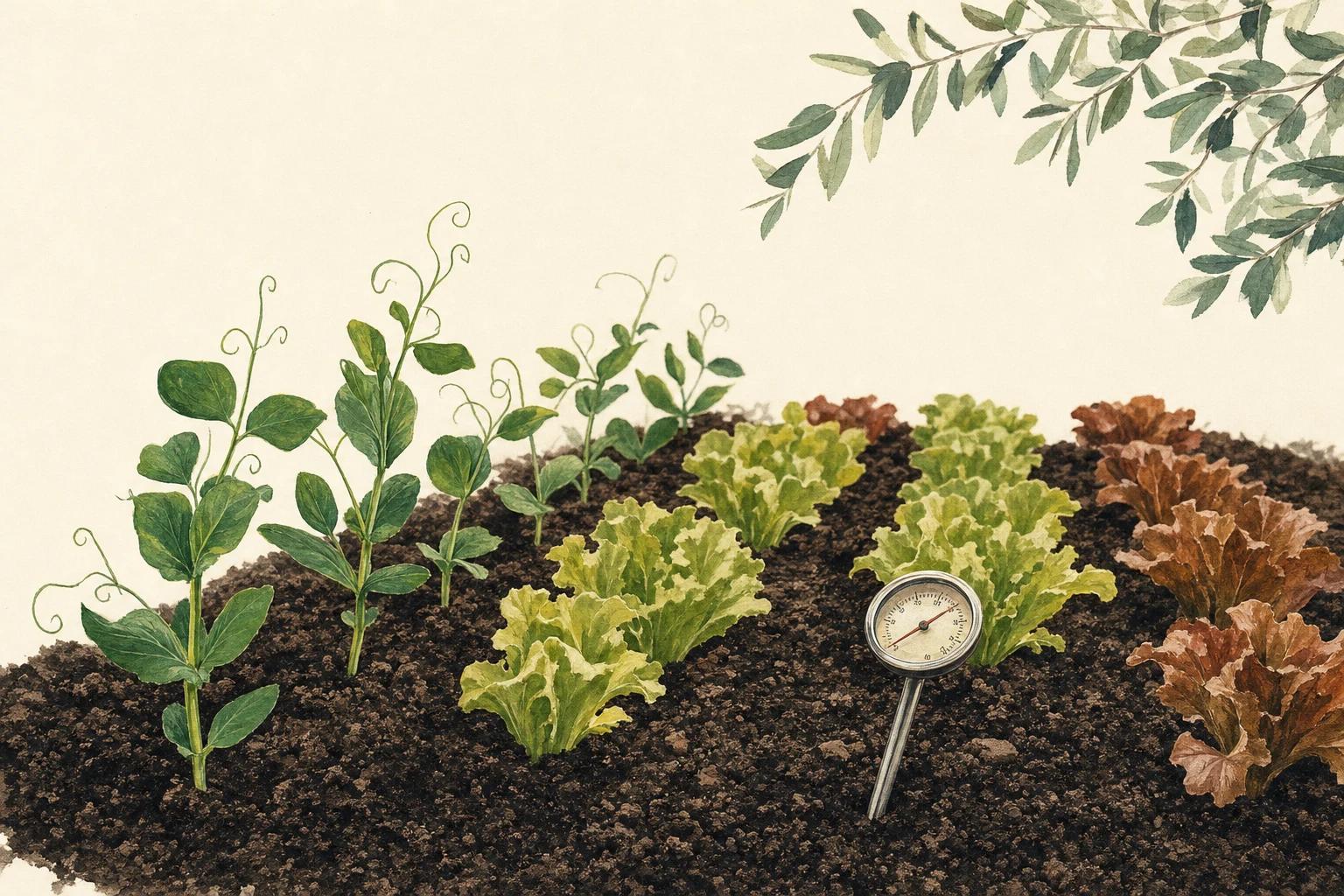
Push a soil thermometer 4 inches (10 cm) into the bed at about 8 a.m., when the soil is coolest, and plant once it reads 65°F (18°C).
Recommended thresholds span 10 degrees, and the method of planting explains most of the spread. Transplants can go out into 60°F (16°C) soil. Seed needs 70°F (21°C) and germinates fastest near 90°F (32°C). A 65°F (18°C) reading covers both reasonably well. A kitchen meat thermometer works if you have no soil probe.
Check the air as well. Watermelon grows best when days run 80–95°F (27–35°C) and nights stay at 60–70°F (16–21°C), and growth stalls below 50°F (10°C). Wait until days stay consistently above 55°F (13°C).
Gaining time with black plastic and row covers
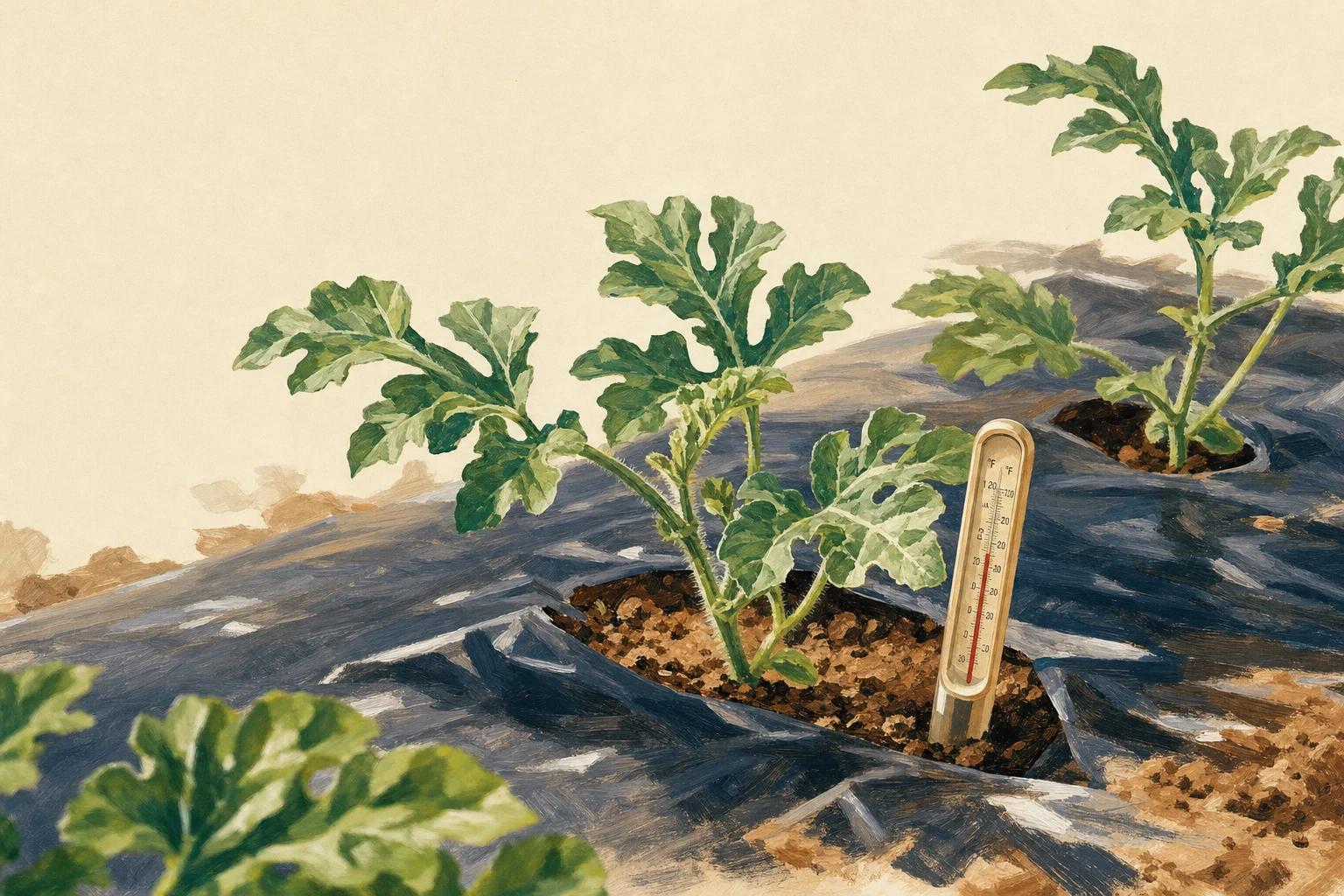
Black plastic mulch warms a cold bed and brings the crop on earlier. Lay it over moist soil and cut a hole for each plant; it works well stretched over a mounded or raised bed. Under black plastic with a floating row cover kept on, you can plant up to 2 to 3 weeks before the last frost, but only once the soil under the plastic reads 65°F (18°C). Leave the cover in place through every cold night.
The row cover must come off when the first female flowers open, so bees can reach them. Hold off on straw or other organic mulch until the soil passes 75°F (24°C).
Transplants or direct seed
Grow transplants wherever the season is short, and sow directly only where warm soil arrives early and summers are long.
Start watermelon indoors 3 to 4 weeks before your outdoor planting date, not before your last frost. Some seed packets count back from the last frost, which leaves seedlings ready a week or two before the soil is. Seedlings that grow too big for their pots become root-bound and transplant poorly, so a late start is safer than an early one. In the coldest regions a 4- to 6-week-old transplant is acceptable, but treat that as the outer limit.
Watermelon roots resent disturbance. Sow 2 to 3 seeds in a peat or other plantable pot and keep the strongest. Set seedlings out when they carry 1 to 3 true leaves, after 4 to 7 days of hardening off outdoors in a sheltered spot. Plant the whole pot, or slide the root ball out without breaking it.
Direct sowing costs time. Catalog days often count from transplanting, so add 10 to 14 days when you sow seed in the garden. Where soil reaches 70°F (21°C) in spring and the frost-free season runs long, as in the low desert, direct sowing is the norm.
Planting depth and spacing
Sow watermelon seed about 1 inch (2.5 cm) deep, 2 to 5 seeds to a hill, and thin each hill to the strongest 1 to 3 plants.
Recommended depths range from 1/2 inch (1.3 cm) on seed packets to 1.5–2 inches (4–5 cm) in Florida plantings. Spacing depends on how much ground you can give the vines.
| Layout | Between plants or hills | Between rows |
|---|---|---|
| Hills, wide spacing | 6 ft (1.8 m) | 7–10 ft (2.1–3 m) |
| Hills, close spacing | 2–3 ft (60–90 cm) | 6–8 ft (1.8–2.4 m) |
| Single plants, wide rows | 3 ft (90 cm) | 7–8 ft (2.1–2.4 m) |
| Single plants, narrow rows | 4 ft (1.2 m) | 5 ft (1.5 m) |
Allow 18–24 square feet (1.7–2.2 m²) per plant; compact Sugar Baby can go 12–18 inches (30–45 cm) apart in 6-foot (1.8 m) rows.
Varieties that change the timing
The variety moves your harvest by a month: a fast icebox watermelon ripens in under 70 days, while a large heirloom needs 90 to 100.
| Type | Examples (days) | Fruit size |
|---|---|---|
| Icebox | Yellow Doll (68), Sugar Baby (75) | 5–12 lb (2.3–5.4 kg) |
| Mid-size, early | Lantha (74) | 12–14 lb (5.4–6.4 kg) |
| Large, seeded | Crimson Sweet (85), Royal Sweet (85), Sangria (87) | 15–26 lb (6.8–11.8 kg) |
| Seedless | Millennium (78) to Millionaire (92) | 16–22 lb (7.3–10 kg) |
| Large heirloom | Moon and Stars (90–100) | 25–40 lb (11–18 kg) |
Days are average days to maturity from variety trials and seed catalogs; Sugar Baby's count from transplanting, so add 10–14 days for seed sown in the garden.
In the North, pick from the fast end. Yellow Doll, Lantha and Sugar Baby suit Fargo, Minneapolis and Denver, where planting closes around mid-June or earlier and the median first frost falls between late September and mid-October. Save Moon and Stars for a long season, such as an April planting in the South.
Seedless melons set no fruit on their own, so plant a seeded variety alongside as a pollenizer. Seedless fruit is often sweeter, which repays the extra planning.
Planting too early or too late
Early planting gambles the crop on frost and cold soil; late planting leaves fruit ripening as autumn nights cool.
Watermelon seed in cold soil rots, and the seedlings that do emerge are prone to disease. A transplant set out too soon stops growing while the soil and nights stay cold, and a single frost can ruin it.
Late planting costs flavor as well as fruit. Melons that ripen during a short or cool season taste flat. In central Iowa, June 20 is the last practical sowing date, and only for early varieties. In the South Carolina Piedmont the window closes June 15. To test a late date, count your variety's days to maturity forward from planting. If the fruit would still be ripening when your median first fall frost arrives, choose a faster variety.
A fall crop works only where the season is very long: Texas plants one 14 to 16 weeks before the first freeze, while South Carolina does not recommend it. Once the vines come out, use the bed for a cool-season crop such as garlic.
If a late frost threatens
Cover plants before sunset with a floating row cover, which gives some frost protection; it can stay in place until the first female flowers open. If frost kills a planting, replace it with transplants rather than seed; that recovers the most time. In northern gardens, resow only a variety short enough to ripen before your first fall frost.
From planting to harvest
Each watermelon fruit ripens about 35 to 45 days after its flower is pollinated, and a healthy vine carries 2 to 3 melons.
In dry weather, give 1 to 2 inches (2.5–5 cm) of water every 7 to 10 days. As the fruit nears full size, halve the amount applied each time, but do not let the vines wilt.
Judge ripeness by the ground spot, the tendril nearest the fruit and the rind together. In some varieties the tendril browns 7 to 10 days before the fruit is ready, so it is never enough on its own.
Store picked melons at 50–60°F (10–16°C); below 40°F (4°C) the fruit suffers chilling injury. A 25- to 40-pound (11–18 kg) heirloom is a two-handed lift, so bend your knees and carry it close.
The same frost-and-soil logic sets the date for other warm-season crops; see tomato planting times and pumpkin planting dates. To keep your watermelon window alongside the rest of your vegetable planting dates, add it to Sow's garden calendar.
Frequently asked questions
Can I just throw watermelon seeds in the ground?
Only once the soil is truly warm. Watermelon seed sown into cold ground rots or comes up weak, so wait until frost is over and the soil reads 70°F (21°C). Push 2 to 5 seeds about 1 inch (2.5 cm) deep in each hill and thin to the strongest 1 to 3 seedlings. In short-season areas, transplants grown for 3 to 4 weeks are the safer bet.
How long does it take for a watermelon to grow?
Most varieties take 80 to 100 days from seed to ripe fruit, or about 65 to 90 days from the day a transplant goes into the garden, depending on the variety. Each melon needs about 35 to 45 days after its flower is pollinated. Small icebox types such as Yellow Doll finish fastest, while heirloom Moon and Stars needs 90 to 100 days.
How many watermelons will grow off one plant?
Plan on 2 to 3 melons per plant. The number depends heavily on bees, because each plant carries separate male and female flowers and each female flower can be pollinated on one day only. Row covers left on past the first female blooms, or a seedless variety planted without a seeded partner, are two common reasons for few or no fruit.
How do I make my watermelon sweeter when growing?
Keep the vines free of stress from planting to harvest. Wilting, long cool spells, insects, disease, weeds, poor nutrition and swings between drought and soaking all reduce flavor. Plant early enough that the fruit ripens in summer warmth rather than as nights cool in autumn, and pick only when the ripeness signs line up, because a watermelon gains no sugar after it leaves the vine.
Is it too late to plant watermelon in June?
Often not, if you choose a fast variety and count forward. A Sugar Baby transplant set out on June 25 needs about 75 days, so it ripens around September 8; seed sown in the garden the same day takes 10 to 14 days longer, into the third week of September. If your median first fall frost comes before the fruit would ripen, use transplants of an early variety or skip the year.
Should I start watermelon seeds indoors?
Yes, wherever the summer is short. Sow 3 to 4 weeks before your outdoor planting date, 2 to 3 seeds to a plantable pot, and keep the strongest seedling. In Minneapolis, where planting opens around May 14, that means sowing indoors in mid- to late April. Transplants ripen up to 2 weeks ahead of seed sown in the garden.
Can you plant watermelon in the fall?
Not in most of the US. A fall crop is not recommended even in South Carolina, and the Phoenix low desert sows only from mid-February to mid-March. Texas is the exception: a fall planting goes in 14 to 16 weeks before the first freeze, which around Dallas-Fort Worth means early to mid-August. South Florida plants from December, and around Houston June and July plantings are marginal.
How do I know when a watermelon is ripe?
Look for three signs together. The pale spot where the melon rests turns cream or buttery yellow, the curly tendril nearest the fruit browns and dries, and the rind loses its shine and resists your thumbnail. Thumping is unreliable, so do not pick on sound alone; a melon cut too early stays bland, because it will not ripen further off the vine.
What is the secret to growing watermelons?
Warm soil, steady care and bees. Plant only after frost into soil of 65°F (18°C) or warmer, warming it under black plastic where springs are cool. Water deeply in dry spells, keep weeds, insects and disease down, and take any row cover off when the first female flowers open, because each one can be pollinated on a single day.
References
- University of Illinois Extension. Watermelon. Accessed October 16, 2026.
- Iowa State University Extension and Outreach. Growing Watermelon in the Home Garden. Accessed October 16, 2026.
- Penn State Extension. Watermelon Production. Accessed October 16, 2026.
- Clemson Cooperative Extension Home & Garden Information Center. Watermelon. Accessed October 16, 2026.
- NC State Extension. Central North Carolina Planting Calendar for Annual Vegetables, Fruits, and Herbs (AG-756-01). Accessed October 16, 2026.
- University of New Hampshire Extension. Growing melons in New Hampshire. Accessed October 16, 2026.
- UF/IFAS Gardening Solutions. Watermelon. Accessed October 16, 2026.
- UF/IFAS Extension. Vegetable Gardening Guide: Table of planting dates, spacing and days to harvest (VH021). Accessed October 16, 2026.
- Texas A&M AgriLife Extension Service. Texas Home Vegetable Gardening Guide (EHT-077). Accessed October 16, 2026.
- Texas A&M AgriLife Extension Service. Watermelon (Commercial and Specialty Crop Guide). Accessed October 16, 2026.
- Texas A&M AgriLife Extension Service, Harris County. Vegetable Planting Calendar for Harris County. Accessed October 16, 2026.
- University of Arizona Cooperative Extension. Vegetable Planting Calendar for Maricopa County. Accessed October 16, 2026.
- UC Cooperative Extension Sacramento County Master Gardeners. Sacramento Vegetable Planting Schedule (EHN 11). Accessed October 16, 2026.
- Oregon State University Extension Service. Vegetable Gardening in Oregon (EC 871). Accessed October 16, 2026.
- Washington State University Extension. Home Vegetable Gardening in Washington (EM057E). Accessed October 16, 2026.
- Utah State University Extension. Watermelon in the Garden. Accessed October 16, 2026.
- Colorado State University Extension. Vegetable Planting Guide. Accessed October 16, 2026.
- High Mowing Organic Seeds. Sugar Baby Watermelon. Accessed October 16, 2026.
- Baker Creek Heirloom Seeds. Watermelon, Moon and Stars. Accessed October 16, 2026.
- NOAA National Centers for Environmental Information. U.S. Climate Normals 1991–2020: Annual/Seasonal freeze data. Accessed October 16, 2026.
Sow Editorial
Written by the Sow team from university extension services, botanical gardens, USDA and NOAA data and plant breeders. Every source is listed under References.