Quick answer
Sow wildflower seed in fall. In Zones 3 to 7 and the Southeast, scatter it from your first hard freeze to five weeks after, roughly October to early January depending on the city, so it lies dormant until spring. Texas sows from September to November, and the West Coast sows with the fall rains. Spring sowing works, but grasses and weeds win more often.
Key facts
- Timing rule, Zones 3–7 and the Southeast
- From the median first hard freeze to 5 weeks after, roughly October to early January
- Texas and the West Coast
- Texas Sept to Nov, earlier farther north; California mid-Oct to late Nov; Pacific Northwest late Sept to early Nov
- Soil temperature, dormant sowing
- A ceiling, not a minimum: in cold-winter areas and the Southeast, wait until soil stays below 40–50°F (4–10°C)
- Germination and first bloom
- Some seed sprouts in 10–20 days, most fall-sown seed in spring; annuals bloom the first season, perennials in year 2 or 3
- Seeding rate
- 4–8 oz per 1,000 sq ft (1.2–2.4 g per m²), or the rate on the mix label
- Seed depth
- On the surface to about 1/4 in (6 mm), pressed in for firm contact
- Spring fallback
- Sow as early as the ground can be worked, using annuals or perennial seed chilled first
- Site prep
- Kill the existing vegetation first; skip deep tilling, manure and nitrogen fertilizer
Sow wildflower seed in fall. Where winters are cold, and across the Southeast, the seed goes down from the first hard freeze onward and lies dormant until spring, while winter's cold and damp break the dormancy that keeps many native perennials from sprouting. In Texas, California and Florida it goes down earlier, into still-warm soil, so many annuals sprout with the fall rains and grow through the cool months before flowering in spring.
Timing only pays off on clean ground. Weed competition, not the sowing date, is the main reason new meadows fail, so the work starts a season before the seed bag is opened. The sections below give the dates for your area, then the preparation, sowing method and first three years that turn a fall sowing into a meadow.
Wildflower seed planting dates by city
Each row gives one city's fall sowing window and what sets it. In Zone 7 and colder, and in the Southeast, the window runs from the median first hard freeze, which lands later than the first light frost shown beside it, to five weeks after. Texas and West Coast cities follow a fall calendar or the fall rains instead of a frost date.
| City (USDA zone) | Median last frost | Median first frost | Fall sowing window | What sets the date |
|---|---|---|---|---|
| Fargo, ND (4a) | May 10 | Sep 30 | Oct 10 – Nov 14 | First hard freeze |
| Minneapolis, MN (5a) | Apr 23 | Oct 18 | Oct 29 – Dec 3 | First hard freeze |
| Chicago, IL (5b) | Apr 16 | Oct 28 | Nov 7 – Dec 12 | First hard freeze |
| Denver, CO (6a) | May 5 | Oct 9 | Oct 18 – Nov 22 | First hard freeze |
| Detroit, MI (6b) | Apr 20 | Oct 27 | Nov 7 – Dec 12 | First hard freeze |
| Kansas City, MO (6b) | Apr 13 | Oct 24 | Nov 1 – Dec 6 | First hard freeze |
| Boston, MA (7a) | Apr 4 | Nov 9 | Nov 21 – Dec 26 | First hard freeze |
| Salt Lake City, UT (7b) | Apr 8 | Oct 31 | Nov 10 – Dec 15 | First hard freeze |
| New York, NY (7b) | Mar 30 | Nov 20 | Dec 1 – Jan 5 | First hard freeze |
| Nashville, TN (7b) | Mar 31 | Nov 3 | Nov 15 – Dec 20 | First hard freeze |
| Raleigh, NC (8a) | Mar 31 | Nov 4 | Nov 16 – Dec 21 | First hard freeze |
| Atlanta, GA (8a) | Mar 15 | Nov 20 | Dec 5 – Jan 9 | First hard freeze |
| Dallas-Fort Worth, TX (8b) | Mar 8 | Nov 24 | Sept to early Nov | Texas fall calendar |
| Seattle, WA (9a) | Mar 2 | Nov 23 | Late Sept to early Nov | Fall rains |
| Sacramento, CA (9b) | Feb 2 | Dec 2 | Mid-Oct to late Nov | Fall rains |
| Houston, TX (9b) | Feb 13 | Dec 9 | Sept to Nov | Texas fall calendar |
Frost dates are medians from NOAA 1991–2020 climate normals for each city's main weather station; Texas and West Coast rows give regional sowing months instead.
For a town not listed in Zone 7 or colder, or in the Southeast east of Texas, look up the median first hard freeze for your nearest weather station and sow from that date to 35 days after. In Texas, sow from September to early November in the north and through November near the Gulf; on the West Coast, use the regional windows further down.
Reading the table for your area
Boston's window falls about a month later than the mid- to late-October target used inland in New Hampshire. Away from the coast, lean toward the early end of your window, because November weather in northern New England is unpredictable and snow can arrive before the seed is down.
Raleigh and Atlanta follow the cold-winter rule because fall sowing in the Southeast is dormant seeding too, and sowing there can run on into February. In western Oregon, sowing from late September through early November is standard, and the later part of that span loses less seed to birds and rodents.
Why fall sowing beats spring for most wildflowers
Fall sowing gives seed the cold, damp winter that many native perennials need before they will germinate, a process called cold stratification. Outdoors, the job costs nothing: rain, snow and freezing nights soften the seed's dormancy and settle the seed into the soil surface by spring.
The timing differs by region because the seed does different things in different climates. In cold-winter zones and the Southeast, fall-sown seed is meant to sit dormant until spring; that is why the window opens only once the ground is cold enough to keep it from sprouting. In warm climates, many annual wildflowers germinate in fall, grow slowly through winter and flower in spring. Fall sowing in Texas, for example, is what lets Texas bluebonnet and other early bloomers flower from late winter into spring, and California sowings follow the same pattern of fall germination, winter growth and spring bloom. Western Oregon is different: seed broadcast there in early November is timed to sprout in spring.
Spring sowing is possible, but it tends to favor grasses over the wildflowers you want to dominate. It suits annual mixes in cold climates. Spring-sown perennials often do not flower until their second growing season.
Fall sowing windows by region
Fall is the preferred season in nearly every US region; only the start and end dates shift.
| Region | Fall window | Notes |
|---|---|---|
| New England | Late Sept to early Dec; mid- to late Oct is safest inland | Frost or snow seeding in Jan or Feb if fall is missed |
| Upper Midwest, Northern Plains, Mountain | Oct to Dec | Grass-heavy prairie mixes have a separate spring window |
| Mid-Atlantic | Oct to Jan | Perennial wildflower mixes |
| Southeast | Nov to Feb, once soil stays below 50°F (10°C); Sept to Nov in South Carolina as soil cools | Spring sowing March to late April |
| Texas | Sept 1 to Nov 30; earlier farther north | Dallas area: Aug to Thanksgiving or Dec 1 |
| Florida | North mid-Sept to late Oct; central mid-Oct to early Jan; south Nov to mid-Jan | Irrigated sowing can run to mid-April |
| California | Mid-Oct to late Nov for annuals | Possible through mid-Feb |
| Pacific Northwest | Late Sept to early Nov | Spring: mid-April in western Oregon |
Windows are for native wildflower mixes sown outdoors where they will grow; local weather in a given year can move the best date within them.
Cold-winter states
From the Northern Plains to New England, fall sowing is dormant seeding: the aim is cold, not growth, so the seed should still be lying dormant when the ground freezes. Grass-heavy prairie mixes are the exception, covered further down.
The South, Gulf Coast and Florida
In the Southeast, the soil sets the date more reliably than the calendar, using the temperature check in the next section. Texas runs on the calendar instead, starting in September and finishing earlier the farther north you are. In Florida and the frost-free Zones 10 and 11, rain and soil warmth decide. Germination falls off when the soil is colder than the mid-60s °F (about 18°C) or warmer than the mid-90s °F (about 35°C), so avoid the hot months entirely.
The West
California and Pacific Northwest sowings ride the return of fall and winter rain. In the Arizona low desert, sow early in November, ahead of the winter rains. Rain rather than frost decides the result there: a wet October followed by rain from December through February brings a strong spring bloom, while a wet summer can fill the ground with summer annuals that hold back winter wildflowers.
How to tell the ground is ready
Sow once the vegetation on the site is dead and cleared and the soil is cold enough, or the season wet enough, for the seed to behave as intended.
In cold-winter areas and the Southeast, soil temperature works as a ceiling rather than a minimum. Check it over several days, not one cold morning. Sow once it stays below 50°F (10°C), or once it starts dropping below 40°F (4°C), so seed does not sprout in a warm fall spell. The first hard freeze is a dependable stand-in if you do not own a soil thermometer, which is why the city table counts from it. In Texas, California and Florida the logic runs the other way: seed goes into still-warm soil so it can sprout with the fall rains, and readiness means steady fall rain or, failing that, a hose that can keep the surface damp for several weeks.
In cold-winter zones and the Southeast, do not sow into warm fall soil. Seed that sprouts in a warm spell meets winter as tender seedlings, and the first hard freeze can kill them. Sowing a little late costs little there; sowing too early can cost the planting.
Prepare the site a season ahead
Clear the existing vegetation before you sow; weed competition for light, water and nutrients is the biggest obstacle to a wildflower stand, and seed scattered onto lawn or weeds loses to them. Weedy ground can take one to two years of preparation, so start in spring or summer for a fall sowing.
| Method | When and how long | Watch for |
|---|---|---|
| Smother with black plastic, 4–6 mil (0.1–0.15 mm) | Mow short, then cover mid-June to mid-Sept | Bury or weight the edges so wind cannot lift it |
| Solarize with clear UV-stabilized plastic | About 6 weeks from June to mid-Aug, or several months in the hottest weather | Bury the edges so cool air cannot get underneath |
| Non-selective herbicide (glyphosate) | Spray actively growing weeds; repeat every 6 weeks or at 4–6 in (10–15 cm) of regrowth | Wait at least 72 hours after the last spray before seeding |
| Strip the sod | Any time; a rented sod cutter speeds it up | Heavy work, and the sod has to go somewhere |
| Water, sprout and weed | Water for several weeks, then remove the flush of weeds | Loosen only the top 2–4 in (5–10 cm) |
Smothering and solarizing need the summer sun, so they set the earliest date a fall sowing can follow.
Non-selective herbicide kills every plant it touches, including nearby shrubs and perennials. Follow the label exactly, spray only when weeds are actively growing, and keep it off any plants and seed you want to keep.
Skip deep tilling. Turning the soil lifts buried weed seed into the light, where it sprouts alongside your wildflowers; if compacted ground needs loosening, work no deeper than 2 to 4 inches (5–10 cm). Skip manure and nitrogen fertilizer too, since wildflowers prefer lean soil and extra fertility feeds leaves and weeds at the expense of flowers. On heavy clay or very poor soil, a thin layer of weed-free compost spread on the surface before seeding is fine.
Pick an open spot in full sun with good drainage, since most meadow wildflowers need full sun. About 400 square feet (37 m²) is a sensible minimum for a true meadow. Buy native seed suited to your state or region, ideally a local ecotype bought species by species, because some non-native mixes include plants that spread and crowd out natives. If a strip of lawn stays beside the meadow, when to plant grass seed covers repairing its edges.
How to sow wildflower seed
Sow onto bare, smooth, firm soil, and aim for contact with the soil rather than burial. The rate depends mostly on seed size, so the label on your mix outranks any general figure.
| Rate type | Amount | Metric | Fits |
|---|---|---|---|
| Weight, meadow mix | 8 oz (0.5 lb) per 1,000 sq ft | 2.4 g per m² | Medium to dry sunny sites |
| Weight, small areas | 4–5 oz per 1,000 sq ft | 1.2–1.5 g per m² | Beds and small plots |
| Weight, annual mix | 1 oz per 125 sq ft | 2.4 g per m² | Annual and wildflower blends |
| Seed count, pollinator meadow | 40–60 seeds per sq ft | 430–650 per m² | Mixes built by species |
| Seed count, simple mixes | About 20 seeds per sq ft | About 215 per m² | General plantings, Texas guidance |
Small, dusty seed covers far more ground per ounce than large seed, which is why rates span a wide range.
- Rake the cleared ground smooth. Remove dead vegetation, plastic and debris, and scratch only the top crust so seed meets bare soil without disturbing buried weed seed.
- Weigh out seed for the area. Measure the plot and weigh the label rate; for most mixes that is 4 to 8 ounces per 1,000 square feet (1.2–2.4 g per m²).
- Bulk the seed with damp sand. Mix it with at least an equal volume of slightly damp sand or vermiculite so tiny seed spreads evenly. For a meadow mix, about 0.5 to 1 gallon (1.9–3.8 L) of carrier covers 500 square feet (46 m²).
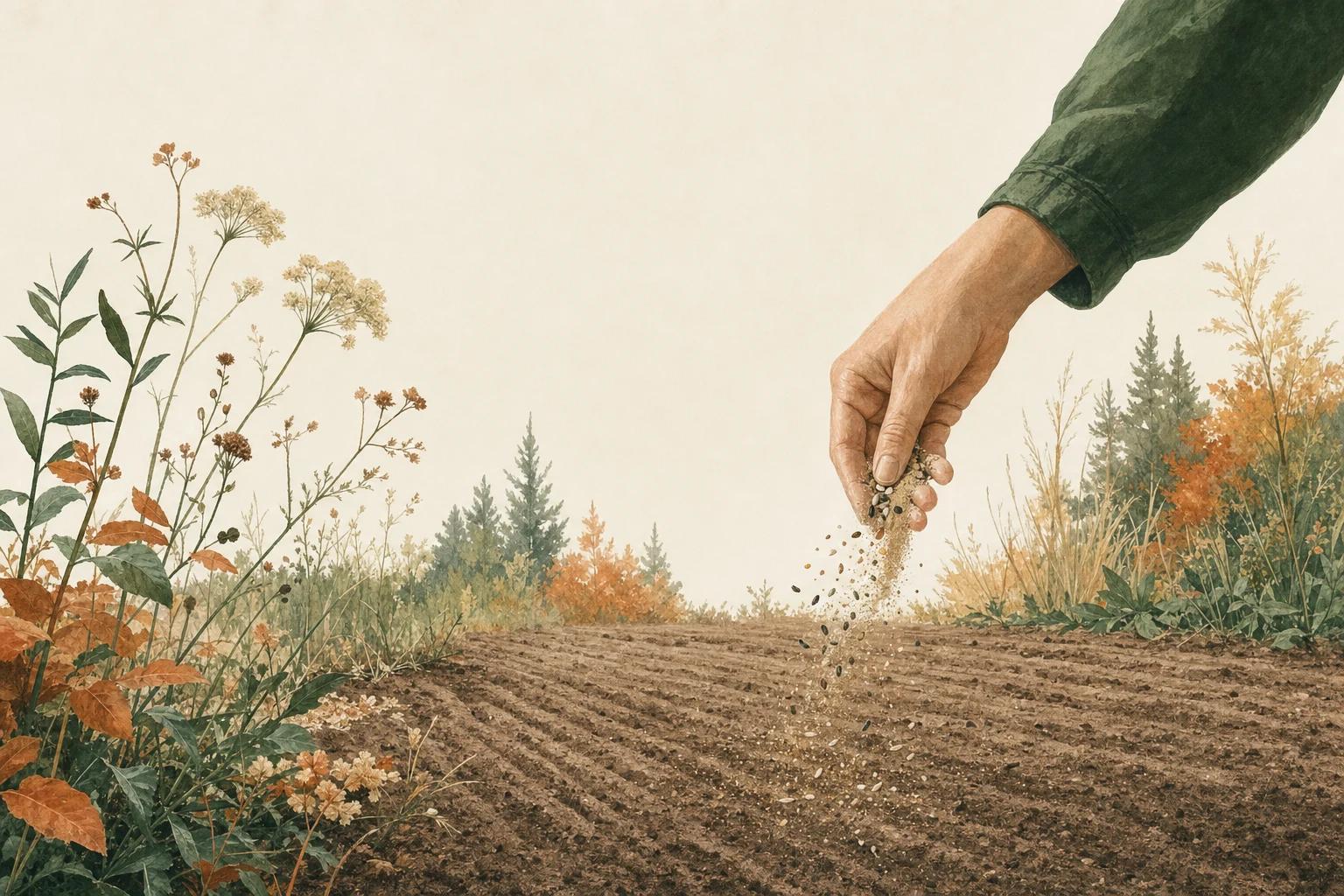
- Broadcast in two passes at right angles. Spread half the mix walking one way and the rest crosswise, which fills thin strips a single pass can leave.
- Press the seed in without burying it. Roll with a lawn roller or cultipacker, tamp, or walk the area. If you rake, go no deeper than about 1/4 inch (6 mm). Most wildflower seed needs light to sprout, and seed buried 1/2 inch (13 mm) or deeper can germinate and still fail to reach the surface.
- Mulch only where seed could wash or blow. On slopes or windy sites, use about one bale of clean straw per 1,000 square feet (93 m²), thin enough that soil still shows through.
- Water to suit the season. Where seed sprouts in fall (Texas, California, Florida) or after a spring sowing, keep the top 1/2 inch (13 mm) damp until seedlings appear and keep them moist for four to six weeks; in Texas, a brief watering every three days for about three weeks does the job. After a dormant fall sowing, skip routine watering and let rain and snow settle the seed. Established native meadows need no routine watering.
Seeds and mixes that change the timing
Annuals and perennials follow the same calendar but reward it differently. Annual wildflowers bloom the first season from either a fall or spring sowing, which makes them the safer choice for a late start; see annual flowers for more on how they differ. Perennials such as purple coneflower gain the most from fall sowing, because many will not germinate until they have been chilled.
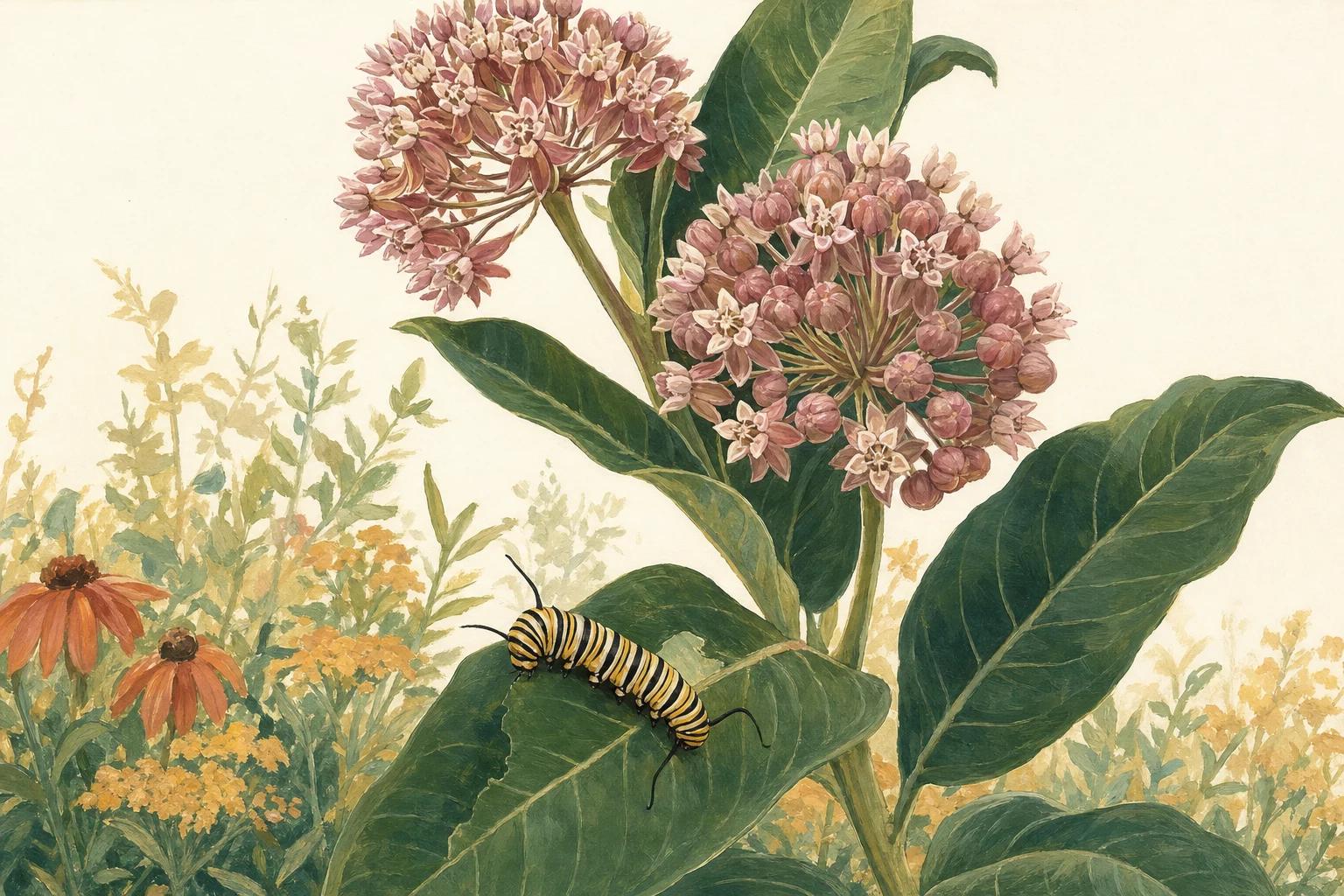
Some seed needs treatment before a spring sowing. Milkweeds such as butterfly weed, columbines and penstemons need 2 to 4 weeks of cold, moist stratification, and many other perennial species need 60 to 90 days at 32–50°F (0–10°C). Chill that seed in the refrigerator before spring sowing, or skip the step by sowing in fall. If monarchs are the goal, milkweed for monarchs covers which species to grow.
Hard-coated seed is the other exception. Texas bluebonnet seed sown untreated may give only one or two plants from 50 seeds, while nicking or sanding the coat (scarification) can raise that to nearly all of them. Scarified seed sprouts fast, though, which leaves the young plants more exposed to a spell of extreme weather.
Grass-heavy tallgrass prairie mixes run on a different calendar from wildflower meadows. They are sown from late May to June 15 in the Upper Midwest, in May elsewhere in the Midwest and from late February to March on the Southern Plains. Late fall and early spring sowings also work, because they give the seed natural chilling. Those mixes are at least 60% grass, seeded at 11 to 13 pure live seeds per square foot (120–140 per m²).
If you sow too early, too late or into a late frost
Too early is the costly error, and too late is easy to recover from.
Too early in fall. If seedlings come up before winter in a cold zone, expect losses, then reseed thin patches late in fall or frost-seed them in January or February.
Too late in fall. If the ground has frozen in a cold-winter state, scatter the seed onto frozen ground or a thin snow cover in January or February and let winter moisture settle it in. Otherwise, hold it and sow as early in spring as the ground can be worked. Store unsown seed cold and dry; the refrigerator at 35–40°F (2–4°C) is ideal. A useful rule for any storage spot is that the temperature in °F plus the relative humidity in percent should stay below 100, or the seed loses viability quickly. In Texas, seed kept cool and dry over summer can be sown the following late August or early September. California sowings can continue from December to mid-February, though earlier sowing fits the natural cycle better.
Into a spring frost. Fall-sown seed is meant to sit through frost, snow and freezing nights, so a cold snap after a fall sowing does no harm. Spring-sown annuals are the ones at risk: sow annual mixes after the danger of frost has passed. Central Oregon is the exception, where spring seed goes down about a month before the last hard frost, typically in early May. Spring dates elsewhere in Oregon run from late March in the south to mid-April in the west and mid- to late May in the east.
What to expect in years one to three
A new perennial meadow looks sparse for two seasons and comes into its own in the third.
| Year | Perennial meadow | Annual mix |
|---|---|---|
| 1 | Annuals dominate; perennials build roots; grasses stay 2–3 in (5–8 cm) tall | Annuals bloom the first season |
| 2 | Some biennials and perennials bloom; the planting looks weedy; most grasses flower | Annuals return if their seed was left to drop |
| 3 | Regular flowering across most native species | Annuals fade as perennials fill in mixed plantings |
| 4 and later | Color from spring to late fall; diversity keeps rising for 5–10 years | Reseed thin spots |
Perennials spend their first year building roots, so a meadow is judged in year three, not year one.
Year one. Mow whenever growth reaches about 12 inches (30 cm), with the blade set above the wildflower seedlings, to stop annual weeds from setting seed. Avoid pulling weeds while young wildflower roots are still developing; mowing does the job with less disturbance.
Year two. Expect the planting to look disappointing: wildflower seedlings and weeds are hard to tell apart, and only some biennials and perennials bloom. Black-eyed Susan is often the first to flower. A mid-summer mow at 4 to 6 inches (10–15 cm) keeps weeds from going to seed.
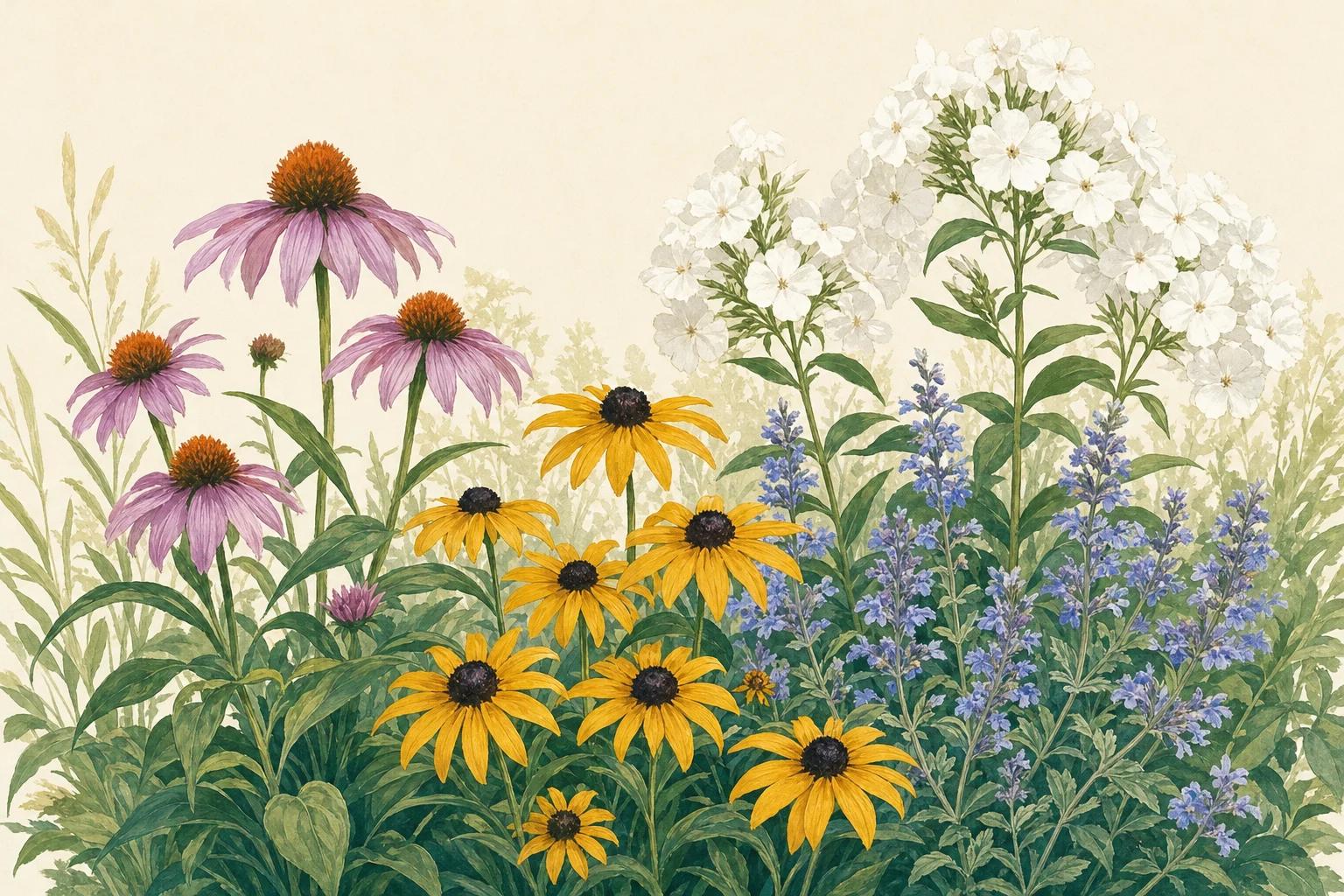
Year three. Most natives flower regularly. Coreopsis and columbines may bloom by late June, followed in midsummer by wild bergamot, oxeye sunflower, purple coneflower and yellow coneflower. Goldenrods carry the bloom into fall for bees. For more long-lived choices, see perennial flowers.
Every year after. Mow or burn only a quarter to a third of the meadow each year. Cut at 6 to 8 inches (15–20 cm) or higher in November, or leave the stems standing until early spring, and never mow until at least half of the late bloomers have dropped their seed. Burning takes expertise, may need a permit and should wait until year three or four. Some species will fade and others spread; reseed thin patches in fall. To plan where a meadow fits among the beds, paths and lawn you already have, map it in Sow's garden planner.
Frequently asked questions
Can I just throw wildflower seeds around?
You can, but seed tossed onto lawn, thatch or weeds rarely establishes, because the existing plants take the light and water first. Seed scattered on undisturbed bare soil can still sprout, only more slowly. For a meadow worth waiting for, kill the existing vegetation, rake the surface smooth, spread the seed and press it in with a roller or your feet. Contact with soil matters more than covering it.
Will wildflowers grow back every year?
Perennial wildflowers return from the same roots and bloom best from their second or third year. Annuals return only from seed they drop, so leave their stalks standing until the seed has shed, and mow only after at least half of the late bloomers have dropped seed. A meadow also shifts over time: some species fade and others spread, and diversity keeps rising for five to ten years.
What time of year is best to scatter wildflower seeds?
Late fall in cold-winter states and the Southeast, and early to mid-fall in Texas and on the West Coast. Mid- to late October is the safe target inland in northern New England, October to December works across the northern states, and the Southeast sows from November to February once the soil is cold. Texas sows from September through November, California from mid-October to late November, and Florida from mid-September in the north to mid-January in the south.
Do you need to soak wildflower seeds before planting?
Not for most mixes. Hard-coated seed such as Texas bluebonnet sprouts far better after scarification: nick or sand the coat, or freeze the seed overnight and drop it into water just off the boil so the coat cracks. Many perennials need cold, moist stratification instead, which fall sowing supplies outdoors for free. For spring sowing, chill milkweed, columbine and penstemon seed for 2 to 4 weeks; some species need 60 to 90 days.
Can I plant wildflowers without tilling the soil?
Yes, and skipping the tiller usually gives a cleaner meadow, because tilling lifts dormant weed seed to the surface where it sprouts with your wildflowers. Kill the existing vegetation by smothering, solarizing, stripping sod or spraying, then rake only the top crust. If the soil is compacted, loosen no more than the top 2 to 4 inches (5–10 cm), then water to sprout one flush of weeds and remove it before you sow.
How long does it take for a wildflower seed to germinate?
Anywhere from 10 days to more than a year. Some seed sprouts in 10 to 20 days once it is warm and moist, but most fall-sown seed waits for spring, and some species sit 3 to 4 months or even several years before emerging. After a dormant fall sowing, judge germination in spring rather than in the weeks after sowing, and expect perennial seedlings to keep appearing for several seasons.
Can I plant wildflower seeds in spring?
Yes, as a fallback. Sow as early as the ground can be worked, or after the last frost for annual mixes, and expect grasses and weeds to compete harder than they do after fall sowing. Annuals still bloom the first summer, but spring-sown perennials often wait until their second growing season. Chill perennial seed in the refrigerator before sowing so it gets the cold it would have had outdoors.
How much wildflower seed do I need?
Plan on 4 to 8 ounces per 1,000 square feet (1.2–2.4 g per m²) for most mixes, or roughly 20 to 60 seeds per square foot when you build a mix by species. Small, dusty seed needs less weight than large seed, so the rate on the mix label comes first. Extra seed will not make up for weedy ground; clearing the site matters more than the rate.
References
- University of New Hampshire Extension. Planting for Pollinators: Establishing a Wildflower Meadow from Seed [fact sheet]. Accessed October 16, 2026.
- University of New Hampshire Extension. Winter Seeding - A Shortcut to Spring?. Accessed October 16, 2026.
- Xerces Society for Invertebrate Conservation. Establishing Pollinator Meadows from Seed. Accessed October 16, 2026.
- Clemson Cooperative Extension Home and Garden Information Center. Wildflowers (HGIC 1157). Accessed October 16, 2026.
- UGA Cooperative Extension, Paulding County. Fall Planting for Spring Wildflowers. Accessed October 16, 2026.
- Texas A&M AgriLife Today. When do I plant wildflower seeds for stunning spring blooms?. Accessed October 16, 2026.
- Texas Department of Transportation. Planting Wildflowers. Accessed October 16, 2026.
- Lady Bird Johnson Wildflower Center. When Should Wildflower Seeds be Planted in Dallas, Texas. Accessed October 16, 2026.
- Lady Bird Johnson Wildflower Center. Plant a Wildflower Meadow. Accessed October 16, 2026.
- Lady Bird Johnson Wildflower Center. How to Prepare Seeds for Sowing. Accessed October 16, 2026.
- Lady Bird Johnson Wildflower Center. Recreate a Prairie. Accessed October 16, 2026.
- Oregon State University Extension. Annual wildflowers bring color and pollinators back every year. Accessed October 16, 2026.
- Oregon State University Extension. Growing wildflowers in Central Oregon. Accessed October 16, 2026.
- Oregon State University Extension. From pasture to pollinators: Lessons learned in creating a native plant meadow (EM 9523). Accessed October 16, 2026.
- University of Arizona Cooperative Extension. November Monthly Gardening Guide for Pima County. Accessed October 16, 2026.
- University of Arizona. UArizona experts available to discuss spring wildflower season. Accessed October 16, 2026.
- Florida Wildflower Foundation. Seeding Dates for Native Wildflowers and Grasses. Accessed October 16, 2026.
- Florida Wildflower Foundation. Starting from Seed. Accessed October 16, 2026.
- Theodore Payne Foundation for Wild Flowers and Native Plants. Sowing California Native Wild Flowers. Accessed October 16, 2026.
- NOAA National Centers for Environmental Information. U.S. Climate Normals 1991–2020: Annual/Seasonal freeze data. Accessed October 16, 2026.
Sow Editorial
Written by the Sow team from university extension services, botanical gardens, USDA and NOAA data and plant breeders. Every source is listed under References.