The Story
Plant Bio
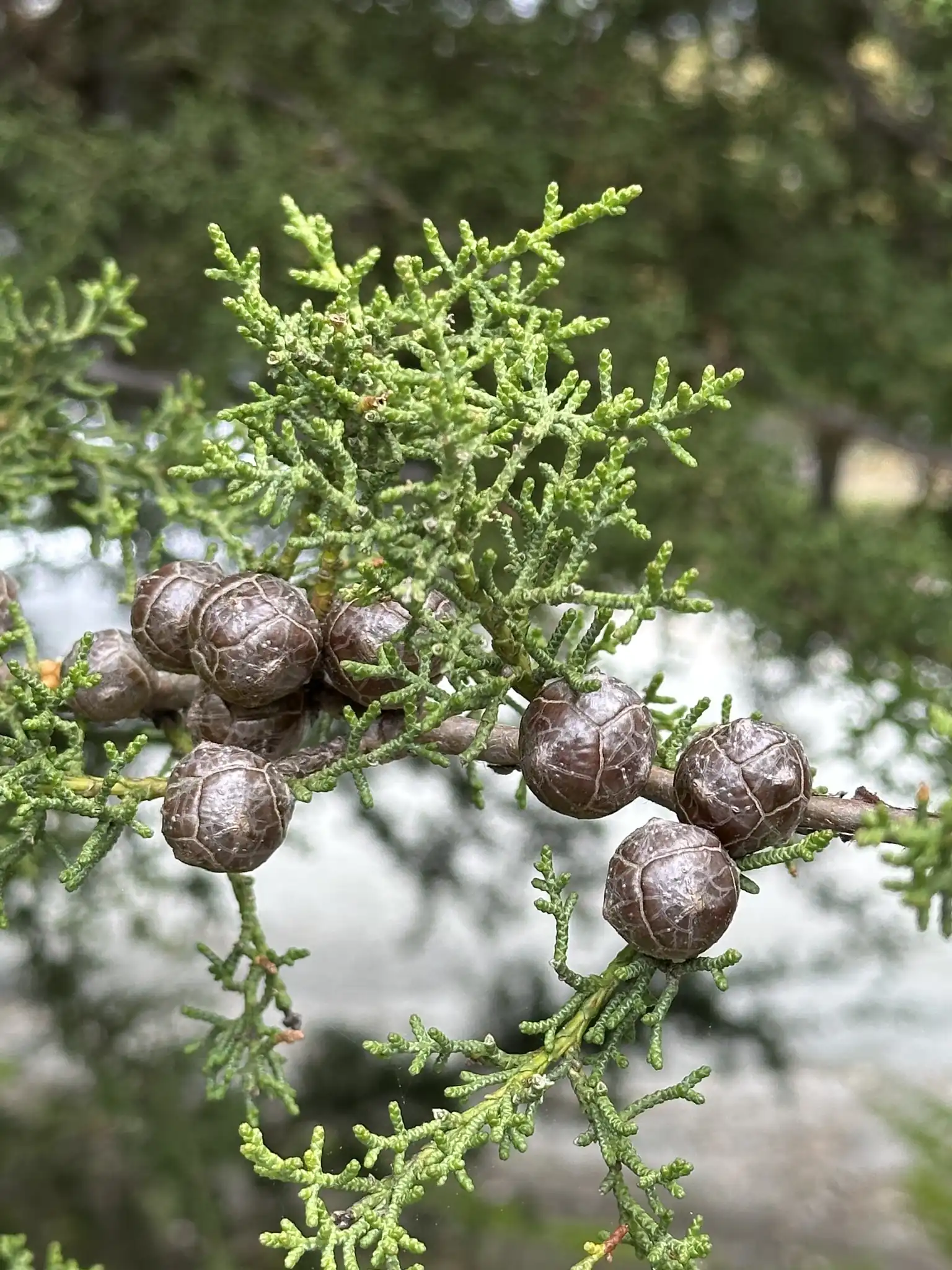
Hesperocyparis abramsiana, the Santa Cruz cypress, is an evergreen conifer native to sandstone and granitic ridges in California's Santa Cruz Mountains. It forms an upright, pyramidal to spreading irregular crown with thin gray bark that peels in fibrous vertical strips, carrying bright green to grayish-green scale foliage on slim branchlets.
This rare species produces compact, globose seed cones that remain firmly closed on the branches for years until heat or maturity prompts their release. Highly adapted to poor, coarse soils and summer drought, it thrives in well-drained upland environments where excess soil moisture is entirely absent.
Uses & Benefits:
Essentials
At a Glance
Plant Type
Tree
Height
236"
Width
197"
Light
Full Sun
Zones
8, 9, 10
Water
Low
Humidity
Moderate
Lifespan
Perennial
Native To
California (Santa Cruz Mountains)
Toxicity
Non-toxic
Bloom period
Spring
In flower about 3 months of the year
Planting
How to Grow
- Select a site in full sun with gritty, sandy, or gravelly soil that drains freely.
- Dig a hole twice as wide as the root ball and equal in depth, keeping the root collar level with the surrounding soil.
- Backfill with native soil without adding rich organic amendments or high-nitrogen fertilizers.
- Water thoroughly at planting to settle the soil, then irrigate sparingly only until established.
Pro Tip
Never prune into old, leafless brown wood, as branches lack dormant buds and will fail to resprout.
Keep It Thriving
Care Guide
Do
- Plant in light, acidic to neutral soils with excellent drainage.
- Provide full sunlight to maintain a dense, healthy crown.
- Prune lightly within active green foliage to remove dead or damaged branches.
Don't
- Do not plant in heavy clay or waterlogged areas where Phytophthora root rot develops.
- Do not prune back into old brown wood that lacks foliage.
- Do not over-fertilize, as excess nitrogen forces weak, disease-prone growth.
Seasonal Care Calendar
| Task | Jan | Feb | Mar | Apr | May | Jun | Jul | Aug | Sep | Oct | Nov | Dec |
|---|---|---|---|---|---|---|---|---|---|---|---|---|
| Mulch | ||||||||||||
| Pest Check | ||||||||||||
| Plant | ||||||||||||
| Prune |
Watch Out For
Pests & Diseases
Common Pests
Common Diseases
In the Garden
Landscape Uses & Companions
Landscape Uses
Companion Plants
Multiply
Propagation Methods
Good to Know
Common Questions
Santa Cruz Cypress questions
What zones can Santa Cruz Cypress grow in?
Santa Cruz Cypress is hardy in USDA Zones 8–10: in that range it survives winter in the ground. Colder than Zone 8, winters are too cold for it to survive outdoors.
Is Santa Cruz Cypress deer resistant?
Not reliably. Deer may browse Santa Cruz Cypress, especially tender spring growth — plan on repellents or fencing where pressure is high.
When does Santa Cruz Cypress bloom?
Santa Cruz Cypress typically blooms in spring. Exact timing shifts a week or two with your zone — Sow's bloom calendar maps it to your garden.
Does Santa Cruz Cypress need full sun?
Santa Cruz Cypress does best in full sun (6+ hours).
Is Santa Cruz Cypress drought tolerant?
Yes — once established (usually after the first full season), Santa Cruz Cypress handles dry spells with minimal watering. Water deeply its first year to build the root system that makes that possible.
More Hesperocyparis to compare
Keep exploring
Explore the genus
Hardy in your zone?
Grow Santa Cruz Cypress with confidence
See it in a design of your actual yard, get zone-matched care reminders, and track it season by season in your garden journal.