Quick answer
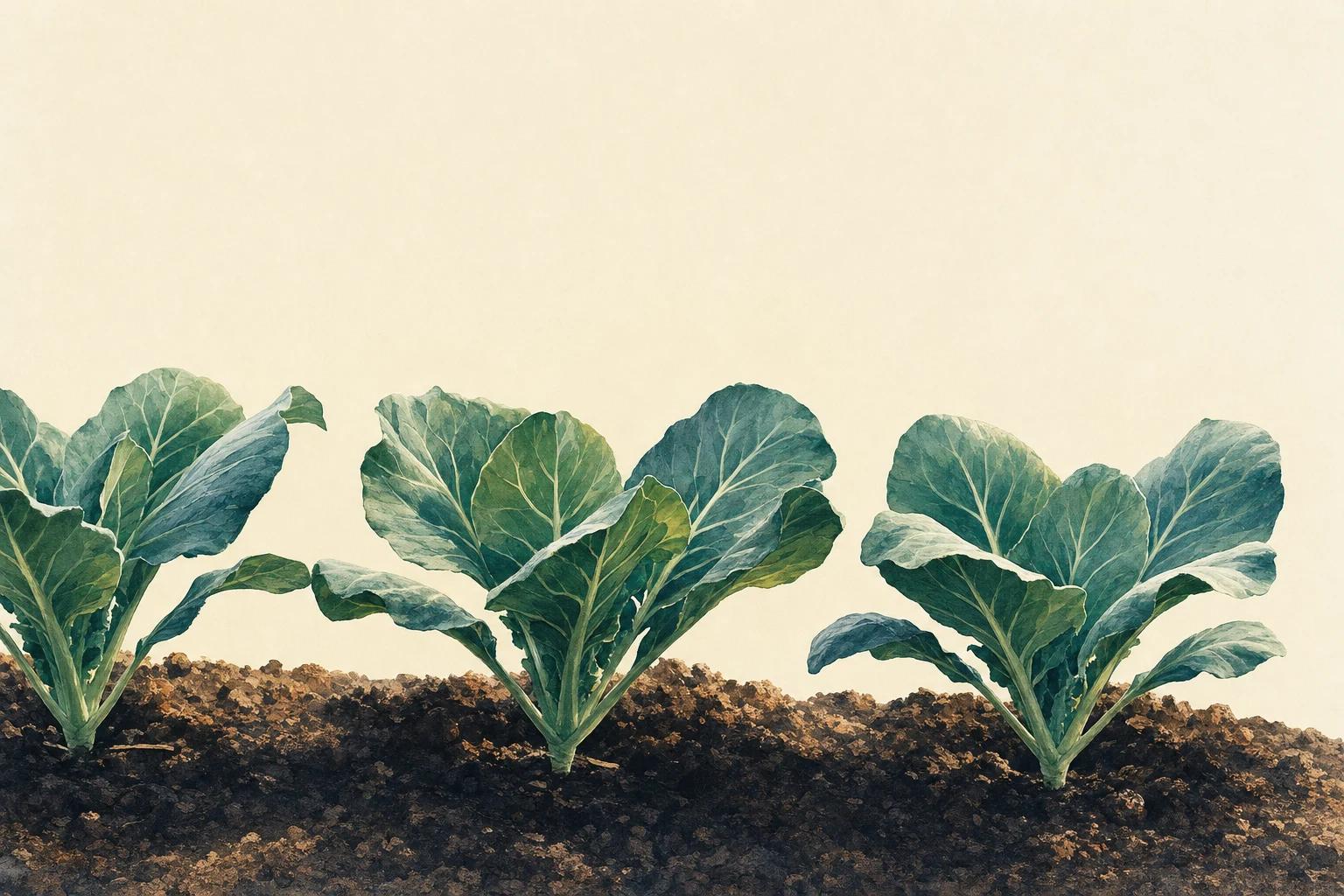
Set cabbage transplants outdoors 1 to 3 weeks before your median last spring frost, once the soil can be worked. Start seed indoors 4 to 7 weeks before that transplant date. For a fall crop, transplant 11 to 15 weeks before your median first fall frost. In frost-light Florida, the Gulf Coast, the low desert and Southern California, plant from about September to February.
Key facts
- Spring transplant
- 1–3 weeks before the median last spring frost, once the soil is workable
- Fall transplant
- 75–105 days (11–15 weeks) before the median first fall frost
- Soil temperature
- Seed sprouts from 40°F (4°C), best near 80°F (27°C)
- Indoor start
- 4–7 weeks before transplanting; sow 1/4–1/2 in (6–13 mm) deep
- Days to maturity
- 60–100 days from transplant for most varieties; add about 2–3 weeks if sown in place
- Cold tolerance
- Mature heads take 15–25°F (−9 to −4°C); young plants are less hardy
- Bolting trigger
- 10 or more days at 35–50°F (2–10°C) on large transplants
- Frost-light regions
- Florida, the Gulf Coast, the low desert and Southern California plant about September to February
Cabbage goes into the spring garden as a transplant 1 to 3 weeks before your median last frost, as soon as the bed has thawed and dried enough to dig. Hardened plants shrug off a light frost; the real spring risks are a long cold spell on oversized plants and heads that form in summer heat. The second crop goes in 75 to 105 days before the median first fall frost, and its heads fill out as the weather cools.
Both windows chase the same conditions. Cabbage grows best when the air averages 60 to 65°F (16–18°C); above about 80°F (27°C), growth and head quality fall off. A spring planting has to head before summer heat, and a fall planting has to head before growth stalls in the cold.
Cabbage planting dates by city
Each spring window below opens 21 days and closes 7 days before the city's median last frost, and each fall window runs from 105 to 75 days before the median first frost. Cells without exact dates, and the Dallas–Fort Worth fall window, follow a state, county or regional calendar instead.
| City (USDA zone) | Median last frost | Median first frost | Spring transplant | Fall transplant |
|---|---|---|---|---|
| Fargo, ND (4a) | May 10 | Sep 30 | Apr 19 – May 3 | Jun 17 – Jul 17 |
| Minneapolis, MN (5a) | Apr 23 | Oct 18 | Early to mid-May | Jul 5 – Aug 4 |
| Chicago, IL (5b) | Apr 16 | Oct 28 | Mar 26 – Apr 9 | Jul 15 – Aug 14 |
| Denver, CO (6a) | May 5 | Oct 9 | Apr 14 – Apr 28 | Jun 26 – Jul 26 |
| Detroit, MI (6b) | Apr 20 | Oct 27 | Mar 30 – Apr 13 | Jul 14 – Aug 13 |
| Kansas City, MO (6b) | Apr 13 | Oct 24 | Mar 23 – Apr 6 | Jul 11 – Aug 10 |
| Boston, MA (7a) | Apr 4 | Nov 9 | Mar 14 – Mar 28 | Jul 27 – Aug 26 |
| Salt Lake City, UT (7b) | Apr 8 | Oct 31 | Mar 18 – Apr 1 | Jul 18 – Aug 17 |
| New York, NY (7b) | Mar 30 | Nov 20 | Mar 9 – Mar 23 | Aug 7 – Sep 6 |
| Nashville, TN (7b) | Mar 31 | Nov 3 | Mar 10 – Mar 24 | Jul 21 – Aug 20 |
| Raleigh, NC (8a) | Mar 31 | Nov 4 | Mar 10 – Mar 24 | Jul 22 – Aug 21 |
| Atlanta, GA (8a) | Mar 15 | Nov 20 | Feb 22 – Mar 8 | Mid-Aug – mid-Oct |
| Dallas-Fort Worth, TX (8b) | Mar 8 | Nov 24 | Late Jan – early Feb | Sep 1 – Sep 20 |
| Seattle, WA (9a) | Mar 2 | Nov 23 | Apr – late May; see below | Sow winter cabbage early Aug |
| Sacramento, CA (9b) | Feb 2 | Dec 2 | Dec – Feb | Jun – Aug |
| Houston, TX (9b) | Feb 13 | Dec 9 | Mid-Jan – late Feb | Mid-Sep – mid-Oct |
Frost dates are medians from NOAA 1991–2020 climate normals for each city's main weather station; in half of years the last frost falls later than the date shown.
For a town not on the list, look up its median frost dates and apply the same arithmetic: count back 21 and 7 days from the last spring frost, and 105 and 75 days from the first fall frost. Where the regional section below gives a state's own timing, as it does for Minnesota, Texas and Georgia, use that instead.
In cold-spring cities such as Fargo, Denver, Boston, New York and Salt Lake City, the opening date can arrive while the ground is still frozen or sodden; wait until you can dig without the soil smearing. Minneapolis waits longer still, for settled weather: seed started indoors in early April is ready to set out in early to mid-May. Dallas–Fort Worth goes the other way, because Texas sets spring transplants out 3 weeks ahead of the count. Houston plants later than that Texas rule would suggest: its best spring window runs from mid-January into late February, and early January plantings are marginal.
Several more cells follow regional calendars rather than the count. Seattle sits in Zone 9a, but its cool springs set the pace: spring and summer cabbage goes out from April to late May, and winter cabbage is sown in place in early August. Sacramento follows the two-season calendar of California's interior valleys, with a winter and a summer planting. In the hot-autumn South, fall planting runs later and closer to frost than the count allows: mid-August to mid-October around Atlanta, September 1 to 20 in Dallas–Fort Worth and mid-September to mid-October in Houston. The regional section below covers each of these, along with Minnesota.
Spring or fall: choosing your cabbage crop
In much of the country the fall crop is easier to time, because its heads form in shortening, cooling days instead of racing toward summer.
A spring planting must finish before heat arrives. Set out late, its heads meet temperatures of 77 to 86°F (25–30°C), where growth suffers, and the quality drops. A fall planting runs the other way: leaves grow in late-summer warmth, and the head firms as nights cool. Hardened fall plants keep growing through the first light frosts, which is why central Iowa harvests fall cabbage from mid-September to late October and central Maryland into mid-November.
To fine-tune the fall date for a particular variety, take its days to maturity, add about 18 days, and count back from your first frost date. A 65-day variety such as Golden Acre goes out about 83 days ahead of the frost. Danish Ball Head, at 100 days, needs 118 days, which is before the standard window opens. Summer-planted cabbage matures 10 to 14 days faster than the catalog figure, which buys a little slack.
The awkward part of fall cabbage is raising seedlings in midsummer. Georgia gardeners start them in August in partial shade, then set them out in September. Elsewhere, sow fall transplants indoors 4 to 6 weeks before your fall transplant date: mid-June to mid-July for central Maryland's mid-July to mid-August planting. Sowing in place skips the nursery stage; Minnesota and Colorado's Front Range sow fall cabbage directly in early July.
How the timing shifts by region and zone
The frost rule fits most of Zones 4 to 8. The far North and the Pacific Northwest plant later, Texas plants spring cabbage earlier, the Southeast's fall crop goes in closer to frost, and frost-light regions grow cabbage through the cool months only.
| Region | Spring planting | Fall or winter planting |
|---|---|---|
| Minnesota | Sow indoors early April; set out early to mid-May | Sow in place early July |
| Central Iowa | Transplant early to mid-April | Transplant mid-June to mid-July |
| Central Maryland | Transplant mid-March to mid-April | Transplant mid-July to mid-August |
| Missouri (south / central / north) | Mar 5–Apr 5 / Mar 20–Apr 20 / Apr 1–20 | Aug 1–15 / Jul 20–Aug 5 / Jul 20–30 |
| Colorado Front Range | 2–4 weeks before last frost | Sow in place early July |
| South Carolina Piedmont / coast | Mar 15–Apr 30 / Feb 1–Mar 31 | Jul 15–Aug 31 / Aug 15–Sep 30 |
| Middle Georgia | Not listed | Set out September to October |
| Texas | 4–6 weeks before last frost | Jul 15 (north) to Nov 1 (south) |
| Houston area | Transplant mid-Jan to late Feb | Transplant mid-Sep to mid-Oct |
| Florida | One cool-season window | North Aug–Feb; central Sep–Feb; south Sep–Jan |
| Phoenix low desert | Jan 1–15 | Seed Aug 15–Sep 1; plants Sep 15–Dec 15 |
| California interior valleys | Dec–Feb | Jun–Aug |
| Pacific Northwest | Transplant April to late May | Sow winter cabbage early August |
Regional planting windows; your own frost dates and soil set the exact week.
Zones 3 to 5. Spring comes late and fast, so lean toward the back of the frost window, or past it in Minnesota, where plants wait for settled weather. Iowa shifts its dates a week earlier in the south of the state and a week later in the north, a useful rule of thumb for any state that spans a few hundred miles.
Zones 6 and 7. This is where the frost rule fits best, though advice still spreads widely. In central Maryland, transplants go out anywhere from mid-March to early May depending on the site, and in Utah 2 to 3 weeks before the last frost. In a cold, wet spring, keep to the later end and use young plants.
The Southeast. Both seasons work, and the South Carolina coast sets spring cabbage out as early as February 1. Fall planting runs later here than the count suggests, because cabbage keeps growing through light frost: the South Carolina coast plants until September 30, and middle Georgia sets fall cabbage out in September and October. North Georgia, Atlanta included, plants fall crops about 2 weeks earlier, which is why the Atlanta cell runs from mid-August to mid-October; south Georgia goes up to 2 weeks later.
Texas and the Gulf Coast. Texas plants spring cabbage earlier than the usual 1-to-3-week lead: 4 to 6 weeks before the frost-free date, which on Dallas–Fort Worth's March 8 median means late January to early February. Fall dates step south from July 15 in the coldest region to November 1 in the warmest, and the last good dates run from August 1 to November 20. Dallas–Fort Worth sits in the middle region, which plants from September 1 to 20. Houston has two best windows, mid-September to mid-October and mid-January into late February, and plantings in the weeks between are possible but marginal. Fall cabbage across Texas does better from transplants than from seed; Bravo, Market Prize and Rio Verde are the recommended varieties.
Florida and the low desert. Cabbage is a winter vegetable here, planted in one long window from late summer or early fall into winter. Around Phoenix, winter cabbage takes 80 to 90 days from transplants and 120 to 130 days from seed.
California. Cabbage grows well from late fall to early spring. The south coast plants from August to February, and the north coast from January to April and again from July to September. The interior valleys around Sacramento plant from December to February and again from June to August, and the desert valleys from September to November.
Pacific Northwest. Cool springs, not frost, set the pace. On Washington State's Pacific Northwest calendar, summer cabbage is sown indoors in late March or early April, set out in late May and harvested from early September to mid-October; the August-sown winter crop is cut from early March into June. In western Oregon's valleys, cabbage goes out from April to June: early varieties as soon as spring allows, later ones in late May or June.
Starting seed and setting out transplants
Start seed indoors 4 to 7 weeks before your transplant date, which puts a spring sowing about 5 to 10 weeks before the median last frost.
- Sow shallow and warm. Cover seed with 1/4 to 1/2 inch (6–13 mm) of mix and keep it above 75°F (24°C) until it sprouts, in 3 to 10 days. Then grow the seedlings on in air near 60°F (16°C) so they stay stocky.
- Grow seedlings for 4 to 7 weeks. Plug trays are ready in 4 to 6 weeks; aim for four to six true leaves. Sow on schedule, because a seedling held too long in its cell grows rootbound.
- Harden off. Give the plants 4 to 7 days outdoors before planting, starting in a shaded, sheltered spot and gradually adding sun, so the plants toughen before they go into the bed.
- Plant on a cloudy day or in the evening. Weak sun lets the roots settle before the leaves face a full day of light, which cuts transplant shock.
- Space by the head size you want. Allow 12 to 18 inches (30–45 cm) for early and mini varieties and 18 to 24 inches (45–60 cm) for large late heads. Leave 24 to 36 inches (60–90 cm) between rows. Plants squeezed to 12 inches (30 cm) make smaller heads.
- Water evenly. Water about every three days until the plants are established, then keep the soil steadily moist through heading.
A plant spacing calculator works out how many plants fit a bed at the spacing you pick.
When buying cabbage transplants, choose small, actively growing plants over tall ones in crowded pots. Once a cabbage stem is as thick as a pencil, a long cold snap can switch the plant from filling a head to sending up a seed stalk. A small plant set out on time is the safer start.
How to tell the soil and site are ready
Transplants need only soil that is thawed and dry enough to work, set out within the frost window; seed sown in place needs soil of at least 40°F (4°C).
Read that seed temperature at 4 inches (10 cm) deep at 8 a.m., when the soil is coldest. The 40°F floor is a minimum; cabbage seed sprouts fastest in soil near 80°F (27°C) and stops at about 90°F (32°C), which matters for the fall crop sown into hot summer ground.
Choose the site before the date. Cabbage needs at least 6 hours of direct sun a day and does better with 8 to 10. It wants fertile, well-drained soil that holds moisture, with a pH of 6 to 7. Heavy ground that stays wet into spring delays planting, and a raised bed drains and warms in time for an early start.
Varieties that change the timing
Days to maturity range from about 55 to 100 after transplanting, and that spread matters more for timing than head color or leaf type does.
| Variety | Type | Days from transplant | Season |
|---|---|---|---|
| Ruby Ball | Red | 55 | Early |
| Golden Acre | Green | 65 | Early |
| Savoy Ace | Savoy | 80 | Mid |
| Danish Ball Head | Green | 100 | Late |
Days count from a cool-weather transplant; sown seed adds about 2 to 3 weeks.
For spring, choose an early variety such as Ruby Ball, Golden Acre or Tendersweet, so heads form before heat sets in. Small-headed varieties mature fast enough to plant in succession, a few weeks apart, for a longer harvest.
For fall in short-season regions (Zones 3 to 6), use an early variety such as Golden Acre, so the head fills before the cold. Late storage varieties such as Danish Ball Head (100 days) and Storage Hybrid #4 need setting out about 16 to 17 weeks before the first frost, which means late May or June in the North, or a long-fall region. The late red Ruby Perfection also suits a fall crop where the season allows, and Red Acre is another red that forms a firm head.
If heads will have to wait in the garden, grow a variety that holds without splitting. Stonehead makes a small, solid head that resists splitting, and Copenhagen Market forms firm heads that do the same. Other brassicas follow their own schedules, so check the cabbage-family crops individually rather than borrowing these dates. Broccoli, for one, has its own windows in when to plant broccoli.
What happens if you plant too early or too late
Too early, cold can make cabbage bolt instead of heading. Too late, spring heat spoils the heads or a fall crop runs out of growing days.
The bolting risk begins once the stem reaches pencil thickness. From then on, 10 or more days in a row between 35 and 50°F (2–10°C) can push the plant to send up a flower stalk instead of a head. That is why large, overgrown transplants set out in an early, raw spring fail more often than small ones. If a cold spell is forecast after planting, cover the bed or hold the plants back a week.
A spring planting that goes in late heads up in warm weather, and the plants grow slowly and make poor heads. Switch to your earliest variety, or skip spring and plant a fall crop. A fall planting that goes in late is still leafy when the cold arrives, and growth slows sharply once temperatures sit below 41°F (5°C). The count-back method in the fall section above prevents it.
If a late frost arrives
Hardened transplants shrug off light frost, but young plants are less hardy than mature heads, so cover new plantings with row cover, hot caps or frost cloth when a hard freeze is forecast. Mature heads come through roughly 15 to 25°F (−9 to −4°C) without serious harm. Cover late-season heads when nights will drop below 25°F (−4°C).
Do not plant cabbage, or any other cabbage-family crop, where clubroot has appeared. The disease survives in soil for years: keep these crops out of an infected spot for at least 4 years, and start with clean transplants.
Harvest, splitting and what to expect
Most cabbage is ready 60 to 100 days after transplanting; cut it as soon as the head feels hard and solid.
Heads split when a firm head takes up a rush of water, most often after heavy rain or a deep soaking. Harvest promptly once heads firm up. If you cannot cut yet, twist the whole plant or slice the roots on one side with a spade; either cuts water uptake and slows the split.
A spring crop planted on time comes in during early summer, and a fall crop fills the gap from mid-September through the first hard freezes. Plan cabbage's two windows alongside the rest of the beds with vegetable planting dates and when to plant potatoes, and follow a fall bed with garlic planting dates. Add both cabbage windows to Sow's garden calendar to keep them on one schedule.
Frequently asked questions
Which month is best for planting cabbage?
Your frost dates decide the month. Across the Mid-Atlantic and lower Midwest, spring transplants go out in March or April; in the far North, late April or May. Fall transplants go in from late June in the northern Plains to August across the middle of the country and September or October in middle Georgia. Florida plants from August in the north and September farther south, and the low desert from mid-August, both running into winter.
Is July too late to plant cabbage?
Not across most of the North and Midwest, where July is the main month for the fall crop. Central Missouri sets transplants from July 20 to August 5, and Minnesota sows fall cabbage in place in early July. In Fargo, aim to have fall transplants in by mid-July and use an early variety. In south Texas and the Arizona low desert, July is too early: desert seed goes in from mid-August, and south Texas plants in October and November.
How do I grow red cabbage?
Grow it on the same dates and spacing as green cabbage, in full sun and evenly moist, fertile soil. Choose the variety by season. Ruby Ball, at about 55 days from transplanting, is quick enough for spring. Ruby Perfection is a late red better suited to a fall planting, when the head can mature in cool weather, and Red Acre forms a dark, firm head.
Do cabbages like sun or shade?
Full sun. Give cabbage at least 6 hours of direct light a day, and 8 to 10 where you can. It tolerates partial shade, though less light means slower growth. The one stage that benefits from shade is the fall nursery: seedlings raised in August heat do better in partial shade until they go into the garden.
What should not be planted near cabbage?
No plant is proven to harm cabbage. The real rule is not to follow or crowd it with other cabbage-family crops, such as broccoli or kale, which share its pests and clubroot. Keep them out of a clubroot-infected spot for at least 4 years. Some neighbors help: marigold, onion and nasturtium have reduced cabbageworm damage, and mustard or arugula can draw flea beetles away as trap crops.
Can cabbage survive a frost?
Yes. Frost alone rarely kills a hardened cabbage plant. In Florida, a frost can damage the outer leaves while the plant itself carries on, and a frost cloth over the bed protects them. Fall heads also keep growing through the first light frosts, which is why a fall planting is often harvested well into October and November.
Why did my cabbage bolt instead of forming a head?
A long cool spell after the plant had grown past seedling size triggered it. Prolonged weather below about 50°F (10°C) can push a cabbage to send up a seed stalk instead of filling a head. A plant that has started a stalk will not go on to make a usable head, so pull it, and replant the space with younger transplants on your fall dates.
How long does cabbage take to grow?
Most varieties are ready 60 to 100 days after transplanting. Fast red and green types such as Ruby Ball and Golden Acre head in 55 to 65 days, while Danish Ball Head takes about 100. Seed sown straight into the garden adds about 2 to 3 weeks. In the Arizona low desert, winter cabbage takes 80 to 90 days from transplants and 120 to 130 days from seed.
Can you sow cabbage seed directly in the garden?
Yes, and it works best for the fall crop. In Minnesota and on Colorado's Front Range, fall cabbage is sown in place in early July, and the Pacific Northwest sows winter cabbage in early August. Sow 1/4 to 1/2 inch (6–13 mm) deep and thin to transplant spacing. In spring, transplants are the better choice, because sown seed needs about 2 to 3 extra weeks to reach harvest.
References
- University of Maryland Extension. Growing Cabbage in a Home Garden. Accessed October 16, 2026.
- University of Maryland Extension. When to Plant Vegetables (central Maryland calendar). Accessed October 16, 2026.
- Iowa State University Extension and Outreach. Growing Cabbage in the Home Garden. Accessed October 16, 2026.
- University of Illinois Extension. Cabbage (Home Vegetable Gardening). Accessed October 16, 2026.
- University of Minnesota Extension. Growing cabbage in home gardens. Accessed October 16, 2026.
- University of Minnesota Extension. Companion planting in home gardens. Accessed October 16, 2026.
- Clemson Cooperative Extension Home & Garden Information Center. Cabbage & Chinese Cabbage (HGIC 1303). Accessed October 16, 2026.
- UF/IFAS Gardening Solutions. Cabbage. Accessed October 16, 2026.
- Texas A&M AgriLife Extension. Texas Home Vegetable Gardening Guide. Accessed October 16, 2026.
- Texas A&M AgriLife Extension. Fall Vegetable Gardening Guide for Texas. Accessed October 16, 2026.
- Texas A&M AgriLife Extension, Harris County. Vegetable Garden Planting Dates for Harris County. Accessed October 16, 2026.
- University of Arizona Cooperative Extension. Vegetable Planting Calendar for Maricopa County. Accessed October 16, 2026.
- Colorado State University Extension. Vegetable Planting Guide. Accessed October 16, 2026.
- University of Missouri Extension. Vegetable Planting Calendar (G6201). Accessed October 16, 2026.
- University of Georgia Cooperative Extension. Georgia Vegetable Garden Planting Calendar (Circular 943). Accessed October 16, 2026.
- Washington State University Extension. Home Vegetable Gardening in Washington (EM057E). Accessed October 16, 2026.
- Oregon State University Extension Service. Vegetable Gardening in Oregon (EC 871). Accessed October 16, 2026.
- Utah State University Extension. Cabbage in the Garden. Accessed October 16, 2026.
- UC Statewide IPM Program, University of California Agriculture and Natural Resources. Cultural Tips for Growing Cabbage. Accessed October 16, 2026.
- Johnny's Selected Seeds. Cabbage: Key Growing Information. Accessed October 16, 2026.
- NOAA National Centers for Environmental Information. U.S. Climate Normals 1991–2020: Annual/Seasonal freeze data. Accessed October 16, 2026.
Sow Editorial
Written by the Sow team from university extension services, botanical gardens, USDA and NOAA data and plant breeders. Every source is listed under References.