Quick answer
The most dependable annual flowers are zinnia, French marigold, cosmos, angelonia and annual vinca for sun and heat; New Guinea impatiens, wax begonia and torenia for shade; petunia, calibrachoa and geranium for pots; and pansy and snapdragon for the cool months. Plant hardy annuals about 4 weeks before your frost-free date, half-hardy ones about 2 weeks before, and tender ones on or after it.
Key facts
- Hardy annuals
- Pansy, snapdragon, sweet alyssum, calendula: plant about 4 weeks before the frost-free date
- Half-hardy annuals
- Petunia, geranium, dianthus, ageratum: about 2 weeks before
- Tender annuals
- Zinnia, impatiens, coleus, begonia, vinca: on or after the frost-free date
- Sun for flowering annuals
- At least 6 hours of direct sun a day for most
- Water
- About 1 inch (2.5 cm) a week, applied deeply and infrequently
- Bedding impatiens
- Downy mildew can wipe them out; use resistant Beacon or Imara XDR, or New Guinea impatiens, begonia or torenia
- Lantana
- Florida: sterile cultivars only; Hawaii: avoid; toxic to dogs, cats and horses
An annual flower lives for one season: it sprouts, blooms, sets seed and dies, usually at the first hard frost of fall. Many plants on the annual bench are really tender perennials, such as geranium, lantana, coleus and angelonia, that would live for years in a frost-free climate. Either way you replant each year, and the best of them flower from the day they go in until frost.
Choosing well comes down to three questions: how many hours of direct sun the spot gets, whether you are planting for summer heat or for the cool months, and how much deadheading you are willing to do. The 30 picks below are sorted that way, each with its height, light, bloom season and the problem most likely to let you down.
How these annuals were chosen
Every pick had to carry color for most of its season in at least one major US region. Its height, light needs, bloom period and weak points also had to be documented in extension plant records or breeder data. Four further tests applied:
- Long bloom or season-long color. Plants that flower for a few weeks and quit did not make the list.
- An honest caution. Each entry names the disease, pest, habit or climate limit most likely to cause trouble.
- Invasive status checked. Plants listed as invasive or high risk in Florida, California or Hawaii are flagged in their entries, and the worst offenders appear in the section on annuals to avoid.
- Safety flagged. Where a pick is toxic to dogs, cats or horses, or irritates skin, the entry says so.
| Pick | Type | Height | Light | Best for |
|---|---|---|---|---|
| Zinnia | Warm-season annual | 6 in–3 ft (15–90 cm) | Full sun | Cutting, pollinators |
| French marigold | Warm-season annual | 6–12 in (15–30 cm) | Sun to part shade | Edging, deer areas |
| Garden cosmos | Warm-season annual | 2–4 ft (60–120 cm) | Full sun | Pollinators, poor soil |
| Angelonia | Tender perennial | 12–18 in (30–45 cm) | Full sun | Heat and humidity |
| Annual vinca | Tender perennial | 6–18 in (15–45 cm) | Sun to part shade | Hot, dry beds |
| Butter daisy | Warm-season annual | 1.5–2 ft (45–60 cm) | Full sun | Pollinators, low care |
| Globe amaranth | Warm-season annual | 6–24 in (15–60 cm) | Full sun | Drying, drought |
| Moss rose | Warm-season annual | 3–8 in (8–20 cm) | Full sun | Hot, dry spots |
| Lantana, sterile types | Tender perennial | Varies by cultivar | Full sun | Butterflies, heat |
| New Guinea impatiens | Tender annual | 6 in–2 ft (15–60 cm) | Part shade | Shade beds |
| Wax begonia | Tender annual | 6–12 in (15–30 cm) | Shade or sun | Edging, pots |
| Wishbone flower | Shade annual | 6–18 in (15–45 cm) | Part to full shade | Shade edging, baskets |
| Coleus | Tender perennial | 6 in–3 ft (15–90 cm) | Shade to sun, by cultivar | Foliage color |
| Caladium | Tender tuber | 1–2 ft (30–60 cm) | Shade to part shade | Foliage in shade |
| Petunia | Half-hardy annual | 6–18 in (15–45 cm) | Full sun | Baskets, beds |
| Calibrachoa | Tender perennial | 3–9 in (8–23 cm) | Full sun | Baskets, window boxes |
| Garden verbena | Warm-season annual | 6–18 in (15–45 cm), spreading | Full sun | Trailing, deer areas |
| Zonal geranium | Tender perennial | 1–3 ft (30–90 cm) | Full sun | Pots, beds |
| Sunflower | Warm-season annual | 1.5–10 ft (0.5–3 m) | Full sun | Pollinators, birds |
| Mexican sunflower | Warm-season annual | 3–6 ft (0.9–1.8 m) | Full sun | Butterflies, screening |
| Spider flower | Warm-season annual | 3–6 ft (90–180 cm) | Sun to part shade | Back of the border |
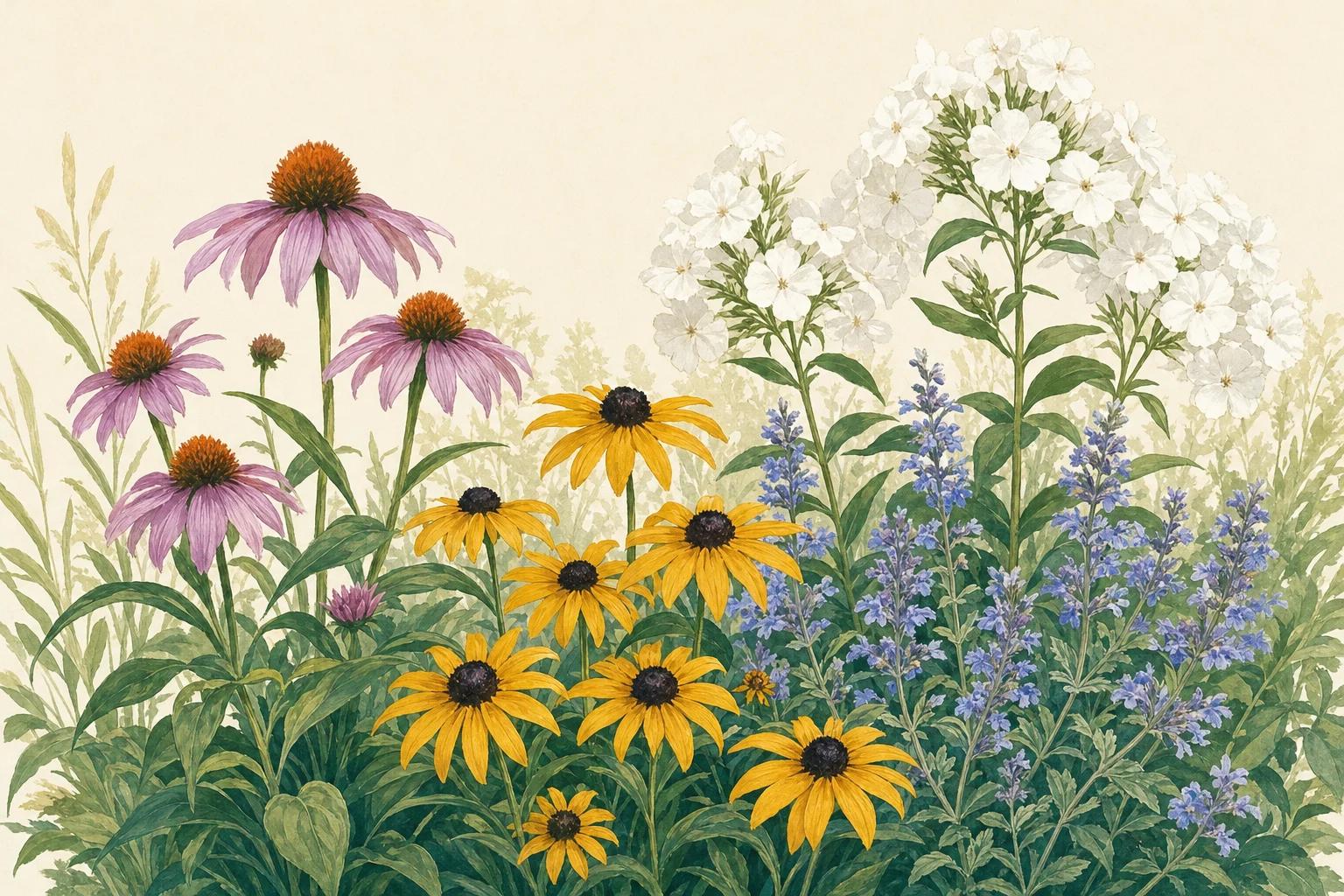
| Black-eyed Susan | Short-lived perennial | 2–4 ft (60–120 cm) | Sun to part shade | Natives, cutting |
| Celosia | Warm-season annual | 9–18 in (23–45 cm) | Full sun | Cutting, drying |
| Mealy cup sage | Tender perennial | 1.5–3 ft (45–90 cm) | Full sun | Bees, hummingbirds |
| Pansy | Cool-season annual | 4–9 in (10–23 cm) | Sun to part shade | Fall to spring color |
| Snapdragon | Cool-season annual | 6–36 in (15–90 cm) | Full sun | Cutting, spring and fall |
| Sweet alyssum | Cool-season annual | 3–10 in (8–25 cm) | Sun to part shade | Edging |
| Calendula | Cool-season annual | 1–2 ft (30–60 cm) | Sun to part shade | Cutting, cool springs |
| Cornflower | Cool-season annual | 1–3 ft (30–90 cm) | Sun to part shade | Cutting, fall sowing |
| Ornamental kale | Cool-season annual | 10 in–2 ft (25–60 cm) | Full sun | Fall foliage |
Heights are for the species or the named series; individual cultivars run shorter or taller. "Tender" means a frost kills it.
When to plant annuals
Plant by cold tolerance, counting from your average frost-free date: hardy annuals about 4 weeks before it, half-hardy annuals about 2 weeks before, and tender annuals on the date or a few weeks after. Find your date on the garden calendar.
| Group | Examples | When to plant | Frost tolerance |
|---|---|---|---|
| Hardy | Pansy, snapdragon, sweet alyssum, calendula, ornamental kale, dusty miller | About 4 weeks before the frost-free date | Takes cold soil, cool air and light frost |
| Half-hardy | Petunia, geranium, dianthus, lobelia, ageratum, gazania | About 2 weeks before | Takes cool soil and air; frost damages it |
| Tender | Zinnia, impatiens, coleus, begonia, vinca, salvia | On or a few weeks after | None; performs poorly in cold soil |
Groups follow Midwest extension practice; northern Arizona sorts annuals into the same three groups.
Tender annuals need warm soil as well as warm air, so setting them out early buys nothing. Above 6,000 feet (1,830 m) in northern Arizona, where the season is short and spring frosts come late, set out only the hardiest annuals early and hold tender ones until late spring or early summer.
The South flips the calendar for hardy annuals: they go in during fall and flower through the winter. On the Upper Texas Gulf Coast pansies go in from November through early December, and in north and central Florida beds change over to winter annuals in November or later. Wait for genuinely cool weather, because heat and humidity stress new transplants. In the low desert and coastal California, where frost is rare, ask your county extension office for local planting windows.
Planting transplants and seed
Most flowering annuals need at least 6 hours of direct sun a day. Before planting, work 2–4 inches (5–10 cm) of compost or other organic matter into the bed. Harden off greenhouse-grown plants by leaving them outdoors a little longer each day for several days; water them a few hours before transplanting, and in hot weather plant late in the day.
- Soak the root ball. A dry root ball sheds water after planting, so moisten each plant in its pot first.
- Loosen circling roots. Tease apart a dense root mass so new roots grow out into the soil.
- Set the plant at its pot depth or slightly lower. A root ball left proud of the soil dries out first.
- Tear off exposed peat pot rims. A rim above the soil wicks moisture away from the roots.
- Firm the soil and water well. Settling the soil removes air pockets around the roots.
Space plants half their mature height apart, or follow the label. A few annuals resent having their roots disturbed and do best sown where they will flower: moss rose, nasturtium and celosia among them.
Annuals for full sun and heat
For a bed in full sun, zinnia, French marigold, cosmos, angelonia, annual vinca and butter daisy carry color from early summer to frost and handle heat that ends cool-season flowers. Several of these also hold up where deer browse; see the full list of deer-resistant plants.
Zinnia (Zinnia elegans)
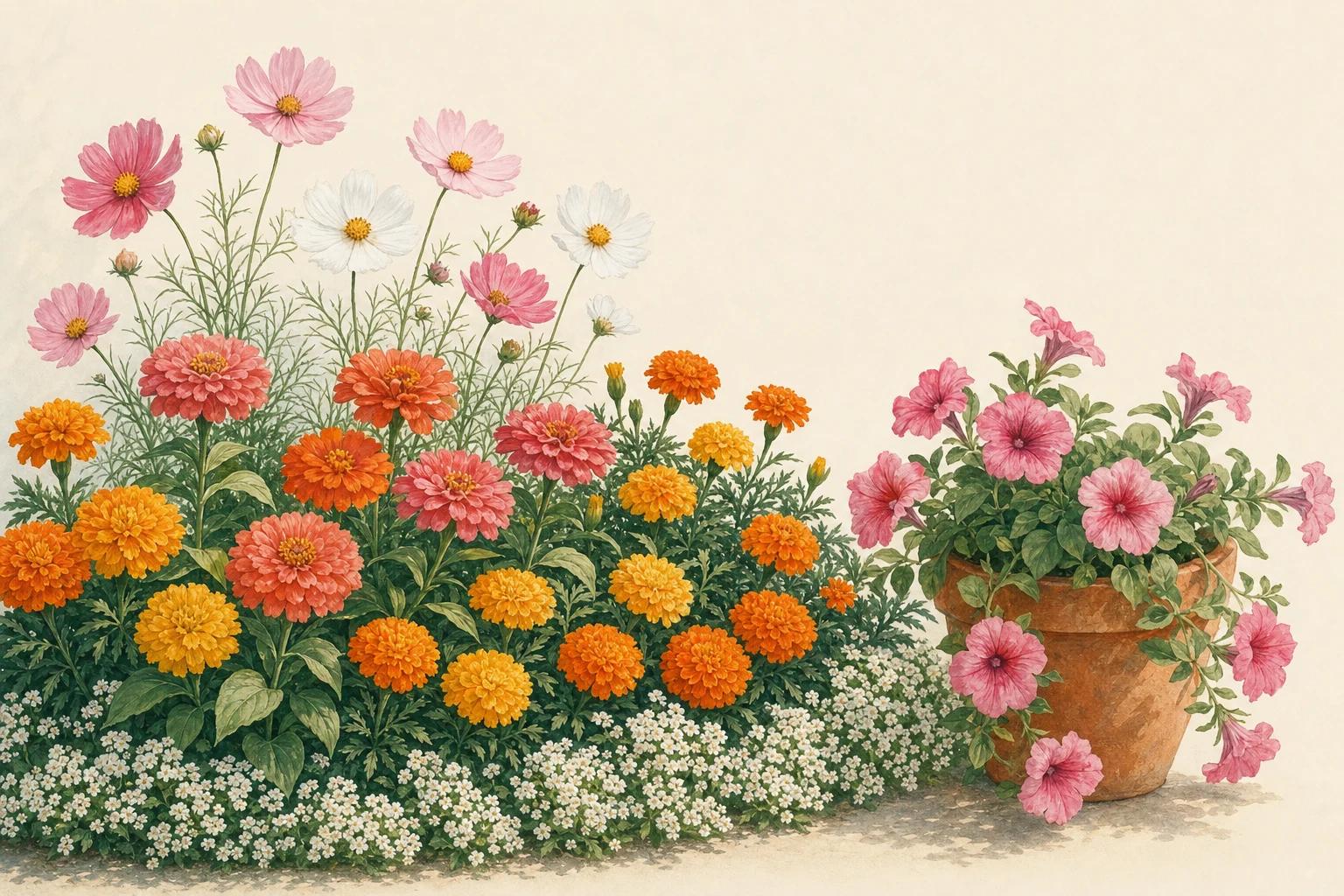
Sow zinnia in place after the last frost and it flowers from summer into fall, at 6 inches to 3 feet (15–90 cm) depending on cultivar. It wants full sun and is non-toxic to dogs, cats and horses. Powdery mildew, leaf spots and blights are its weakness, and all three get worse in shade, humidity and crowded beds. Where mildew strikes every year, grow narrowleaf zinnia (Z. angustifolia), a 6–18 inch (15–45 cm) species with excellent resistance to mildew and leaf spot.
French marigold (Tagetes patula)
French marigold forms a tidy mound 6–12 inches (15–30 cm) tall and up to 18 inches (45 cm) wide that blooms from spring to fall if you pick off spent flowers. It is deer resistant and drought tolerant once established, in full sun to part shade. Spider mites, thrips and powdery mildew are the usual troubles. Wear gloves when deadheading on sunny days: the sap plus sunlight can redden and blister skin.
Garden cosmos (Cosmos bipinnatus)
Garden cosmos grows 2–4 feet (60–120 cm) tall and flowers from spring into fall, tolerating heat, drought and poor soil. Sow seed in place after the last frost, once the soil reaches at least 65°F (18°C). Tall plants flop and may need stakes, and it self-seeds aggressively. Orange cosmos (C. sulphureus) is a heat-tolerant species of 2–3 feet (60–90 cm) that blooms from summer to frost and reseeds just as freely. Both species are rated high risk of becoming invasive in Hawaii, where orange cosmos may already be naturalizing on Oʻahu and Maui.
Angelonia (Angelonia angustifolia)
Sold as summer snapdragon, angelonia carries upright 12–18 inch (30–45 cm) flower spikes from June into September and holds up in heat and humidity. It is a perennial only in Zones 9–11; elsewhere, buy fresh plants each spring and give them full sun. Aphids and powdery mildew are the common pests, and some cultivars, 'Night Sky' among them, are prone to Phytophthora root and stem rot.
Annual vinca (Catharanthus roseus)
Annual vinca, also called Madagascar periwinkle, stays under 18 inches (45 cm) and flowers from about June until frost through heat and drought; deer leave it alone. Phytophthora root rot is its main disease, so keep it out of soggy beds. It poisons dogs, cats and horses. It has naturalized on several Hawaiian islands and is rated high risk of becoming invasive there, and it is on California's invasive-plant watch list.
Butter daisy (Melampodium divaricatum)
Butter daisy, sold as melampodium, covers 1.5–2 foot (45–60 cm) plants with small golden daisies from about May until frost. It is drought tolerant once established and deer resistant. Sow it in the garden after the last frost, or get a head start by sowing indoors 6–8 weeks earlier. Stems can flop in midsummer heat, powdery mildew can appear, and plants may self-seed.
Globe amaranth (Gomphrena globosa)
Globe amaranth bears round flower heads from June until frost on plants 6–24 inches (15–60 cm) tall, with no serious pest problems and good drought tolerance once established. The heads keep their color when cut and dried. Its one weakness is patchy germination, so sow thickly, whether in the bed or in trays started 6–8 weeks ahead of the last frost.
Moss rose (Portulaca grandiflora)
Moss rose is the annual for the hottest, driest spot in the yard: a 3–8 inch (8–20 cm) carpet that blooms spring through fall in full sun. Sow seed where it will grow, because it resents transplanting, and plant only in fast-draining soil, since wet ground causes crown rot. It self-seeds, so deadhead it to limit volunteers. It is rated high risk of becoming invasive in Hawaii, though it is not known to have naturalized there.
Lantana, sterile cultivars (Lantana camara)
Lantana flowers from midsummer to frost in full sun, takes heat and drought, and is a reliable butterfly plant; it is a tender perennial that lives on only where winters stay frost-free. Common lantana is invasive in Florida, so plant only sterile cultivars there, such as 'Bloomify Red', 'Bloomify Rose' and 'Luscious Royale Red Zone', which produce no viable seed or pollen. In Hawaii, common lantana is rated high risk of becoming invasive and forms dense thickets, so leave it out. All lantana is toxic to dogs, cats and horses.
Annuals for shade
In part to full shade, plant New Guinea impatiens, wax begonia, wishbone flower, coleus and caladium, and skip standard bedding impatiens anywhere downy mildew has appeared. For perennials and shrubs that share the same conditions, see these plants for shade.
Bedding impatiens (Impatiens walleriana) were the default shade annual until impatiens downy mildew, a water mold, drove them out of production nationwide. Leaves first show yellow-green speckling and curl downward, a white fuzz forms on their undersides, then leaves and flowers drop and leave bare stems; plants rarely recover. The pathogen survives winter in soil and old plant debris, so do not replant impatiens in a bed that had it the year before. Newer bedding series bred for resistance, such as Beacon and Imara XDR, help, though even resistant plants can still catch it. I. walleriana is also no longer recommended in Florida, where it may become invasive. Wax begonia, wishbone flower and caladium cannot catch impatiens downy mildew, so they can go straight into a bed where impatiens died.
If impatiens leaves show white fuzz underneath, pull the plants roots and all, seal them in a plastic bag and put them in the trash, not the compost. Consider removing any impatiens within 3 feet (0.9 m) as well. Fungicide sprayed at this stage does nothing.
New Guinea impatiens (Impatiens hawkeri)
New Guinea impatiens are the direct replacement for bedding impatiens: they resist or tolerate downy mildew and flower from spring to fall on plants 6 inches to 2 feet (15–60 cm) tall. They do best in partial shade, while the hybrid SunPatiens series takes full sun. Resistance is not immunity, so water at the soil with a soaker hose or drip line and leave room for air to move between plants.
Wax begonia (Begonia × semperflorens-cultorum)
Wax begonia grows 6–12 inches (15–30 cm) tall, flowers from spring to frost, and is one of the few bedding plants that adapts to anything from shade to full sun, in beds or pots; bronze-leaved types handle the sunnier spots. It drops its own spent flowers, so it needs no deadheading. Begonias are toxic to dogs, cats and horses, with irritating oxalates in the roots and sap, so keep digging dogs out of the bed.
Wishbone flower (Torenia fournieri)
Wishbone flower, or torenia, is a 6–18 inch (15–45 cm) shade annual for edging, pots and baskets that flowers through summer and fall. It needs part sun to shade, especially where summers are hot, and rich, evenly moist soil; mulch around it to keep the roots cool. Because it needs that steady moisture, it is a poor fit for dry shade.
Coleus (Coleus scutellarioides)
Coleus is grown for patterned leaves, on plants anywhere from 6 inches (15 cm) to 3 feet (90 cm) tall. Traditional types do best in part shade and may wilt in full sun, while many newer varieties take full, hot sun; check the tag. Cuttings root easily in moist potting mix, and because it is a tender perennial you can pot a favorite before frost and keep it indoors. Handling the leaves can mildly irritate skin, and coleus is toxic to dogs, cats and horses.
Caladium (Caladium bicolor)
Caladium is a tender tuber grown for its patterned leaves, 1–2 feet (30–60 cm) tall in shade to part shade. Plant tubers once daytime temperatures reach 70°F (21°C). It is perennial only in Zones 9–10. Farther north, dig the tubers after the first fall frost and store them dry at 45°F (7°C) or warmer, or treat it as an annual. Caladium is toxic to dogs, cats and horses: its calcium oxalate crystals burn and swell the mouth and can cause vomiting.
Annuals for containers and hanging baskets
For pots, window boxes and baskets, spreading petunias and calibrachoa give the longest show, with verbena to trail and zonal geranium for upright color. In shade, wax begonia and New Guinea impatiens fill the same role. Limit each planting to a few kinds and colors for the strongest effect; for pairings, see this guide to garden color schemes.
Petunia (Petunia × hybrida)
Petunia makes plants 6–18 inches (15–45 cm) high that spread 1–3 feet (30–90 cm) and flower from early summer until frost. It is safe around dogs, cats and horses. The spreading series are far bigger: Supertunia Vista Bubblegum II reaches 12–24 inches (30–61 cm) tall, trails to 36 inches (91 cm) and spreads 2–3 feet (60–90 cm). Space it 18–32 inches (45–81 cm) apart, or give one plant a large pot. Petunias tolerate shade but flower less in it, so give them full sun, although the Vista series manages with 4–6 hours. In north and central Florida, treat petunias as a winter flower: plant them in November or later for bloom until April or May.
Calibrachoa (Calibrachoa × hybrida)
Calibrachoa, or million bells, carries masses of small petunia-like flowers on trailing stems 3–9 inches (8–23 cm) tall, spreading 6–24 inches (15–60 cm), from early summer until frost. It keeps blooming through hot summers, tolerates some drought and needs no deadheading. It sets very few seeds, so it is grown from cuttings and bought as plants. Overwatering rots its roots, so use a fast-draining potting mix.
Garden verbena (Verbena × hybrida)
Garden verbena reaches 6–18 inches (15–45 cm), spreading up to 2 feet (60 cm), and blooms from late spring to fall, drawing butterflies. It needs full sun and good drainage, deer rarely bother it, and removing faded flower clusters extends bloom. Buy plants, because it is hard to raise from seed, and do not overwater, which rots the roots.
Zonal geranium (Pelargonium × hortorum)
Zonal geranium forms a rounded mound 1–3 feet (30–90 cm) tall and flowers through the warm months until frost, in pots or beds. Because it tolerates cool weather, it can go out anywhere from about 2 weeks before the frost-free date to just after the last frost, but frost damages it. Give it full sun and well-drained soil; in low light it turns leggy and blooms poorly. Fungal and bacterial leaf diseases are its weak point, so give it good air movement and snap off faded flower heads, which keeps buds coming and cuts disease. It is mildly toxic if eaten, and cats are the most sensitive.
Annuals for cutting gardens and pollinators
For flowers to cut and for bees and butterflies, grow sunflower, Mexican sunflower, spider flower, black-eyed Susan, celosia and salvias alongside the zinnias and cosmos above. Snapdragon, calendula, cornflower and fragrant flowering tobacco also cut well; for drying, add strawflower and statice to globe amaranth and celosia.
| Top pollinator cultivar | Plant | Height × width | Notes |
|---|---|---|---|
| Music Box Mix | Sunflower | 4–5 × 2–3 ft (1.2–1.5 × 0.6–0.9 m) | Sow in place; blooms until frost |
| Lemon Queen | Sunflower | 7–8 × 2 ft (2.1–2.4 × 0.6 m) | Sow in place; reseeds |
| Summer Jewel Pink | Salvia coccinea | 18–22 × 12–18 in (45–56 × 30–45 cm) | Remove spent spikes; reseeds |
| Purple Fairy Tale | Salvia verticillata | 12–15 × 12 in (30–38 × 30 cm) | Not a bedding salvia; sow in place or indoors; reseeds |
| Orange Fudge | Black-eyed Susan | 24 × 18 in (60 × 45 cm) | Slow to sprout; reseeds |
| Prairie Sun | Black-eyed Susan | 24 × 12–18 in (60 × 30–45 cm) | Indoors or in place; reseeds |
| Showstar | Butter daisy | 24 × 24 in (60 × 60 cm) | Start indoors |
| Dakota Gold | Sneezeweed | 12 × 8–12 in (30 × 20–30 cm) | Start indoors |
| Envy | Zinnia | 24 × 18 in (60 × 45 cm) | Pale yellow-green flowers |
The nine plants that drew the most pollinators among more than 30 varieties grown as annuals in a University of Minnesota Extension trial, 2015–2018. Not all are true annuals: black-eyed Susan can live two years or more.
Pick named cultivars with care, because some bedding plants offer pollinators little. Many bedding cultivars of red salvia (Salvia splendens) produce little nectar, and modern vinca hybrids produce less than the wild species.
Sunflower (Helianthus annuus)
Sunflower runs from 1.5 to 10 feet (0.5–3 m) tall by cultivar and flowers from July to October. Sow seed where it will grow after the last frost. It is a monarch nectar plant, and the seed heads feed birds into fall; Lemon Queen is one of the strongest pollinator magnets among annuals and is very popular with bees. Tall cultivars need a sheltered spot and staking, and dropped seed comes up as volunteers that can turn weedy.
Mexican sunflower (Tithonia rotundifolia)
Mexican sunflower grows 3–6 feet (0.9–1.8 m) tall, with 3-inch (8 cm) orange-red flowers from midsummer through fall that draw butterflies and hummingbirds. It tolerates heat, drought, poor soil and deer, which makes it a tall summer screen for a hot, dry spot. Removing spent flowers keeps it blooming longer, and tall plants may need staking in wind.
Spider flower (Cleome hassleriana)
Spider flower reaches 3 to 6 feet (90–180 cm) at the back of a border, flowering from summer to fall in sun to part shade. It tolerates heat, humidity, drought and deer, and it self-seeds freely. Older strains carry small spines at the leaf bases and have a musky smell, so wear gloves when you cut stems for the vase.
Black-eyed Susan (Rudbeckia hirta)
Black-eyed Susan is a native that behaves as an annual, biennial or short-lived perennial and flowers its first year from seed, so it is sold with the annuals. Plants grow 2–4 feet (60–120 cm) tall, bloom from midsummer into fall in sun to part shade, and make long-lasting cut flowers; 'Prairie Sun' stays near 24 inches (60 cm). It hosts butterfly caterpillars and its seed feeds birds. Expect it to self-seed freely.
Celosia (Celosia argentea)
Plumed celosia carries feathery plumes 9–18 inches (23–45 cm) tall from late spring until frost and dries well for arrangements. Sow it in place after the last frost, or start it indoors and move it out young, handling the roots gently, because celosia sulks when its roots are disturbed. Crowding, rain and humidity can rot the plumes, and it self-seeds weedily unless deadheaded. It has naturalized on Maui and Hawaii Island and is rated high risk of becoming invasive in Hawaii.
Salvias (Salvia farinacea and Salvia coccinea)
Mealy cup sage sends up blue spikes from spring to frost on 1.5–3 foot (45–90 cm) plants that feed bees, butterflies and hummingbirds, and goldfinches eat the seed. It is perennial in Zones 8–10 and an annual elsewhere. Downy mildew, powdery mildew and damping off are its problems, so give it drainage and air. Salvia coccinea, in the cultivar 'Summer Jewel Pink', is one of the best annuals for bumblebees, which reach its pollen and nectar easily.
Cool-season annuals for spring and fall
Pansy, snapdragon, sweet alyssum, calendula, cornflower and ornamental kale tolerate cold and fade in summer heat. Plant them early in spring across the North and in fall across the South, then pull them when they decline and replant with heat lovers.
Pansy (Viola × wittrockiana)
Pansy grows 4–9 inches (10–23 cm) tall and, where winters are mild, flowers through fall, winter and spring for 4–6 months. Pansies survive nights down to the single digits °F (about −13 to −17°C) and rebound when it warms. Plant when the soil is 45–65°F (7–18°C): colder soil leaves plants stunted and pale, while warm soil makes them stretch, yellow and flower poorly. Buy stocky plants with at least 4–5 strong leaves and space them 6–10 inches (15–25 cm) apart. Set the top of the root ball about 1/4 inch (6 mm) below the soil line; deeper planting invites root rot. Do not eat nursery pansies, which may have been treated with systemic pesticides.
Snapdragon (Antirrhinum majus)
Snapdragon blooms best in cool weather and takes light frost, so plant it with the hardy annuals about 4 weeks before the frost-free date, or in fall where winters are mild. Dwarf edging types start at 6 inches (15 cm) and cutting types reach 3 feet (90 cm) and may need staking. It is a short-lived tender perennial in Zones 7–10. Rust is its main disease, and plants languish in summer heat.
Sweet alyssum (Lobularia maritima)
Sweet alyssum makes a 3–10 inch (8–25 cm) edging of tiny flowers from spring to first frost in sun to part shade. Sow it outdoors several weeks before the last frost or indoors 5–6 weeks before; an August sowing gives fall flowers. It slumps in hot summers, so shear it back to bring on new growth. It needs very good drainage and self-sows; it is rated a limited invasive in California and high risk of becoming invasive in Hawaii.
Calendula (Calendula officinalis)
Calendula, or pot marigold, grows 1–2 feet (30–60 cm) tall and flowers in spring and summer, a good cut flower that deer and rabbits avoid. Sow it in the garden just before the last frost, or in trays 6–8 weeks earlier. It does poorly in hot, dry summers, reseeds readily, and attracts powdery mildew, aphids and whiteflies.
Cornflower (Centaurea cyanus)
Cornflower, or bachelor's button, grows 1–3 feet (30–90 cm) tall with blue, pink or white flowers for cutting. Sow it outdoors in fall where winters are mild; elsewhere, start it indoors 6–8 weeks ahead of the last spring frost. It reseeds and naturalizes easily, so deadhead it if you do not want it everywhere. Stems flop in too much shade.
Ornamental kale and cabbage (Brassica oleracea)
Ornamental kale is grown for its leaves, whose color deepens as temperatures drop, on plants about 10 inches to 2 feet (25–60 cm) tall. Buy plants and set them out in fall in full sun; shade invites downy mildew. Slugs and aphids are the usual pests.
Annuals to avoid or plant with care
Skip seed-setting lantana in Florida and all common lantana in Hawaii, castor bean anywhere children or pets play, and green crimson fountain grass in California. A handful of other common annuals spread in mild climates and deserve a check before planting.
Castor bean (Ricinus communis) is grown for dramatic bronze leaves, but every part is toxic and the seeds contain ricin. It is toxic to dogs, cats and horses, and as little as an ounce of seeds can kill an animal. It has also naturalized on all the main Hawaiian islands.
| Plant | Where it is a problem | What to plant instead |
|---|---|---|
| Lantana (seed-setting) | Florida: invasive. Hawaii: high risk, dense thickets. California: watch list | Florida: sterile cultivars. Hawaii: leave it out |
| Castor bean | Hawaii: naturalized on all main islands. California: limited invasive | Avoid entirely |
| Crimson fountain grass | California: moderate invasive | Sterile red-leaved purple fountain grass ('Rubrum') |
| Annual vinca | Hawaii: naturalized, high risk. California: watch list | Fine elsewhere |
| Celosia | Hawaii: naturalized, high risk | Fine elsewhere |
| Nasturtium | Hawaii: naturalized on Kauai, Molokai, Maui and Hawaii Island | Fine elsewhere |
| Sweet alyssum | California: limited invasive. Hawaii: high risk | Fine elsewhere |
| Cosmos, moss rose | Hawaii: high risk; orange cosmos may be naturalizing on Oʻahu and Maui | Deadhead before seed sets |
| Bedding impatiens | Florida: no longer recommended; may become invasive | New Guinea impatiens |
Status from UF/IFAS (Florida), Cal-IPC (California) and the Hawaii Pacific Weed Risk Assessment (Hawaii). Hawaii ratings are screening scores, not legal bans. Cal-IPC lists the red-leaved fountain grass as sterile and not considered invasive.
A few more plants on the annual bench need care around people and pets. Browallia is toxic to cats and dogs. Edging lobelia contains lobeline and is poisonous to people if eaten. Sweet pea seeds are poisonous, so keep sweet peas away from edible peas. Flowering tobacco can spread viruses such as tobacco mosaic, so plant it well away from tomatoes, potatoes and peppers.
Keeping annuals blooming until frost
Annuals keep flowering when they are stopped from setting seed, never run dry and get modest, steady feeding. Deadhead the types that need it, water deeply about once a week, and feed containers far more often than beds.
| Plant | Deadhead? |
|---|---|
| Geranium, marigold, salvia, cosmos, snapdragon | Yes; removing spent flowers keeps buds coming and cuts disease |
| Begonia, impatiens, vinca | No; they drop spent flowers on their own |
| Supertunia petunias, calibrachoa | No; self-cleaning |
| Other petunias | Helps; pinch off faded blooms |
| Pansy | Pinch spent flowers and feed lightly each month |
Deadheading also reduces the self-seeding of cosmos, celosia and cornflower.
Pinch for bushier plants. Pinching a growing tip makes a plant branch from lower down and carry more flowers. Pinching the open blooms off new transplants at planting gives bushier, fuller plants later. When spreading petunias turn leggy in midsummer, cut back the longest stems, removing no more than 20 percent of the plant, then feed to push new growth.
Water deeply, not often. Established beds need about 1 inch (2.5 cm) of water a week, applied in one deep soaking early in the day so leaves dry before night, rather than in frequent light sprinklings. Water new transplants daily until they root in, and spread 2–3 inches (5–8 cm) of organic mulch to hold moisture, slow weeds and keep the soil cool.
Feed beds lightly and pots often. Most bed annuals get by on the fertilizer worked in at planting; add more 6–8 weeks later, at a quarter to half the original rate, only if plants look pale or slow. Containers are different. Feed spreading petunias in pots with a water-soluble fertilizer every third watering or at least weekly, and in-ground petunias every one to two weeks. For calibrachoa, work slow-release fertilizer into the potting mix at planting and add diluted liquid fertilizer every few weeks while it blooms. Skip fertilizer for nasturtium, which answers rich soil with leaves instead of flowers.
Before the first fall frost, dig and pot tender perennials worth keeping, such as geranium, coleus and lantana. Grow them on indoors in a bright, sunny window and plant them out again after your frost-free date.
At season's end. The first frost ends tender annuals, while hardy ones such as pansy keep going through cold nights. Pull spent plants and old debris, especially any impatiens, to keep diseases from overwintering in the bed. Leave a few seed heads on sunflowers and black-eyed Susans for birds, and watch next spring for volunteer seedlings. To decide where next year's annuals will go alongside your perennial flowers, sketch the bed in Sow's garden design studio.
Frequently asked questions
Do annuals come back each year?
No. An annual sprouts, flowers, sets seed and dies in one growing season, usually at the first fall frost, so the plant itself never returns. Some drop enough seed that volunteers appear the next spring, notably cleome, cosmos, snapdragon, sweet alyssum and black-eyed Susan. Tender perennials sold as annuals, such as geranium, lantana and coleus, survive only where winters stay frost-free, or if you dig and pot them before frost.
What flowers are annuals?
True annuals include zinnia, marigold, cosmos, sunflower, moss rose, cornflower and nasturtium. Many other bedding plants are tender perennials grown as annuals because frost kills them: geranium, lantana, coleus, annual vinca and angelonia among them. Snapdragon is a short-lived perennial that shrugs off light frost, so it is planted early with the hardy annuals. Pansy and black-eyed Susan can live two years or more but flower in their first, so they are treated the same way.
What are the top 10 most popular annual flowers?
Five bedding plants rank among the most common annuals grown: marigold, petunia, impatiens, geranium and zinnia. For a dependable top 10, add cosmos and angelonia for hot sun, wax begonia for sun or shade, calibrachoa for pots and pansy for the cool months. Where downy mildew has struck impatiens, plant New Guinea impatiens in their place, and choose by your light and season rather than by any ranking.
What annual flowers last all summer?
The longest performers flower from planting until frost: Supertunia Vista petunias and calibrachoa, which need no deadheading, plus butter daisy (about May to frost), globe amaranth and annual vinca (about June to frost), celosia (late spring to frost) and wax begonia (spring to frost). Zinnia, marigold and cosmos also last all summer if you keep removing spent blooms. Cool-season annuals such as pansy and snapdragon fade once summer heat sets in.
Which plant gives 12 months of flowers?
No single annual blooms all year in most of the US; you get year-round color by changing the planting. Put pansies, snapdragons and sweet alyssum in for fall through spring, then replace them with heat-tolerant annuals in late spring. In mild-winter areas pansies alone flower for 4 to 6 months. In Florida, SunPatiens flower year-round, the closest thing to a 12-month bedding plant.
Which annual flowers are safe for dogs and cats?
Zinnia, petunia and nasturtium are non-toxic to dogs, cats and horses, so they are safe choices for beds pets can reach. Avoid or fence off lantana, annual vinca, begonia, caladium, coleus and castor bean, which are toxic to all three; castor bean seeds contain ricin. Browallia is toxic to cats and dogs, and geranium is mildly toxic, with cats the most sensitive. If a pet chews an unknown plant, call a veterinarian or an animal poison line.
Should I grow annuals from seed or buy transplants?
Use both, depending on the plant. Calibrachoa sets almost no seed and verbena is hard to raise from seed, so buy them as plants, along with edging lobelia, which is more reliable from transplants. Sow zinnia, cosmos and sunflower directly after the last frost. For earlier flowers, start globe amaranth, butter daisy, calendula and cornflower indoors 6 to 8 weeks before the last frost, then set them out once the weather suits each one.
Do I need to deadhead petunias?
Only some. Supertunia Vista and similar spreading series drop their own spent flowers and keep blooming without help. Other petunias flower longer when you pinch off faded blooms before they set seed, because a plant busy making seed makes fewer new buds. Pinch new plants back at planting time too, so they branch and fill out sooner. If a plant still stalls, check the light: petunias in shade bloom less however often you deadhead.
When should I plant annuals in the South?
Plant twice a year. Cool-season annuals go in during fall, once the weather has truly cooled, and flower through winter into spring; warm-season annuals follow after the last spring frost. In north and central Florida, pansies, snapdragons, petunias and sweet alyssum all count as winter flowers and bloom until April or May. For the summer beds that follow, choose heat-proof annuals such as annual vinca, angelonia, zinnia and SunPatiens.
References
- University of Illinois Extension. Annuals. Accessed October 16, 2026.
- University of Illinois Extension. Planting Annuals. Accessed October 16, 2026.
- University of Illinois Extension. Caring for Annuals. Accessed October 16, 2026.
- Penn State Extension. Planting and Growing a Home Garden. Accessed October 16, 2026.
- University of Wisconsin-Madison Division of Extension, Plant Disease Diagnostics Clinic. Impatiens Downy Mildew (UW Plant Disease Facts D0066). Accessed October 16, 2026.
- University of Minnesota Extension. Annual Flowers That Attract Pollinators. Accessed October 16, 2026.
- Mississippi State University Extension. Selected Annual Flowering Plants for Mississippi Gardens. Accessed October 16, 2026.
- University of Arizona Cooperative Extension. Annual Flowers for Northern Arizona Above 6,000 Foot Elevations (AZ1255). Accessed October 16, 2026.
- Texas A&M AgriLife Extension Service, Galveston County. Cooler Weather Means Time to Plant Pansies. Accessed October 16, 2026.
- University of Florida IFAS Extension, Gardening Solutions. Winter Annuals. Accessed October 16, 2026.
- University of Florida IFAS Extension, Gardening Solutions. Impatiens. Accessed October 16, 2026.
- University of Florida IFAS Extension, Gardening Solutions. Lantana. Accessed October 16, 2026.
- University of Florida IFAS Extension, Gardening Solutions. Coleus. Accessed October 16, 2026.
- NC State Extension. Extension Gardener Plant Toolbox: species pages for each annual named (search by botanical name, e.g. Zinnia elegans, Angelonia angustifolia, Salvia farinacea, Antirrhinum majus, Calibrachoa x hybrida, Begonia wax types, Pelargonium x hybridum, Caladium bicolor). Accessed October 16, 2026.
- ASPCA Animal Poison Control. Castor Bean Plant. Accessed October 16, 2026.
- ASPCA Animal Poison Control. Toxic and Non-Toxic Plant List (entries for lantana, periwinkle, caladium, begonia, coleus, zinnia, petunia, nasturtium). Accessed October 16, 2026.
- Hawaii Pacific Weed Risk Assessment (Plant Pono). Plant Pono species risk assessments (Lantana camara, Ricinus communis, Catharanthus roseus, Celosia argentea, Tropaeolum majus, Lobularia maritima, Cosmos bipinnatus, Cosmos sulphureus, Portulaca grandiflora). Accessed October 16, 2026.
- California Invasive Plant Council (Cal-IPC). California Invasive Plant Inventory. Accessed October 16, 2026.
- California Invasive Plant Council (Cal-IPC). Pennisetum setaceum (crimson fountain grass) profile. Accessed October 16, 2026.
- Proven Winners. Supertunia Vista Bubblegum II Petunia. Accessed October 16, 2026.
Sow Editorial
Written by the Sow team from university extension services, botanical gardens, USDA and NOAA data and plant breeders. Every source is listed under References.