Quick answer
For pink from late winter to frost, plant hellebore, redbud, 'Kanzan' cherry and 'Sarah Bernhardt' peony for spring; coneflower, 'Jeana' garden phlox, 'Ruby Spice' summersweet and crape myrtle for summer; and 'Autumn Joy' sedum, Japanese anemone and pink muhly grass for fall. Peonies need cold winters, and crape myrtle grows as a tree only in Zones 7 to 9 and dies back in Zone 6. Skip purple loosestrife, mimosa, Japanese spirea and butterfly bush.
Key facts
- Earliest pink
- Hybrid hellebore, February to April, in part to full shade
- Spring flowering trees
- Eastern redbud, 'Kanzan' cherry, pink flowering dogwood (April and May)
- Longest bloom
- 'New Dawn' and Pink Knock Out roses, May to frost
- Fall pinks
- 'Autumn Joy' sedum, Japanese anemone, pink muhly grass, sasanqua camellia (to December)
- Hardy to Zone 3
- Coneflower, peony, bleeding heart, steeplebush, 'Pinky-Winky' hydrangea
- Pink bigleaf hydrangea
- Needs slightly acid to alkaline soil, about pH 6 to 7 or higher; strongly acid soil with available aluminum turns it blue
- Invasive pinks to skip
- Purple loosestrife, mimosa, Japanese spirea, butterfly bush, tamarisk
- Toxic to pets and horses
- Peony, hydrangea, hellebore, azalea, clematis, cyclamen, milkweed, flowering cherry
Pink can be in flower somewhere in a US garden from February to December. Hellebores open it under bare trees, redbud, cherry and dogwood carry it overhead in April, peonies and roses take over in May, and coneflower, phlox, hydrangea and crape myrtle hold the summer. Sedum, Japanese anemone and pink muhly grass finish the year, with sasanqua camellia flowering into December where winters are mild.
The 30 picks below are grouped by bloom season. Each gets its actual shade of pink, hardiness zones, size, light and one honest caution. After them come the color rules that make pink look good against a house, notes by region, the pink-flowered invasives to avoid, and fixes for the pinks that refuse to perform.
How these plants were chosen
Every pick had to clear three bars. Its zones, size and bloom months had to be on record with a botanical garden or university. Its flower color had to be documented, not inferred from a name like "purple coneflower". And it could not be ranked invasive on Virginia's 2024 list or the California Invasive Plant Council inventory, or classed as invasive in North Carolina's plant records beyond a low-threat watch.
That check has limits, and three picks carry a disclosure. Crape myrtle has naturalized from Virginia to Arkansas and south to Texas and Florida, although none of those lists names it. Garden phlox has escaped gardens and naturalized beyond its native range. North Carolina regards all hellebores as potentially invasive, though at low threat. No single national invasive list exists, so check your own state's before planting.
The exact shade of pink matters as much as the plant. Where a species comes in several colors, such as creeping phlox, hellebore, zinnia and sasanqua camellia, buy a plant labeled pink or one already in flower. Deer notes use a four-step scale from rarely damaged to frequently severely damaged; no plant is deer proof, and the fuller list is in this guide to deer-resistant plants. Look up your own zone with the plant hardiness checker.
| Pick | Zones | Height, ft (m) | Bloom; tone of pink | Best for |
|---|---|---|---|---|
| Hybrid hellebore (perennial) | 4–9 | 1–1.5 (0.3–0.45) | Feb–Apr; pink among mixed colors | Part to full shade; earliest pink |
| Creeping phlox (groundcover) | 3–9 | 0.25–0.5 (0.08–0.15) | Mar–May; pink, white or purple | Full sun; low native mats |
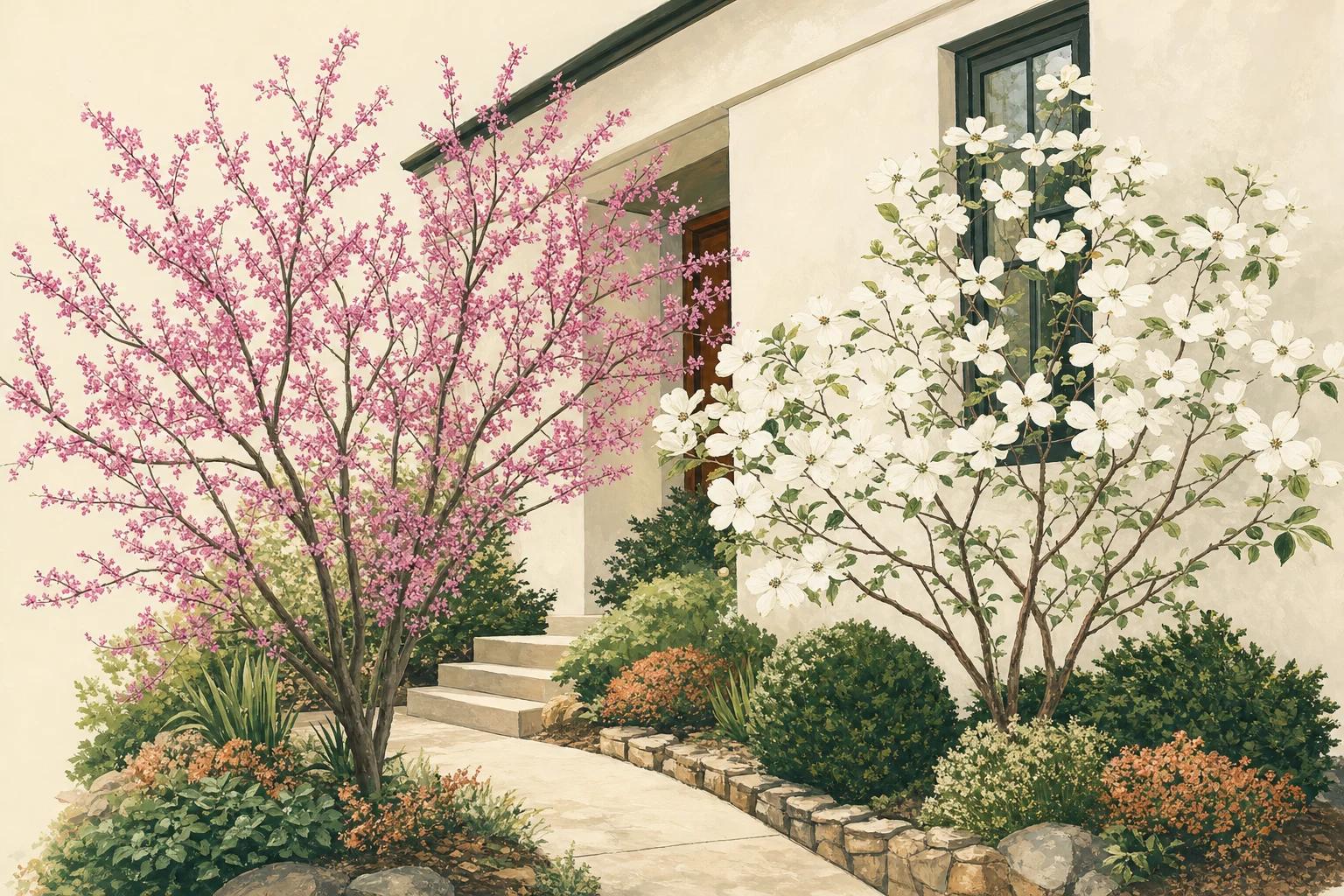
| Eastern redbud (tree) | 4–8 | 20–30 (6–9) | Apr; pink, on bare twigs | Sun to part shade; native |
| 'Kanzan' cherry (tree) | 5–9 | 25–30 (7.6–9) | Apr; deep pink double | Sun or part shade; spring show |
| Pink flowering dogwood (tree) | 5–9 | 15–30 (4.6–9) | Apr–May; pink to reddish bracts | Sun or part shade; native understory |
| Bleeding heart (perennial) | 3–9 | 2–3 (0.6–0.9) | Apr–May; rose-pink and white | Part to full shade |
| Pinxterbloom azalea (shrub) | 4–9 | 3–6 (0.9–1.8) | Apr–May; soft pink to white | Sun or light shade; native |
| Weigela (shrub) | 4–8 | 6–10 (1.8–3) | Apr–Jun; rose-pink | Full sun; hummingbirds |
| 'Sarah Bernhardt' peony (perennial) | 3–8 | 2.5–3 (0.75–0.9) | May; pink double | Cold winters; fragrance |
| Cheddar pink (perennial) | 4–8 | 0.75–1 (0.23–0.3) | May–Jun; rose-pink | Full sun; fast-draining soil |
| Clematis 'Nelly Moser' (vine) | 4–8 | 6–10 (1.8–3) | May–Jun; pale pink, carmine stripe | Sun or part shade; vertical pink |
| 'New Dawn' rose (climber) | 5–9 | 8–12 (2.4–3.7) | May–frost; blush pink | Arbors and fences |
| Pink Knock Out rose (shrub) | 5–9 | 3–4 (0.9–1.2) | May–frost; pink | Low-care borders; disease resistance |
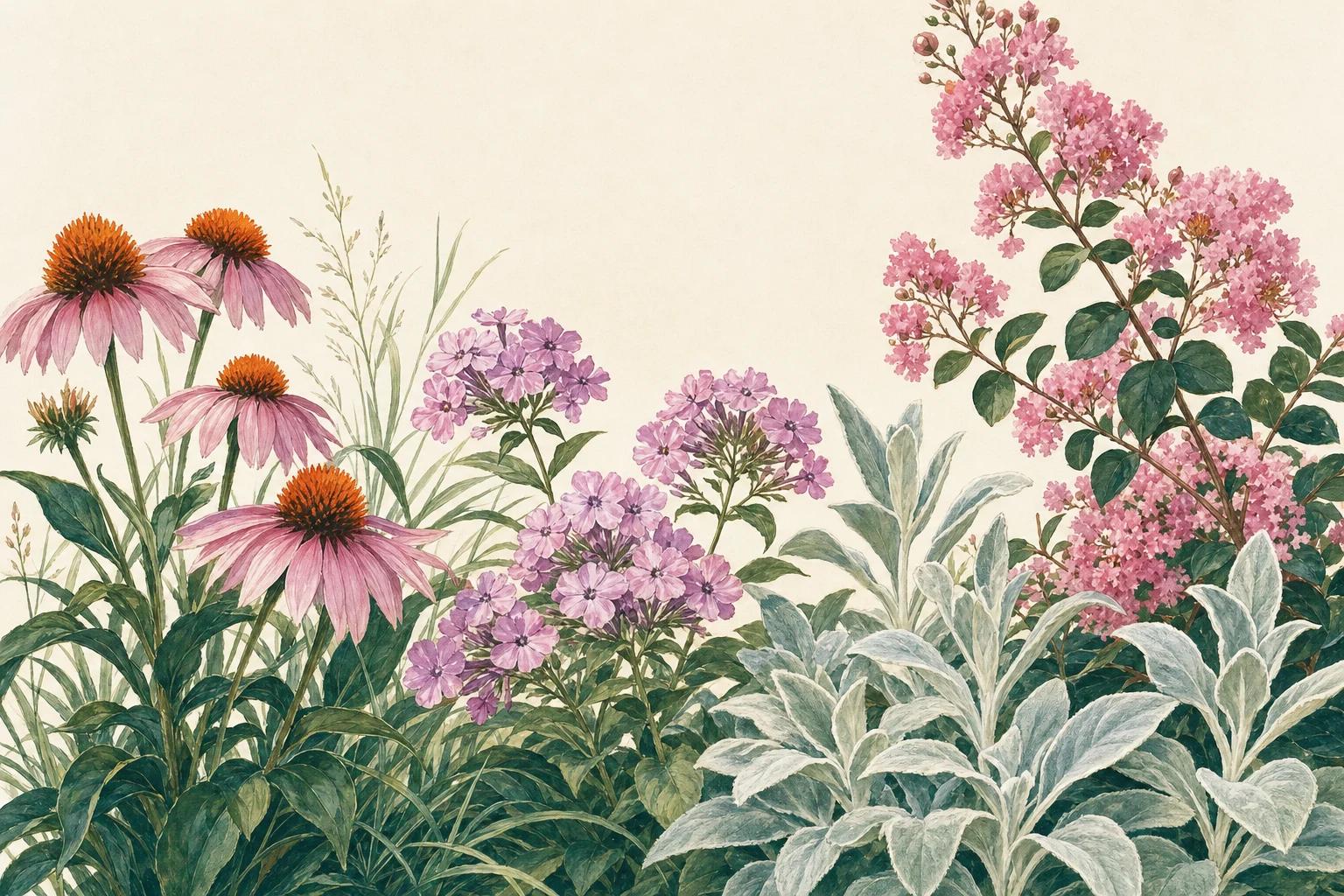
| Purple coneflower (perennial) | 3–8 | 2–5 (0.6–1.5) | Jun–Aug; purplish pink | Full sun to part shade; drought, deer |
| Garden phlox 'Jeana' (perennial) | 4–8 | 2–4 (0.6–1.2) | Jul–Oct; lavender-pink | Sun or light shade; mildew resistance |
| 'Visions' astilbe (perennial) | 4–8 | 1–1.5 (0.3–0.45) | Early to midsummer; raspberry | Part to full shade; moist soil |
| Swamp milkweed (perennial) | 3–9 | 3–4 (0.9–1.2) | Jul–Aug; pink to mauve | Full sun; wet soil, monarchs |
| Steeplebush (shrub) | 3–8 | 2–4 (0.6–1.2) | Jul–Sep; pink to rose-purple | Full sun; moist to wet soil |
| Summersweet 'Ruby Spice' (shrub) | 4–8 | 4–6 (1.2–1.8) | Jul–Aug; rose-pink | Sun to shade; wet soil, fragrance |
| Endless Summer hydrangea (shrub) | 4–9 | 3–4 (0.9–1.2) | Jul–Sep; pink unless soil is strongly acid | Part shade; reliable bloom in the cold |
| 'Pinky-Winky' hydrangea (shrub) | 3–8 | 6–8 (1.8–2.4) | Jul–Sep; white and pink | Sun or part shade; coldest zones |
| Crape myrtle (shrub or tree) | 6–9 (dies back in 6) | 6–25 (1.8–7.6) | Jul–Sep; pink cultivars | Full sun; Southern heat |
| Desert willow (tree) | 7–9 | 10–30 (3–9) | May–Sep; white to rose-pink | Full sun; dry Southwest |
| Zinnia (annual) | Annual | 1–4 (0.3–1.2) | Jun–frost; pink and rose | Budget color from seed |
| 'Autumn Joy' sedum (perennial) | 3–9 | 1.5–2 (0.45–0.6) | Sep–Oct; pink to rust | Full sun; dry soil, butterflies |
| Japanese anemone (perennial) | 4–8 | 1.5–2.5 (0.45–0.75) | Aug–Oct; pale pink | Part shade; late color |
| Surprise lily (bulb) | 5–9 | 1.5–2 (0.45–0.6) | Aug–Sep; rose-pink, lilac tint | Sun to part shade; late summer |
| Pink muhly grass (grass) | 5–11 | 2–3 (0.6–0.9) | Sep–Nov; pink to pinkish red | Sun to part shade; drought |
| Hardy cyclamen (tuber) | 5–9 | 0.3–0.5 (0.1–0.15) | Sep–Oct; pink or blush white | Dry part shade under trees |
| Sasanqua camellia (evergreen shrub) | 7–9 | 6–10 (1.8–3) | Sep–Dec; white to red by cultivar | Part shade; fall into winter |
USDA hardiness zones (2023 map) as rated by botanical gardens and extension services. Crape myrtle survives in Zone 6 but often dies back; most bigleaf hydrangeas lose flower buds below Zone 6, Endless Summer excepted.
Several pinks here are poisonous. Peony, hydrangea, hellebore, pinxterbloom azalea, clematis, hardy cyclamen, swamp milkweed and flowering cherry are toxic to dogs, cats and horses. Every part of a hellebore is poisonous, cyclamen tubers hold the most toxin, cherry leaves, stems and seeds are most dangerous as the leaves wilt, and Japanese anemone is poisonous if eaten. Roses, zinnias and Camellia japonica are listed as non-toxic; sasanqua camellia is not listed. Check any plant not named here before planting where pets or horses graze, and if an animal chews one, call your veterinarian or an animal poison control line.
Spring pink flowers (February to May)
Spring pink starts low, with hellebores in February and creeping phlox in March, then climbs into the trees in April, and weigela carries it into June. Pink tulips belong to April too, but deer browse them hard and the bulbs are toxic to pets.
Hybrid hellebore (Helleborus x hybridus)
Hybrid hellebore is the first pink of the year, flowering from February to April above evergreen leaves in part to full shade. Clumps reach 1–1.5 feet (30–45 cm) tall and wide in Zones 4–9, and deer rarely touch them. Seedlings range from yellow through pink and red to maroon and near-black purple, so choose a plant in flower. Expect occasional crown rot and leaf spot.
Creeping phlox (Phlox subulata)
Creeping phlox is a native mat 3–6 inches (8–15 cm) tall and 1–2 feet (30–60 cm) wide. It covers itself in notched flowers from March to May in Zones 3–9. Wild plants vary from red-purple and violet-purple to pink and white, so a pink sheet depends on buying a named pink. It needs full sun. Rabbits graze it and spider mites flare in hot, dry weather, but it is less prone to mildew than tall garden phlox.
Eastern redbud (Cercis canadensis)
Eastern redbud carries pink, pea-shaped flowers directly on bare twigs in April, before a single leaf opens; across its native range bloom can start in March and last into May. The tree is hardy in Zones 4–8 and matures at 20–30 feet (6–9 m) tall with a 25–35-foot (7.6–10.7 m) spread. It takes full sun to part shade and appreciates afternoon shade where summers are hot. Plant a young tree, because redbuds transplant poorly, and watch for canker, a significant disease of redbuds.
'Kanzan' cherry (Prunus serrulata 'Kanzan')
'Kanzan' cherry, also sold as 'Kwanzan', hangs clusters of deep pink double flowers with 20–30 petals each in April, just as the leaves unfold. It grows into a vase 25–30 feet (7.6–9 m) tall and wide in Zones 5–9 and accepts full sun or part shade. Deer seldom do it serious harm. The price of that spring show is a long pest list: leaf spot, fire blight, borers and Japanese beetles all attack it. Its leaves, stems and seeds are also toxic to dogs, cats and horses, most of all as the leaves wilt, so do not leave pruned branches where animals graze. Compare other options in this guide to flowering trees.
Pink flowering dogwood (Cornus florida f. rubra)
The pink on pink flowering dogwood comes from four pink to reddish-pink bracts that open flat into a 3–4-inch (8–10 cm) "flower" around a knot of tiny yellowish-green true flowers in April and May. This native understory tree reaches 15–30 feet (4.6–9 m) in height and spread, is hardy in Zones 5–9 and grows in sun or partial shade. Dogwood anthracnose is its most serious disease and hits trees already under stress; powdery mildew, leaf spot and canker also appear.
Bleeding heart (Lamprocapnos spectabilis)
Bleeding heart dangles rows of rose-pink hearts, each with white inner petals protruding below, from arching stems in April and May. It grows 2–3 feet (60–90 cm) tall in part to full shade, is hardy in Zones 3–9, and deer rarely damage it. The plant goes dormant in summer, so set later perennials around it to cover the gap. Good drainage is essential.
Pinxterbloom azalea (Rhododendron periclymenoides)
Pinxterbloom azalea is a native deciduous azalea whose slightly fragrant flowers, soft pink to white, open in April and May before the leaves. Expect 3–6 feet (0.9–1.8 m) of height and 4–7 feet (1.2–2.1 m) of spread in Zones 4–9, in sun or light shade. It resists pests better than many hybrid azaleas. Two cautions: deer browse it hard, and azaleas can cause vomiting, diarrhea, weakness and even cardiac failure in pets that eat them.
Weigela (Weigela florida)
Old-fashioned weigela smothers its branches in rose-pink funnel flowers up to 1.25 inches (3 cm) long from April into June, then repeats sparsely in mid to late summer, and hummingbirds visit. It is a big shrub, 6–10 feet (1.8–3 m) tall and up to 12 feet (3.7 m) wide in Zones 4–8, with branches that arch to the ground. Give it full sun and room. It has no serious pests and is seldom badly browsed.
Late spring and repeat bloomers (May to frost)
May belongs to peonies, and for pink that keeps going after they drop their petals, the two roses here flower from May until frost.
'Sarah Bernhardt' peony (Paeonia lactiflora)
'Sarah Bernhardt' is the classic pink peony, with large, very fragrant double flowers in May on plants 2.5–3 feet (75–90 cm) tall and wide. It is rated for Zones 3–8 but needs a cold winter dormancy, and it performs best in Zones 5–7 and the northern parts of Zone 8. One plant flowers for only 7–10 days; mix early, midseason and late peonies to stretch the show to about six weeks, from late April into early June. Stake before the heavy flowers open. Deer rarely damage peonies.
Cheddar pink (Dianthus gratianopolitanus)
Cheddar pink forms a blue-gray to gray-green mat 1.5–2 feet (45–60 cm) wide and 9–12 inches (23–30 cm) tall. In May and June it covers itself with fragrant rose-pink flowers ringed by a darker eye, and deadheading brings scattered repeat bloom. It needs full sun and fast drainage in Zones 4–8, because wet soil rots the crown. Deer seldom do much damage to it.
Clematis 'Nelly Moser'
'Nelly Moser' and other clematis give pink on a vertical. This one opens pale pink flowers with a carmine stripe down the middle of each petal in May and June. The vine climbs 6–10 feet (1.8–3 m) in Zones 4–8 and takes sun or partial shade. Clematis wilt and stem rot can kill a plant outright, and clematis is poisonous to pets.
'New Dawn' climbing rose
'New Dawn' repeats its fragrant blush-pink flowers from May to frost. It climbs 8–12 feet (2.4–3.7 m) and spreads 3–6 feet (0.9–1.8 m), enough to cover an arbor or fence. It is hardy in Zones 5–9 in sun or light shade. Watch for black spot, powdery mildew, rust and rose rosette, and wear gloves for the prickly canes.
Pink Knock Out rose
Pink Knock Out packs the same May-to-frost season into a compact shrub 3–4 feet (0.9–1.2 m) tall and wide, with mildly fragrant single pink flowers. It fits the front of a border or a foundation bed in Zones 5–9, in sun or part shade. It resists black spot far better than most roses, needs no deadheading and flowers with as little as 3 hours of direct sun a day, though crowns need winter protection where winters are cold.
Summer pink flowers (June to September)
Summer is pink's strongest season: native perennials and shrubs handle sunny borders and wet ground, while hydrangeas and crape myrtle supply color at shrub and tree scale.
Purple coneflower (Echinacea purpurea)
Despite its name, purple coneflower has purplish-pink rays. The native species flowers from June to August, and recorded bloom across its native range runs from April to September. It grows 2–5 feet (0.6–1.5 m) tall in Zones 3–8, in full sun to part shade, and tolerates drought, clay and deer. For a shorter plant, 'PowWow Wild Berry' stays 2–3 feet (60–90 cm) tall with rose-purple rays. Left standing, the species seed heads self-sow freely; Japanese beetles, leaf spot and aster yellows are its problems.
Garden phlox 'Jeana' (Phlox paniculata)
'Jeana' garden phlox carries fragrant lavender-pink flower clusters from July into October. Its excellent resistance to powdery mildew sets it apart from most garden phlox. Plants reach 2–4 feet (0.6–1.2 m), are hardy in Zones 4–8 and flower in full sun or light shade. They dislike drought and do best where summers are mild, and deer occasionally cause severe damage.
'Visions' astilbe (Astilbe chinensis)
'Visions' astilbe holds thick raspberry-pink plumes 12–15 inches (30–38 cm) tall over a foliage mound about 9 inches (23 cm) high, in early to midsummer. It is hardy in Zones 4–8 in part to full shade and takes more sun and drought than most hybrid astilbes. It still needs evenly moist soil, or the leaves brown in hot summers. Deer seldom browse it hard. More options for low light are in this guide to shade plants.
Swamp milkweed (Asclepias incarnata)
Swamp milkweed is a monarch host native across the central and eastern US. Its pink to mauve flowers open in July and August, and from June to October across its range. It grows 3–4 feet (0.9–1.2 m) tall in full sun, handles wet ground and clay, and is hardy in Zones 3–9. The plant is toxic to pets, and its milky sap can irritate skin and eyes, so wear gloves when cutting it. Do not treat aphids on it, because the treatments can harm monarch caterpillars.
Steeplebush (Spiraea tomentosa)
Steeplebush is the native answer to Japanese spirea. This suckering shrub, 2–4 feet (0.6–1.2 m) tall and 3–5 feet (0.9–1.5 m) wide, carries narrow, steeple-shaped clusters of pink to rose-purple flowers from July to September. Grow it in Zones 3–8 in sun, in soil that stays moist or even wet. Like other rose-family plants it can get leaf spot, fire blight and powdery mildew.
Summersweet 'Ruby Spice' (Clethra alnifolia)
'Ruby Spice' summersweet is a rose-pink selection of a native shrub that normally flowers white, with fragrant spikes in July and August. Plants grow 4–6 feet (1.2–1.8 m) tall, are hardy in Zones 4–8 and take full sun to part shade. The species tolerates wet soil, clay and heavy shade and prefers acid soil. Spider mites move in when it is kept too dry.
Endless Summer bigleaf hydrangea (Hydrangea macrophylla)
Endless Summer hydrangea is a 3–4-foot (0.9–1.2 m) mophead that flowers from July to September. Its color is set by the soil: pink where the soil is slightly acid to alkaline, blue where strongly acid soil frees aluminum for the roots. Older bigleaf hydrangeas are hardy only to Zone 6, or Zone 5 in shelter. Endless Summer flowers on both old and new wood and is hardy to Zone 4, so it still blooms after a winter that kills its old-wood buds. Give it part shade, or full sun only where the soil stays moist; hydrangeas are toxic to pets. The soil fixes that shift the color are under troubleshooting below.
'Pinky-Winky' panicle hydrangea (Hydrangea paniculata)
'Pinky-Winky' is the pink hydrangea for cold gardens. This panicle hydrangea selection carries two-toned white and pink panicles from July to September, and it is hardy in Zones 3–8. Plants reach 6–8 feet (1.8–2.4 m) tall and 5–6 feet (1.5–1.8 m) wide and flower in sun or part shade. Expect some bud blight, bacterial wilt, leaf spot, rust and mildew.
Crape myrtle (Lagerstroemia indica)
Crape myrtle is the South's summer pink, flowering from July to September in full sun, resisting drought and seldom badly damaged by deer. Wild plants are rose to red, so choose a pink cultivar: 'Seminole' is a clear medium pink at about 8 feet (2.4 m), and 'Hopi' is a mildew-resistant medium pink at about 11 feet (3.4 m). The species ranges from 6 to 25 feet (1.8–7.6 m). It is rated for Zones 6–9 and grows as a tree in Zones 7–9. Powdery mildew and leaf spot are common, and fallen flowers stain walkways and car paint.
Desert willow (Chilopsis linearis)
Desert willow is the pink-flowered native for hot, dry gardens in the Southwest. Fragrant white to rose-pink flowers appear from May to September on a small tree 10–30 feet (3–9 m) tall and 15–20 feet (4.6–6 m) wide. It needs full sun and dry to medium soil in Zones 7–9, tolerates drought and has no major pests. Outside warm, dry climates it is the wrong choice.
Zinnia (Zinnia elegans)
Zinnia is the budget pink on this list, grown from seed and flowering from June to frost on plants 1–4 feet (0.3–1.2 m) tall, depending on variety. Sow outdoors after the last frost and again every 2–3 weeks until the end of June, or start seed indoors 4–6 weeks before the last frost, and deadhead to keep flowers coming. In hot, humid climates choose varieties resistant to powdery mildew, leaf spot and blight. Zinnias are non-toxic to pets; more choices are in the guide to annual flowers. Garden cosmos gives airier pink on similar terms; sow it after the last frost, once the soil reaches 65°F (18°C), in lean soil, and know that it has naturalized along roadsides in many parts of the country.
Fall pink flowers (August to December)
As summer pinks fade in September, sedum, Japanese anemone and hardy cyclamen take over, pink muhly grass carries the color into November, and sasanqua camellia lasts until December in the South. Surprise lily bridges August and September.
'Autumn Joy' sedum (Hylotelephium 'Herbstfreude')
'Autumn Joy' holds flat flower heads 3–6 inches (8–15 cm) across that open pink in September, deepen to rose-red and age to coppery rust through October. It grows 1.5–2 feet (45–60 cm) tall and wide in Zones 3–9, in full sun and dry to medium soil, and it draws butterflies. Wet, poorly drained soil rots it.
Japanese anemone (Anemone hupehensis)
Japanese anemone sends wiry stems to about 30 inches (75 cm) topped with cup-shaped flowers, pinkish white to pale rose-mauve, from August into October and sometimes until frost. It is hardy in Zones 4–8 and tolerates deer. It is slow to establish, then spreads into colonies by suckering roots, so give it room. In hot, dry sun the leaves scorch, so part shade is best.
Surprise lily (Lycoris squamigera)
Surprise lily, also called resurrection lily, produces leaves in spring that die back by summer. Then, in August and September, bare stalks about 2 feet (60 cm) tall appear with fragrant rose-pink funnel flowers tinged lilac. It grows in Zones 5–9 in sun to part shade. Mark the spot when the leaves fade so you do not dig into the bulbs.
Pink muhly grass (Muhlenbergia capillaris)
Pink muhly grass is a native grass whose airy plumes, pink to pinkish red, turn a clump 2–3 feet (60–90 cm) tall and wide into a haze from September to November. It grows in Zones 5–11, in full sun to part shade and dry to medium soil, tolerates drought and has no serious pests.
Hardy cyclamen (Cyclamen hederifolium)
Hardy cyclamen flowers in September and October, pink or white tinged pink, on plants only 4–6 inches (10–15 cm) tall. Its marbled leaves persist through winter. It grows in Zones 5–9 in part shade and dry to medium soil, which suits the ground under trees. Tubers rot in wet soil, mice and squirrels dig them, and the tubers are toxic to pets.
Sasanqua camellia (Camellia sasanqua)
Sasanqua camellia is an evergreen shrub 6–10 feet (1.8–3 m) tall and wide. From September to December it opens mildly scented flowers of six to eight petals. The species is white to pale pink, but cultivars run from white to red, so buy a plant labeled pink or in flower. It is hardy in Zones 7–9 and not reliably hardy in Zone 6a. Part shade suits it best, with full sun possible on soil that never dries out. Watch for petal blight, and remove infected flowers promptly.
How to design with pink
Check the color of the house first, then plant pink in drifts and pair it with silver, deep purple or lavender-blue partners.
On the color wheel, the warm side runs from yellow to red and the cool side from green to violet. Pinks that lean toward violet sit on the cool side, and those that lean toward orange on the warm side. Pink against orange-toned brick makes an unpleasant combination. Look at the walls, fence and paving before you choose, and where the backdrop is warm, use paler pinks or separate them from the wall with green foliage.
Plant pink in masses or bands of one plant rather than one of everything. A single color in a sweep makes a stronger picture than scattered singles. A monochromatic scheme uses lighter and darker shades of one color, so a planting that runs from blush 'New Dawn' through mid-pink coneflower to the deep pink of 'Kanzan' holds together. Bright colors seem to come forward and dark ones recede, and white is the last color to fade at dusk. Mix white-touched pinks such as 'Pinky-Winky' near a patio used in the evening.
Foliage partners do much of the work:
- Lamb's ears: a silver-gray, velvety mat 4–6 inches (10–15 cm) tall for Zones 4–8. Silver leaves stand out as an accent against deeper colors, so edge cheddar pink or sedum with it.
- Russian sage: lavender-blue flowers from July to October on gray-green leaves, 3–5 feet (0.9–1.5 m) tall in Zones 5–9, tolerant of drought and deer. It is a natural partner for coneflower and 'Jeana'.
- 'Palace Purple' coral bells: deep purple leaves, beet-red beneath, for Zones 4–9, a dark base under pale pinks.
- 'Diabolo' ninebark: dark purple leaves and pinkish-white flowers on a shrub for Zones 3–7, a backdrop for pink perennials. Its leaves turn greener in hot summers.
For a garden that is never without pink, choose one anchor per season: hellebore or redbud for early spring, peony for May, coneflower and phlox for summer, and 'Autumn Joy', anemone and muhly for fall. The bigger picture of color schemes is in this guide to garden colors, and layering heights is covered under border planting.
Pink flowers by region
The same pink plant can thrive in Minnesota and sulk in Georgia, so match the pick to your winters and summers.
North, Zones 3 to 5. The hardiest pinks here reach Zone 3: coneflower, 'Sarah Bernhardt' peony, bleeding heart, creeping phlox, 'Autumn Joy', steeplebush, swamp milkweed and 'Pinky-Winky'. Peonies like these winters, since they need the cold. Summersweet is hardy to Zone 4. Older bigleaf hydrangeas are the risky ones, so lean on panicle types or a rebloomer such as Endless Summer.
Midwest. Humid summers bring out mildew on garden phlox and disease on zinnias, so choose resistant varieties, and crape myrtle dies back in cold winters. Minnesota prohibits purple loosestrife and Wisconsin restricts it, which matters because it still turns up for sale.
South and Southeast, Zones 7 to 10. Crape myrtle and sasanqua camellia come into their own, and pink muhly grass thrives. Garden phlox prefers milder summers, and peonies need more winter cold than the Deep South gives. Mimosa and Japanese spirea are invasive in much of this region, so pass them by.
West. In the Pacific Northwest, hydrangeas tend toward pink in soils of pH 6 to 7.5, and Washington and Oregon quarantine butterfly bush. California gives both purple loosestrife and tamarisk its High invasive rating. Desert willow is the pink native for dry Southwestern sites. This list is thin for the arid West and coastal California, so pair it with your state extension service's regional plant lists.
Pink-flowered invasive plants to avoid
Six pink-flowered plants cause real damage in parts of the US, and a native or better-behaved pink can replace each one.
| Plant | Pink trait | Where it is a problem | Plant instead |
|---|---|---|---|
| Purple loosestrife | Pink-purple spikes | Prohibited in MN; restricted in WI; high rank in VA and CA; invasive in NC | Swamp milkweed, steeplebush, Joe Pye weed |
| Mimosa (silk tree) | Pink powder puffs | Invasive in NC; medium rank in VA; spreads across the Southeast | Redbud, pink dogwood, crape myrtle |
| Butterfly bush | Pink cultivars | Noxious weed in WA; quarantined in OR; watch list in CA | 'Ruby Spice' summersweet, Joe Pye weed |
| Japanese spirea | Pink flat clusters | Invasive in VA, GA, SC, TN, KY and NC | Steeplebush, weigela |
| Tamarisk | Pink plumes | High rank in CA; Class B noxious and quarantined in WA | Desert willow, crape myrtle |
| Rose of Sharon | Pink forms | Reported invasive in some states, such as KY; not on VA's 2024 list | Crape myrtle in Zones 7 to 9 |
State listings as checked in October 2026. A plant missing from this table may still be listed in your state.
Purple loosestrife is the most serious; do not trust a "sterile" label, and plant spotted Joe Pye weed or obedient plant, which spreads aggressively, for wet ground instead.
Mimosa (Albizia julibrissin) spreads by seed and root sprouts onto disturbed ground and stream banks, where its impacts are best documented in the Southeast. Butterfly bush is quarantined in Washington and Oregon except approved sterile cultivars. State-by-state detail on both is in the guide to purple flowers. For butterflies, wild bergamot is a native lavender-to-pink alternative with good mildew resistance.
Japanese spirea (Spiraea japonica) includes pink favorites such as 'Little Princess', 'Gold Mound' and 'Shirobana', and it is listed invasive in Virginia, Georgia, South Carolina, Tennessee, Kentucky and North Carolina. Some northern shrub lists still include it, but steeplebush gives the same pink without the risk. Tamarisk, or saltcedar (Tamarix ramosissima), flowers pink from late June to August. It is ranked High in California, is a Class B noxious weed on Washington's quarantine list, and invades moist ground that stays wet for part of the year. Rose of Sharon (Hibiscus syriacus) is the least certain case: reported invasive in some states, including Kentucky, but absent from Virginia's 2024 list.
When pink plants don't deliver
Most pink failures come down to soil pH, winter cold, planting depth or crowding, and each has a clear fix.
A pink hydrangea turned blue. Bigleaf hydrangea color follows soil aluminum, which soil pH controls. Acid soil, around pH 5.5 to 6 or lower, frees aluminum and turns flowers blue; slightly acid to alkaline soil, around pH 6 to 7 or higher, locks it up and keeps them pink. Test the soil first. To push toward pink, broadcast 1 cup (240 ml) of dolomitic lime per 10 square feet (0.9 m²) and water it in, then expect about a year for a visible change. For a faster shift, dissolve 1 tablespoon (15 ml) of hydrated lime in 1 gallon (3.8 L) of water and drench the soil in March, April and May, keeping it off the leaves. Wear gloves, goggles and a dust mask, because hydrated lime is caustic and can permanently damage eyes. Start in late fall or early spring, well before flowering. White hydrangeas stay white whatever you do.
A bigleaf hydrangea that only makes leaves. Winter or late-spring cold kills the flower buds, a common problem below Zone 6. Just as often the buds were cut off: bigleaf hydrangea sets next year's buds in late summer, so do not prune after August 1. Too much shade or heavy nitrogen fertilizer also gives leaves without flowers. Plant it in the most sheltered spot you have, or replace it with a rebloomer such as Endless Summer or with 'Pinky-Winky', which is hardy to Zone 3.
A peony with no flowers. The usual causes are planting too deep or too shallow, too much shade, a late frost killing the buds, or a plant that is young or was recently moved. Set the buds on the rootstock about 2 inches (5 cm) below the soil surface, give it sun or light shade, and then leave it alone.
Crape myrtle killed to the ground. Winter injury is likely in Zones 5 and 6, and top growth often dies to the ground when winter drops below about -5°F (-21°C). The roots usually survive to Zone 5. Cut the stems to 8 inches (20 cm) each spring and the plant regrows 2–4 feet (0.6–1.2 m) as a shrub rather than a tree. How to prune it without topping is covered in the guide to flowering trees.
Phlox gray with mildew. Garden phlox also suffers phlox bugs and root rot in crowded, humid beds. Plant 'Jeana' or another resistant cultivar, space plants for air circulation, mulch, and cut stems to the ground in winter.
'Autumn Joy' splayed open. It flops in rich soil or too much shade. Move it to lean, well-drained soil in full sun, and pinch the stems in spring for sturdier growth.
Plan where your new pinks will go, and how big they will get, with Sow's garden planner.
Frequently asked questions
What types of flowers are pink?
Every plant group has pink members. Among perennials, look at purple coneflower, garden phlox, peony, bleeding heart and 'Autumn Joy' sedum. Shrubs include weigela, bigleaf and panicle hydrangeas, 'Ruby Spice' summersweet and crape myrtle. Eastern redbud, 'Kanzan' cherry and pink flowering dogwood are the classic pink trees, 'New Dawn' rose and 'Nelly Moser' clematis are pink climbers, and surprise lily and hardy cyclamen are pink bulbs. Zinnia covers annuals.
What are the best pink perennials?
For sun, purple coneflower (Zones 3 to 8), 'Jeana' garden phlox (4 to 8), 'Sarah Bernhardt' peony (3 to 8), cheddar pink (4 to 8) and 'Autumn Joy' sedum (3 to 9) cover May through October between them. For shade, add hybrid hellebore, bleeding heart and 'Visions' astilbe. Japanese anemone, best in part shade, flowers as summer perennials fade, from August into October.
What are some cheap pink flowers I can buy?
Seed is the cheapest route to pink. Zinnias and cosmos both come in pink, are sown directly outdoors after the last frost date, and flower from early summer until frost. Snapdragons are inexpensive enough to replace each spring rather than nurse through winter. Among perennials, creeping phlox and purple coneflower spread or self-sow, so a few plants fill more ground each year.
What pink flowers bloom in fall?
'Autumn Joy' sedum opens pink in September and deepens to rust through October. Japanese anemone flowers from August into October, surprise lily sends up bare pink-flowered stalks in August and September, and hardy cyclamen flowers under trees in September and October. Pink muhly grass turns a pink haze from September to November. In Zones 7 to 9, sasanqua camellia keeps flowering into December.
What pink flowers are blooming now?
It depends on the month. In October, look for 'Autumn Joy' sedum turning from pink to rust, Japanese anemone, hardy cyclamen under trees and the pink haze of muhly grass, which lasts into November. Sasanqua camellia carries on until December in Zones 7 to 9. Hellebores open the next round in February, followed by redbud and cherry in April, peonies in May, and coneflower, phlox and crape myrtle in July.
What are the best pink flowering shrubs?
In cold climates, 'Pinky-Winky' panicle hydrangea (Zones 3 to 8) and native steeplebush (3 to 8) are the safest pinks. Weigela and pinxterbloom azalea flower in spring, 'Ruby Spice' summersweet adds fragrance in July and August, and Pink Knock Out rose flowers from May to frost on a 3- to 4-foot (0.9 to 1.2 m) plant. In the South, choose crape myrtle for summer and sasanqua camellia for fall.
What pink flowers grow in shade?
Hybrid hellebore flowers in part to full shade from February to April, and bleeding heart follows in April and May. 'Visions' astilbe carries raspberry-pink plumes in summer as long as the soil stays moist, and hardy cyclamen flowers in dry part shade in fall. Summersweet tolerates heavy shade, and the understory trees pink flowering dogwood and redbud both grow in part shade beneath taller trees.
Which pink flowers do deer leave alone?
No plant is deer proof, but peony, hellebore, bleeding heart and snapdragon are rarely damaged, and coneflower, astilbe, weigela, crape myrtle, cheddar pink, zinnia and swamp milkweed are seldom severely damaged. Avoid tulips and pinxterbloom azalea where deer are common, since both are frequently browsed hard. Garden phlox, hydrangea, dogwood, redbud and roses fall in between and may need protection.
What is the prettiest pink flower?
That is a matter of taste, but three plants make a strong case. 'Sarah Bernhardt' peony gives very fragrant double pink flowers in May on long-lived plants. 'Kanzan' cherry fills April with deep pink doubles carrying 20 to 30 petals each. For fall, 'Autumn Joy' sedum moves from pink to rose-red to coppery rust on one plant. Each is hardy at least from Zone 5 to Zone 8.
References
- Missouri Botanical Garden. Plant Finder database (searched by name for each pick and partner plant). Accessed October 16, 2026.
- Missouri Botanical Garden. Hydrangea macrophylla 'Bailmer' ENDLESS SUMMER, Plant Finder. Accessed October 16, 2026.
- Lady Bird Johnson Wildflower Center, The University of Texas at Austin. Native Plants Database (Echinacea purpurea, Cercis canadensis, Cornus florida, Asclepias incarnata, Spiraea tomentosa, Clethra alnifolia, Muhlenbergia capillaris, Physostegia virginiana, Monarda fistulosa). Accessed October 16, 2026.
- ASPCA Animal Poison Control. Toxic and Non-Toxic Plants (peony, hydrangea, hellebore, azalea, clematis, cyclamen, milkweed, cherry, tulip, rose, zinnia, camellia). Accessed October 16, 2026.
- Rutgers Cooperative Extension (NJAES). Landscape Plants Rated by Deer Resistance. Accessed October 16, 2026.
- North Carolina State Extension. Extension Gardener Plant Toolbox (Cosmos bipinnatus, Lagerstroemia indica, Albizia julibrissin, Spiraea japonica, Lythrum salicaria, Buddleja davidii, Hibiscus syriacus, Helleborus orientalis, Asclepias incarnata). Accessed October 16, 2026.
- North Carolina State Extension. 10. Herbaceous Ornamentals, North Carolina Extension Gardener Handbook. Accessed October 16, 2026.
- North Carolina State Extension. 19. Landscape Design, North Carolina Extension Gardener Handbook. Accessed October 16, 2026.
- University of Georgia Cooperative Extension. Growing Bigleaf Hydrangea (Circular 973). Accessed October 16, 2026.
- University of Georgia Cooperative Extension. Pond Fertilization and Liming in Georgia (Bulletin 867). Accessed October 16, 2026.
- Oregon State University Extension Service. General care of hydrangeas. Accessed October 16, 2026.
- University of Wisconsin-Madison Division of Extension. Summer Flowering Trees, Shrubs and Vines. Accessed October 16, 2026.
- Virginia Department of Conservation and Recreation, Natural Heritage. Virginia Invasive Plant Species List (September 2024). Accessed October 16, 2026.
- California Invasive Plant Council. Cal-IPC Inventory. Accessed October 16, 2026.
- Minnesota Department of Natural Resources. Purple loosestrife (Lythrum salicaria). Accessed October 16, 2026.
- Wisconsin Department of Natural Resources. Purple loosestrife (Lythrum salicaria). Accessed October 16, 2026.
- Washington State Noxious Weed Control Board. Butterfly bush (Buddleja davidii). Accessed October 16, 2026.
- Washington State Noxious Weed Control Board. Saltcedar (Tamarix ramosissima). Accessed October 16, 2026.
- USDA Forest Service. Albizia julibrissin, Fire Effects Information System. Accessed October 16, 2026.
Sow Editorial
Written by the Sow team from university extension services, botanical gardens, USDA and NOAA data and plant breeders. Every source is listed under References.