Quick answer
Match plants to hours of direct sun and soil moisture. Part shade (2 to 6 hours of sun, shaded in the afternoon) suits hosta, astilbe, Siberian bugloss and bleeding heart. Full shade (under 4 hours) suits foamflower, Solomon's seal, wild ginger and ferns. Dry shade under trees needs barrenwort, Lenten rose, bigroot geranium and Pennsylvania sedge, planted small with no more than 2 inches (5 cm) of added soil.
Key facts
- Part shade
- 2 to 6 hours of direct sun, with afternoon and evening shade
- Full shade
- Under 4 hours of direct sun, ideally in the morning
- Moist part shade
- Hosta, astilbe, Siberian bugloss, bleeding heart
- Dry shade under trees
- Barrenwort, Lenten rose, bigroot geranium, Pennsylvania sedge, Christmas fern
- Summer flowers
- Wishbone flower and New Guinea impatiens all summer; toad lily in August and September
- Under trees
- No more than 2 in (5 cm) of added soil, none within 1 ft (30 cm) of the trunk
- Toxic to dogs, cats and horses
- Hosta, hellebore, hydrangea, buckeye, coleus, cyclamen, lily of the valley
- Do not plant
- English ivy, periwinkle, goutweed, creeping Jenny, wintercreeper
Shade plants are chosen by two measurements: how many hours of direct sun the spot gets, and how wet its soil stays. A bed with a few hours of morning sun and moist soil can grow hosta, astilbe and bleeding heart. A dry patch under a maple that sees less than 4 hours of sun needs tougher plants, such as barrenwort, Lenten rose and Pennsylvania sedge.
The 30 picks below follow that order, from moist part shade to full shade to dry shade under trees, then ferns, shrubs, and annuals and bulbs. Each entry gives zones, size, season and moisture, plus the one problem most likely to catch you out. After the picks come the spreaders to keep out of a woodland bed, and how to plant under a tree without slowly killing it.
How these plants were chosen
Every pick has a documented hardiness range, mature size, bloom season and shade rating, and none appears on the Virginia or Connecticut invasive plant lists. Twelve are native to parts of the United States, and so is one of the two Solomon's seals; all are marked in the table below. Entries flag the plants that spread hard, the ones that are toxic to pets, and how deer treat them.
Deer ratings vary by region, and no plant is safe from a hungry herd in every year. If deer are a constant problem, cross-check your choices against this list of deer resistant plants. Zones are USDA hardiness zones; confirm yours with the plant hardiness checker.
Light levels in hours of direct sun
Shade is measured in hours of direct sun, not by how dark a spot feels.
| Light level | Direct sun per day | What it looks like |
|---|---|---|
| Full sun | 6 hours or more | Sun through morning and early afternoon |
| Partial sun | 4 to 6 hours | Most of the sun comes before mid-afternoon |
| Part shade | 2 to 6 hours | Shaded through the afternoon and evening |
| Full shade | Under 4 hours | Best if the sun arrives in the morning; filtered light otherwise |
| Dappled shade | No fixed count | Shifting, filtered light through a tree canopy |
| Deep shade | Almost none | Canopy so dense the sun is not visible from the ground; too dark for most plants |
Hours are direct sun on a clear day in the growing season. Part shade and full shade overlap between 2 and 4 hours, so timing decides which list to use.
Morning sun arrives in the cooler hours, which is why full-shade plants are rated for under 4 hours with morning light preferred. Too much hot sun browns the leaf edges of hostas and wild ginger. To rate a spot, check it every hour on a clear day and note whether it sits in direct sun; a bed lit from 8 a.m. to noon gets 4 hours. Check again after deciduous trees leaf out, since an April sun patch can be shaded by June, and shade deepens as trees grow.
Then judge the soil. Under trees, shade usually comes with dry soil, because the roots take most of the water and the canopy sheds rain out toward the drip line. Treat any bed inside a tree's root zone as dry shade unless you plan to water it.
The picks at a glance
| Pick | Type | Zones | Height | Best for |
|---|---|---|---|---|
| Hosta | Perennial | 3–8 | 6 in–4 ft (15 cm–1.2 m) | Foliage in moist part shade |
| Chinese astilbe | Perennial | 4–8 | 2–4 ft (60 cm–1.2 m) | Summer plumes, moist soil |
| Siberian bugloss | Perennial | 3–8 | 12–18 in (30–45 cm) | Spring blue where deer roam |
| Bleeding heart | Perennial | 3–9 | 2–3 ft (60–90 cm) | Spring flowers, walnut sites |
| Japanese toad lily | Perennial | 4–8 | 2–3 ft (60–90 cm) | Late-summer flowers |
| Foamflower | Native perennial | 4–9 | 9–12 in (23–30 cm) | Spring drifts in full shade |
| Solomon's seal | Perennial (P. biflorum native) | 3–8 | 2–3 ft (60–90 cm) | Arching stems, heavy shade |
| Black cohosh | Native perennial | 3–8 | 4–6 ft (1.2–1.8 m) | Tall back-of-bed accent |
| Canada wild ginger | Native perennial | 4–6 | 6–12 in (15–30 cm) | Low woodland carpet |
| Virginia bluebells | Native perennial | 3–8 | 18–24 in (45–60 cm) | Early spring blue |
| Barrenwort | Perennial | 5–9 | 6–12 in (15–30 cm) | Dry shade under trees |
| Lenten rose | Perennial | 4–9 | 12–18 in (30–45 cm) | Evergreen leaves, late-winter flowers |
| Bigroot geranium | Perennial | 4–8 | 12–18 in (30–45 cm) | Dry-shade groundcover |
| Pennsylvania sedge | Native sedge | 3–8 | 6–12 in (15–30 cm) | Lawn substitute under trees |
| Coral bells | Native perennial | 4–9 | 1–2 ft (30–60 cm) | Leaf color in part shade |
| Cast iron plant | Perennial | 8–10 | 2–3 ft (60–90 cm) | Deep, dry Southern shade |
| Christmas fern | Native fern | 3–9 | 1–2 ft (30–60 cm) | Evergreen fern for dry shade |
| Japanese painted fern | Fern | 3–8 | Up to 2 ft (60 cm) | Silver foliage |
| Ostrich fern | Native fern | 3–7 | 3–6 ft (90 cm–1.8 m) | Wet banks and large spaces |
| Western sword fern | Native fern | Hardy to 4 | 1–4 ft (30 cm–1.2 m) fronds | Pacific Northwest woodland |
| Oakleaf hydrangea | Native shrub | 5–9 | 4–8 ft (1.2–2.4 m) | Flowers plus fall color |
| Mountain laurel | Native shrub | 4–9 | 5–15 ft (1.5–4.5 m) | Evergreen, acidic soil |
| Sweet box | Shrub | 6–8 | 1–2 ft (30–60 cm) | Low evergreen, fragrance |
| Japanese aucuba | Shrub | 6–9 | 6–10 ft (1.8–3 m) | Evergreen for heavy shade |
| Bottlebrush buckeye | Native shrub | 4–8 | 8–12 ft (2.4–3.7 m) | Summer flowers, big spaces |
| Coleus | Annual | Annual | 6 in–3 ft (15–90 cm) | Summer leaf color |
| Wishbone flower | Annual | Annual | 6–12 in (15–30 cm) | Flowers June to frost |
| New Guinea impatiens | Annual | Annual | 6 in–2 ft (15–60 cm) | Flowers all summer |
| Snowdrop | Bulb | 3–7 | 6–9 in (15–23 cm) | February flowers |
| Hardy cyclamen | Tuber | 5–9 | 3–6 in (8–15 cm) | Fall flowers in dry shade |
Zones and sizes are documented ranges for the species; named varieties can differ. "Native" means native to part of the United States, not necessarily to your region.
Perennials for part shade and moist soil
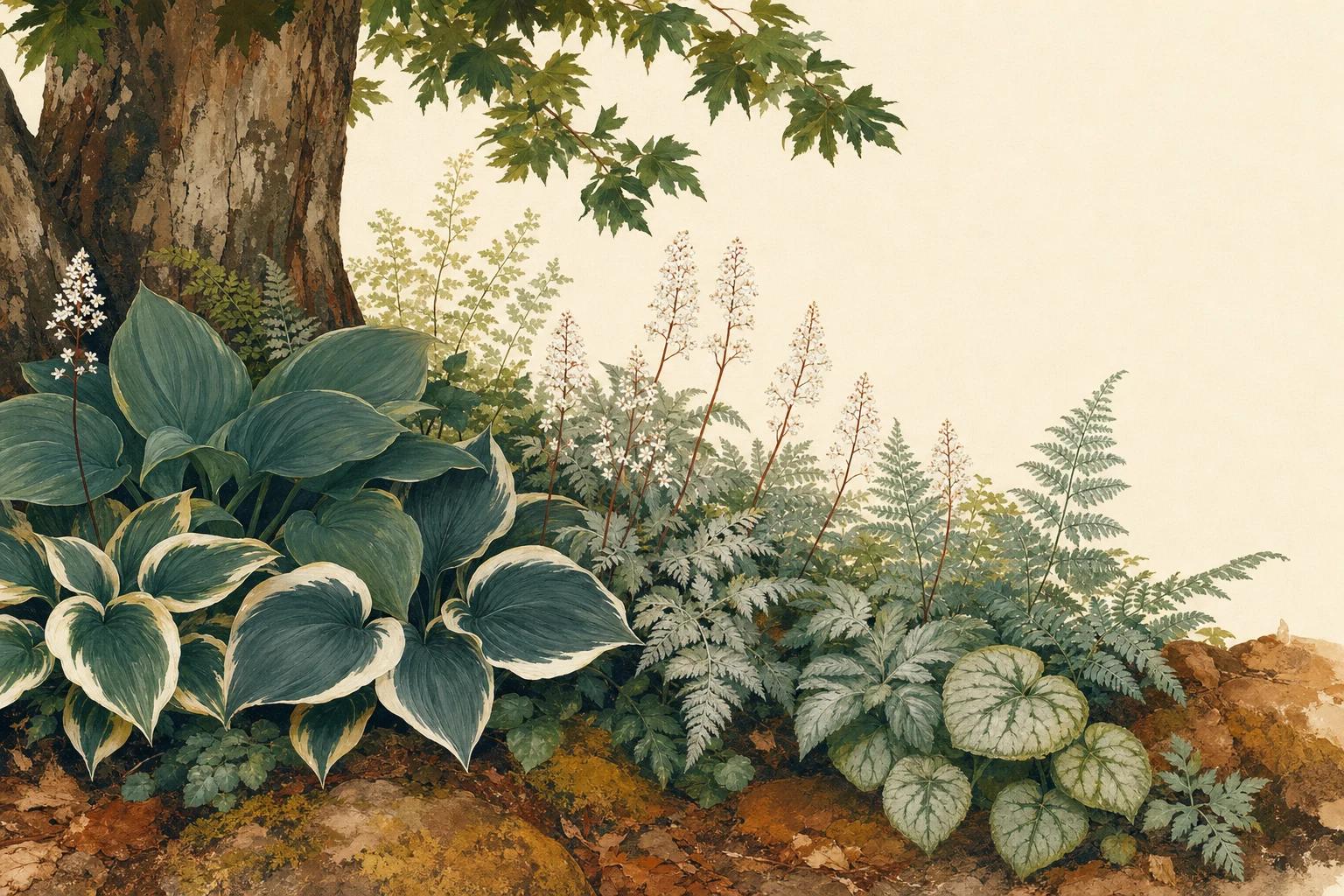
Morning sun followed by afternoon shade, over soil that stays damp, supports the classic shade border: big hosta leaves, astilbe plumes and early blue from Siberian bugloss.
Hosta
Hosta earns its place on foliage, and the variety you buy decides its job. The smallest are 6-inch (15 cm) edgers about 1 foot (30 cm) across. The largest form clumps 3–4 feet (90–120 cm) tall and 5–6 feet (1.5–1.8 m) wide, and they send up white, lavender or purple flowers in summer. Most are hardy in Zones 3–8, some only to Zone 4. Give it filtered shade or morning sun. Gold-leaved types need 2–3 hours of morning sun to color well, blue-leaved types need more shade to keep their blue, and in deep shade hostas survive but grow slowly. Slugs and deer both rank it a favorite, and it is toxic to dogs, cats and horses.
Astilbe
Astilbe supplies the feathery plumes hostas lack, in June and July over finely divided leaves, in Zones 4–8. Height depends on the variety; Chinese astilbe (Astilbe chinensis var. taquetii) grows 2–4 feet (60 cm–1.2 m) tall and handles drier soil than the common hybrids. It takes part to full shade, and deer seldom damage it. Water is the weak point: most astilbes need soil that never dries out, and their leaves brown in a hot, dry summer.
Siberian bugloss
Siberian bugloss (Brunnera macrophylla) sends up sprays of tiny sky-blue flowers in April and May above heart-shaped leaves. Deer and rabbits seldom bother it, which makes it a sound stand-in for hosta where deer roam. Plants grow 12–18 inches (30–45 cm) tall and 18–30 inches (45–75 cm) wide in Zones 3–8. It takes part to full shade but needs soil kept evenly moist, so do not ask it to fill the driest corner.
Bleeding heart
Bleeding heart (Lamprocapnos spectabilis) hangs rows of pink-and-white hearts from arching stems in April and May. Mature clumps stand 2–3 feet (60–90 cm) high and nearly as wide in Zones 3–9, in part to full shade with steady moisture, and they tolerate black walnut. Deer rarely damage it. Plan for the gap it leaves: the whole plant dies back and goes dormant by August, so set hostas or ferns beside it to cover the space.
Japanese toad lily
Japanese toad lily (Tricyrtis hirta) flowers in August and September, after nearly every other shade perennial has finished. The small, orchid-like flowers are white to pale lilac and heavily spotted with purple, on stems up to 3 feet (90 cm) tall in Zones 4–8. It grows in part to full shade but wants medium to wet soil, which makes it a poor choice for the dry ground under trees.
Perennials for full shade
Under 4 hours of sun narrows the field to woodland plants, several of them native, that either flower before the trees leaf out or grow mainly for their leaves.
Foamflower
Foamflower (Tiarella cordifolia) is a low native with evergreen to semi-evergreen leaves and spikes of white or pink flowers in May. It forms mounds 9–12 inches (23–30 cm) high that spread up to 2 feet (60 cm) in Zones 4–9, in part to full shade and average moisture. Deer rarely bother it. One plant gets lost in a bed, so set it out in drifts.
Solomon's seal
Solomon's seal (Polygonatum odoratum from Europe and Asia, and the native P. biflorum) gives a shade bed its arching lines: stems 2–3 feet (60–90 cm) long hung with white bells in April and May, on clumps only 9–12 inches (23–30 cm) wide. It is hardy in Zones 3–8, and fragrant Solomon's seal (P. odoratum) tolerates heavy shade, drought and dry soil. Deer are the problem, browsing it often in many areas, so give it a spot they cannot reach.
Black cohosh
Black cohosh (Actaea racemosa) is the tall native for the back of a shade bed, sending white flower candles up to 4–6 feet (1.2–1.8 m) in June and July. It is hardy in Zones 3–8 and grows in part to full shade with average moisture. It will take drier shade under trees, but its leaves scorch if the soil dries out, so it does best where the soil stays moist. Deer rarely damage it. Clumps spread 2–4 feet (60–120 cm), so give it the room a small shrub would need, not a slot at the front.
Canada wild ginger
Canada wild ginger (Asarum canadense) makes a low native carpet of heart-shaped leaves 6–12 inches (15–30 cm) tall, each plant covering 12–18 inches (30–45 cm). Its purplish-brown April flowers hide under the foliage. It takes part to full shade in medium to wet soil and tolerates deer and heavy shade. Watch two limits: it is rated hardy only in Zones 4–6, and its leaves burn in too much sun.
Virginia bluebells
Virginia bluebells (Mertensia virginica) are native spring ephemerals, opening clusters of blue bells in March and April on stems 18–24 inches (45–60 cm) tall. They are hardy in Zones 3–8 and grow in part to full shade, including dry shade. After flowering the whole plant goes dormant and disappears, so mark the spot to avoid digging into the roots in summer.
Plants for dry shade under trees
Dry shade is the hardest site in most yards, so choose plants rated for both shade and drought. For low, mat-forming options beyond these, see the guide to ground cover plants.
Barrenwort
Barrenwort (Epimedium) is one of the most dependable perennials for dry shade, a tough clump 6–12 inches (15–30 cm) tall with small flowers in April. The genus is rated for part to full shade in dry to average soil, and deer rarely touch it. The catch is cold hardiness: the genus is rated for Zones 5–9, so in Zone 4 check the hardiness of the exact species before you buy.
Lenten rose
Lenten rose (Helleborus × hybridus) keeps leathery evergreen leaves all year and opens white, pink or rose-purple flowers in late winter, blooming on into spring for 8–10 weeks. Clumps stay 12–18 inches (30–45 cm) high and across in Zones 4–9 and tolerate heavy shade, dry soil and deer. Hellebores are toxic to dogs, cats and horses, so site them away from pets that chew plants.
Bigroot geranium
Bigroot geranium (Geranium macrorrhizum) forms an aromatic, semi-evergreen mat 1–1.5 feet (30–45 cm) high that spreads to 2 feet (60 cm), with purple-pink flowers from May to July. It is hardy in Zones 4–8, takes dry to average soil in part shade or sun, and deer and rabbits avoid it. It spreads steadily, which suits a groundcover under trees but crowds small, slow neighbors.
Pennsylvania sedge
Pennsylvania sedge (Carex pensylvanica) is a fine-textured native sedge for dry shade, 6–12 inches (15–30 cm) tall in Zones 3–8, with small greenish flowers in May. It is the closest thing to a lawn under trees, but not one you can walk on every day.
Coral bells
Coral bells (Heuchera americana and its many hybrids) is grown for its leaves. The native species is green, while hybrid selections run from lime to near-black, and red or purple forms stand out sharply against green neighbors. Flower stems rise 1–2 feet (30–60 cm) from a leafy mound 1–1.5 feet (30–45 cm) across in Zones 4–9, with greenish-white flowers from June to August. It handles part shade and short dry spells, but its leaves look best with steady moisture, so water it through summer under trees. Freeze-thaw winters can heave the crowns out of the ground, so check them in early spring and firm them back in.
Cast iron plant
In Zones 8 to 10, cast iron plant (Aspidistra elatior) handles deep, dry shade better than almost anything else. Its dark green leaves reach 2–3 feet (60–90 cm), and they are so dark that they add little light to a dim corner, so pair them with silver or variegated foliage.
Ferns for shade
Ferns supply the fine texture a shade bed needs, slugs rarely bother them, and the evergreen kinds keep a bed furnished through winter. Most want steady moisture; Christmas fern is the exception that handles dry shade.
Christmas fern
Christmas fern (Polystichum acrostichoides) is the native evergreen fern for dry shade, 1–2 feet (30–60 cm) tall and wide in Zones 3–9. It takes dry to average soil, drought and shallow, rocky ground. Its one weakness is fall leaf litter: a thick blanket left on the crown smothers it, so rake fallen leaves off the plant each autumn.
Japanese painted fern
Japanese painted fern (Athyrium niponicum 'Pictum') has silver fronds washed with wine-red, the brightest fern for a dim corner. It is deciduous, hardy in Zones 3–8, and grows up to 2 feet (60 cm) tall and 2–2.5 feet (60–75 cm) wide in moist, humus-rich soil that never dries out, in part to full shade. Deer browse it heavily in some regions, so protect it where they feed.
Ostrich fern
Ostrich fern (Matteuccia struthiopteris), native to eastern North America, forms tall vases of fronds 3–6 feet (90 cm to 1.8 m) high in moist to wet shade in Zones 3–7, and deer rarely touch it. It spreads hard by underground runners: six clumps can cover an 8-by-10-foot (2.4 by 3 m) slope in five years. Use it to fill a wet bank or a large empty space, not a mixed border.
Western sword fern
In the Pacific Northwest, western sword fern (Polystichum munitum) is the native evergreen of woodland gardens, with fronds 1–4 feet (30 cm to 1.2 m) long. It is hardy to Zone 4 and grows in part to full shade in rich, moist soil. Woodland natives in the region may need more irrigation than other native plantings, so do not count on it in dry shade without a hose.
Shrubs for shade
Shade-tolerant shrubs give a bed height and structure, and the evergreens among them carry it through the months when perennials are dormant. For more year-round options, browse these evergreen shrubs.
Oakleaf hydrangea
Oakleaf hydrangea (Hydrangea quercifolia), a Southeastern native, has a season that runs from spring flowers to fall color: white panicles from May to July that age to purplish pink, then lobed leaves that turn red-bronze. It grows 4–8 feet (1.2–2.4 m) tall and wide in Zones 5–9, in sun to part shade with average moisture. Deer browse it often, and all hydrangeas are toxic to dogs, cats and horses.
Mountain laurel
Mountain laurel (Kalmia latifolia) is a native evergreen with clusters of rose-to-white flowers marked with purple in May. Mature plants range from 5 to 15 feet (1.5 to 4.5 m) in height and spread, in Zones 4–9. Like azaleas and other heath-family shrubs, it needs acidic soil, here in part shade. It is toxic to horses, and regional deer-damage ratings disagree on it, so do not count on it surviving heavy browsing.
Sweet box
Sweet box (Sarcococca hookeriana var. humilis) is a low evergreen 1–2 feet (30–60 cm) tall that spreads 2–4 feet (60–120 cm), with small, fragrant white flowers in March and April. It grows in part to full shade. Zone 6 is its cold limit, and Zone 8 its warm limit, so most gardens in the North and Deep South need another choice.
Japanese aucuba
Japanese aucuba (Aucuba japonica) is an evergreen for heavy shade, clay and city conditions in Zones 6–9. It grows 6–10 feet (1.8–3 m) tall and 5–9 feet (1.5–2.7 m) wide. Plain green forms read as a dark mass in deep shade, so choose a variegated form to lighten the spot.
Bottlebrush buckeye
Bottlebrush buckeye (Aesculus parviflora) is a native shrub for large shady spaces, with white bottlebrush flower spikes and red anthers in June and July. It grows in part to full shade in Zones 4–8. Measure before you plant: it reaches 8–12 feet (2.4–3.7 m) tall and 8–15 feet (2.4–4.6 m) wide, so site it where it has room to spread. Buckeyes are toxic to dogs, cats and horses.
Annuals and bulbs for color from February to frost
Annuals for shade carry summer flowers, and bulbs cover the two ends of the season, snowdrops in late winter and hardy cyclamen in fall. The three annuals here give color from early summer to frost, in beds or in pots, and let you change the scheme each year.
Coleus
Coleus (Coleus scutellarioides) gives summer-long color from its leaves rather than its flowers, in part to full shade. Plants range from 6 inches to 3 feet (15–90 cm) depending on variety, and it is perennial only in Zones 10–11, so most gardens replant it each spring. Coleus is toxic to dogs, cats and horses.
Wishbone flower
Wishbone flower (Torenia fournieri) blooms from June until frost in part to full shade, with pale violet and dark purple bicolor flowers on plants 6–12 inches (15–30 cm) tall. It is one of the recommended replacements for garden impatiens. At under a foot tall it belongs at the front of a bed or in a pot, where hostas and ferns will not hide it.
New Guinea impatiens
New Guinea impatiens (Impatiens hawkeri) flowers freely all summer in a wide range of colors, from 6 inches to 2 feet (15–60 cm) tall depending on variety. It is the safer impatiens to plant: standard garden impatiens (Impatiens walleriana) collapse from impatiens downy mildew, while New Guinea types appear resistant or tolerant. How to spot and clear the disease is covered with the other annual flowers. New Guinea impatiens prefers part shade over full shade.
Snowdrop
Snowdrop (Galanthus nivalis) opens white flowers in February on stems 6–9 inches (15–23 cm) tall. It suits dry shade under deciduous trees, flowering in late-winter light before the canopy fills in. It is hardy in Zones 3–7, so gardens in Zone 8 and warmer should look elsewhere, and the foliage dies back soon after flowering.
Hardy cyclamen
Hardy cyclamen (Cyclamen hederifolium) closes the season with pink or white flowers in September and October on plants only 3–6 inches (8–15 cm) tall, in Zones 5–9. It takes part shade and dry to average soil and resists deer and drought. The whole plant is toxic to dogs, cats and horses, the tubers most of all, so keep digging dogs away from it.
Shade plants to avoid, and what to grow instead
Skip English ivy, periwinkle, goutweed, creeping Jenny, wintercreeper, fruiting nandina, lily of the valley and creeping lilyturf, all of which escape into woods or lawns. Plant Allegheny spurge, foamflower, barrenwort or bigroot geranium instead; state-by-state listings are in the guide to ground cover plants.
Allegheny spurge (Pachysandra procumbens) is the native relative of Japanese pachysandra, an evergreen to semi-evergreen clump-former for dry shade in Zones 5–9.
Planting, designing and caring for a shade bed
Under trees, the tree's roots come first: keep added soil to a thin skim, plant small, and water through the first two summers.
Planting under a tree without harming it
Most of a tree's feeder roots lie in the top 12–18 inches (30–45 cm) of soil, so even a few inches of added soil can hurt the tree. The decline may not show for 2–5 years. That is why a raised bed built around a trunk is a slow way to lose the tree.
Some trees resent root disturbance more than others. Oaks, sugar maples, beeches, dogwoods, magnolias, pines, cherries, lindens, hemlocks and buckeyes are sensitive; red maple, river birch, hornbeam, redbud, honeylocust, Norway spruce and sycamore tolerate it better. Under a large or valuable tree, consult a certified arborist before you dig.
- Clear by hand. Pull or dig out existing weeds and groundcover with a trowel. Skip herbicides and never chop through roots with an ax or spade; the aim is to leave the tree's roots untouched.
- Add a thin layer, not a raised bed. Spread no more than 2 inches (5 cm) of compost or good soil, keep it at least 1 foot (30 cm) from the trunk, and leave exposed roots bare. Spread it on the surface rather than digging it in, since digging cuts the feeder roots.
- Plant small, starting a foot out. Use plugs, small pots or divisions, and dig each hole only as big as the root ball, beginning about 1 foot (30 cm) from the trunk. If you hit a root 2 inches (5 cm) thick or more, refill the hole and try a new spot.
- Mulch lightly. Spread 1–2 inches (2.5–5 cm) of finely shredded bark or compost between plants, kept off the trunk and off plant crowns.
- Water deeply for two years. Soak the bed once a week, about 1 inch (2.5 cm) of water, through the first one to two growing seasons. Until they root in, the new plants compete with the tree for every drop.
Design for low light
Light colors carry in shade and dark ones vanish. White, cream and pale pink flowers stand out, as do silver, gold and variegated leaves, while deep blue and purple flowers recede unless a lighter color sits beside them. Glossy leaves catch more light than matte ones and brighten a corner more. A lighter-colored mulch helps too.
Contrast texture as much as color. Broad hosta leaves read as coarse and finely cut fern fronds as fine; set them side by side and vary the heights from groundcovers in front to the tallest perennials at the back.
Then plan the seasons. Spring ephemerals such as Virginia bluebells, snowdrops and great white trillium flower before the canopy closes and then vanish, so plant summer foliage such as Japanese forest grass (Hakone grass) and barrenwort among them. Buy trilliums from nurseries that propagate their own, since some are still dug from the wild. Lenten rose, Christmas fern and sweet box hold the bed together in winter.
Aftercare: slugs, crowns and the first summers
Slugs and snails are the main pest of a moist shade bed, and hostas take the worst of it, while ferns and hydrangeas are less to their taste. Control works only when you take away shelter and moisture. Clear boards and dense debris where they hide, water with drip lines or at sunrise so the surface dries before evening, and hand-pick at night.
If you use slug bait, choose iron phosphate. It works more slowly, over about a week, but metaldehyde baits are particularly poisonous to dogs and cats.
Pull winter mulch back from hosta crowns in spring so they do not rot. Brown, crisp edges on hosta leaves are sunscald: move the plant into more shade or water it more often. To lay out the bed and space each plant before you buy, sketch it in Sow's garden design studio.
Frequently asked questions
What plants grow best in shade?
It depends on how much sun reaches the spot and how dry the soil is. In moist part shade, hosta, astilbe, Siberian bugloss, bleeding heart and most ferns are dependable. In dry shade under trees, barrenwort, Lenten rose, bigroot geranium, Pennsylvania sedge and Christmas fern hold up best. Count the hours of direct sun before you shop, since part-shade and full-shade plants are not interchangeable.
What plant is best for full shade?
For under 4 hours of direct sun, foamflower, wild ginger, Solomon's seal, black cohosh and Christmas fern are among the most reliable, all rated for part to full shade. In Zones 8 to 10, cast iron plant handles deep, dry shade better than almost anything else. Under a canopy too dense to show the sun from ground level, even these struggle, and most shade plants need at least some filtered light to grow well.
Which flowers bloom in full shade?
Several woodland perennials flower with under 4 hours of sun: Lenten rose from late winter into spring, Virginia bluebells in March and April, bleeding heart in April and May, foamflower in May, astilbe and black cohosh in June and July, and Japanese toad lily in August and September. Wishbone flower is the annual for the same light, blooming from June to frost. Expect fewer flowers than the same plants give in part shade.
What flowers bloom all summer in the shade?
Annuals do most of the work. Wishbone flower blooms from June until frost, New Guinea impatiens flowers freely all season, and wax begonias bloom from May to September in part shade. Among perennials, green-and-gold (goldenstar) flowers from May into October and coral bells from June to August. Plan on a little direct sun even for these, since shade-tolerant flowers bloom with less light, not with none.
Do hostas grow in full shade?
They survive it but grow slowly. Hostas do best in filtered shade or with a few hours of morning sun followed by afternoon shade. Gold-leaved varieties need 2 to 3 hours of morning sun to develop their color, while blue-leaved ones need more shade to stay blue. Brown, crisp leaf edges are sunscald, a sign the plant is getting too much sun or too little water.
Which shade plants are safe for dogs and cats?
Fewer than you might hope. Hosta, hellebore, hydrangea, buckeye, coleus, begonia, cyclamen, English ivy, nandina and lily of the valley are all toxic to dogs, cats and horses; lily of the valley can cause an irregular heartbeat. Heuchera sanguinea, one of the coral bells, and Oregon grape (Mahonia aquifolium) are listed as non-toxic. Avoid metaldehyde slug bait too, which is particularly poisonous to dogs and cats.
Can grass grow in shade?
Most lawn grasses will not thrive in shade, so replace thin turf with a shade-tolerant groundcover instead. Pennsylvania sedge is the closest substitute, a fine-textured native that grows 6 to 12 inches (15 to 30 cm) tall in dry shade. Most groundcovers take little foot traffic or mowing, so lay a path or stepping stones where people actually walk.
What can I plant under a black walnut tree?
Choose plants rated tolerant of black walnut, whose roots suppress many garden plants. Hosta, lungwort, bleeding heart, Japanese forest grass (Hakone grass) and bloodroot all carry that rating and grow in shade. Plant them small and without raising the soil level, using the same root-safe method as under any other tree.
Why are my shade plants leggy and not flowering?
They are not getting enough light, and fertilizer will not fix it. A plant short of light stretches tall with sparse leaves; move it to a brighter spot or replace it with one rated for less sun. Most annuals need at least 6 hours of sun to flower well, so sun-loving bedding plants in a shady bed will sulk however well you feed them.
Which plant gives 12 months of flowers?
No shade plant flowers all year, but you can chain them. Snowdrops open in February, Lenten roses from late winter into spring, Virginia bluebells in March and April, bleeding heart and foamflower in spring, astilbe in June and July, wishbone flower from June to frost, toad lily in August and September and hardy cyclamen in September and October. Evergreen ferns and hellebore leaves carry the bed through winter.
References
- Missouri Botanical Garden. Plant Finder (individual plant pages). Accessed October 16, 2026.
- UGA Cooperative Extension, Paulding County. Do You Find Sunlight Terminology for Plants Confusing?. Accessed October 16, 2026.
- UF/IFAS Gardening Solutions, University of Florida. Landscaping in the Shade. Accessed October 16, 2026.
- Penn State Extension. Underplanting Trees: Respect the Roots. Accessed October 16, 2026.
- Nebraska Extension in Lancaster County, University of Nebraska-Lincoln. Planting Under Trees. Accessed October 16, 2026.
- Cornell Cooperative Extension, Tompkins County. 'Top' Shade Perennial Flowering Plants. Accessed October 16, 2026.
- University of Minnesota Extension. Growing Hostas in Minnesota. Accessed October 16, 2026.
- Clemson Cooperative Extension, Home and Garden Information Center. Plants for Shade (HGIC 1005). Accessed October 16, 2026.
- NC State Extension. Extension Gardener Plant Toolbox (Brunnera macrophylla, Hydrangea quercifolia, Impatiens hawkeri, Helleborus × hybridus, Coleus scutellarioides, Kalmia latifolia, Aesculus parviflora). Accessed October 16, 2026.
- University of Maryland Extension. Native Plants for Shade. Accessed October 16, 2026.
- University of Maryland Extension. Resistance of Ornamentals to Deer Damage (FS-655). Accessed October 16, 2026.
- Penn State Extension. Gardening with Ferns. Accessed October 16, 2026.
- Oregon State University Extension. Pacific Northwest Native Plants for the Woodland Garden. Accessed October 16, 2026.
- Oregon State University Landscape Plants. Polystichum munitum (Swordfern). Accessed October 16, 2026.
- Colorado State University Extension. Designing Shade (PlantTalk 1126). Accessed October 16, 2026.
- University of Wisconsin-Madison Division of Extension. Impatiens Downy Mildew. Accessed October 16, 2026.
- UC Statewide IPM Program, University of California. Snails and Slugs (Pest Notes 7427). Accessed October 16, 2026.
- ASPCA Animal Poison Control. Toxic and Non-Toxic Plants. Accessed October 16, 2026.
- Virginia Department of Conservation and Recreation. Virginia Invasive Plant Species List (2024). Accessed October 16, 2026.
- Connecticut Invasive Plant Working Group, University of Connecticut. Connecticut Invasive Plant List. Accessed October 16, 2026.
Sow Editorial
Written by the Sow team from university extension services, botanical gardens, USDA and NOAA data and plant breeders. Every source is listed under References.
The plants Sow gardeners save most