Quick answer
The perennials that come closest to blooming all summer are 'Rozanne' geranium (late spring to mid-fall, no deadheading), 'Walker's Low' catmint (mid-May to late September), 'Butterfly Blue' pincushion flower (late April to frost) and 'Goldsturm' black-eyed Susan (June to September). Many perennials flower for three weeks or less, so plan a June-to-frost border around these anchors plus staggered bloomers and a midsummer shearing.
Key facts
- Many perennials
- Flower for three weeks or less
- Longest windows
- 'Rozanne' geranium and 'Butterfly Blue' pincushion flower, spring to frost
- Coldest gardens (Zone 3)
- 'Goldsturm', 'Moonbeam', 'David' phlox, butterfly weed, 'Stella de Oro'
- Catmint second flush
- Cut back by about half as the first flush fades
- Shade
- Yellow corydalis, May to September; hardy begonia, July to October
- Single-flush plants
- Amsonia, astilbe and poppy do not rebloom when deadheaded
- Pet risk
- Daylilies are toxic to cats; butterfly weed, yarrow, lavender and begonias to dogs, cats and horses
No perennial flowers nonstop from June to frost on its own, but a few come close. 'Rozanne' geranium, 'Walker's Low' catmint, 'Butterfly Blue' pincushion flower and 'Goldsturm' black-eyed Susan each hold color for three months or more, while many perennials manage three weeks or less.
The 29 picks below give each plant's real bloom months, its zones and height, and the one thing most likely to disappoint you. Treat them as a relay: two or three long performers carry the border, and plants that start in May, June and July take turns filling the gaps until frost.
How these plants were chosen
Every pick has a recorded bloom window of roughly two months or longer in at least one US region, documented in botanical garden plant records, grower data or university trials. Each is a hardy perennial across at least part of Zones 3 to 9, and none is documented as invasive in US natural areas; the close relatives that are invasive are named near the end. Twelve are past winners of the Perennial Plant of the Year award.
Three limits apply. A month range records when flowers are present, not peak color, so "June to September" can include a thin August. Bloom windows stretch or shrink with climate: several of these plants flower longer in the cool North than through a humid St. Louis summer. And the windows here come from Midwest, Southern and Intermountain West gardens; timing on the cool-summer Pacific Coast is not covered. For the wider picture of dependable perennials beyond the long bloomers, see the best perennial flowers by season.
| Pick | Light | Zones | Height, ft | Bloom window |
|---|---|---|---|---|
| 'Rozanne' geranium | Sun to part shade | 5–8 | 1–2 | Late spring to mid-fall |
| 'Walker's Low' catmint | Sun to part shade | 4–8 | 2–2.5 | Mid-May to late Sept |
| 'Butterfly Blue' pincushion flower | Sun | 5–9 | 1–1.5 | Late April to frost |
| 'Caradonna', 'May Night' salvia | Sun | 4–8 | 1–2 | May to June; repeats to Sept |
| 'Moonbeam' coreopsis | Sun | 3–9 | 1.5–2 | June to Aug; fall rebloom |
| 'Arizona Sun' blanket flower | Sun | 3–10 | 0.5–1 | May to Aug; to frost in Utah |
| 'Stella de Oro', 'Happy Returns' daylily | Sun to part shade | 3–9 | 1–1.5 | May or June to Aug–Oct |
| 'Goldsturm' black-eyed Susan | Sun | 3–9 | 2–3 | June to Sept |
| Purple coneflower | Sun to part shade | 3–8 | 2–5 | June to Aug; sporadic to fall |
| 'Coronation Gold' yarrow | Sun | 3–8 | 2.5–3 | June to Sept |
| 'Summer Sun' false sunflower | Sun | 3–9 | 2–3 | June to early fall |
| Butterfly weed | Sun | 3–9 | 1–3 | June to Aug |
| Lesser calamint | Sun | 5–7 | 1–1.5 | June to Sept or frost |
| 'Royal Candles' speedwell | Sun | 3–8 | 0.75–1 | June to Aug |
| Balloon flower | Sun to part shade | 3–8 | 1–2.5 | June to Aug |
| 'Firetail' mountain fleece | Sun to part shade | 4–7 | 3–4 | June to Oct |
| 'Becky' Shasta daisy | Sun | 5–9 | 3–4 | July to Sept |
| 'David' garden phlox | Sun to light shade | 3–8 | 3–4 | July to Sept |
| Russian sage | Sun | 5–9 | 3–5 | July to Oct |
| 'Blue Fortune' anise hyssop | Sun | 5–9 | 2–3 | July to Sept |
| Leadwort | Sun to part shade | 5–9 | 0.75–1 | July to frost |
| Hardy hibiscus | Sun | 5–9 | 3–7 | July to Sept |
| Yellow corydalis | Part to full shade | 5–7 | 1–1.5 | May to Sept |
| Fringed bleeding heart | Part shade | 3–9 | 1–1.5 | April to July; longer if cool |
| Hardy begonia | Part to full shade | 6–7 | 1.5–2 | July to Oct |
| 'Honorine Jobert' anemone | Part shade | 4–8 | 3–4 | Aug to Sept |
| 'Henry Duelberg' salvia | Sun | 7 and warmer | 3 | Spring to frost (Texas) |
| Autumn sage | Sun | 6–9 | 2–3 | June to Oct; summer lull |
| Gaura | Sun | 5–9 | 3–5 | Aug to Oct; June to frost in Utah |
Bloom months are for the Midwest unless a place is named. Zones are USDA ratings; where growers disagree, the narrower range is shown. Heights are in feet (1 ft = 30 cm).
Full sun perennials that start in May
These open in late spring and, given the care noted for each, are still flowering in September, which makes them the anchors of a long-blooming border.
'Rozanne' geranium
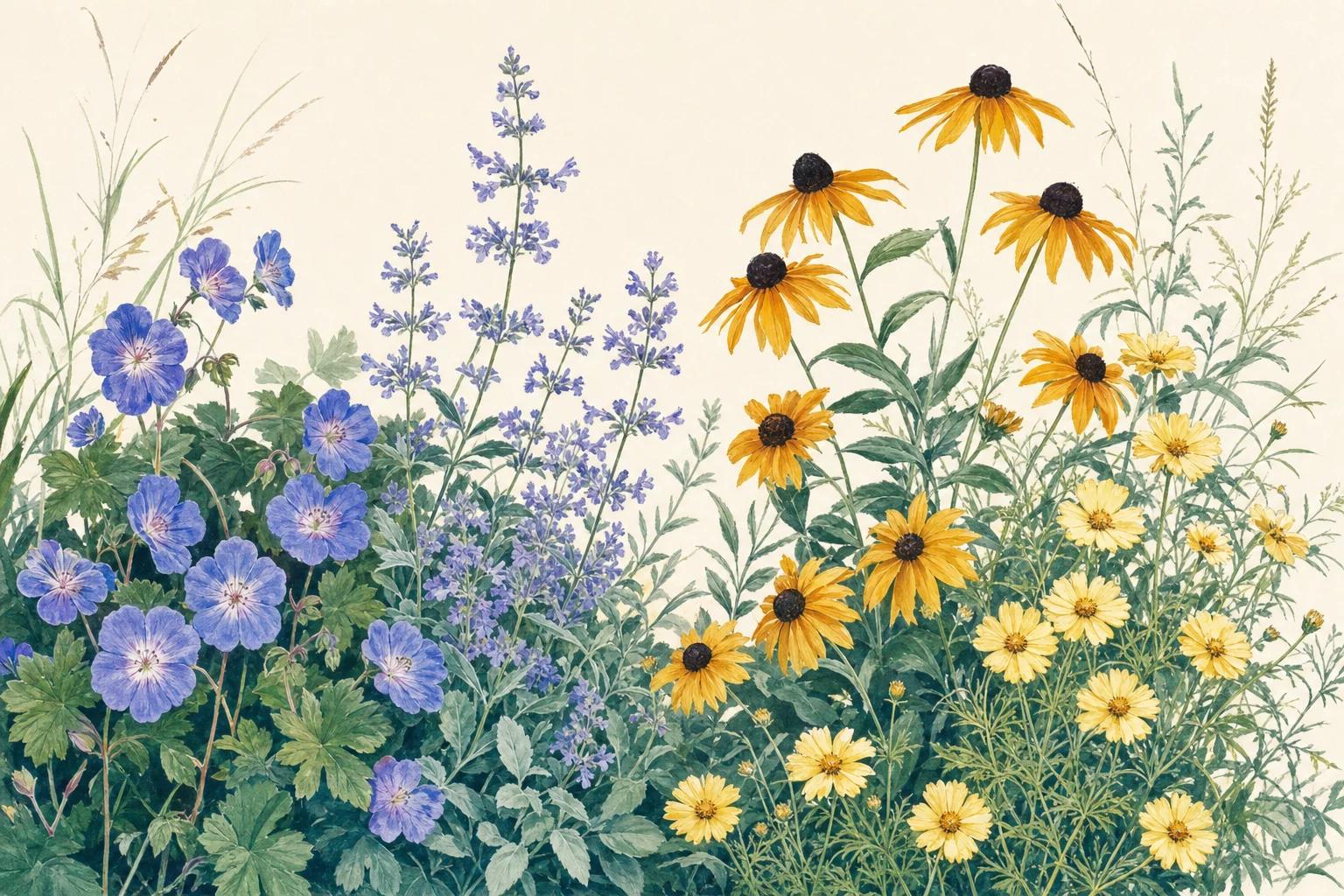
Rozanne geranium (Geranium 'Gerwat', sold as ROZANNE) is a hardy cranesbill with sterile flowers, so it never stops to ripen seed and keeps opening violet-blue blooms from late spring into mid-fall. It grows 1 to 2 feet (30 to 60 cm) tall, spreads 2 feet (60 cm) or more, takes full sun to part shade in Zones 5 to 8, and needs no deadheading. It was the 2008 Perennial Plant of the Year. The caution is heat: in St. Louis its main show runs June and July, with lighter flowering afterward, and a cutback (covered in the shearing section) restarts it.
'Walker's Low' catmint
In Zone 5b, Walker's Low catmint (Nepeta × faassenii 'Walker's Low') flowers from mid-May to late September and keeps going without deadheading. Despite the name it can reach 30 inches (75 cm) tall and 36 inches (90 cm) wide, so give it room at the front of a deep border, not a narrow edge. It is hardy in Zones 4 to 8 (some growers rate it to Zone 3) and sterile, so it never self-sows. Its weak points are Deep South heat and humidity, where it wants afternoon shade, and soggy winter soil, a bigger threat than cold even in Zone 5b.
'Butterfly Blue' pincushion flower
Butterfly Blue pincushion flower (Scabiosa 'Butterfly Blue') has one of the longest recorded windows on this list: lavender-blue pincushions from late April until frost in St. Louis. It forms a 12 to 18 inch (30 to 45 cm) mound for the front of a sunny bed in Zones 5 to 9 and tolerates part shade in the hot Deep South. It was the 2000 Perennial Plant of the Year. It dies in wet winter soil, so plant it only where water drains away quickly, and pick off spent heads to keep new buds coming.
'Caradonna' and 'May Night' salvia
These meadow sages open in May with dense violet-blue spikes. May Night salvia (Salvia × sylvestris 'Mainacht', sold as MAY NIGHT), the 1997 Perennial Plant of the Year, grows 18 to 24 inches (45 to 60 cm) and peaks in May and June. Caradonna salvia (Salvia nemorosa 'Caradonna') carries its flowers on dark purple stems 12 to 24 inches (30 to 60 cm) tall and can repeat through September. Both are hardy in Zones 4 to 8 and repeat only with regular moisture and deadheading. They flop in hot, humid summers, and 'May Night' does best north of Zone 7.
'Moonbeam' coreopsis
Moonbeam coreopsis (Coreopsis verticillata 'Moonbeam') is a sterile threadleaf tickseed that covers itself in pale yellow flowers from June through August, then reblooms in fall if you shear it. It stands 1.5 to 2 feet (45 to 60 cm) and is hardy in Zones 3 to 9; coreopsis is listed as non-toxic to dogs, cats and horses. It was the 1992 Perennial Plant of the Year. In moist or rich soil it sprawls and can rot at the crown, and it can spread fairly quickly by rhizomes, so give it room or edge it. The brighter yellow Zagreb coreopsis stays under 18 inches (45 cm) but has a shorter first flush, May to June, unless you shear it for a second round.
'Arizona Sun' blanket flower
Arizona Sun blanket flower (Gaillardia 'Arizona Sun') is a compact 6 to 12 inch (15 to 30 cm) gaillardia, a 2005 All-America Selections winner that flowers from May into August in the Midwest. In the dry West, blanket flower runs much longer: from late May to the first frost in Utah. Expect it to be short-lived, and expect root rot in heavy or wet soil. If flowering stalls in summer, cut it back to encourage a fall flush.
'Stella de Oro' and 'Happy Returns' daylilies
Stella de Oro daylily (Hemerocallis 'Stella de Oro'), about 1 foot (30 cm) tall, blooms for two to three months from late spring. Its lemon-yellow hybrid Happy Returns daylily starts in June and repeats well until frost. Both are hardy in Zones 3 to 9 and take sun to part shade; each flower lasts a single day, and clumps need dividing every 3 to 5 years. Rebloom depends on season length: in Minnesota, rebloomers do not repeat, and a daylily plant flowers for 30 to 40 days. Daylilies are toxic to cats.
Full sun perennials that start in June
These carry midsummer, overlapping the May starters just as those slow down or wait for a shearing.
'Goldsturm' black-eyed Susan
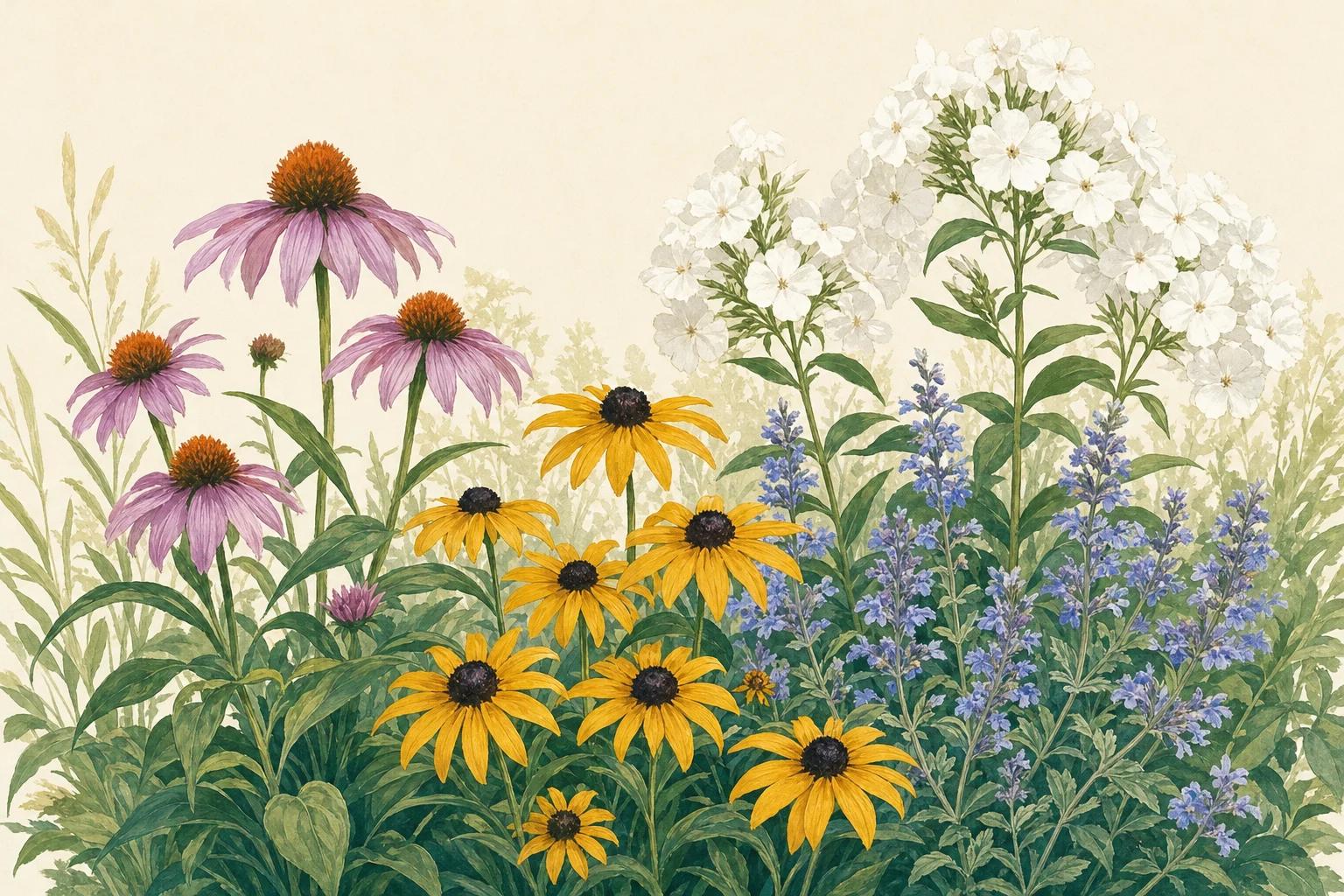
Goldsturm black-eyed Susan (Rudbeckia fulgida var. sullivantii 'Goldsturm') opens golden daisies in June and keeps them coming into September, about four months of flowers from one plant. It grows 2 to 3 feet (60 to 90 cm) tall in Zones 3 to 9 and was the 1999 Perennial Plant of the Year. It needs steady moisture, and two leaf problems are common: angular leaf spot, a bacterial disease, and powdery mildew.
Purple coneflower
Purple coneflower (Echinacea purpurea) blooms June to August, at its best from late June to late July, with scattered flowers into autumn; it reblooms on its own without deadheading. The species grows 2 to 5 feet (60 to 150 cm) tall in Zones 3 to 8. The compact PowWow Wild Berry coneflower, a 2010 All-America Selections winner at 24 to 36 inches (60 to 90 cm), flowers from late spring to late summer and sometimes until frost. Its peak is shorter than its reputation, and aster yellows and Japanese beetles are the common troubles.
'Coronation Gold' yarrow
Coronation Gold yarrow (Achillea 'Coronation Gold') holds flat mustard-yellow heads over silvery leaves from June to September and is one of the best yarrows for hot, humid Midwest summers. It reaches 2.5 to 3 feet (75 to 90 cm) in Zones 3 to 8. Give it full sun and lean soil, because shade or rich soil makes it flop, and divide it every 3 to 4 years. Common yarrow is toxic to dogs, cats and horses, so treat this hybrid with the same care.
'Summer Sun' false sunflower
Summer Sun false sunflower (Heliopsis helianthoides var. scabra 'Sommersonne') is a compact oxeye sunflower, 2 to 3 feet (60 to 90 cm) tall, that seldom needs staking in full sun. It flowers from summer into early fall in Zones 3 to 9. Removing spent flowers stretches the show. Like the wild species it is short-lived, so plan to replace it, and watch for aphids. On taller oxeyes, cutting the stems back by a third to a half in late May keeps them shorter.
Butterfly weed
Butterfly weed (Asclepias tuberosa) gives about three months of bright orange from early through late summer, and its leaves feed monarch caterpillars. It was the 2017 Perennial Plant of the Year. It grows 1 to 3 feet (30 to 90 cm) tall in Zones 3 to 9. It sits on a deep taproot, so it resents being moved, takes 2 to 3 years to flower from seed and is late to emerge in spring. It is toxic to dogs, cats and horses. Leave aphids alone where caterpillars are feeding; there is more on growing it for monarchs in the milkweed for monarchs guide.
Lesser calamint
Lesser calamint (Clinopodium nepeta, formerly Calamintha nepeta) makes a 1 to 1.5 foot (30 to 45 cm) cloud of tiny white flowers that bees work from June until September, or until frost in some gardens. It was the 2021 Perennial Plant of the Year and is rated for Zones 5 to 7. It is short-lived, spreads, and has naturalized in parts of the US, notably the North Carolina Piedmont, so shear it after flowering to stop it seeding. It does poorly south of Zone 7.
'Royal Candles' speedwell
Royal Candles speedwell (Veronica spicata 'Glory', sold as ROYAL CANDLES) is a compact spike speedwell, 9 to 12 inches (23 to 30 cm) tall, with blue-purple candles from June to August in Zones 3 to 8. Removing spent spikes brings more. Its shallow roots dislike drought, yet it rots in wet soil, so it wants steady, well-drained moisture.
Balloon flower
Balloon flower (Platycodon grandiflorus) swells its buds into little balloons that pop open into blue-purple bells from June to August. Stems reach 12 to 30 inches (30 to 75 cm), the plant is hardy in Zones 3 to 8 in sun to part shade, and deadheading prolongs bloom. The stems flop, so cut them back by half in May to skip staking. New shoots appear very late in spring, so mark the spot and do not dig into the crown by mistake.
'Firetail' mountain fleece
Firetail mountain fleece (Persicaria amplexicaulis 'Firetail') carries slim crimson spikes from June to October and sometimes until the first frost, the longest run of any large plant here. It forms a clump 3 to 4 feet (0.9 to 1.2 m) tall and wide in Zones 4 to 7. It needs consistent moisture and part shade where summers are hot. It is not considered invasive, unlike some relatives such as Persicaria wallichii, but it spreads slowly, so give it space.
Midsummer starters for July to fall
These begin in July and carry the border into fall, picking up as the May starters fade.
'Becky' Shasta daisy
Becky Shasta daisy (Leucanthemum × superbum 'Becky') holds 3 to 4 inch (8 to 10 cm) white daisies on rigid stems up to 4 feet (1.2 m) tall from July through September, with no staking. It is hardy in Zones 5 to 9 and was the 2003 Perennial Plant of the Year. Like other Shastas it is somewhat short-lived: divide it every 2 to 3 years, and avoid soggy winter soil, which can kill it outright.
'David' garden phlox
David garden phlox (Phlox paniculata 'David') bears fragrant white flower heads 3 to 4 feet (90 to 120 cm) up from July into September and is hardy to -40°F (-40°C), Zone 3. Garden phlox flowers for six weeks or more per plant, and because cultivars open anywhere from midsummer to late August, mixing two or three stretches the show. 'David' has a reputation for good mildew resistance and was the 2002 Perennial Plant of the Year. Mildew, phlox bugs and root rot can still strike, so space plants 18 inches (45 cm) apart for air and water them in dry spells.
Russian sage
Russian sage (Perovskia atriplicifolia) sends up airy lavender-blue spires from July into October and has good drought tolerance. It grows 3 to 5 feet (90 to 150 cm) tall in Zones 5 to 9 (some growers rate it to Zone 4) and was the 1995 Perennial Plant of the Year. Its stems flop in part shade and tend to sprawl as summer goes on, so give it full sun and sharp drainage. Cut it nearly to the ground in late winter.
'Blue Fortune' anise hyssop
Blue Fortune anise hyssop (Agastache 'Blue Fortune') carries lavender-blue bottlebrush spikes from July to September, bridging midsummer and fall. Plants reach 2 to 3 feet (60 to 90 cm), are hardy in Zones 5 to 9 or Zone 4 by some ratings, and keep flowering if you deadhead them. The risk is drainage: it needs very well-drained soil and may not survive winter in heavy clay.
Leadwort
Leadwort (Ceratostigma plumbaginoides) is a 9 to 12 inch (23 to 30 cm) groundcover with gentian-blue flowers from July to frost and red fall leaves. Grow it in sun or part shade, Zones 5 to 9. It spreads by rhizomes and can be aggressive, so keep it away from small neighbors. It may not be reliably hardy in Zone 5 without a winter mulch, and it leafs out late in spring.
Hardy hibiscus
Hardy hibiscus (Hibiscus moscheutos) flowers from July to September on stems 3 to 7 feet (0.9 to 2.1 m) tall, in full sun in Zones 5 to 9. Its window is shorter than most picks here, but no other plant on this list adds that much height to a late-summer border. It needs deep, regular watering, Japanese beetles chew the leaves, and it emerges so late in spring that it is easy to assume it has died.
Long-blooming perennials for part shade and shade
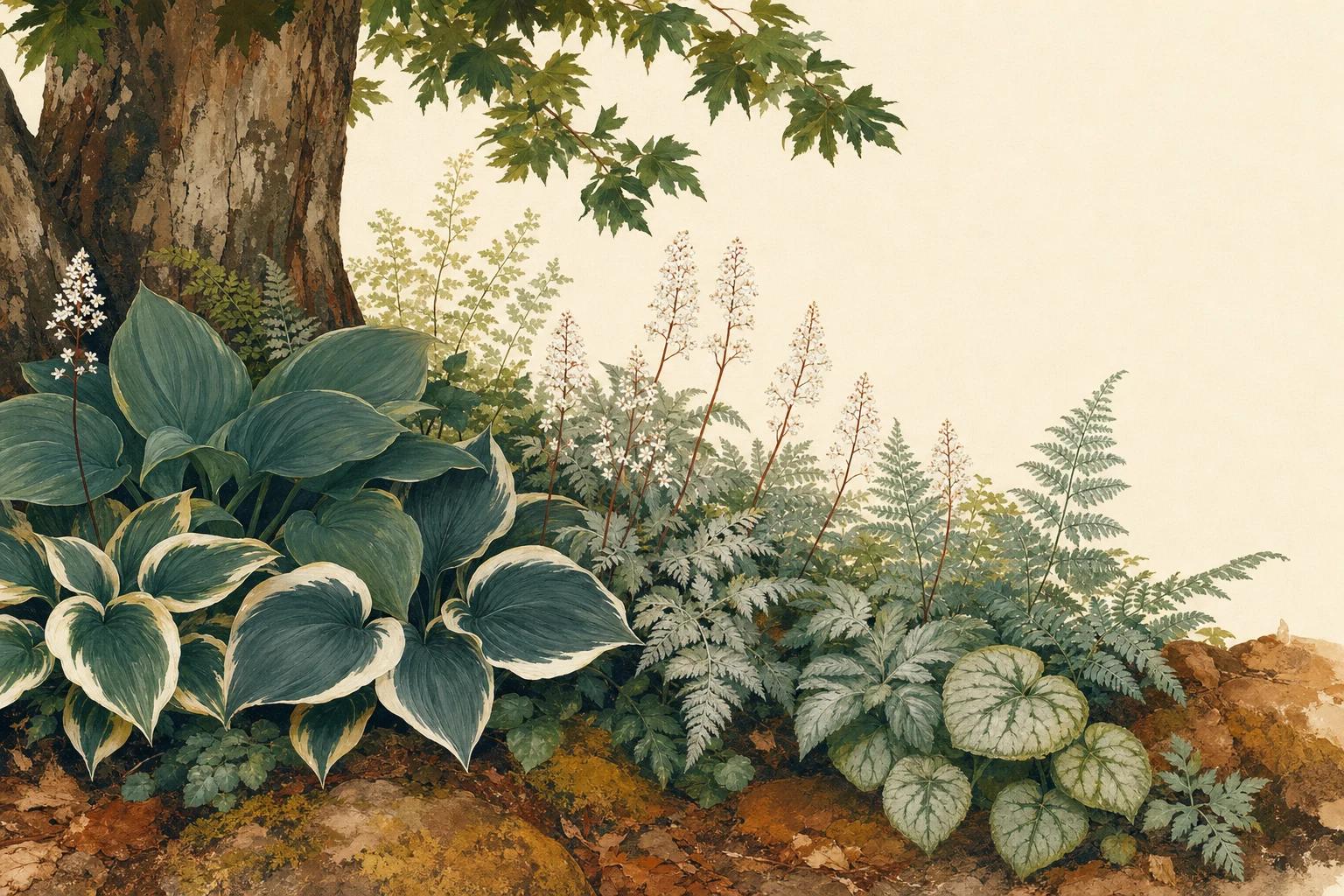
Long bloom is rarer in shade, which makes these four valuable; pair them with hostas sorted by how much shade they take for foliage, and see plants for shade for early-spring choices.
Yellow corydalis
Yellow corydalis (Corydalis lutea) produces yellow spurred flowers from May to September, and from June to frost in Utah. It makes a mound a foot to 18 inches (30 to 45 cm) high in part to full shade, and Zones 5 to 7 suit it best. Individual plants live only 3 to 5 years but seed themselves freely, sometimes too freely. It dislikes hot, humid summers and wet winter soil.
Fringed bleeding heart
Fringed bleeding heart (Dicentra eximia) flowers from April to July and keeps going through summer in cool climates; hot weather stops it, sometimes with a rebloom late in the season. Its ferny leaves stay attractive all season on a plant 12 to 18 inches (30 to 45 cm) tall, hardy in Zones 3 to 9. It needs good drainage and naturalizes by self-seeding.
Hardy begonia
Hardy begonia (Begonia grandis) hangs pink flower clusters from July to October in part to full shade, on a 1.5 to 2 foot (45 to 60 cm) plant hardy in Zones 6 and 7. Deadheading extends bloom. It spreads by small bulblets, emerges very late in spring and needs a heavy winter mulch at the cold edge of its range. Like all begonias, it is toxic to dogs, cats and horses.
'Honorine Jobert' anemone
Honorine Jobert anemone (Anemone × hybrida 'Honorine Jobert') is a finisher, not an all-season plant: single white flowers on wiry 3 to 4 foot (90 to 120 cm) stems from August into September. Grow it in Zones 4 to 8, ideally in part shade with steady moisture; it was the 2016 Perennial Plant of the Year. It is slow to establish, then creeps by rhizomes; its leaves scorch in hot, dry sun, and it does not perform south of Zone 7.
Long bloomers for hot Southern and dry Western summers
Heat reshapes bloom windows: several Midwest stars, including catmint, 'May Night' salvia and calamint, sulk in Deep South humidity, while these three are at their best in hot sun.
'Henry Duelberg' salvia
Henry Duelberg salvia (Salvia farinacea 'Henry Duelberg'), a selection of mealy cup sage, flowers from spring until frost in Texas on a plant about 3 feet (90 cm) tall and wide. It wants full sun, little care and Zone 7 or warmer winters, so it is a Southern pick rather than one for Zones 3 to 6.
Autumn sage
Autumn sage (Salvia greggii) blooms from June to October in Zones 6 to 9 and forms a shrubby mound 2 to 3 feet (60 to 90 cm) across. Its heaviest flowering comes in late spring and again in fall, with only scattered flowers through the hottest weeks. Give it sharp drainage, and afternoon shade where summers are fierce.
Gaura
Gaura (Oenothera lindheimeri, formerly Gaura lindheimeri) floats white to pink flowers on wiry 3 to 5 foot (0.9 to 1.5 m) stems and is hardy in Zones 5 to 9. Its window depends on climate: August to October in the Midwest, but June to frost in Utah, where shearing off the spent flowers brings new ones in about a week. It is a taprooted plant that self-sows if spent stems stay up in fall, and rich soil makes it leggy and floppy; cutting it back by half in late spring keeps it smaller.
Shorter than their reputation, and invasives to skip
A few popular "all summer" plants flower for far less time than their tags suggest, and a few long bloomers do harm outside the garden.
Popular picks with short windows
Phenomenal lavender (Lavandula × intermedia 'Niko', sold as PHENOMENAL) flowers from July to August, a six-to-eight-week anchor rather than a season-long plant. It is hardy in Zones 5 to 8, struggles in humid summers and wet winters, and lavender is toxic to dogs, cats and horses; for timing cuts, see when to prune lavender. Stokes' aster (Stokesia laevis) flowers from May to July with only an occasional fall repeat, and wet winter soil is its main killer. Rose verbena (Glandularia canadensis) flowers from May to August and behaves as an annual in the colder part of Zone 5.
Some perennials simply do not repeat. Amsonia, astilbe and poppy give one flush, and deadheading them brings nothing back, so count them as single-season color.
Invasive long bloomers and relatives
Purple loosestrife is a genuine long bloomer, but it is invasive and illegal to sell in North Carolina and many other states. Cultivars once sold as safe have crossed with wild plants and spread.
Several close relatives of the picks above are documented as invasive in US natural areas; check your state's list before planting any of them:
- Orange daylily (Hemerocallis fulva): grow named hybrids such as 'Happy Returns' instead.
- Oxeye daisy (Leucanthemum vulgare): grow 'Becky' Shasta daisy.
- Catnip (Nepeta cataria): grow sterile 'Walker's Low'.
- Tropical milkweed (Asclepias curassavica): grow butterfly weed.
- Long-leaf speedwell (Veronica longifolia): grow spike speedwell.
- Sweet scabious (Scabiosa atropurpurea) and Knautia arvensis: grow 'Butterfly Blue' pincushion flower.
- Purpletop vervain (Verbena bonariensis): grow rose verbena.
How to stretch the bloom: shear, deadhead or leave alone
Shear the plants that flush and pause, deadhead the ones that keep budding from side shoots, and leave alone those that will not repeat. Many perennials put their energy into seed once flowers fade, and removing the spent heads redirects it into new buds.
| Plant | What to do | When | What you get |
|---|---|---|---|
| Catmint | Cut back by about half | As the first flush fades | A second flush |
| 'Moonbeam' coreopsis | Deadhead steadily, or shear | Mid to late summer | Fall rebloom |
| Meadow sage | Deadhead; cut to basal leaves when tired | After the first flush | Repeat bloom if watered |
| 'Rozanne' geranium | Cut back to about 3 in (8 cm) | Only if bloom stalls in heat | Fresh growth and fall flowers |
| Coneflower, phlox, butterfly weed | Cut to the next side bud | Through summer | More flowers from side shoots |
| Shasta daisy, 'Goldsturm', pincushion flower | Remove spent heads | Through summer | Extra bloom |
| Daylilies | Deadhead for neatness | Daily | Little extra bloom |
| Amsonia, astilbe, poppy | Nothing | None | No rebloom |
Cut to just above a leaf or bud so the stem does not leave a bare stub.
Catmint rewards shearing without depending on it. 'Walker's Low' keeps flowering through summer with no help at all, yet cutting it back by about half after the first bloom tends to set off a second cycle. If yours looks open and floppy in July, shear it; if it is still tidy and full, leave it.
'Rozanne' follows climate. Where summers are cool, it flowers well from late spring into fall with no attention. In hot-summer areas, flowering often stalls in midsummer; shearing it to about 3 inches (8 cm) then brings fresh leaves and a fall flush.
Cut back no more than half of a plant's foliage at one time; removing more stresses it. On butterfly weed, a second round of flowers often follows about a month after you deadhead the first.
Salvia's rebloom has a ceiling: cut all the way back to fresh basal leaves, 'Caradonna' may flower again in fall, but with fewer and smaller spikes. Blazing star (Liatris), not on this list, answers the same treatment: cut its finished spikes to the basal leaves and it often reblooms in August and September.
Leave the last coneflower and black-eyed Susan heads standing from late summer on. Birds eat the seed, and the dried heads give the bed some winter structure.
How to plan a border that blooms June to frost
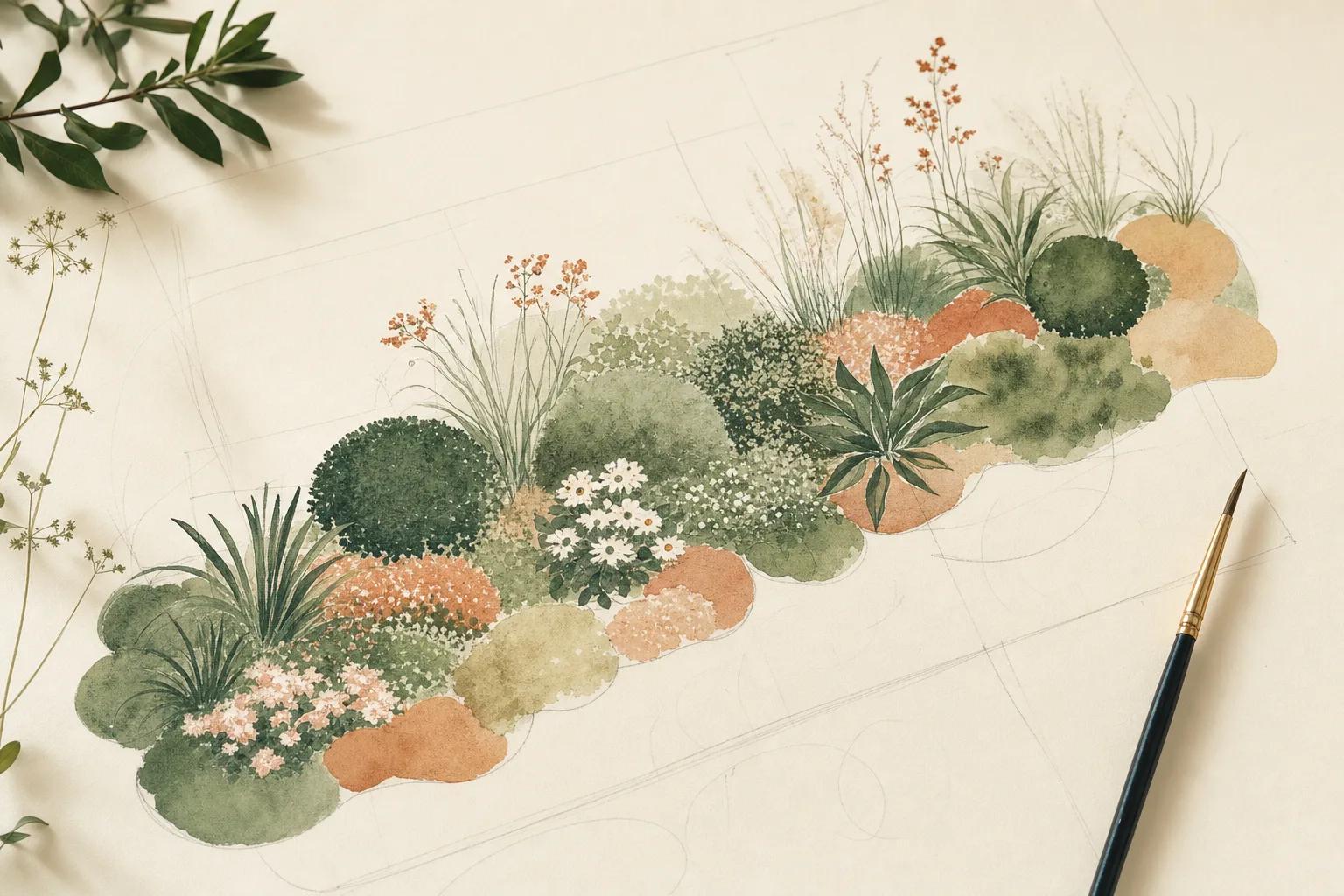
A border that flowers for five months is built from timing, not from one miracle plant. Choose a few long performers, then add plants that peak in each month between them. For bed shapes, depths and layering, see how to plan a planting border.
- List what flowers now, month by month. Note which months are bare in your own garden, then use catalog bloom charts to find plants for those months. Check the charts against your own plants, since timing shifts with weather and climate.
- Anchor with two or three long performers. Choose from 'Rozanne' geranium, catmint, 'Butterfly Blue', 'Goldsturm' and 'Moonbeam', and plant each in groups of three to five, which reads as a deliberate drift rather than scattered dots.
- Stagger early, mid and late bloomers. For May and June add meadow sage and blanket flower; for July and August, coneflower, 'Becky' Shasta, reblooming daylilies and false sunflower; for August to frost, Russian sage, 'Blue Fortune', 'Firetail' and, in shade, 'Honorine Jobert'.
- Match each plant to your drainage and light. Pincushion flower, Stokes' aster, lavender and anise hyssop are often killed by wet winter soil; give them a slope or a raised spot. Russian sage flops in part shade, and yarrow and gaura flop in rich soil, so give all three full sun and lean, well-drained soil.
- Fill early gaps with annuals. A new border looks thin for its first seasons, and even a mature one can develop bare spots or bare months after 3 to 5 years. Annuals fill both.
- Divide before clumps decline. 'Becky' Shasta every 2 to 3 years, yarrow every 3 to 4, coneflower about every 4 and daylilies every 3 to 5 keep each plant flowering at full strength.
Several long bloomers are toxic to pets. Daylilies can cause kidney failure in cats. Butterfly weed, lavender, common yarrow and hardy begonia are toxic to dogs, cats and horses. The "geranium" on pet-toxicity lists is the annual bedding geranium (Pelargonium), a different plant from 'Rozanne'.
Keep a note of which plants needed a July shear and which months still looked thin, and adjust the mix the following spring. When you are ready to lay out the bed, Sow's garden planner lets you place each plant at its mature spread before you dig.
Frequently asked questions
What flowers continuously bloom all summer?
No hardy perennial blooms without a break, so unbroken color comes from rebloomers plus annuals. Even the longest bloomers pause or thin out in midsummer heat. 'Walker's Low' catmint is the easiest anchor: cut it back by about half as the first flush fades and it tends to start a second round. Then tuck annuals between the perennials to cover any lull, especially in a young border that has not filled in.
Do perennial flowers grow every year?
Yes. A perennial hardy in your zone regrows from its roots each spring, but lifespans differ. Shasta daisy and blanket flower are short-lived, and 'Becky' Shasta needs dividing every 2 to 3 years to stay vigorous. Coneflower wants dividing about every 4 years, daylilies every 3 to 5 and yarrow every 3 to 4. Long-lived clumps flower better when you split them before the centers die out.
What are the longest blooming perennials in zone 5?
In Zone 5, rely on 'Walker's Low' catmint (mid-May to late September), 'Rozanne' geranium (Zones 5 to 8), 'Goldsturm' black-eyed Susan and 'Moonbeam' coreopsis (both Zones 3 to 9), 'Butterfly Blue' pincushion flower (Zones 5 to 9), 'Caradonna' salvia (Zones 4 to 8) and 'Firetail' mountain fleece (Zones 4 to 7, June to October). Leadwort is borderline at Zone 5 and benefits from a winter mulch.
What is the longest blooming perennial flower?
No head-to-head trial ranks them, but 'Rozanne' geranium and 'Butterfly Blue' pincushion flower have the longest recorded windows: late spring to mid-fall for 'Rozanne' and late April to frost for 'Butterfly Blue'. 'Rozanne' wins on effort, because its sterile flowers keep coming without deadheading, while pincushion flower needs spent heads removed and fast-draining soil to survive winter.
What is the best low maintenance perennial?
'Rozanne' geranium asks for the least: no deadheading and no shearing, apart from a cutback in hot-summer regions if it stalls. 'Walker's Low' catmint, 'Moonbeam' coreopsis, 'Goldsturm' black-eyed Susan, purple coneflower and 'Stella de Oro' daylily are all rated low maintenance as well. Yarrow takes more care: it flops in rich soil or shade and needs dividing every 3 to 4 years.
Do reblooming daylilies really bloom all summer?
Only where the season is long. 'Stella de Oro' flowers for two to three months, and 'Happy Returns' blooms in June with good repeat flowering to frost in Missouri. In Minnesota, though, rebloomers fail to repeat because the season is too short, and each plant flowers for 30 to 40 days. Each flower lasts a single day, but an established clump can open 200 to 400 flowers in a season.
Which long-blooming perennials are safe around cats and dogs?
Coreopsis, including 'Moonbeam', is listed as non-toxic to dogs, cats and horses. Coneflower, black-eyed Susan, meadow sage, blanket flower, garden phlox and Russian sage have no entry on the ASPCA toxic-plant lists, which is not proof they are safe. Catnip (Nepeta cataria, also sold as catmint) is listed as toxic to cats, so keep cats from chewing ornamental catmints too. Daylilies can cause kidney failure in cats, and butterfly weed, yarrow, lavender and begonias are toxic to dogs, cats and horses.
What are some of the best perennial flowers?
The Perennial Plant of the Year winners make a dependable shortlist for long bloom: 'Moonbeam' coreopsis (1992), Russian sage (1995), 'May Night' salvia (1997), 'Goldsturm' black-eyed Susan (1999), 'Butterfly Blue' pincushion flower (2000), 'David' phlox (2002), 'Becky' Shasta daisy (2003), 'Walker's Low' catmint (2007) and 'Rozanne' geranium (2008). Choose by your light and zone first, then by when each one flowers.
References
- Missouri Botanical Garden. Long-blooming Perennials (Visual Guides). Accessed October 16, 2026.
- Missouri Botanical Garden. Plant Finder: Geranium 'Gerwat' ROZANNE and other taxon profiles. Accessed October 16, 2026.
- Walters Gardens. Nepeta x faassenii 'Walker's Low' and other variety pages ('Stella de Oro', 'Caradonna', 'Blue Fortune', Russian sage, 'Phenomenal', 'PowWow Wild Berry'). Accessed October 16, 2026.
- Walters Gardens (Perennial Plant Association list). Perennial Plant of the Year Award Winners. Accessed October 16, 2026.
- Proven Winners. 'Rozanne' Hardy Geranium. Accessed October 16, 2026.
- Chicago Botanic Garden. Plant Evaluation Notes No. 29: Catmints (Nepeta). Accessed October 16, 2026.
- Chicago Botanic Garden. How do I get perennials to bloom all summer?. Accessed October 16, 2026.
- University of Illinois Extension. Care for perennial gardens with 3 proven pruning methods. Accessed October 16, 2026.
- University of Illinois Extension. Want continuous blooms in your yard?. Accessed October 16, 2026.
- University of Minnesota Extension. Daylilies. Accessed October 16, 2026.
- University of Minnesota Extension. Tall garden phlox. Accessed October 16, 2026.
- Utah State University Extension. Long-blooming Perennials Add Lasting Beauty to Landscapes. Accessed October 16, 2026.
- Texas A&M AgriLife Extension (Texas Superstar). 'Henry Duelberg' Salvia. Accessed October 16, 2026.
- Purdue University Indiana Yard and Garden. Geranium 'Rozanne', the 2008 Perennial of the Year. Accessed October 16, 2026.
- NC State Extension. Clinopodium nepeta (Calamintha nepeta) (Plant Toolbox). Accessed October 16, 2026.
- NC State Extension. Lythrum salicaria (Plant Toolbox). Accessed October 16, 2026.
- University of Georgia Center for Invasive Species and Ecosystem Health and National Park Service. Invasive Plant Atlas of the United States: species list. Accessed October 16, 2026.
- ASPCA Animal Poison Control. Toxic and Non-Toxic Plant List: Cats. Accessed October 16, 2026.
- ASPCA Animal Poison Control. Toxic and Non-Toxic Plant List: Dogs. Accessed October 16, 2026.
- ASPCA Animal Poison Control. Toxic and Non-Toxic Plant List: Horses. Accessed October 16, 2026.
Sow Editorial
Written by the Sow team from university extension services, botanical gardens, USDA and NOAA data and plant breeders. Every source is listed under References.
The plants Sow gardeners save most