Quick answer
A fast-growing tree adds about 2 feet (60 cm) or more a year. For most yards, choose Freeman maple 'Autumn Blaze', red maple, Accolade or Triumph elm, or thornless honeylocust. River birch and pin oak suit moist, acidic soil, tuliptree and dawn redwood need a big lot, and 'Green Giant' arborvitae makes the fastest screen. Skip the invasive Callery (Bradford) pear, princess tree (empress tree), tree of heaven and mimosa.
Key facts
- What counts as fast
- About 2 ft (60 cm) or more of height a year
- Fast shade that lasts
- Accolade and Triumph elms, pin and Nuttall oak; Freeman maple on acidic soil
- Fastest privacy screen
- 'Green Giant' arborvitae, up to 3–4 ft (0.9–1.2 m) a year
- Invasive, do not plant
- Callery (Bradford) pear, princess tree (empress tree), tree of heaven, mimosa
- The usual trade-off
- Brittle wood, shallow roots and a shorter life
- Best planting time
- Fall after leaf drop or early spring before bud break
- Toxic to horses
- Red, silver and Freeman maple leaves; oaks, including acorns
Speed is worth having only in a tree that will still be sound when it reaches full size. The trees worth planting for speed put on about 2 feet (60 cm) of height a year and still have strong limbs and a long life ahead of them. Which one suits you depends as much on your soil and lot size as on the growth rate.
Speed usually costs something. Many fast growers have brittle wood that snaps under ice, shallow roots that lift paving, or a short life, and several popular ones, led by Callery pear, are invasive. The 25 picks below are grouped by the job you need done, followed by the fast trees to avoid and the planting care that gets the most growth out of a young tree.
How these plants were chosen
Every pick is rated fast or rapid in at least one published growth rating and slow in none, has documented hardiness zones and mature size, and is absent from the federal and state invasive-species records checked for this page. "Fast" here means roughly 2 feet (60 cm) or more of new height a year, which is roughly where the two tree keys below draw the line.
| Growth class | Missouri key | Chicago-region key |
|---|---|---|
| Slow | 12 in (30 cm) or less a year | Under 10 in (25 cm) a year |
| Medium or moderate | 12–24 in (30–61 cm) a year | 10–20 in (25–51 cm) a year |
| Fast | 24 in (61 cm) or more a year | Over 20 in (51 cm) a year |
Growth classes as defined by the Missouri Department of Conservation and The Morton Arboretum.
The keys disagree by a few inches, so a tree adding 18 to 24 inches (46 to 61 cm) a year can be fast in one and medium in the other. The same species can also earn different labels in different keys: tuliptree is rated medium in one, fast in another and rapid in a third. Rate depends on site and age. A young tree on deep, moist soil in full sun grows at the top of its range, and an old tree or one on thin, dry ground grows at the bottom. Where ratings split, this page calls the tree moderate to fast.
Measured growth tells the same story. Over 24 years of measurement in Westminster, Colorado, about 1,500 surviving city trees were tracked by trunk diameter. Eastern cottonwood grew fastest, adding 0.57 inch (1.4 cm) of diameter a year. Catalpa followed at 0.45 inch (1.1 cm), then silver maple and white oak at 0.43 inch (1.1 cm); red maple and hackberry sat near the bottom at about 0.3 inch (0.8 cm). Growth averaged 0.48 inch (1.2 cm) a year in the first eight years of measurement (1992 to 2000) and about 0.3 inch (0.8 cm) after that. The slowdown came partly from the trees aging and partly from an early-2000s drought. More than half of the trees first planted never reached the final count, lost to insects, disease, too little water and development.
Fast growth and weak wood often travel together. Many fast trees are short-lived. Their brittle limbs snap in wind, snow and ice, worst where a branch meets the trunk at a narrow angle. They suffer more canker disease, and their shallow roots crack sidewalks and find sewer lines. Willows and poplars are the textbook examples. The elms and honeylocust break the pattern and live for generations. Kentucky coffeetree and black gum sometimes appear on fast-tree lists, but both are rated slow-growing in standard growth keys, so they are left off this one.
| Pick | Type | Zones | Mature height | Best for |
|---|---|---|---|---|
| Freeman maple 'Autumn Blaze' | Deciduous shade | 3–8 | 40–55 ft (12–17 m) | Quick shade, fall color |
| Red maple | Deciduous shade | 3–9 | 40–70 ft (12–21 m) | Wide climate range, red flowers |
| Accolade elm | Deciduous shade | 4–8 | 50–60 ft (15–18 m) | Long-lived, vase-shaped shade |
| Triumph elm | Deciduous shade | 4–7 | 50–60 ft (15–18 m) | Alkaline clay, road salt |
| Sweetgum | Deciduous shade | 5–9 | 60–80 ft (18–24 m) | Fall color on moist soil |
| Tuliptree | Large shade | 4–9 | 60–90 ft (18–27 m) | Big lots, spring flowers |
| Dawn redwood | Deciduous conifer | 4–8 | 70–100 ft (21–30 m) | Tall, narrow accent |
| London planetree | Large shade | 5–8 | 70–100 ft (21–30 m) | Open sites, city conditions |
| American sycamore | Large shade | 4–9 | 75–100 ft (23–30 m) | Streambanks, big properties |
| River birch | Multi-trunk shade | 4–9 | 40–70 ft (12–21 m) | Wet spots, peeling bark |
| Pin oak | Deciduous shade | 4–8 | 50–70 ft (15–21 m) | Wet, acidic soil |
| Nuttall oak | Deciduous shade | 6–9 | 50–80 ft (15–24 m) | Wet, heavy soil |
| Willow oak | Deciduous shade | 5–9 | 40–75 ft (12–23 m) | Streets, pond edges |
| Thornless honeylocust | Deciduous shade | 3–8 | 40–70 ft (12–21 m) | Dry, salty, windy sites |
| Northern red oak | Deciduous shade | 4–8 | 50–75 ft (15–23 m) | Dry soil, long life |
| Common hackberry | Deciduous shade | 2–9 | 40–60 ft (12–18 m) | Cold, wind, drought |
| Northern catalpa | Flowering shade | 4–8 | 40–70 ft (12–21 m) | Tough sites, spring flowers |
| 'Green Giant' arborvitae | Evergreen screen | 5–8 | 40–60 ft (12–18 m) | Tall privacy screen |
| Cryptomeria 'Yoshino', 'Radicans' | Evergreen screen | 5–9 | 30–45 ft (9–14 m) | Leyland cypress replacement |
| Eastern white pine | Evergreen | 3–8 | 50–80 ft (15–24 m) | Northern screens |
| Norway spruce | Evergreen | 2–7 | 40–60 ft (12–18 m) | Cold-climate windbreaks |
| Nellie R. Stevens holly | Evergreen | 6–9 | 15–25 ft (4.6–7.6 m) | Mid-size screen, berries |
| Crape myrtle | Small flowering | 6–9 | 6–30 ft (1.8–9 m) | Summer bloom |
| Desert willow | Small flowering | 7–9 | 10–30 ft (3–9 m) | Hot, dry gardens |
| American plum | Small flowering | 3–9 | 10–25 ft (3–7.6 m) | Native blossom and fruit |
Zones are USDA hardiness zones; for several trees, references differ by one zone at the cold edge.
Most picks suit the East, Midwest and Plains. On the Pacific coast in Zones 7 to 9, coast redwood is a rapid-growing evergreen that reaches 60 to 100 feet (18 to 30 m) in gardens, but it needs cool, steadily moist conditions. In the hot, dry Southwest, desert willow is the small-tree choice, and along the Gulf Coast, Nuttall oak, willow oak, crape myrtle and Nellie R. Stevens holly all grow into Zone 9. Few trees on this page are rated for Zones 10 and 11; bald cypress and desert willow are the exceptions in some references.
Not sure of your zone? Look it up with the plant hardiness checker before you shortlist.
Fast shade trees for most yards
For a typical suburban lot, Freeman maple 'Autumn Blaze' and the Accolade and Triumph elms give the best mix of speed and staying power. Red maple and sweetgum rate a notch slower in some keys but are just as useful.
Freeman maple 'Autumn Blaze' (Acer × freemanii 'Jeffersred')
Autumn Blaze maple is a red maple and silver maple cross. It grows faster than red maple, carries stronger wood than silver maple and takes its fall color from the red side. Expect a height of 40 to 55 feet (12 to 17 m) and a 30- to 40-foot (9 to 12 m) spread in Zones 3 to 8, in sun or light shade; it rarely flowers. It wants moist, acidic soil and is hit-or-miss on the alkaline soils of the Northern Plains, and young trees attract leafhoppers and scale. Buy it by its full name, because an invasive Callery pear is also sold as 'Autumn Blaze'.
Red maple (Acer rubrum)
Red maple has one of the widest climate ranges here, Zones 3 to 9, with red flowers in March and April and dependable red fall color. Ratings run from moderate to rapid; it outpaces Norway and sugar maples but not silver maple. Mature trees stand 40 to 70 feet (12 to 21 m) high with a 30- to 50-foot (9 to 15 m) crown, in sun or part shade. Its shallow, flattened roots can buckle a nearby driveway, and verticillium wilt can kill it.
Red maple and oaks are toxic to horses. Silver maple carries the same toxins, so treat Freeman maple, a red and silver maple cross, as toxic too. Wilted or dried red maple leaves, such as those on a branch brought down by a storm, are the most dangerous, and fallen autumn leaves stay toxic for about 30 days. On oaks, young leaves and green acorns are the most toxic. Keep these trees and their debris out of pastures and paddocks. Only horses and ponies are reported to be poisoned by red maple.
Accolade and Triumph elms
Accolade elm (Ulmus davidiana var. japonica 'Morton') is fast and vase-shaped, with very good resistance to Dutch elm disease and elm leaf beetle. It grows 50 to 60 feet (15 to 18 m) tall with a spread of 25 to 40 feet (7.6 to 12 m), hardy from Zone 4 or 5 to Zone 8. Triumph elm (Ulmus 'Morton Glossy') matches that height, spreads 35 to 40 feet (11 to 12 m) and is hardy in Zones 4 to 7. It resists Dutch elm disease and elm yellows and tolerates alkaline clay, dry sites and road salt. Both take full sun to part shade. Elms need yearly structural pruning while young, done outside the growing season, and no elm is immune to Dutch elm disease.
Sweetgum (Liquidambar styraciflua)
Sweetgum is a moderate-to-fast native shade tree with brilliant fall color for Zones 5 to 9, though it is not reliably hardy in the colder half of Zone 5. Plan on 60 to 80 feet (18 to 24 m) of height and a 40- to 60-foot spread (12 to 18 m); it needs full sun and deep, moist soil that is not alkaline. The spiny round seed capsules make walking barefoot underneath painful, so keep it away from patios and play areas.
Fast trees for large properties
Tuliptree, dawn redwood, London planetree and American sycamore are among the fastest big trees, and all four outgrow an ordinary lot. Plant them where a tree of 60 to 100 feet (18 to 30 m) has room above and around it, well away from the house.
Tuliptree (Liriodendron tulipifera)
Tuliptree, also sold as tulip poplar, is one of the tallest eastern natives, with yellow, orange-banded flowers in May and June. Rated fast or rapid in most keys, it climbs to 60 to 90 feet (18 to 27 m) with a crown 30 to 50 feet (9 to 15 m) across. Grow it in full sun in Zones 4 to 9 (5 to 9 in some references). The wood is somewhat weak, so limbs break in wind and ice, and aphid honeydew blackens with sooty mold. Shallow roots limit what grows beneath it, so plan any underplanting around tough ground cover plants. Rabbits chew the bark of young trees.
Dawn redwood (Metasequoia glyptostroboides)
Dawn redwood is a deciduous conifer that sheds its soft needles every fall. It grows fast into a narrow pyramid in Zones 4 to 8, reaching 70 to 100 feet (21 to 30 m) but only 15 to 25 feet (4.6 to 7.6 m) across. It needs full sun and steady moisture. It has no serious pest or disease problems apart from Japanese beetles chewing the foliage, but an early fall freeze can damage it.
London planetree (Platanus × acerifolia)
London planetree grows about 2 feet (60 cm) a year and tolerates city conditions. Hardy in Zones 5 to 8, or Zone 4 in some references, it reaches 70 to 100 feet (21 to 30 m) tall, with a spread of 65 to 80 feet (20 to 24 m). Plant it at least 6 feet (1.8 m) from any sidewalk or curb, because the roots lift pavement. Canker stain can kill it, and anthracnose resistance varies by cultivar: 'Columbia' and 'Liberty' are reported to resist it better, though neither is immune.
American sycamore (Platanus occidentalis)
American sycamore also adds about 2 feet (60 cm) a year. Hardy in Zones 4 to 9, it becomes a giant 75 to 100 feet (23 to 30 m) tall and just as broad, in full sun to light shade. It belongs beside a stream or pond, or in open ground away from lawns and paving. Anthracnose can be severe in cool, wet springs, the tree drops a steady litter of leaves, bark, twigs and seed balls, and its big leaves smother grass.
Fast trees for wet or heavy soil
Where water lingers after rain, river birch, pin oak, Nuttall oak and willow oak are the fast choices that tolerate it. Bald cypress is rated medium rather than fast, but it is worth knowing for wet ground: it grows in wet or ordinary soil in Zones 4 to 11 and reaches 50 to 70 feet (15 to 21 m). Several of these trees need acidic soil, so test pH before you plant: most ornamental trees do best between pH 5.8 and 6.5, and several of these yellow with chlorosis above that range.
River birch (Betula nigra)
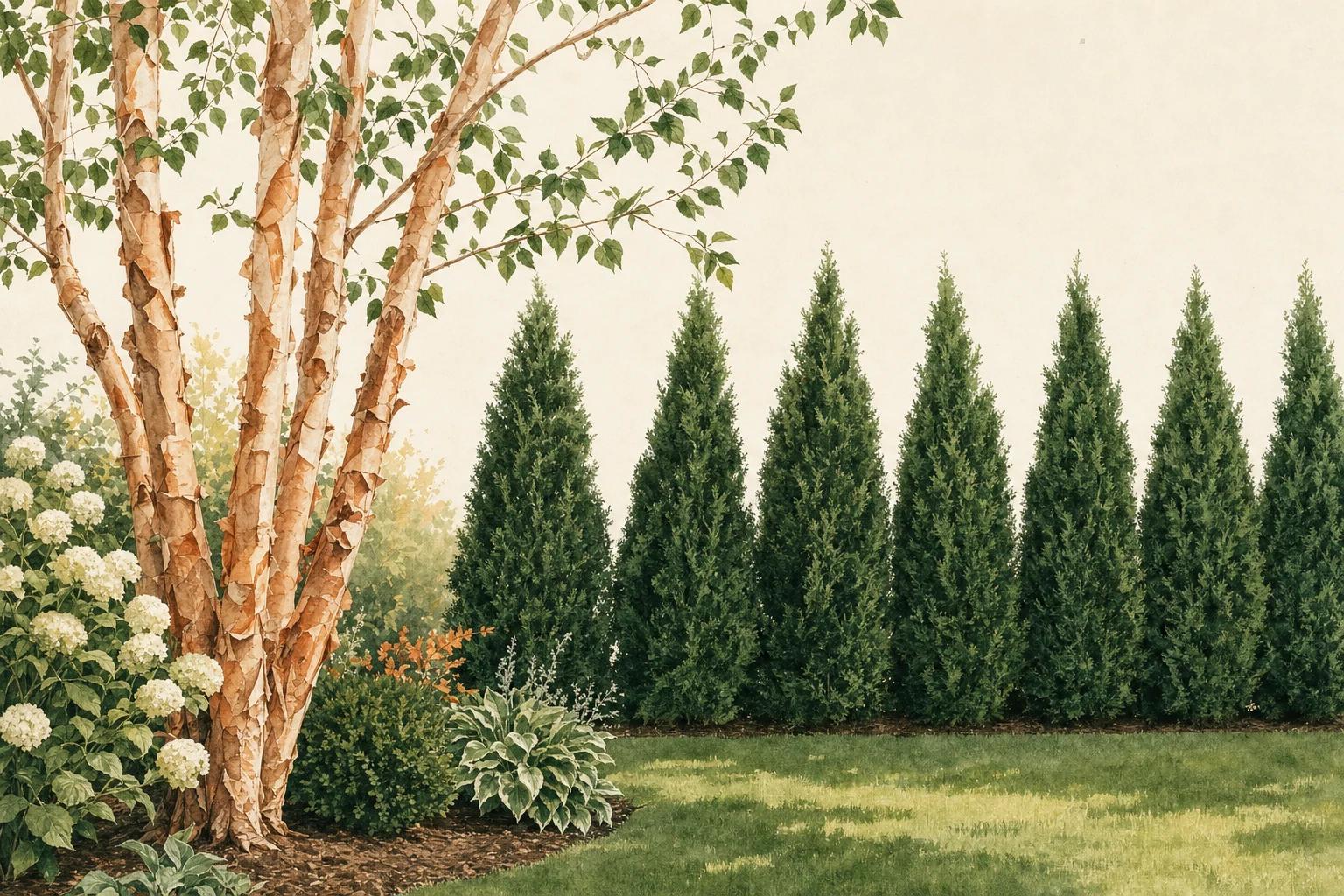
River birch grows 1.5 to 2 feet (45 to 60 cm) a year on moist, fertile ground and is grown for its peeling bark, often as a multi-trunk clump. Give it full sun to part shade in Zones 4 to 9. Most become 40- to 70-foot (12 to 21 m) trees with a 40- to 60-foot (12 to 18 m) crown, though some stop short, at 30 to 40 feet (9 to 12 m). Unlike paper birch, it resists bronze birch borer. Iron chlorosis sets in at pH 6.5 or higher, it drops leaves in severe drought, and it bleeds sap if pruned in spring.
Pin oak (Quercus palustris)
Pin oak is one of the fastest-growing oaks, with a neat pyramidal form. Rated fast or rapid, it grows to 50 to 70 feet (15 to 21 m) high and spreads 40 to 60 feet (12 to 18 m) in Zones 4 to 8. Give it full sun and acidic, medium-to-wet soil. On alkaline ground its chlorosis can become severe enough to kill the tree, so plant it only where a soil test shows acid conditions.
Nuttall oak (Quercus texana)
Nuttall oak comes from wet, heavy bottomland soils of the south-central US, yet tolerates drought once established. Rated fast to rapid, it matures at 50 to 80 feet (15 to 24 m) with a 40- to 65-foot (12 to 20 m) spread in Zones 6 to 9. It needs full sun and has no serious pests. It is not hardy north of Zone 6, and it appears under two botanical names, Quercus texana and Q. nuttallii, for the same tree.
Willow oak (Quercus phellos)
Willow oak has narrow, willow-like leaves and grows relatively fast for an oak. Expect 40 to 75 feet (12 to 23 m) of height and 25 to 50 feet (7.6 to 15 m) of width in Zones 5 to 9, in full sun. It is long-lived and low-maintenance, and it suits streets and pond edges. It shares the usual oak problems, including oak wilt, anthracnose and galls.
Fast trees for dry, windy or alkaline sites
On dry or windy ground, thornless honeylocust, common hackberry, northern catalpa and northern red oak are the toughest fast-to-moderate choices. On alkaline, high-pH soil, honeylocust, hackberry and Triumph elm cope where pin oak, red maple, river birch, bald cypress and white pine turn yellow with chlorosis.
In the semi-arid West the fastest trees are often the worst bets. Along Colorado's Front Range, cottonwood and silver maple lose limbs in spring and fall snowstorms, while the slower honeylocust and hackberry are better choices there.
Thornless honeylocust (Gleditsia triacanthos f. inermis)
Thornless honeylocust grows fast, shrugs off drought, road salt and wind, and casts light, dappled shade from leaflets so small they need no raking. It forms a 40- to 70-foot (12 to 21 m) canopy as wide as it is tall, in Zones 3 to 8 and full sun. Wild honeylocust carries thorns up to 3 inches (7.5 cm) long, so buy a named thornless form, ideally a fruitless one. Mites, canker, borers and webworms all attack it, and it is already overplanted in many towns, so pair it with other species rather than lining a street with it.
Northern red oak (Quercus rubra)
Northern red oak is the long-lived choice here: moderate to fast, tolerant of dry soil and drought, and durable as a lawn or street tree. Height and spread both run 50 to 75 feet (15 to 23 m); it is hardy in Zones 4 to 8 and needs full sun. Oak wilt has no cure, and the tree turns chlorotic on soil that is not acidic.
Common hackberry (Celtis occidentalis)
Common hackberry takes cold, wind, drought and flooding, and it is hardy from Zone 2 to Zone 9. Ratings range from moderate to rapid, and in sun or part shade it grows into a broad tree that reaches 40 to 60 feet (12 to 18 m) in each direction. Nipple galls on the leaves and witches' broom on the twigs are cosmetic, but a witches'-broom-resistant cultivar looks better. Limbs break under ice, fall color is poor, and the fruit needs sweeping off paving.
Northern catalpa (Catalpa speciosa)
Northern catalpa is a moderate-to-fast native with big heart-shaped leaves and white flowers spotted purple and yellow in May and June. It handles drought and flooding and grows in sun or part shade in Zones 4 to 8. Expect it to reach 40 to 70 feet (12 to 21 m), with a width of 20 to 50 feet (6 to 15 m). The branches are brittle, the long seed pods litter the lawn, and catalpa sphinx caterpillars can strip the leaves.
Fast evergreens for privacy screens
'Green Giant' arborvitae is the fastest dependable evergreen screen for Zones 5 to 8. In the North, eastern white pine and Norway spruce do the job; farther south, cryptomeria and Nellie R. Stevens holly widen the choice.
Plant a mix rather than one species along a whole boundary. Pests and diseases target particular hosts, and a single outbreak can open a gap the length of the fence, as emerald ash borer has done to ash. For a lower hedge, evergreen shrubs give year-round structure without the height; see also these fast-growing privacy shrubs.
'Green Giant' arborvitae (Thuja standishii × plicata 'Green Giant')
Green Giant arborvitae can add 3 to 4 feet (0.9 to 1.2 m) a year in good conditions. It grows into a column 40 to 60 feet (12 to 18 m) tall but stays only 12 to 18 feet (3.7 to 5.5 m) wide, in sun or part shade in Zones 5 to 8. It resists most diseases and insects, periodic drought and deer. It outgrows small yards fast, is not salt tolerant, gets bagworms, rots in poorly drained soil and lives about 40 to 60 years.
Cryptomeria 'Yoshino' and 'Radicans' (Cryptomeria japonica)
Japanese cryptomeria grows slowly as a species, but its cultivars 'Yoshino' and 'Radicans' are fast and make strong replacements for Leyland cypress in Zones 5 to 9. 'Yoshino' grows 30 to 40 feet (9 to 12 m) high with a 20- to 30-foot (6 to 9 m) spread. 'Radicans' is narrower, 40 to 45 feet (12 to 14 m) tall and 15 to 20 feet (4.6 to 6 m) wide. Give them full sun or light shade, keep the soil from drying out and shelter them from drying winter wind. 'Yoshino' bronzes in winter.
Eastern white pine (Pinus strobus)
Eastern white pine is the fast-to-moderate, soft-needled native for cold-climate screens and windbreaks, hardy in Zones 3 to 8. It puts on about 1 to 1.5 feet (30 to 45 cm) a year in sun or part shade. Mature trees stand 50 to 80 feet (15 to 24 m) tall and 20 to 40 feet (6 to 12 m) wide. It needs moist, well-drained soil and fails on compacted clay, road salt and polluted air. White pine blister rust is usually fatal, so do not plant it near currants or gooseberries, which carry the disease.
Norway spruce (Picea abies)
Norway spruce is a moderate-to-fast, very cold-hardy windbreak tree for Zones 2 to 7. In full sun it grows 40 to 60 feet (12 to 18 m) high and 25 to 30 feet (7.6 to 9 m) wide. It likes cool summers and often grows poorly south of Zone 7. Watch for cytospora canker, bagworms and spider mites.
Nellie R. Stevens holly (Ilex 'Nellie R. Stevens')
Nellie R. Stevens holly grows rapidly into an evergreen screen or small tree with red winter berries. It reaches 15 to 25 feet (4.6 to 7.6 m) tall and 8 to 12 feet (2.4 to 3.7 m) wide in Zones 6 to 9, in sun or part shade. Its leaves are prickly, it dislikes wet sites and alkaline soil, and holly leafminer, scale and mites are common.
Fast small trees
For spots that need a tree under about 30 feet (9 m), crape myrtle, desert willow and American plum grow rapidly and flower. For more ornamental choices, see these flowering trees.
Crape myrtle (Lagerstroemia indica)
Crape myrtle grows rapidly and flowers from July to September in white, pink, red or lavender-purple, depending on cultivar, over peeling bark. Varieties range from 6 to 30 feet (1.8 to 9 m) tall, so choose one that fits the space rather than topping it each year; all want full sun in Zones 6 to 9. Winter cold can injure it at the northern edge of its range, and powdery mildew and aphids are common.
Desert willow (Chilopsis linearis)
Desert willow is a drought-tolerant Southwest native for hot, dry gardens in Zones 7 to 9, with white-to-pink trumpet flowers from May to September, heaviest in May and June, over a long season that can start in spring and run into fall. It grows rapidly while young, then slows, reaching 10 to 30 feet (3 to 9 m) in height with a 15- to 20-foot (4.6 to 6 m) spread in full sun. It needs dry to medium, well-drained, slightly alkaline soil, and it reseeds into nearby beds.
American plum (Prunus americana)
American plum is a fast native small tree for Zones 3 to 9, with white blossoms in early spring and edible plums later. It grows 10 to 25 feet (3 to 7.6 m) tall in sun or part shade. It suckers into thickets and is thorny, so it suits a hedgerow better than a lawn, and plum curculio, brown rot, black knot and deer all damage it.
Fast-growing trees to avoid, and what to plant instead
Do not plant Callery (Bradford) pear, princess tree (empress tree), tree of heaven or mimosa: all four are invasive. Several other fast trees are brittle, short-lived or doomed by a pest. The table gives a better tree for the same job.
| Tree | Problem | Plant instead |
|---|---|---|
| Callery pear, including 'Bradford' | Invasive; splits apart after 15 to 20 years | American plum or crape myrtle |
| Princess tree (empress tree) | Invasive; weak wood, resprouts from roots | Northern catalpa |
| Tree of heaven | Invasive in about 30 states; suckers; spotted lanternfly host | Thornless honeylocust |
| Mimosa (silk tree) | Invasive in the Southeast; weak; seeds poison dogs and livestock | Crape myrtle or desert willow |
| Siberian elm | Highly invasive self-seeder; brittle | Accolade or Triumph elm |
| Amur maple | Invasive in parts of the Midwest and Northeast | American plum |
| Goldenrain tree | On a Mid-Atlantic invasive list; brittle; self-seeds | Crape myrtle |
| Silver maple | Brittle limbs, surface roots | Freeman maple 'Autumn Blaze' |
| Eastern cottonwood, hybrid poplar | Weak wood, canker, roots in sewer lines | River birch |
| Weeping and white willow | Cracking wood, roots clog drains | Bald cypress |
| Boxelder | Weak wood, suckers, boxelder bugs | Red maple |
| Green ash | Emerald ash borer kills infested trees in 3 to 5 years | Common hackberry |
| Leyland cypress | Incurable cankers after drought; root rots; short life | 'Green Giant' or cryptomeria 'Yoshino' |
Invasive status from state and federal invasive-species records; check your own state's list before planting.
Callery pear deserves the strongest warning: every cultivar cross-pollinates and birds spread the seed into thorny thickets. The state bans and better spring-flowering replacements are in the flowering trees guide.
Leyland cypress is fast but a poor long-term screen. It can grow 18 to 36 inches (46 to 91 cm) a year when young and has reached 50 feet (15 m) in 15 years. But Seiridium and Botryosphaeria cankers move in after drought, and neither those cankers nor its root rots can be cured. Bagworms can strip a tree in weeks, big trees topple on shallow roots, it struggles in hot summers and it lives only 20 to 50 years. Wear gloves when trimming it, because the foliage can irritate skin.
The weak-wooded natives are not invasive and still have uses. Silver maple suits poor or wet ground where stronger trees will not grow, cottonwood a rural low spot along a stream, and boxelder a difficult site or the coldest climates. Keep all of them, along with willows and poplars, well clear of houses, septic fields and sewer lines.
Planting and early care for faster, stronger growth
A young tree grows fastest when it goes in at the right depth, in the dormant season, with steady water and no competition from grass. In the first year, weekly water does far more than fertilizer, which has no place in the planting hole.
How to plant a young tree
- Site it for its mature size. Measure the full-grown spread before you dig. Keep fast growers 8 to 20 feet (2.4 to 6 m) or more from the house, depending on the tree, and away from septic systems, sewer lines, driveways and patios, where their roots do the most damage.
- Call 811 first. Have underground utilities marked before you dig, so the spade never meets a buried line.
- Choose a sound tree. Look for a straight trunk with well-spaced branches, wound-free bark, a visible trunk flare and roots growing straight out from the trunk. A balled-and-burlapped root ball should be at least 10 to 12 times the trunk diameter; pass over trees with circling or crushed roots.
- Plant while the tree is dormant. Fall after leaf drop or early spring before bud break lets roots settle in before heat drives top growth. In the Southeast, fall is best because roots keep growing through the mild winter; in northern states such as Indiana, aim for spring, around Arbor Day on the last Friday in April. Container trees can go in during the growing season if you keep them watered.
- Dig wide, not deep. Make the hole 2 to 3 times as wide as the root ball and no deeper, so the trunk flare sits partly above grade; most roots grow in the top 12 inches (30 cm) of soil. In poorly drained or compacted ground, set the tree 2 to 4 inches (5 to 10 cm) high. Cut away the top of any wire basket and all wrapping, and straighten or cut circling roots.
- Backfill and water in. Use the soil you dug out, mixed with 10 to 20 percent compost, and firm it gently. Build a 3-inch (7.5 cm) ring of soil around the hole to hold water, soak the root ball, and skip fertilizer.
- Mulch, but not against the trunk. Lay mulch over the root zone 2 to 3 inches (5 to 7.5 cm) deep and leave a 1 to 2 inch (2.5 to 5 cm) bare ring at the trunk. Keep grass and weeds out of the circle so they do not take the tree's water and nutrients. The mulch calculator works out how much to buy.
- Water every week. Soak the root zone at least once a week when it does not rain, more often in hot, windy weather, through mid-fall.
- Stake only if you must. Trees left unstaked grow stronger trunks and roots. Stake only bare-root trees or trees on windy sites, and remove the stakes after one year.
The first few years
Hold off on shaping at planting: remove only dead or broken branches, and never prune to balance roots lost in digging. Begin structural pruning a year or two after planting, cutting back to the strongest branches and removing narrow forks. Fast growers need this more than most trees, because their weak wood fails first at a poorly attached branch.
Feed a young tree moderately, if at all, and only once it is established. Extra fertilizer makes a fast grower grow even faster at the expense of wood strength.
Leave large limbs, tall trees and any chainsaw work to a certified arborist. Never cut branches growing on or near power lines yourself.
Call an arborist, too, after any construction near the roots, or if you see large dead or hanging branches, loose bark, trunk cracks or cavities, mushrooms at the base, or unusually yellow or small leaves. Before you buy, sketch the full-grown canopy against your house and lot lines in Sow's design studio so the tree you choose for speed still fits at maturity.
Frequently asked questions
What are the fastest growing small trees?
Crape myrtle, desert willow, Nellie R. Stevens holly and American plum all grow rapidly and stay under about 30 feet (9 m). Match them to your winters: American plum is hardy in Zones 3 to 9, crape myrtle and the holly in Zones 6 to 9, and desert willow only in Zones 7 to 9. Amur maple and goldenrain tree grow fast too, but both are listed as invasive in parts of the country, so check your state list first.
What is the fastest growing tree in the US?
Eastern cottonwood is the fastest-growing tree native to the United States on record. It makes a poor yard tree: the wood is weak, limbs come down after storms, the roots buckle sidewalks and damage sewer lines, and female trees shed drifts of cotton. If you want one for a rural low spot along a stream, plant an all-male cultivar, which produces no cotton, and keep it well away from buildings.
How far apart should I plant Green Giant arborvitae for a privacy screen?
Space 'Green Giant' by its mature width of 12 to 18 feet (3.7 to 5.5 m), trunk to trunk. It quickly grows very large and becomes a problem when crowded into too little room. Set the row back from the fence by at least half the plant's mature width so it does not grow over the line.
Which fast-growing trees live the longest?
Elms and thornless honeylocust break the fast-but-short-lived rule: elms often pass 100 years and honeylocust 70. American sycamore can live anywhere from 50 to more than 200 years. At the other end, Bradford pear lives only 15 to 25 years, willows rarely reach 50 and mimosa averages about 30. If you want a tree your grandchildren will sit under, choose from the first group.
What are the signs of a healthy tree?
A healthy tree carries leaves of normal size and color and has no large dead or hanging branches, loose bark, cracks in the trunk, cavities or mushrooms at its base. Leaves that turn unusually yellow or come in smaller than before are an early warning, and so is recent construction or a change in soil level over the roots. If something looks off, compare the tree with others of the same species nearby to see whether only yours is affected.
Can you save a tree that's dying?
Sometimes, if you find the cause early. Dig gently and check the roots: brown roots point to dry soil or chemical injury, while black ones point to waterlogged soil or root rot. Damage spread evenly over many plants in an area usually comes from drainage, weather or chemicals rather than a pest. Some diseases, including oak wilt and Leyland cypress canker, cannot be cured, so ask a certified arborist whether treatment or removal is the safer call.
How long until a fast-growing tree gives shade?
Expect little top growth in the first year, while the roots recover from transplanting. After that, a fast shade tree adds about 2 feet (60 cm) of height a year on a good site, and fast growers are often defined as trees that reach maturity in 20 to 30 years. Screens close faster: 'Green Giant' arborvitae can add 3 to 4 feet (0.9 to 1.2 m) a year in good conditions. Growth runs quickest while the tree is young and slows with age.
Will fertilizer make my new tree grow faster?
Not at planting. Leave fertilizer out of the planting hole and put the effort into water instead: soak the root zone at least once a week without rain, through mid-fall. Once the tree is established, apply fertilizer only at the recommended rate and keep feeding moderate. Pushing a fast grower with heavy feeding buys extra speed at the expense of wood strength, which is the weakness these trees already have.
References
- Purdue University Extension, Forestry and Natural Resources. Fast-Growing Trees for the Landscape (Purdue Landscape Report). Accessed October 16, 2026.
- Missouri Department of Conservation. Tree Growth Information. Accessed October 16, 2026.
- The Morton Arboretum. Trees and Plants: growth-rate definitions and species profiles. Accessed October 16, 2026.
- The Morton Arboretum. TRIUMPH elm. Accessed October 16, 2026.
- Missouri Botanical Garden. Plant Finder (species pages searchable by botanical name). Accessed October 16, 2026.
- NC State Extension. North Carolina Extension Gardener Plant Toolbox. Accessed October 16, 2026.
- Clemson Cooperative Extension, Home and Garden Information Center. River Birch (HGIC 1005). Accessed October 16, 2026.
- Clemson Cooperative Extension, Home and Garden Information Center. Sycamore (HGIC 1022). Accessed October 16, 2026.
- Clemson Cooperative Extension, Home and Garden Information Center. Japanese Cryptomeria (HGIC 1012). Accessed October 16, 2026.
- Clemson Cooperative Extension, Home and Garden Information Center. Planting Trees Correctly (HGIC 1001). Accessed October 16, 2026.
- Clemson Cooperative Extension, Home and Garden Information Center. Bradford Pear (HGIC 1006). Accessed October 16, 2026.
- North Dakota State University Extension. Fast Growing Trees: Should I, or Shouldn't I. Accessed October 16, 2026.
- Colorado State Forest Service, Colorado State University. Growth Rates of Common Urban Trees in Westminster, Colorado. Accessed October 16, 2026.
- Colorado State Forest Service. Study Identifies Fastest-Growing Trees for the Front Range. Accessed October 16, 2026.
- International Society of Arboriculture (TreesAreGood.org). New Tree Planting. Accessed October 16, 2026.
- International Society of Arboriculture (TreesAreGood.org). Buying High-Quality Trees. Accessed October 16, 2026.
- International Society of Arboriculture (TreesAreGood.org). Recognizing Tree Risk. Accessed October 16, 2026.
- International Society of Arboriculture (TreesAreGood.org). Insect and Disease Problems. Accessed October 16, 2026.
- USDA National Invasive Species Information Center. Callery Pear (species profile). Accessed October 16, 2026.
- Penn State Extension. Plants Toxic to Horses. Accessed October 16, 2026.
Sow Editorial
Written by the Sow team from university extension services, botanical gardens, USDA and NOAA data and plant breeders. Every source is listed under References.
The plants Sow gardeners save most