Quick answer
For hummingbirds, plant cardinal flower, scarlet bee balm, trumpet honeysuckle and red buckeye. For spring red, add flowering quince, eastern red columbine and peony 'America'; for summer, Knock Out rose, red-hot poker and zinnia; for late summer, red spider lily. Check zones: camellia needs Zones 7 to 9; oriental poppy struggles in the heat and humidity of Zone 8 and warmer. Skip nandina and Japanese barberry for red berries.
Key facts
- Top hummingbird reds
- Cardinal flower, scarlet bee balm, trumpet honeysuckle, red buckeye, eastern red columbine
- Earliest red
- Japanese camellia from December in Zones 7–9; red maple and flowering quince in March
- Longest season
- Knock Out rose and zinnia, June to frost
- Red for shade
- Carolina pink in part to full shade; fire pink and red buckeye in dappled light
- Red for wet soil
- Cardinal flower, scarlet rose mallow, scarlet monkey flower (West)
- Hardy to Zone 3
- Cardinal flower, columbine, peony 'America', coral bells, red maple, 'Fusilier' tulip
- Invasive reds to skip
- Nandina and Japanese barberry (red berries); Lantana camara (invasive across Florida and on the Gulf Coast, on California's watch list)
- Toxic to pets and horses
- Red buckeye, cardinal flower, peony, tulip, amaryllis, dahlia, zonal geranium, winterberry
Red can be in flower in a US garden for most of the year. Camellias open it in winter where Zones 7 to 9 stay mild, and red maple and flowering quince carry it in March. Columbine and red buckeye feed hummingbirds in April, then cardinal flower, bee balm and roses hold red through summer until red spider lily in September and the last zinnias at frost. Many of the strongest reds are North American natives with tubular flowers built for hummingbirds.
The 30 picks below are grouped by bloom season, and each gives the actual shade (scarlet, crimson, cherry, orange-red or burgundy), zones, size, light and the problem to watch for. After them come the hummingbird plants in bloom order, how to place red so it reads instead of glares, the invasive reds to pull or avoid, and which picks to lead with in your region.
How these plants were chosen
Each plant had to clear four tests. Its zones, size and bloom months had to be on record with a botanical garden or a university extension service. Its flowers had to be documented as red, not just named red. It could not be ranked invasive on the Virginia, Connecticut or California invasive plant lists. And where a species comes in several colors, the entry names a red cultivar or tells you to buy in flower.
Three picks come with a flag. Trumpet creeper is native but spreads so aggressively that it belongs only where you can mow around it. Red-hot poker sits on California's watch list for plants that may become invasive. The wild crape myrtle species has naturalized from Virginia to Arkansas and south to Texas and Florida, although Virginia and California do not list it and Florida does not treat it as a problem species. No single national invasive list exists, so check your own state's before planting, and confirm your zone with the plant hardiness checker.
| Pick | Zones | Height, ft (m) | Bloom; tone of red | Best for |
|---|---|---|---|---|
| Japanese camellia, red forms (evergreen shrub) | 7–9 | 7–12 (2.1–3.7) | Dec–Apr; red in named cultivars | Winter color in part shade |
| Red maple (tree) | 3–9 | 40–70 (12–21) | Mar–Apr; red clusters on bare twigs | Native shade tree |
| Flowering quince (shrub) | 4–8 | 6–10 (1.8–3) | Mar–Apr; scarlet to red | Earliest shrub red |
| Species tulip 'Fusilier' (bulb) | 3–8 | 0.5–0.75 (0.15–0.23) | Apr; orange-red | Rock gardens, bed edges |
| Eastern red columbine (perennial) | 3–8 | 2–3 (0.6–0.9) | Apr–May; red and yellow | Spring hummingbirds |
| Fire pink (perennial) | 4–8 | 1–1.5 (0.3–0.45) | Apr–Jun; scarlet | Dappled light, dry soil |
| Red buckeye (shrub or small tree) | 4–8 | 10–20 (3–6) | Apr–May; bright red | Native understory |
| Red flowering currant (shrub) | Hardy to 6 | 8–10 (2.4–3) | Early spring; rich red to pink | Pacific Northwest natives |
| Trumpet honeysuckle (vine) | 4–9 | 8–15 (2.4–4.6) | May–Jun; scarlet, yellow inside | Fences and trellises |
| Carolina pink (perennial) | 5–9 | 1–2 (0.3–0.6) | May–Jun; red, yellow inside | Part to full shade |
| Peony 'America' (perennial) | 3–8 | 2.5–3 (0.75–0.9) | May; brilliant red, gold center | Cold-winter borders |
| Beardlip penstemon (perennial) | 4–8 | 2–3 (0.6–0.9) | May–Jun; rose-red to red-orange | Lean, dry soil |
| Red-hot poker (perennial) | 5–9 | 3–4 (0.9–1.2) | May–Jun; red buds open yellow | Sun, sharp drainage |
| Coral bells (perennial) | 3–8 | 1–1.5 (0.3–0.45) | May–Jun; deep pink to red | Edging, not clay |
| Oriental poppy 'Beauty of Livermere' (perennial) | 3–7 | 2–3 (0.6–0.9) | Jun–Jul; scarlet, black blotch | Northern gardens |
| Cardinal flower (perennial) | 3–9 | 2–4 (0.6–1.2) | Jul–Sep; scarlet | Moist to wet soil |
| Scarlet bee balm (perennial) | 4–9 | 2–4 (0.6–1.2) | Jul–Aug; scarlet | Pollinator borders |
| Crocosmia 'Lucifer' (bulb) | 5–9 | 2–4 (0.6–1.2) | Jun–Aug; scarlet | Hummingbirds, cutting |
| Scarlet rose mallow (perennial) | 6–9 | 3–6 (0.9–1.8) | Jun–Sep; bright scarlet | Wet spots, back of border |
| Hardy hibiscus 'Luna Red' (perennial) | 5–9 | 2–3 (0.6–0.9) | Jul–Sep; deep burgundy red | Huge flowers, small plant |
| Knock Out rose (shrub) | 5–9 | 3–4 (0.9–1.2) | Jun–frost; cherry red | Low-care beds |
| Crape myrtle 'Country Red' (shrub) | 6–9 | 4–10 (1.2–3) | Jul–Sep; bright red | Southern summer heat |
| Trumpet creeper (vine) | 4–9 | 25–40 (7.6–12) | Jun–Sep; orange to scarlet | Big, open sites only |
| Standing cypress (biennial) | 6–9 | 2–5 (0.6–1.5) | Jun–Aug; red, speckled inside | Dry sun, reseeding |
| Scarlet monkey flower (perennial) | 7–10 | 1–3 (0.3–0.9) | Jun–Oct; scarlet | Western stream banks |
| Red spider lily (bulb) | 6–10 | 1–2 (0.3–0.6) | Aug–Sep; coral to bright red | Late summer, part shade |
| Zinnia (annual) | Annual | 1–4 (0.3–1.2) | Jun–frost; scarlet, deep red | Cheap red from seed |
| Salvia coccinea 'Forest Fire' (annual or perennial) | 8–10 | 1–2 (0.3–0.6) | Jul–Oct; fire red | Native bedding red |
| Scarlet runner bean (annual vine) | Annual | 8–12 (2.4–3.7) | Jun–Oct; scarlet | Edible summer screen |
| Firebush (shrub or annual) | 9–10 | 1–3 (0.3–0.9) as an annual | Jun–Sep; orange-red to red | Frost-free gardens |
USDA hardiness zones from botanical garden and extension plant records; check your own zone on the 2023 USDA map. Zone ranges for tender plants show where they survive winter outdoors; elsewhere grow them as annuals.
Several reds here are poisonous. Red buckeye, cardinal flower, peony, tulip, amaryllis, dahlia, zonal geranium, lantana, nandina and winterberry (a holly) are toxic to dogs, cats and horses. Red maple is dangerous to horses only, and its wilted leaves are the most toxic part. Red buckeye seeds and shoots and every part of cardinal flower are poisonous to people too, Carolina pink contains the toxic alkaloid spigeline, and red spider lily is mildly poisonous. Trumpet creeper sap can irritate skin, so wear gloves when you cut it back. If an animal or child eats a plant, call your veterinarian or poison control right away.
Late winter and spring red flowers (December to May)
The first reds of the year come on woody plants: camellias in the South, then red maple and quince on bare branches, and then the native spring wildflowers and shrubs that feed hummingbirds.
Japanese camellia, red forms (Camellia japonica)
Japanese camellia brings red to midwinter, flowering from December to March where winters are warm and in April at the cold edge of its range. The species comes in white, pink and red, so buy a named red. 'Korean Fire' flowers red in April on a shrub 10 to 15 feet (3–4.6 m) tall and is rated a zone hardier than the species, to Zone 6. The species reaches 7–12 feet (2.1–3.7 m) in Zones 7–9 and wants part shade and moist, acid, well-drained soil. Yellowing leaves can mean the soil is not acid enough, and buds drop when the plant is disturbed or watered unevenly. For other winter structure, see these evergreen shrubs.
Red maple (Acer rubrum)
Red maple earns its name in March and April, when small red flower clusters cover the bare twigs before the leaves open; red fruit, red twigs and red fall color follow. It is a fast native shade tree, 40–70 feet (12–21 m) tall and 30–50 feet (9–15 m) wide, hardy in Zones 3–9 in sun or part shade. Male and female flowers grow mostly on separate trees. Keep it well away from paving, because its shallow, flattened roots can lift sidewalks, and watch for verticillium wilt, which can kill it.
Flowering quince (Chaenomeles speciosa)
Flowering quince opens 2-inch (5 cm) scarlet to red flowers on bare, spiny branches in March and April, then sets hard, bitter quinces that make good preserves and jelly. The shrub grows 6–10 feet (1.8–3 m) tall and wide in Zones 4–8, flowers most heavily in full sun and tolerates drought and clay. For a smaller plant, 'Texas Scarlet' is low and compact with tomato-red flowers. An early spring frost can damage the flower buds, and leaves turn yellow in alkaline soil.
Species tulip 'Fusilier' (Tulipa praestans)
'Fusilier' is a short species tulip, 6–9 inches (15–23 cm) tall, that carries one to four bright orange-red cups on each stem in April. It naturalizes in full sun, so it suits rock gardens and the front edge of beds in Zones 3–8. Plant at least 12 to 15 bulbs together so the color reads. Its red leans toward orange rather than blue.
Eastern red columbine (Aquilegia canadensis)
Eastern red columbine hangs nodding flowers with red spurs and sepals around yellow petals, so it reads red and yellow rather than solid red. It flowers in April and May, or May and June in the upper Midwest, and is an important nectar source for hummingbirds in spring. Expect 2–3 feet (60–90 cm) of height in Zones 3–8, in full sun to shade, with good resistance to deer, rabbits and leaf miner. It self-seeds gently around the bed. Keep watering after bloom or the foliage declines.
Fire pink (Silene virginica)
Fire pink is a true scarlet, with 2-inch (5 cm) flowers on a plant only 12–18 inches (30–45 cm) tall, in bloom from April to June. Give it dappled light and dry to medium soil in Zones 4–8; it tolerates drought and clay. It is short-lived and uncommon in the wild, listed as endangered in Florida, Michigan and Wisconsin, so buy nursery-propagated plants and never dig wild ones.
Red buckeye (Aesculus pavia)
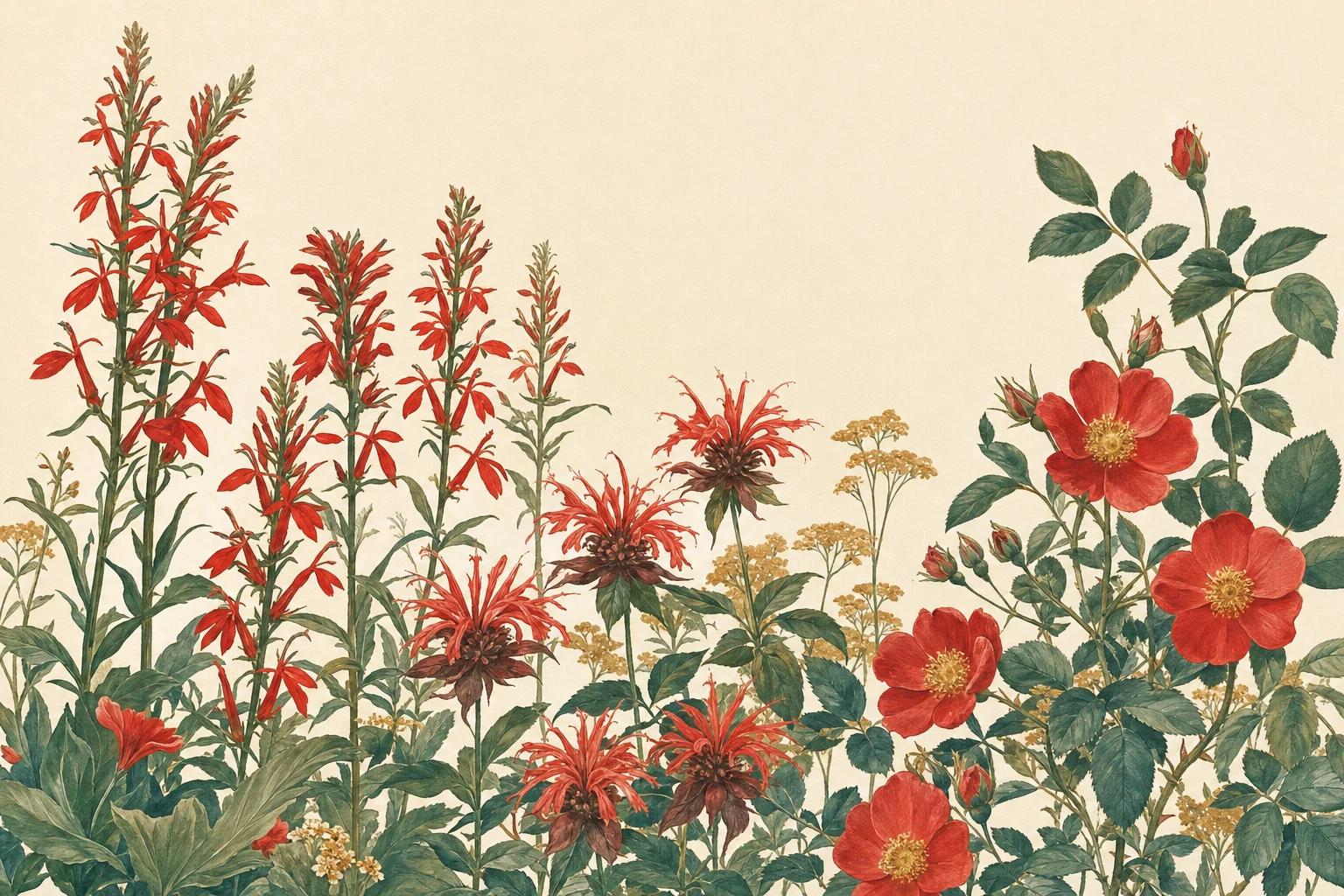
Red buckeye raises upright 4–10 inch (10–25 cm) spikes of red tubular flowers in April and May, and the show lasts about a month. In gardens it makes a shrub or small tree 10–20 feet (3–6 m) tall, taller in the wild, hardy in Zones 4–8 and tolerant of clay. Partial shade suits it best; hot sun scorches the leaves. Expect leaf blotch, and leaves that look tired by August and drop early. Plant it away from play areas, because the seeds are highly poisonous.
Red flowering currant (Ribes sanguineum)
Red flowering currant is the West's answer to red buckeye: a native shrub from British Columbia to northern California with hanging clusters of rich red to pink flowers in early spring that hummingbirds visit. It grows 8–10 feet (2.4–3 m) tall, is hardy to Zone 6 and takes sun or shade. Wild plants vary from red to pink and white, so choose a named red such as 'Pulborough Scarlet', red with white centers. The blue-black berries are edible but bland.
Late spring and early summer red flowers (May to July)
The May and June reds range from a shade wildflower and a native vine to dry-site penstemon and the big poppies and peonies of cold-winter gardens.
Trumpet honeysuckle (Lonicera sempervirens)
Trumpet honeysuckle, also called coral honeysuckle, is a twining native vine with unscented trumpets, scarlet to orange-red outside and yellow inside, in May and June. It climbs 8–15 feet (2.4–4.6 m) on a trellis or fence in Zones 4–9, flowers best in full sun, and follows with red berries for birds. 'Alabama Crimson' is a deeper crimson red. Mildew and leaf spot appear in hot, humid summers, and heavy nitrogen feeding gives leaves instead of flowers. Do not confuse it with the invasive Japanese honeysuckle.
Carolina pink (Spigelia marilandica)
Carolina pink, also sold as Indian pink, is the rare red that flowers in real shade. Upward-facing red trumpets split open to a yellow star in May and June on clumps up to 2 feet (60 cm) tall, in part to full shade in Zones 5–9, and they last well when cut. It is threatened in the wild in North Carolina, so buy propagated stock. More plants for low light are in this guide to shade plants.
Peony 'America' (Paeonia)
'America' is a single peony with brilliant red petals around a golden center, flowering in May on plants 30–36 inches (75–90 cm) tall and wide. It won the American Peony Society's Gold Medal in 1992. Grow it in Zones 3–8 with at least half a day of sun. Deer and rabbits rarely bother it. Peonies refuse to flower if planted too deep or too shallow, set in too much shade or recently moved, and botrytis blight is the disease to watch.
Beardlip penstemon (Penstemon barbatus)
Beardlip penstemon, sometimes called scarlet bugler, carries loose spikes of rose-red to red-orange tubes on 2–3 foot (60–90 cm) stems in May and June. It is native from Utah and Colorado south to Texas and Mexico, hardy in Zones 4–8, and wants full sun and lean, well-drained soil, where it shrugs off drought and deer. Wet clay rots its roots, so it is the wrong plant for a soggy bed.
Red-hot poker (Kniphofia uvaria)
Red-hot poker sends up thick spikes 3–4 feet (0.9–1.2 m) tall in May and June, with red buds that open yellow, so each torch is two-toned. It needs full sun and sharp drainage in Zones 5–9 and tolerates drought, deer and rabbits; hummingbirds visit. 'Flamenco' is a brighter red. Wet soil rots the roots, and where winters are cold the crown needs a winter mulch or the leaves tied over it. It spreads by rhizomes and seed, and it is on California's watch list.
Coral bells (Heuchera sanguinea)
Coral bells holds airy sprays of small deep pink to red bells on 12–20 inch (30–50 cm) stems above a low mound of leaves in May and June, and may repeat later. It is native to Arizona, New Mexico and northern Mexico and is hardy in Zones 3–8 in sun or part shade; hummingbirds visit. It will not tolerate clay, and roots heave out of the ground where winters swing between freezing and thawing.
Oriental poppy 'Beauty of Livermere' (Papaver orientale)
'Beauty of Livermere' opens crepe-paper scarlet flowers 4–6 inches (10–15 cm) across in June and July, each with a black blotch at the base and dark purple stamens. Clumps stand 2 to 3 feet (60–90 cm) tall, sometimes 40 inches (1 m), in full sun in Zones 3–7, and deer leave them alone. The leaves yellow and die after flowering, so set baby's breath or boltonia beside it to fill the hole. It sprawls without support and rots in wet winter soil.
Summer and late-summer red flowers (June to frost)
High summer is red's strongest season: native perennials handle wet ground and hummingbirds, roses and crape myrtle give shrub-sized color, and a big native vine and a bulb finish the year.
Cardinal flower (Lobelia cardinalis)
Cardinal flower is the benchmark red for wet soil: spikes of scarlet tubes from July to September, 2–4 feet (0.6–1.2 m) tall and as much as 6 feet (1.8 m) in flower. It grows in Zones 3–9, takes sun or part shade, and deer tend to leave it alone. Despite the name, it feeds hummingbirds and butterflies, not cardinals. The soil must never dry out, and plants are short-lived, so divide clumps every few years. 'Black Truffle' adds near-black spring foliage under deep red flowers in Zones 3–8, and 'Queen Victoria' pairs vivid red with bronze leaves.
Scarlet bee balm (Monarda didyma)
Scarlet bee balm carries shaggy heads of scarlet tubular flowers on 2–4 foot (0.6–1.2 m) stems in July and August, visited by hummingbirds, bees and butterflies. It is native to eastern North America and hardy in Zones 4–9 in sun or light shade; deer and rabbits avoid it. It spreads by runners, each clump reaching 2–3 feet (60–90 cm) wide. Powdery mildew is its weak point, worst in crowded plantings and dry soil, and rust also appears.
Crocosmia 'Lucifer' (Crocosmia hybrid)
'Lucifer' is a summer bulb, a hybrid montbretia, with nodding scarlet tubes along arching stems from June to August. The stems reach 2–4 feet (0.6–1.2 m) above sword-shaped leaves, hummingbirds feed at the flowers, deer usually pass it by, and the spikes last well in a vase. Grow the corms in Zones 5–9 in full sun, or part shade where summers are hot, setting them 3–4 inches (8–10 cm) deep in spring in groups of a dozen or more. At the cold end of the range give it a sheltered spot and winter mulch, or lift the corms in fall as you would gladiolus. Spider mites can ruin the leaves and cut flowering, and rabbits eat the foliage.
Scarlet rose mallow (Hibiscus coccineus)
Scarlet rose mallow is a native hibiscus 3–6 feet (0.9–1.8 m) tall, sometimes 8 feet (2.4 m), with bright scarlet flowers 3–5 inches (8–13 cm) across from June to September. It grows in Zones 6–9 in full sun to part shade and is at home in wet ground. Tall plants may need staking, Japanese beetles chew the leaves, and deer sometimes browse it despite its reputation.
Hardy hibiscus 'Luna Red' (Hibiscus moscheutos)
'Luna Red' puts deep burgundy-red flowers 6–8 inches (15–20 cm) wide, with a cream column of stamens, on a compact plant only 2–3 feet (60–90 cm) tall. It flowers from July to September in full sun in Zones 5–9. Each flower lasts a day or two, the leaves scorch if the soil dries, and Japanese beetles can strip it. Its burgundy is a cooler red than scarlet.
Knock Out rose (Rosa 'Radrazz')
Knock Out rose flowers cherry red from June to frost on a compact shrub, 3 to 4 feet (0.9–1.2 m) each way, and it blooms with as little as 3 hours of direct sun. It is hardy in Zones 5–9 and has excellent resistance to black spot, powdery mildew and rust, but do not count on it against rose rosette disease. Orange-red hips follow the flowers. Wear gloves for the thorns.
Crape myrtle 'Country Red' (Lagerstroemia)
'Country Red' is a crape myrtle with bright red, crinkled flowers from July to September on a shrub 4–10 feet (1.2–3 m) tall, nearer 8–10 feet (2.4–3 m) in the South. It is rated for Zones 6–9 in full sun, with reportedly excellent resistance to powdery mildew. In Zones 5 and 6 cold kills the tops back, and alkaline soil yellows the leaves.
Trumpet creeper (Campsis radicans)
Trumpet creeper is a native clinging vine whose orange to scarlet trumpets draw hummingbirds from June to September. It climbs 25–40 feet (7.6–12 m) in Zones 4–9 and needs a sturdy structure. Plant it only where you can mow around it: it suckers and self-seeds into dense colonies, has naturalized in many northern states, and its sap irritates skin, which is why it is also called cow-itch vine. Keep it off houses, roofs and small gardens.
Standing cypress (Ipomopsis rubra)
Standing cypress spends its first year as a clump of feathery leaves. In its second summer it sends up spikes 2–5 feet (0.6–1.5 m) tall of red tubes speckled yellow inside, from June to August, and hummingbirds work them. It is native from central Texas east to Kentucky, North Carolina and Florida, hardy in Zones 6–9 in full sun, and tolerates drought and deer. It dies after flowering, so leave the seed heads to sow the next generation.
Scarlet monkey flower (Mimulus cardinalis)
Scarlet monkey flower is the West's cardinal flower: a native of stream banks with scarlet, snapdragon-like tubes from June to October that hummingbirds pollinate. It grows 1–3 feet (30–90 cm) tall and wide in Zones 7–10, in part shade and medium to wet soil, and deer and rabbits leave it alone. It fails in dry ground.
Red spider lily (Lycoris radiata)
Red spider lily sends up bare stems 1–2 feet (30–60 cm) tall in August and September topped with spidery coral-red to bright red flowers. Leaves appear after the flowers and stay green all winter. Plant the bulbs with the neck above the soil, 6–12 inches (15–30 cm) apart; part shade gives the best flowering. It is hardy in Zones 6–10 but can take several seasons to settle in at the cold end of that range, where the winter leaves need protection.
Red annuals and warm-climate reds
Annual flowers fill the gaps between perennials with red from early summer to frost, and in frost-free gardens several of them live for years.
Zinnia (Zinnia elegans)
Zinnia gives red from seed in full sun from June to frost and draws hummingbirds and butterflies. Choose by height. 'Benary's Giant' Scarlet and Deep Red grow 36–42 inches (90–107 cm) with 5-inch (13 cm) double flowers for cutting. 'Holi' Scarlet, a 2019 All-America Selections winner, stays 12–14 inches (30–36 cm). Deer leave zinnias alone. Space plants for airflow, because powdery mildew and leaf spot follow crowding.
Scarlet sage (Salvia coccinea)
Salvia coccinea is a red-flowered sage native along the coast from South Carolina to Florida and west to Texas. 'Forest Fire' sets fire-red tubes in reddish-black calyxes from July to October on plants 1–2 feet (30–60 cm) tall. It is perennial in Zones 8–10 and grown as an annual farther north, takes sun or part shade, resists deer and reseeds readily, so expect volunteers. Mildew and whiteflies are its main problems.
Scarlet runner bean (Phaseolus coccineus)
Scarlet runner bean twines 8–12 feet (2.4–3.7 m) up a teepee or fence, closer to 6–8 feet (1.8–2.4 m) in most Midwestern gardens. Its scarlet flower clusters open from June to October, and hummingbirds and bees visit them. Sow it outdoors after the last frost, once the soil reaches 50°F (10°C). Young pods are edible; raw beans are mildly toxic if eaten in quantity. Hot weather cuts the number of pods.
Firebush (Hamelia patens)
Firebush carries clusters of orange-red to red tubular flowers that feed hummingbirds, butterflies and birds. It is native to southern and central Florida and hardy in Zones 9–10, where it flowers year-round and becomes a shrub up to 15 feet (4.6 m) tall. Farther north it makes a 1–3 foot (30–90 cm) annual or container plant that flowers from June to September. Its red leans orange.
Other annual and tender reds
Salvia splendens, the bedding scarlet sage, gives dense red spikes from June to frost, and many compact cultivars stay 8–15 inches (20–38 cm) tall. Dahlias and cannas supply red from July to September and survive winter in the ground in Zones 7–10. Dahlias are high-maintenance and toxic to pets. Hummingbirds visit cannas, but in Florida check that a canna is not Canna indica, which is rated a high invasion risk there. Zonal geranium, the standard red for pots and window boxes, flowers all season on mounds 1–3 feet (30–90 cm) tall in full sun, with light afternoon shade in hot climates; it survives winter outdoors only in Zones 10–11, rots in poorly drained soil and is toxic to pets. Cockscomb has crested or plumed red heads from June to September and handles drought. Amaryllis is a pot plant for most of the country, planted at Thanksgiving for Christmas flowers and hardy outdoors only in Zones 8–10.
Red flowers for hummingbirds
To feed hummingbirds with red, plant a sequence of tubular flowers from April to frost rather than one big summer show. Their long bills and tongues are built to reach deep into tube-shaped flowers, and they are especially drawn to red and orange.
| Months | Hummingbird reds in flower | Light and soil |
|---|---|---|
| April–May | Eastern red columbine, red buckeye, fire pink, red flowering currant (West) | Sun to part shade |
| May–June | Trumpet honeysuckle, Carolina pink, beardlip penstemon, coral bells, red-hot poker | Shade for Carolina pink; sun and drainage for the rest |
| June–August | Scarlet bee balm, crocosmia 'Lucifer', trumpet creeper, standing cypress, scarlet runner bean | Full sun |
| July–September | Cardinal flower, scarlet monkey flower (West), Salvia coccinea, zinnia | Wet soil for the first two |
Hummingbird visits as recorded by botanical gardens, extension services and state wildlife agencies for each plant.
Not every red on this list is a hummingbird plant. 'Luna Red' hibiscus is listed for butterflies rather than hummingbirds. Open, bowl-shaped reds such as roses, peonies and poppies have no tube to feed from. Plant the tubular reds where you can watch them from a window, and add other colors from the perennial flowers list to keep the bed in flower when red takes a break.
How to design with red
Red carries across a yard, so use it where you want the eye to land. A bed of red shows from a distance, while blue and purple flowers are best enjoyed up close. That pull works both ways: red next to an air-conditioning unit or trash cans draws attention straight to them.
Put deep reds in sun. Dark, saturated colors such as burgundy 'Luna Red' show best in full sun, while pale colors carry shade and evening. White is the last color to fade at dusk, so mix white flowers into a red bed you use after work.
Use red in deliberate doses. Warm colors seem to advance toward the viewer and are hard to balance because they dominate. A drift of cardinal flower or a single red-hot poker clump does more than red scattered through a whole border. Design on paper first; this guide to garden colors covers color wheels and schemes in more depth.
Let green set it off. Red and green are complementary, so plain green foliage is already a strong frame.
Read the shade on the label. "Red" covers orange-reds ('Fusilier' tulip, firebush, trumpet creeper), clear scarlets (cardinal flower, fire pink, bee balm), cherry red (Knock Out) and burgundy ('Luna Red'). Buy in flower, or from a named cultivar, if the exact shade matters.
Group reds by water, not just color. The wet-soil reds and the dry-soil reds cannot share a bed:
| Soil | Red picks | What happens in the wrong spot |
|---|---|---|
| Moist to wet | Cardinal flower, scarlet rose mallow, scarlet monkey flower, 'Luna Red' hibiscus | Cardinal flower declines and 'Luna Red' leaves scorch as soon as the soil dries |
| Evenly moist, well drained | Scarlet bee balm, crocosmia 'Lucifer' | Bee balm mildews in dry soil; crocosmia needs drainage as well as moisture |
| Dry, lean, sharply drained | Beardlip penstemon, red-hot poker, standing cypress | Penstemon and red-hot poker rot in wet soil |
Soil moisture needs from botanical garden plant records.
Invasive red flowers and berries to avoid
The red plants to avoid are mostly red-berried shrubs that birds spread into woods, plus a few red-flowered plants that escape in the South and California. Each has a native or better-behaved alternative.
| Avoid | Where it is a problem | Plant instead |
|---|---|---|
| Nandina (red berries) | Invasive in some southern states; prohibited in Florida; low rank in Virginia | Winterberry or red chokeberry; or non-fruiting 'Fire Power' |
| Japanese barberry (red berries) | Invasive across the East; noxious weed in Pennsylvania; banned in Connecticut from October 2028 | Red chokeberry, winterberry, or a WorryFree or Sunjoy cultivar |
| Lantana camara (red among mixed colors) | Invasive and not recommended across Florida; escaped on the Gulf Coast; on California's watch list | Salvia coccinea, firebush, standing cypress |
| Coralberry, Ardisia crenata (red berries) | Parts of the South; prohibited in Florida | Winterberry |
| Crimson bottlebrush | Rated a high invasion risk in Florida | Firebush in Zones 9–10 |
| Cypress vine (scarlet flowers) | Rated a high invasion risk in Florida; not considered aggressive elsewhere | Scarlet runner bean |
| Firethorn, Pyracantha coccinea (red berries) | California (limited impact) and Florida (high risk) | Red chokeberry or winterberry (East) |
| Japanese honeysuckle (often confused with the native) | High rank in Virginia; prohibited in Connecticut and Florida | Trumpet honeysuckle |
Status from state invasive plant lists and assessments in Virginia, Connecticut, Pennsylvania, Florida and California, checked October 2026.
Nandina is the most widely planted red-berried problem. Its berries hang from fall to spring, birds carry the seed into southeastern forests, and in Georgia, cedar waxwing deaths from cyanide poisoning have been linked to gorging on them. The berries are also toxic to dogs, cats and horses. If you want its red winter leaves, 'Fire Power' is a dwarf that sets almost no fruit.
Japanese barberry carries bright red berries into winter and forms impenetrable, spiny thickets in eastern woodlands. Sterile cultivars in the WorryFree and Sunjoy groups carry less risk. The better swap is native. Winterberry holds bright red berries from late summer through winter on a shrub 6–12 feet (1.8–3.7 m) tall in Zones 3–9, though berries form only with a male plant nearby for pollination. Red chokeberry gives glossy red fruit into winter and red fall leaves on a 6–10 foot (1.8–3 m) shrub, and it suckers into colonies, so give it room.
Lantana is hard to resist in a hot summer border, but Lantana camara is rated invasive and not recommended across Florida, has escaped gardens along the Gulf Coast, and is on California's watch list. In those warm regions, plant Salvia coccinea or firebush for the same hummingbirds.
Red flowers by region
Start with hardiness and summer heat, then water. Oriental poppy needs cold winters and struggles in the heat and humidity of Zone 8 and warmer, while firebush is a year-round shrub in Zones 9–10 and an annual farther north.
North and upper Midwest (Zones 3–5). The reds hardy to Zone 3 do the heavy lifting: cardinal flower, eastern red columbine, peony 'America', 'Beauty of Livermere' poppy, coral bells, 'Fusilier' tulip and red maple. Bee balm, trumpet honeysuckle and fire pink join from Zone 4, and Knock Out rose and crocosmia 'Lucifer' from Zone 5. Columbine flowers in May and June here, later than farther south. For summer color, add zinnias and scarlet runner beans as annuals.
Mid-Atlantic and lower Midwest (Zones 5–7). Nearly every pick on the list grows here. Red-hot poker, scarlet rose mallow, red spider lily and standing cypress need at least Zone 5 or 6, crape myrtle 'Country Red' dies back in Zone 6 winters, and camellias are hardy from Zone 7 ('Korean Fire' from Zone 6).
Southeast and Gulf Coast (Zones 7–10). Lean on heat-loving natives: scarlet rose mallow, Salvia coccinea, firebush in Zones 9–10, plus camellias for winter and crape myrtle for summer. This is also where the invasives cluster: skip Lantana camara, nandina, coralberry and, in Florida, crimson bottlebrush. Bottlebrush itself is hardy only to about 20–25°F (−7 to −4°C).
Southwest and south-central states. Beardlip penstemon is native from Utah and Colorado to Texas and needs dry, well-drained soil, the same conditions red-hot poker and standing cypress want. Standing cypress and Salvia coccinea are native to Texas, and coral bells comes from Arizona and New Mexico.
West Coast and Pacific Northwest. Use western natives in place of the eastern classics. Red flowering currant opens the season, and western columbine follows with red and yellow flowers from May to August that hummingbirds visit. Scarlet monkey flower covers wet ground, and California fuchsia opens red tubes from August to October. Where winters stay in Zone 10 or 11, zonal geraniums live outdoors year-round. In California, avoid Lantana camara and firethorn, and keep red-hot poker from spreading.
Once you have a shortlist, check each plant's deer rating in this guide to deer-resistant plants and use the plant spacing calculator to work out how many to buy for a drift that reads from a distance.
Frequently asked questions
What are some examples of red plants?
Red turns up in every plant group. Cardinal flower, scarlet bee balm and red-hot poker are red perennials; red buckeye, flowering quince, Knock Out rose and crape myrtle 'Country Red' are red-flowered shrubs; trumpet honeysuckle and scarlet runner bean are red vines; and red spider lily, crocosmia 'Lucifer' and the species tulip 'Fusilier' are red bulbs. Red maple carries red flower clusters on bare branches in March, zinnia gives red from seed all summer, and zonal geranium is the standard red for pots.
What red flowers attract hummingbirds?
Hummingbirds favor red and orange tube-shaped flowers, which suit their long bills and tongues, so plant tubular reds that follow one another from April to frost. Columbine and red buckeye cover spring, cardinal flower, bee balm and crocosmia 'Lucifer' cover summer, and standing cypress and beardlip penstemon suit drier sites. Scarlet runner bean is an annual vine they visit from June to October. If you also hang a feeder, the sugar water needs no red dye.
Are there red and black flowers?
Yes. Chocolate cosmos opens brownish-red flowers, 1.5 inches (4 cm) across, with a chocolate scent from June to September, and is also called black cosmos; it is hardy only in Zones 7 to 9. Oriental poppy 'Beauty of Livermere' has scarlet petals with a black blotch at the base around dark purple stamens. Cardinal flower 'Black Truffle' sets deep red spikes over near-black spring foliage and is hardy to Zone 3.
What red flowers grow in shade?
Carolina pink is the best red for real shade, flowering in May and June in part to full shade with red trumpets that open to a yellow star. Fire pink and red buckeye prefer dappled light, and red buckeye scorches in hot afternoon sun. Cardinal flower and scarlet monkey flower handle part shade if the soil stays wet. In shade, pair red with white, which stays visible after deep red goes dark.
What are the best red perennials?
For sun and average soil, scarlet bee balm, red-hot poker, beardlip penstemon and peony 'America' cover May through August between them. For wet ground, cardinal flower and scarlet rose mallow carry red from June into September. In cold Zones 3 to 7, oriental poppy 'Beauty of Livermere' adds scarlet flowers up to 6 inches (15 cm) across in June. For shade, Carolina pink is the red perennial to choose.
What are the best red flowering shrubs?
Knock Out rose has the longest season, flowering cherry red from June to frost in Zones 5 to 9 on as little as 3 hours of direct sun. Flowering quince opens scarlet flowers on bare branches in March, red buckeye flowers in April and May, and crape myrtle 'Country Red' covers July to September in Zones 6 to 9. In Zones 7 to 9, red camellias flower in winter, and firebush flowers all year in frost-free gardens.
What red flowers bloom all summer?
Knock Out rose, zinnia and scarlet runner bean all flower from June until frost, and scarlet monkey flower runs from June to October in the West. Salvia coccinea flowers from July to October on 1- to 2-foot (30–60 cm) plants. Among perennials, scarlet rose mallow lasts from June to September, while cardinal flower and 'Luna Red' hibiscus cover July through September.
Which red flowers are safe for dogs and cats?
Roses, zinnias, Camellia japonica and bottlebrush are non-toxic to dogs, cats and horses (skip bottlebrush in Florida, where it is a high invasion risk). That makes Knock Out rose and red zinnias the easy choices for a yard with pets, with a red camellia in Zones 7 to 9. The toxic reds on this page are flagged in the warning under the summary table. If a pet eats a plant, call your veterinarian.
What red flowers grow well in hot, humid Southern gardens?
Lead with natives that like heat: scarlet rose mallow (Zones 6 to 9), Salvia coccinea, perennial in Zones 8 to 10, and firebush, which flowers year-round where frost never reaches. Crape myrtle 'Country Red' and red camellias are the shrub choices, and red spider lily flowers on bare stems in late summer. Skip oriental poppy, which needs winter cold and struggles in the heat and humidity of Zone 8 and warmer.
References
- Missouri Botanical Garden. Plant Finder database (searched by name for each pick, including Lobelia cardinalis, Monarda didyma, Aesculus pavia, Rosa 'Radrazz', Lagerstroemia 'Country Red', Lagerstroemia indica, Paeonia 'America', Papaver orientale 'Beauty of Livermere', Tulipa praestans 'Fusilier', Crocosmia 'Lucifer', Pelargonium × hortorum, Cosmos atrosanguineus, Lantana camara and Lycoris radiata). Accessed October 16, 2026.
- Lady Bird Johnson Wildflower Center, The University of Texas at Austin. Native Plants Database (Lobelia cardinalis, Monarda didyma, Aesculus pavia, Silene virginica, Spigelia marilandica, Campsis radicans, Ipomopsis rubra, Hamelia patens, Ribes sanguineum, Aquilegia formosa, Epilobium canum). Accessed October 16, 2026.
- North Carolina State Extension. Extension Gardener Plant Toolbox (Aesculus pavia, Campsis radicans, Silene virginica, Spigelia marilandica, Papaver orientale, Kniphofia uvaria, Heuchera sanguinea, Lycoris radiata, Hibiscus coccineus, Lonicera sempervirens, Chaenomeles speciosa, Callistemon citrinus, Ipomopsis rubra, Salvia coccinea, Hamelia patens, Crocosmia 'Lucifer', Nandina domestica, Berberis thunbergii). Accessed October 16, 2026.
- North Carolina State Extension. 10. Herbaceous Ornamentals, North Carolina Extension Gardener Handbook. Accessed October 16, 2026.
- UF/IFAS Extension. Color in the Landscape: Finding Inspiration for a Color Theme (EP425). Accessed October 16, 2026.
- Mississippi State University Extension. Using Color in the Landscape. Accessed October 16, 2026.
- Missouri Department of Conservation. Ruby-Throated Hummingbird (Field Guide). Accessed October 16, 2026.
- University of Wisconsin-Madison Division of Extension. Cardinal Flower, Lobelia cardinalis. Accessed October 16, 2026.
- University of Wisconsin-Madison Division of Extension. Eastern Red Columbine, Aquilegia canadensis. Accessed October 16, 2026.
- University of Wisconsin-Madison Division of Extension. Scarlet Runner Bean, Phaseolus coccineus. Accessed October 16, 2026.
- University of Wisconsin-Madison Division of Extension. Zinnia. Accessed October 16, 2026.
- Oregon State University. Landscape Plants (Ribes sanguineum, Camellia japonica, Chaenomeles speciosa). Accessed October 16, 2026.
- ASPCA Animal Poison Control. Toxic and Non-Toxic Plants (buckeye, lobelia, peony, tulip, amaryllis, dahlia, geranium, lantana, nandina, holly, red maple, rose, zinnia, camellia, bottlebrush). Accessed October 16, 2026.
- USDA Natural Resources Conservation Service. PLANTS Database (native and introduced status for each species named). Accessed October 16, 2026.
- UF/IFAS. Assessment of Non-Native Plants in Florida's Natural Areas (Lantana camara, Nandina domestica, Lonicera japonica, Ardisia crenata, Callistemon citrinus, Ipomoea quamoclit, Berberis thunbergii, Pyracantha coccinea, Canna indica, Lagerstroemia indica). Accessed October 16, 2026.
- California Invasive Plant Council. Cal-IPC Inventory. Accessed October 16, 2026.
- Virginia Department of Conservation and Recreation, Natural Heritage. Virginia Invasive Plant Species List (September 2024). Accessed October 16, 2026.
- Connecticut Invasive Plant Working Group, University of Connecticut. Connecticut Invasive Plant List. Accessed October 16, 2026.
- USDA Agricultural Research Service. USDA Plant Hardiness Zone Map (2023). Accessed October 16, 2026.
- USDA National Invasive Species Information Center. Japanese Barberry. Accessed October 16, 2026.
Sow Editorial
Written by the Sow team from university extension services, botanical gardens, USDA and NOAA data and plant breeders. Every source is listed under References.