Quick answer
Dependable yellow flowers for US gardens run from 'Arnold Promise' witch hazel in February and winter aconite in March, through daffodils, forsythia and 'Screamin' Yellow' baptisia in spring, to 'Moonbeam' coreopsis, 'Stella de Oro' daylily and 'Goldsturm' black-eyed Susan in summer, then swamp sunflower and goldenrod into fall. Use bright yellow sparingly beside violet and blue, and never plant yellow flag iris, lesser celandine or Scotch broom.
Key facts
- Late winter yellows
- 'Arnold Promise' witch hazel, winter aconite, Carolina jessamine (February to April)
- Spring yellows
- Daffodil, forsythia, spicebush, trout lily, 'Butterflies' magnolia (March to May)
- Summer yellows
- 'Moonbeam' coreopsis, 'Moonshine' yarrow, 'Stella de Oro' daylily, shrubby cinquefoil
- Late summer to frost
- 'Goldsturm' black-eyed Susan, swamp sunflower, 'Fireworks' goldenrod, Maximilian sunflower
- Softest yellows
- 'Moonbeam' coreopsis (creamy), 'John Clayton' honeysuckle (pale), 'Moonshine' yarrow (lemon)
- Yellow for shade
- Goldenstar, yellow trout lily, 'The Rocket' ligularia (moist soil), spicebush
- Invasive yellows to skip
- Yellow flag iris, lesser celandine, Scotch broom, Japanese barberry, Japanese honeysuckle
- Toxic to pets
- Daylilies (cats), daffodils and yarrow (dogs, cats, horses); Carolina jessamine is poisonous in every part
Yellow can be in flower somewhere in a US garden from February to hard frost. Witch hazel and winter aconite open the year, daffodils and forsythia take over in March, baptisia and daylilies carry late spring, coreopsis and yarrow hold the summer, and swamp sunflower and goldenrod finish it. Those are the backbone of the 30 picks below.
Yellow is also among the hardest colors to design with, because a little goes a long way. Each pick below notes its actual shade, from creamy to deep gold. After the picks come the design rules for yellow, a regional guide, and the yellow-flowered plants that are invasive or banned in parts of the country.
How these plants were chosen
Every pick had to meet four tests. Its hardiness zones, size and bloom months had to be on record from a botanical garden or university extension service. Its flower color had to be described in those records, not inferred from a name like "Gold" or "Sun". It could not appear on the Connecticut or Virginia invasive plant lists. And it had to be available to home gardeners. A few picks spread by suckers, rhizomes or seed, and their entries say so. Eighteen of the 30 are North American natives or selections of native species.
Zones are USDA hardiness zones on the 2023 map, which sorts the country by average annual extreme minimum winter temperature into 10°F (5.6°C) zones with 5°F (2.8°C) half zones. Check yours with the plant hardiness checker. Deer notes are a guide, not a promise; the fuller picture is in the guide to deer-resistant plants.
| Pick | Type | Zones | Height, ft (m) | Bloom and tone of yellow |
|---|---|---|---|---|
| 'Arnold Promise' witch hazel | Shrub | 5–8 | 12–15 (3.7–4.6) | Feb–Mar; yellow, fragrant |
| Winter aconite | Bulb (tuber) | 3–7 | 0.25–0.5 (0.08–0.15) | Mar–Apr; bright yellow |
| Cornelian cherry dogwood | Small tree | 4–8 | 15–25 (4.6–7.6) | Late Mar–early Apr; yellow |
| Carolina jessamine | Native evergreen vine | 6–9 | 20+ (6+) | Feb–Apr; golden yellow |
| Daffodil 'February Gold' | Bulb | 4–8 | 1–1.5 (0.3–0.45) | Mar–Apr; bright yellow |
| 'Meadowlark' forsythia | Shrub | 4–8, buds to -35°F | 7–10 (2.1–3) | Mar–Apr; bright yellow |
| Spicebush | Native shrub | 5–9 | 6–12 (1.8–3.7) | Mar–Apr; greenish yellow |
| Yellow trout lily | Native bulb | 3–8 | 0.33–0.5 (0.1–0.15) | Apr; yellow |
| Magnolia 'Butterflies' | Small tree | 5–9 | 15–20 (4.6–6) | Apr; yellow, fragrant |
| Creeping Oregon grape | Native groundcover shrub | 5–8 | 1–2 (0.3–0.6) | Apr–Jul; yellow |
| 'Screamin' Yellow' baptisia | Native selection, perennial | 5–8 | 2–3 (0.6–0.9) | Apr–May; bright yellow |
| Golden alexanders | Native perennial | 3–8 | 1.5–3 (0.45–0.9) | May–Jun; yellow |
| Goldenstar | Native groundcover | 5–9 | 0.25–0.8 (0.08–0.25) | May–Oct in cool summers; bright yellow |
| 'Stella de Oro' daylily | Perennial | 3–8* | 0.75–1 (0.23–0.3) | May–Aug; yellow, deeper throat |
| Missouri evening primrose | Native perennial | 3–7 | 0.5–1 (0.15–0.3) | May–Aug; bright yellow |
| 'John Clayton' honeysuckle | Native selection, vine | 4–9 | 6–12 (1.8–3.7) | May–Jun; pale yellow |
| Calendula | Annual | Annual | 1–2 (0.3–0.6) | May–fall where summers are cool; yellow to orange |
| 'Moonbeam' coreopsis | Native selection, perennial | 3–9 | 1.5–2 (0.45–0.6) | Jun–Aug; creamy pale yellow |
| 'Moonshine' yarrow | Perennial | 3–8 | 1–2 (0.3–0.6) | Jun–Sep; lemon yellow |
| Yellow coneflower | Native perennial | 5–8 | 2–3 (0.6–0.9) | Jun–Aug; yellow |
| Shrubby cinquefoil | Native shrub | 3–7 | 2–4 (0.6–1.2) | Jun–Sep; yellow |
| Northern bush honeysuckle | Native shrub | 3–7 | 2–3 (0.6–0.9) | Jun–Jul; yellow |
| 'Hidcote' St. John's wort | Shrub | 5–9 | 2–4 (0.6–1.2) | Jun–Sep; golden yellow |
| 'The Rocket' ligularia | Perennial | 4–8 | 3–5 (0.9–1.5) | Jun–Jul; lemon yellow |
| French marigold | Annual | Annual | 0.5–1 (0.15–0.3) | Jun–frost; yellow among other colors |
| 'Goldsturm' black-eyed Susan | Native selection, perennial | 3–9 | 2–3 (0.6–0.9) | Jun–Sep; deep yellow |
| Common sunflower | Native annual | Annual | 3–10 (0.9–3) | Jul–Oct; yellow among other colors |
| Swamp sunflower | Native perennial | 5–9 | 5–8 (1.5–2.4) | Jul–frost; gold |
| 'Fireworks' goldenrod | Native selection, perennial | 4–8 | 3–3.5 (0.9–1.1) | Sep–Oct; yellow |
| Maximilian sunflower | Native perennial | 4–9 | 3–10 (0.9–3) | Aug–Nov; yellow |
Zones on the USDA 2023 map. * 'Stella de Oro' is listed to Zone 10, but as a winter-dormant daylily it is a poor choice in Zone 9 and warmer.
Four of these picks need care around animals and children. Daylilies, including 'Stella de Oro', are toxic to cats and can cause kidney failure and death. Daffodils are toxic to dogs, cats and horses, and the bulbs are the most poisonous part. Yarrow, including 'Moonshine', is listed as toxic to dogs, cats and horses. Every part of Carolina jessamine is very poisonous, and children can be poisoned by sucking nectar from the flowers. If a pet chews one, call your veterinarian or an animal poison control line right away.
Late winter yellow (February to April)
Late winter yellow comes from shrubs and small trees that flower on bare wood and from low bulbs that open before the grass greens up.
'Arnold Promise' witch hazel (Hamamelis × intermedia)
Witch hazel 'Arnold Promise' hangs fragrant, spidery yellow flowers on bare branches in February and March, weeks before forsythia, and adds good fall leaf color. It grows 12–15 feet (3.7–4.6 m) tall and wide in Zones 5–8 and flowers best in full sun with steady moisture in acidic soil. Pull any suckers that rise from the roots, especially below the graft, and water in summer drought or the leaves scorch. Deer tend to leave it alone. The native Ozark witch hazel (Hamamelis vernalis) flowers even earlier, from January, in yellow, orange or red.
Winter aconite (Eranthis hyemalis)
Winter aconite is one of the first yellows at ground level: upward-facing buttercup cups, each set on a ruff of leafy bracts, on stems 3–6 inches (8–15 cm) tall in March and April. It is hardy in Zones 3–7 and likes sun at bloom time and shade once trees leaf out. Soak the dry tubers overnight and plant them 2–3 inches (5–8 cm) deep and 3 inches (8 cm) apart in late summer or early fall. The plants go dormant by late spring but still need soil that never dries out. Deer avoid it, and it may seed itself into small colonies.
Cornelian cherry dogwood (Cornus mas)
Cornelian cherry covers its bare branches with small clusters of yellow flowers in late March and early April, then follows with red fruit. Grow it as a large multi-stem shrub or a small tree of 15–25 feet (4.6–7.6 m) in Zones 4–8, in full sun to part shade. Its weakness is suckering: cut suckers as soon as they appear or the plant spreads into a thicket. Deer browse its leaves and twigs, so it is not deer proof.
Carolina jessamine (Gelsemium sempervirens)
Carolina jessamine is the southeastern native evergreen vine that hangs fragrant, golden yellow trumpets from February to April. It climbs 20 feet (6 m) or more on a fence, arbor or trellis in Zones 6–9, and flowers most heavily in full sun. Prune right after flowering and go easy on fertilizer. Keep it away from play areas (see the warning above); deer and rabbits do not eat it.
Spring yellow (March to May)
Spring yellow comes from bulbs, flowering shrubs and native woodland plants that bloom before the trees overhead fully leaf out.
Daffodil 'February Gold' (Narcissus)
Daffodil 'February Gold' is an early cyclamineus daffodil with a bright yellow trumpet and slightly swept-back yellow petals on stems 12–18 inches (30–45 cm) tall. It flowers in March and April, as early as February in Zone 7, and grows in Zones 4–8. Plant bulbs in early to mid fall at two to three times their height, with at least 3 inches (8 cm) of soil over the tip. Leave the leaves until they turn yellow, because they feed next year's bulb, and avoid wet soil, where bulbs rot. Deer and rabbits tend to avoid daffodils, and unlike tulips they keep flowering year after year. More detail is in the daffodil growing guide.
'Meadowlark' forsythia (Forsythia)
Forsythia 'Meadowlark' is the forsythia for cold winters, hardy in Zones 4–8. Common border forsythia loses its flower buds below -5°F (-21°C), but 'Meadowlark' buds survive to -35°F (-37°C). It flowers bright yellow along the whole stem in March and April, not just below the snow line. It grows 7–10 feet (2.1–3 m) tall and 6–10 feet (1.8–3 m) wide, and up to 13–15 feet (4–4.6 m) if never pruned. 'Northern Gold' and 'Northern Sun' are bud-hardy to -30°F (-34°C). Prune right after flowering and take out one-quarter to one-third of the oldest stems every other year; any cut after mid-July removes next spring's flowers.
Spicebush (Lindera benzoin)
Spicebush is a native shrub whose tiny greenish-yellow flowers make a soft haze on bare twigs in March and April. Expect a subtle yellow, not a bright one. It grows 6–12 feet (1.8–3.7 m) tall in Zones 5–9 and does well in part shade with two to six hours of direct sun. Its leaves feed spicebush swallowtail caterpillars, and female plants need a male nearby to set fruit. Laurel wilt can kill it, and deer browse it.
Yellow trout lily (Erythronium americanum)
Yellow trout lily is a native woodland bulb with nodding yellow lilies in April, petals swept back and often brushed purple on the outside, over leaves mottled brown and purple. Plants stand 4–6 inches (10–15 cm) tall in part to full shade in Zones 3–8 and go dormant by late spring. Buy corms rather than seed, which takes four to five years to reach flowering size, and set them 2–3 inches (5–8 cm) down, 4–5 inches (10–13 cm) apart, in fall.
Magnolia 'Butterflies'
Magnolia 'Butterflies' brings fragrant yellow flowers in April on a tree small enough for a house lot: 15–20 feet (4.6–6 m) tall and 10–15 feet (3–4.6 m) wide in Zones 5–9. Avoid warm south-facing walls, which coax the buds open early. Its fleshy roots are easily damaged, so choose the site once and leave it alone. Its larger relative 'Elizabeth' reaches 20–35 feet (6–10.7 m) and flowers earlier, in March and April, which exposes it to late frosts. For more spring-flowering trees, see the guide to flowering trees.
Creeping Oregon grape (Mahonia repens)
Creeping Oregon grape is a low, spreading western native with clusters of yellow flowers from April to July over holly-like evergreen leaves, followed by blue fruit that birds eat. It stays 6–10 inches (15–25 cm) tall in the wild and 1–2 feet (30–60 cm) in gardens. Grow it in full sun to part shade in Zones 5–8, with a sheltered spot in Zone 5. Its native range runs through the mountains from British Columbia and Alberta to California, the Black Hills, Arizona and west Texas, so it suits gardens in that region best.
Late spring and early summer yellow (May and June)
Late spring yellow comes mostly from long-lived perennials and vines that bridge the gap between bulbs and the summer daisies.
'Screamin' Yellow' baptisia (Baptisia sphaerocarpa)
Baptisia 'Screamin' Yellow' sends up spikes of bright yellow pea flowers 12–15 inches (30–38 cm) long over blue-green leaves, then dark seed pods. It scored a perfect 5.0 out of 5 in a 2012–2015 Delaware trial of 46 baptisia selections. Plants grow 2–3 feet (60–90 cm) tall and spread to 5 feet (1.5 m) in Zones 5–8, flowering in April and May. Give it full sun and shear it after bloom so it stays rounded without staking. It is slow to settle in, resents being moved, and grows poorly near black walnut.
Golden alexanders (Zizia aurea)
Golden alexanders is a native carrot-family plant with flat clusters of tiny yellow flowers in May and June, on stems 1.5–3 feet (45–90 cm) tall in Zones 3–8. Black swallowtail caterpillars feed on it, and it is especially valuable to native bees. It grows naturally from Quebec to Saskatchewan and Montana and south to Florida and Texas, in full sun to part shade. The leaves look tired by midsummer and it can reseed heavily, so place it among later perennials that will hide it.
Goldenstar (Chrysogonum virginianum)
Goldenstar, also called green-and-gold, is a native groundcover that forms a mat 3–4 inches (8–10 cm) high with bright yellow, five-petaled flowers 1.5 inches (4 cm) across on stems to 10 inches (25 cm). In cool-summer gardens it flowers from May to October; where summers are hot it flowers heavily in spring, sparsely in summer and lightly again in fall. It grows in part to full shade in Zones 5–9, and in sun only with steady moisture. It spreads by rhizomes but is easy to keep in bounds.
'Stella de Oro' daylily (Hemerocallis)
Daylily 'Stella de Oro' is a compact daylily about 1 foot (30 cm) tall that reblooms from May into August with 2.75-inch (7 cm) yellow flowers, each with a deeper yellow throat. It grows in full sun to part shade and is hardy from Zone 3. It is a winter-dormant type, and dormant daylilies are a poor choice in Zone 9 and warmer. Each flower lasts one day, and daylily rust can be a problem in some areas. Deer often eat daylily buds. The cat warning above applies to every daylily. For culture across the genus, see the daylily growing guide.
Missouri evening primrose (Oenothera macrocarpa)
Missouri evening primrose carries huge bright yellow flowers, 3–5 inches (8–13 cm) across and mildly fragrant, on a sprawling plant only 6–12 inches (15–30 cm) tall from May to August. Each flower opens in late afternoon and stays open until the next morning, which makes it a natural for patios used in the evening. It is native to the south-central US, where it grows on limestone glades and rocky prairies. Give it full sun in Zones 3–7 and sharply drained ground or a rock garden, because it rots in wet, poorly drained soil.
'John Clayton' trumpet honeysuckle (Lonicera sempervirens)
'John Clayton' honeysuckle is the pale yellow form of the native trumpet honeysuckle. This twining vine climbs 6 to 12 feet (1.8 to 3.7 m) in Zones 4–9 and flowers in May and June. Hummingbirds visit the tubular flowers. It needs a trellis or other support and flowers best in full sun. Powdery mildew and leaf spot show up in hot, humid summers, so give it open air. It is the native replacement for invasive Japanese honeysuckle.
Calendula (Calendula officinalis)
Calendula, or pot marigold, is a cool-season annual with bright yellow to deep orange daisies on plants 1–2 feet (30–60 cm) tall and wide. It flowers from May into fall where summers are cool but stalls in heat, so give it afternoon shade in hot regions and cut it back in midsummer for a fall flush. Start seed indoors six to eight weeks before your last frost or sow it outdoors just before. It is listed as non-toxic to dogs and cats. Flowers range from bright yellow to deep orange, so buy a named yellow selection.
Summer yellow (June to August)
Summer is peak season for yellow daisies in sun, but the best summer yellows also include shrubs, a shade perennial and an annual for edging.
'Moonbeam' coreopsis (Coreopsis verticillata)
Coreopsis 'Moonbeam' is the softest yellow on this list: creamy, pale yellow daisies with a darker yellow center over a mound of thread-fine leaves from June to August. It grows 1.5–2 feet (45–60 cm) tall and wide in Zones 3–9 in full sun. The cultivar is sterile, so it never seeds around, though it does spread by rhizomes. Shear it in mid to late summer for a second flush in fall. It sprawls in rich or moist soil and its crown rots where water stands, so plant it in lean, well-drained ground. It was the 1992 Perennial Plant of the Year. See the coreopsis growing guide for other threadleaf types.
'Moonshine' yarrow (Achillea)
Yarrow 'Moonshine' holds flat heads of bright lemon yellow, lighter than the gold of 'Coronation Gold', over silvery, fern-like leaves from June to September. It grows 1–2 feet (30–60 cm) tall in Zones 3–8 and wants full sun and lean, dry to medium soil, never heavy clay or rich beds. Treat it as a cool-summer plant: in hot, humid summers such as those of the lower Midwest and Southeast it tends to melt out by mid to late summer. Handling yarrow can cause skin rashes in sensitive people.
Yellow coneflower (Echinacea paradoxa)
Yellow coneflower is the only Echinacea with naturally yellow flowers: drooping yellow to orange-yellow petals around a brown cone from June to August. It grows 2–3 feet (60–90 cm) tall in Zones 5–8, in full sun. Native mainly to the Ozarks of Missouri and Arkansas, with outlying populations in Oklahoma and Texas, it tolerates deer, drought and clay soil. Watch for aster yellows, which distorts the flowers, and Japanese beetles.
Shrubby cinquefoil (Potentilla fruticosa)
Shrubby cinquefoil is the toughest yellow shrub here, hardy to Zone 3, with saucer-shaped, five-petaled yellow flowers up to 1.5 inches (4 cm) across from June to September. It makes a mound 2–4 feet (60–120 cm) tall and 3–5 feet (0.9–1.5 m) wide in full sun. Deer and rabbits leave it alone. It dislikes heat and humidity and is not recommended in the Southeast south of Zone 7; mildew and spider mites are the common problems.
Northern bush honeysuckle (Diervilla lonicera)
Northern bush honeysuckle is a native shrub 2–3 feet (60–90 cm) tall with small yellow trumpet flowers in June and July that hummingbirds and butterflies visit, then good fall color. It grows in Zones 3–7 in full sun to part shade, handles dry slopes and spreads by suckers. It does best where summers are cool. Despite the name, it is not a true honeysuckle (Lonicera).
'Hidcote' St. John's wort (Hypericum)
St. John's wort 'Hidcote' is a rounded shrub 2–4 feet (60–120 cm) tall with golden yellow cup-shaped flowers, each with a brush of stamens, from June to September. It suits Zones 5–9 in full sun to part shade and copes with dry, rocky or sandy soil. It flowers on new growth, which matters in cold winters: in Zone 5 it often dies to the ground, so cut it down each spring and it will still bloom. In hot, humid climates root rot and wilt can strike. Do not substitute Aaron's beard (Hypericum calycinum), which spreads rapidly by underground stems.
'The Rocket' ligularia (Ligularia)
Ligularia 'The Rocket' sends up lemon yellow spikes in June and July on plants 3 to 5 feet (0.9 to 1.5 m) tall. It is the yellow for wet shade by a pond, stream or rain garden, in part to full shade in Zones 4–8. Its soil must never dry out; the leaves wilt in hot sun even when the roots are wet. Slugs and snails chew the foliage.
French marigold (Tagetes patula)
French marigold is the easiest yellow for edging and containers: an annual flower 6–12 inches (15–30 cm) tall that flowers from June until frost. Sow seed outdoors at your last frost date or start it indoors six to eight weeks earlier. Give it full sun, with light afternoon shade where summers are hot, because flowering can slow in heat. Deer tend to avoid it; powdery mildew, botrytis and spider mites are its common problems. The species also comes in orange, red and bicolors, so buy a named yellow.
Late summer and fall yellow (July to frost)
Late-season yellow comes mostly from big daisies, and four of these five spread by rhizomes or into colonies, so give them room.
'Goldsturm' black-eyed Susan (Rudbeckia fulgida var. sullivantii)
Black-eyed Susan 'Goldsturm' is the standard yellow daisy: deep yellow rays 3–4 inches (8–10 cm) across around dark brown-black cones, on plants 2–3 feet (60–90 cm) high, hardy in Zones 3–9. It spreads slowly by rhizomes into wider clumps. It flowers from June or July into September, and the species carries on into October. Introduced in 1937, it was the 1999 Perennial Plant of the Year. Grow it in full sun, or light shade at most; angular leaf spot is its common disease. Deer usually leave it alone. For a smaller version, 'Little Goldstar' stays 12–15 inches (30–38 cm) tall and flowers from July to September.
'Goldsturm' does not come true from seed, and seed-grown plants are sometimes sold as a "Goldsturm strain". For the true cultivar, avoid seed-grown plants.
Common sunflower (Helianthus annuus)
Common sunflower is the classic yellow annual, native to the western US, growing 3–10 feet (0.9–3 m) tall and flowering from July into October. Sow seed directly after your last frost in full sun, at least six hours a day. Tall types need a sheltered spot and a stake, rust and powdery mildew are common, and plants reseed. Rays can be red, mahogany or bicolor, so choose a named yellow cultivar, and leave a few heads standing for the birds.
Swamp sunflower (Helianthus angustifolius)
Swamp sunflower covers itself in gold daisies with purple-brown centers from late summer until frost on stems 5–8 feet (1.5–2.4 m) tall in Zones 5–9. It is native to the eastern and southern US, takes wet ground, floods and salt, and is non-toxic to dogs, cats and horses. Its stems are flimsy and it spreads aggressively by rhizomes, so give it space. Cutting it back hard in June gives a shorter, sturdier plant, and 'First Light' (3–4 feet, or 0.9–1.2 m) and 'Low Down' (2–3 feet, or 0.6–0.9 m) are naturally compact.
'Fireworks' goldenrod (Solidago rugosa)
Goldenrod 'Fireworks' throws out arching sprays of yellow in September and October from a bushy clump 3–3.5 feet (0.9–1.1 m) tall in Zones 4–8. It rated 4.6 out of 5 and was a top performer in a 2021–2023 Delaware goldenrod trial. It wants full sun and medium to wet soil, spreads by rhizomes and seed, and is best divided every two to three years, though it is not considered invasive. Goldenrods support generalist and specialist pollinators, caterpillars and seed-eating birds.
Maximilian sunflower (Helianthus maximiliani)
Maximilian sunflower is a prairie perennial whose yellow flowers line stems 3 to 10 feet (0.9 to 3 m) tall from August into November, in Zones 4–9. It grows naturally from Minnesota and Saskatchewan south to Missouri, Oklahoma and Texas, and its seeds feed birds. Give it full sun and a large site, because it forms large colonies, and lean soil, because fertile ground produces weak stems that need staking.
How to design with yellow
Use yellow in measured doses, set it against violet or blue, and put the strongest yellows where you want the eye to land.
Soft versus strong yellow. Yellow runs from the creamy, pale tones of 'Moonbeam' coreopsis and 'John Clayton' honeysuckle, through the lemon of 'Moonshine' yarrow and 'The Rocket' ligularia, to the deep gold of 'Goldsturm' and the orange-tinged yellow of calendula and marigold. Soft yellows blend easily with almost anything. Bright, saturated yellow has the highest intensity of any hue and contrasts with every other color, so use it sparingly, as a focal point rather than filler.
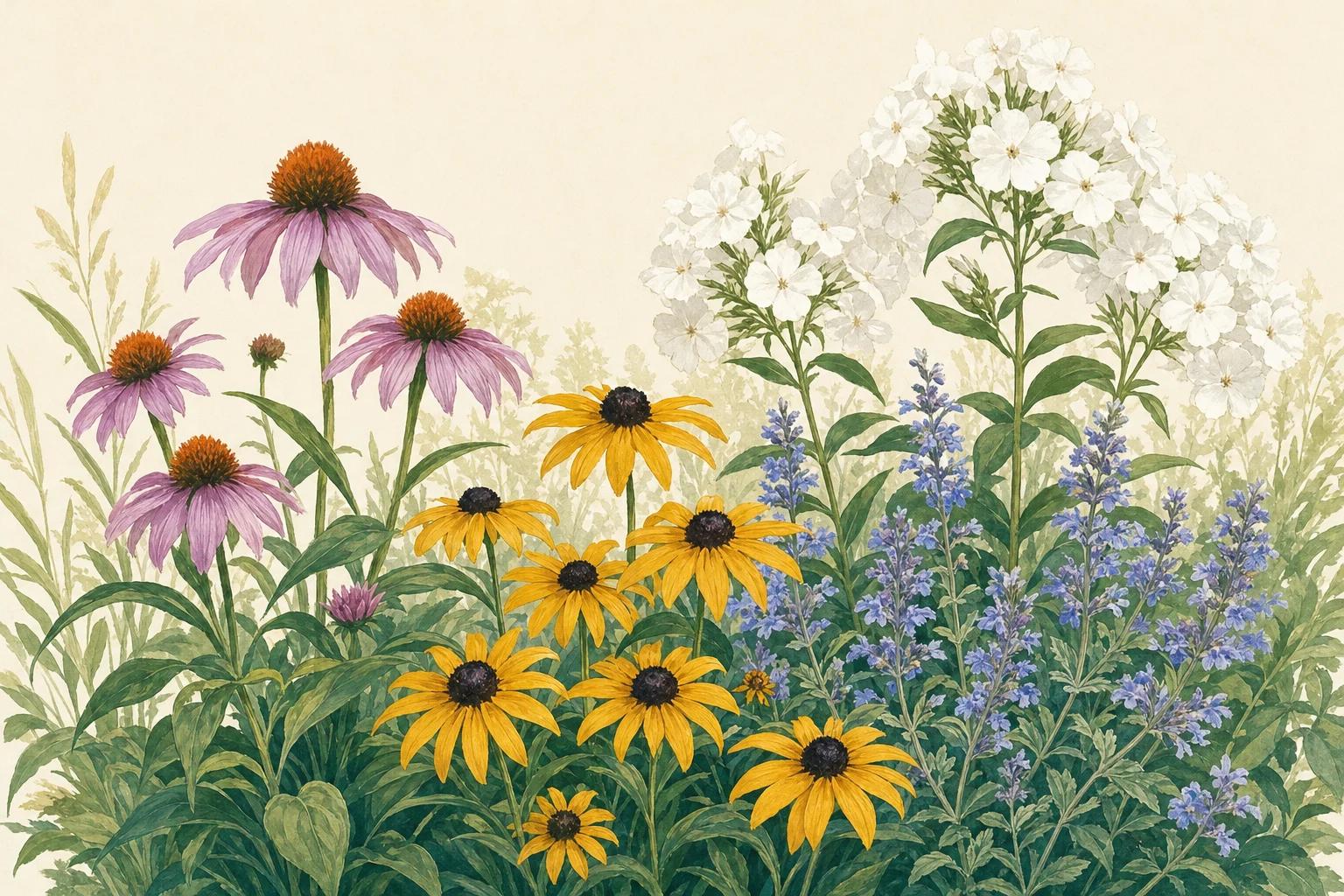
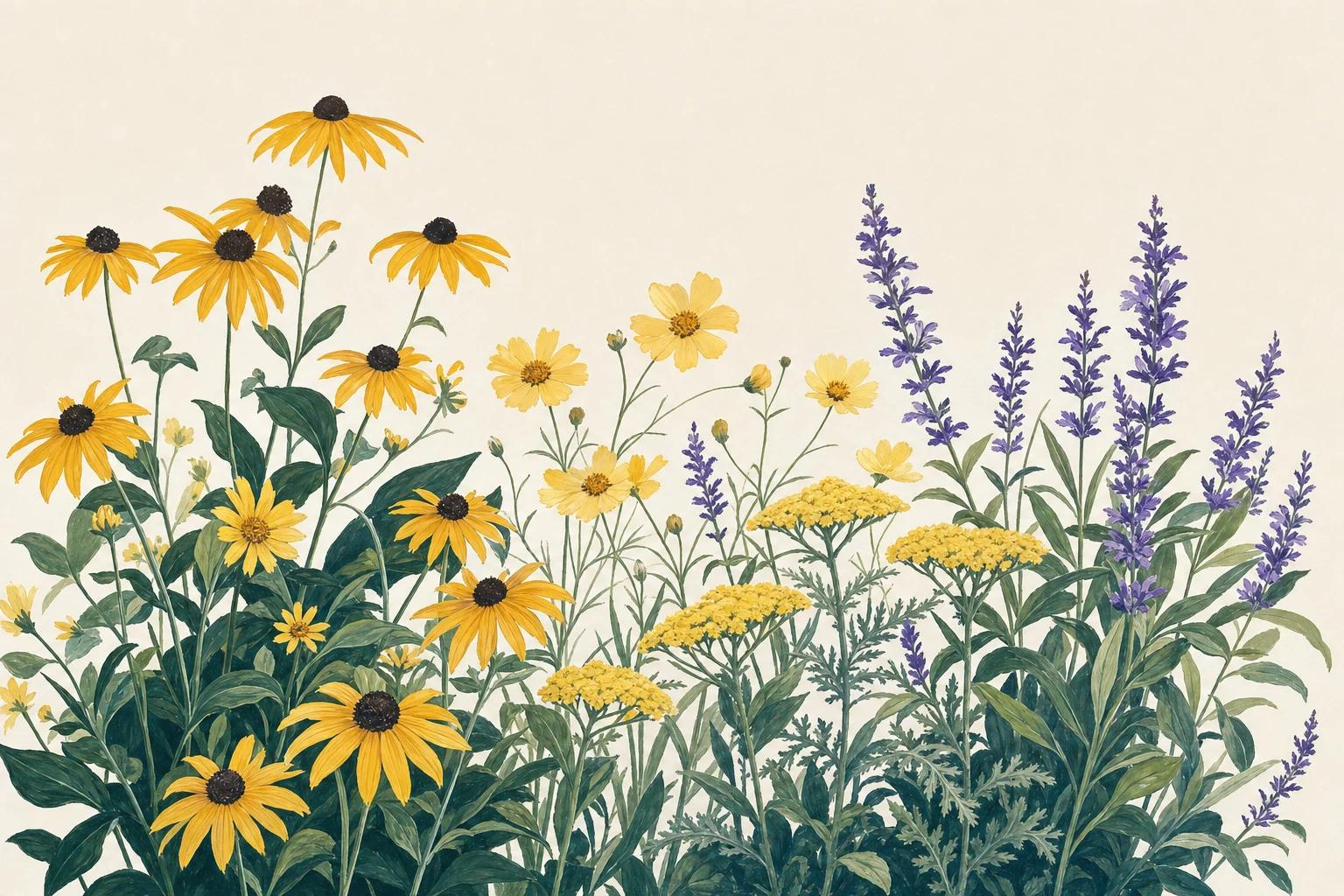
Pair it with violet and blue. Yellow and violet sit opposite each other on the color wheel, and the pairing occurs widely in nature. Blues and greens planted nearby or behind calm the strength of warm colors. A drift of 'Goldsturm' in front of purple coneflower, or 'Moonbeam' at the feet of catmint, uses both rules at once. The purple flowers guide has partners for every season, and garden colors covers the color wheel in depth.
Place it where it will be seen. Warm colors seem to advance toward the viewer and read as lively, while blues and purples recede and make a space feel larger. Put the brightest yellows by an entry, at the end of a path or around a seat, and keep cooler colors at the far edges of a small yard. Light changes the effect too: strong summer sun saturates colors, while thin winter light mutes them. Whites and yellows brighten a space used mostly in the evening, such as a patio, and evening primrose opens its flowers just as you sit down.
Light up shade. Several picks carry yellow into shade. Goldenstar, yellow trout lily and 'The Rocket' ligularia flower in part to full shade, spicebush and creeping Oregon grape in part shade, and golden alexanders and bush honeysuckle in sun or part shade. For more options by light level, see the guide to shade plants.
Yellow flowers by region
The right yellow depends as much on summer heat and humidity as on winter cold, so match the plant to both ends of your climate.
| Region | Lean on | Watch out for |
|---|---|---|
| Cold North and upper Midwest (Zones 3–5) | 'Meadowlark' or 'Northern Gold' forsythia (Zones 4–5), shrubby cinquefoil, bush honeysuckle, winter aconite, trout lily, 'Goldsturm' | Standard forsythia buds die below -5°F (-21°C); 'Screamin' Yellow' and witch hazel start at Zone 5 |
| Mid-Atlantic and humid Midwest (Zones 5–7) | 'Screamin' Yellow' baptisia, 'Fireworks' goldenrod, golden alexanders, spicebush | 'Moonshine' yarrow melts out in humid heat; goldenstar flowers sparsely in hot summers |
| Southeast and Gulf Coast (Zones 7–9) | Carolina jessamine, swamp sunflower, spicebush, French marigold | Shrubby cinquefoil, 'Moonshine' yarrow and 'Hidcote' suffer in heat and humidity |
| Southern Plains and Texas | Maximilian sunflower, golden alexanders, yellow coneflower, 'Screamin' Yellow' | Maximilian sunflower forms colonies; site it where it can spread |
| Mountain West, Pacific Northwest and California | Creeping Oregon grape, California poppy, shrubby cinquefoil (mountain areas), 'Moonshine' yarrow, Missouri evening primrose | Scotch broom (see the invasive list below) |
Use with the zone range in each pick's entry.
'Screamin' Yellow' belongs on the Plains list because its parent species is native from the Gulf Coast of Texas, Louisiana and Mississippi north through Oklahoma and Arkansas to Missouri. Yellow coneflower and Missouri evening primrose, both native to the south-central states, suit the eastern edge of the region.
In the West, California poppy is the native yellow to add. It grows wild in California, Oregon, Washington and Nevada and opens orange to yellow cups from February to October in full sun and dry, lean soil. Sow it in fall where you want it, since it transplants poorly, and expect it to reseed. It can be poisonous if eaten, so keep children from nibbling it.
In Zones 10 and 11, the only pick rated that warm apart from the annuals is 'Stella de Oro', which is a poor choice there. Lean on the annuals instead: French marigold and common sunflower, plus calendula, a cool-season annual, in the cooler months.
Invasive yellow flowers to avoid and what to plant instead
Several yellow-flowered plants still sold in nurseries escape into wetlands, woods and rangeland, and some are illegal to sell or plant in parts of the country.
| Avoid | Where it is a problem | Plant instead |
|---|---|---|
| Yellow flag iris (Iris pseudacorus) | Class C noxious weed and on the quarantine list (illegal to sell) in Washington; prohibited in Connecticut; high invasive rank in Virginia | 'Fireworks' goldenrod or swamp sunflower for wet sun; 'The Rocket' ligularia for wet shade |
| Lesser celandine (Ficaria verna) | Prohibited in Wisconsin and Connecticut; high invasive rank in Virginia | Winter aconite or yellow trout lily |
| Scotch broom (Cytisus scoparius) | Class B noxious weed in Washington; high impact rating in California | 'Screamin' Yellow' baptisia, shrubby cinquefoil or 'Hidcote' |
| Japanese barberry (Berberis thunbergii) | Highly invasive in parts of the East; Connecticut prohibition takes effect October 2028; on Virginia's list | Spicebush or northern bush honeysuckle |
| Creeping Jenny (Lysimachia nummularia) | Invasive in parts of the US; medium rank in Virginia; potentially invasive in Connecticut | Goldenstar in shade |
| Japanese honeysuckle (Lonicera japonica) | High invasive rank in Virginia; prohibited in Connecticut | 'John Clayton' trumpet honeysuckle |
| Goldenrain tree (Koelreuteria paniculata) | On the National Park Service Mid-Atlantic invasive plant list; self-seeds | Magnolia 'Butterflies' or Cornelian cherry |
| Leatherleaf mahonia (Mahonia bealei) | Medium invasive rank in Virginia; spreads by suckers | Spicebush in the East, creeping Oregon grape in the West |
Listings as of the 2024 Virginia and 2025 Connecticut state lists and current Washington and California ratings; check your own state before planting.
Yellow flag iris is still sold for ponds. It spreads by seed and by pieces of rhizome that drift downstream, and its resin irritates skin, so wear gloves when you pull it.
Lesser celandine carpets damp, shady ground in March and April with glossy yellow flowers of about 8 petals (up to 12). It spreads by underground tubers and by bulblets, smothers native spring wildflowers, and is poisonous to people and livestock. The cultivars 'Pencarn' and 'Buttered Popcorn' are as invasive as the wild plant. Do not confuse it with native marsh marigold, which is much larger, has 5–9 petal-like sepals and makes no tubers or bulblets.
Scotch broom covers green, broom-like stems with bright yellow pea flowers. Its seed stays alive in soil for decades, more than 30 years and possibly up to 80, so one plant can reseed a site long after it is removed. The seeds are toxic to livestock and horses, and dense stands raise wildfire risk.
Japanese honeysuckle opens white and ages to yellow, and Japanese barberry carries small pale yellow flowers in April and May, so both turn up among yellow-flowered plants. Creeping Jenny spreads by rooting stems, and its taller relative, garden yellow loosestrife (Lysimachia vulgaris), is prohibited in Connecticut.
When you have settled on your yellows, map where each will go, and how wide it will spread, in Sow's garden planner.
Frequently asked questions
What are the names of some yellow flowers?
By season, the yellow flowers most gardeners grow are witch hazel, winter aconite and Carolina jessamine in late winter; daffodil, forsythia and magnolia 'Butterflies' in spring; baptisia, daylily and evening primrose in late spring; coreopsis, yarrow, black-eyed Susan and sunflower in summer; and goldenrod and swamp sunflower in fall. Less familiar names worth learning are golden alexanders, goldenstar, spicebush, yellow trout lily and yellow coneflower, the only Echinacea with yellow petals.
What are the little yellow flowers all over my yard?
The most common yellow flower in American lawns is the dandelion; the other is black medic. Dandelion carries one bright yellow head 0.8–1.4 inches (2–3.5 cm) across on a hollow stalk and regrows from its deep taproot. Black medic has tiny yellow pea-like flowers in round clusters from April to July on a low plant with three-part leaves. Glossy yellow flowers with about 8 petals carpeting damp, shady ground in March and April are probably lesser celandine, a prohibited invasive in Wisconsin and Connecticut.
What is the most popular yellow flower?
No sales ranking of yellow flowers exists. Sunflowers and daffodils are the familiar classics. Among garden perennials, 'Goldsturm' black-eyed Susan, introduced in 1937, was the 1999 Perennial Plant of the Year, and 'Moonbeam' coreopsis won the same award in 1992. 'Stella de Oro' is perhaps the most popular daylily in cultivation, prized for flowering from May into August on a plant only about 1 foot (30 cm) tall.
What yellow perennials come back every year?
The most reliable are 'Goldsturm' black-eyed Susan and 'Moonbeam' coreopsis (both Zones 3–9), 'Moonshine' yarrow (3–8), golden alexanders (3–8), Missouri evening primrose (3–7), 'Screamin' Yellow' baptisia (5–8), yellow coneflower (5–8), 'Fireworks' goldenrod (4–8) and swamp sunflower (5–9). Daffodils, winter aconite and yellow trout lily return each spring from bulbs, tubers and corms. Marigold, calendula and sunflower are annuals, so replant them or let them reseed.
What are the best yellow flowering shrubs?
For late winter, 'Arnold Promise' witch hazel flowers in February and March in Zones 5–8. In cold climates, 'Meadowlark' forsythia keeps its flower buds to -35°F (-37°C). For summer, shrubby cinquefoil flowers from June to September and is hardy to Zone 3, northern bush honeysuckle suits cool-summer gardens, and 'Hidcote' St. John's wort gives golden cups in Zones 5–9. Spicebush is the native choice for part shade in early spring.
Why didn't my forsythia bloom this year?
Usually one of two things happened. Standard border forsythia loses its flower buds when winter drops below -5°F (-21°C), so in cold areas it flowers only on branches that were buried under snow. Or the shrub was pruned too late: forsythia sets next spring's buds in summer, and cutting after mid-July removes them. Prune right after flowering, and in Zones 4–5 plant a bud-hardy cultivar such as 'Meadowlark' (buds to -35°F, or -37°C), 'Northern Gold' or 'Northern Sun' (-30°F, or -34°C).
Which yellow flowers are safe for dogs and cats?
Calendula (pot marigold) is listed as non-toxic to dogs and cats, and swamp sunflower as non-toxic to dogs, cats and horses. Threadleaf coreopsis, the species behind 'Moonbeam', is also considered non-toxic to all three. Keep cats away from every daylily, including 'Stella de Oro', because eating it can cause kidney failure. Daffodils are toxic to dogs, cats and horses, especially the bulbs, and every part of Carolina jessamine is poisonous.
Does goldenrod cause hay fever?
No. Goldenrod takes the blame because it flowers conspicuously in late summer, but hay fever is an allergic reaction to wind-borne pollen from other plants, such as ragweed. Goldenrods are worth planting: they feed both generalist and specialist pollinators, host caterpillars and supply seed for birds. 'Fireworks' is a compact choice at 3–3.5 feet (0.9–1.1 m) for Zones 4–8.
What yellow flowers bloom all summer?
'Stella de Oro' daylily flowers from May to August, 'Moonbeam' coreopsis from June to August with a second flush in fall if you shear it in mid to late summer, and 'Moonshine' yarrow from June to September in cool-summer regions. Shrubby cinquefoil and 'Hidcote' St. John's wort both flower from June to September. For containers and edging, French marigold flowers from June until frost.
References
- Missouri Botanical Garden. Plant Finder profiles (Eranthis hyemalis, Hamamelis 'Arnold Promise', Narcissus 'February Gold', Forsythia 'Meadowlark' and Forsythia x intermedia, Erythronium americanum, Magnolia 'Butterflies' and 'Elizabeth', Baptisia 'Screamin' Yellow', Zizia aurea, Hemerocallis 'Stella de Oro', Oenothera macrocarpa, Lonicera 'John Clayton', Mahonia repens, Chrysogonum virginianum, Calendula officinalis, Coreopsis 'Moonbeam', Achillea 'Moonshine', Rudbeckia 'Goldsturm' and 'Little Goldstar', Echinacea paradoxa, Potentilla fruticosa, Diervilla lonicera, Hypericum 'Hidcote' and H. calycinum, Ligularia 'The Rocket', Tagetes patula, Helianthus annuus and H. maximiliani, Solidago rugosa and 'Fireworks', Iris pseudacorus, Lysimachia nummularia, Lonicera japonica, Berberis thunbergii, Mahonia bealei, Koelreuteria paniculata). Accessed October 16, 2026.
- NC State Extension. Extension Gardener Plant Toolbox (Cornus mas, Gelsemium sempervirens, Narcissus, Forsythia x intermedia, Lindera benzoin, Hamamelis vernalis, Hemerocallis, Coreopsis verticillata, Achillea millefolium, Rudbeckia fulgida, Helianthus annuus, Helianthus angustifolius, Koelreuteria paniculata). Accessed October 16, 2026.
- Clemson Cooperative Extension Home & Garden Information Center. Daylily. Accessed October 16, 2026.
- Clemson Cooperative Extension Home & Garden Information Center. Carolina Jessamine. Accessed October 16, 2026.
- Wisconsin Horticulture, University of Wisconsin-Madison Extension. Forsythia, Forsythia spp.. Accessed October 16, 2026.
- University of Minnesota Extension. Forsythia. Accessed October 16, 2026.
- UF/IFAS Gardening Solutions, University of Florida. Sunflowers. Accessed October 16, 2026.
- UF/IFAS Extension, University of Florida. Using Color in the Landscape (EP425). Accessed October 16, 2026.
- Mississippi State University Extension. Using Color in the Landscape. Accessed October 16, 2026.
- USDA Agricultural Research Service. USDA Plant Hardiness Zone Map (2023). Accessed October 16, 2026.
- Lady Bird Johnson Wildflower Center, University of Texas at Austin. Native Plants Database (Zizia aurea, Mahonia repens, Helianthus maximiliani, Eschscholzia californica). Accessed October 16, 2026.
- Mt. Cuba Center. Trial Reports (Baptisia 2012–2015, Solidago 2021–2023). Accessed October 16, 2026.
- ASPCA Animal Poison Control Center. Toxic and Non-Toxic Plants (Daffodil, Pot Marigold, Sunflower, Yarrow). Accessed October 16, 2026.
- Washington State Noxious Weed Control Board. Noxious Weed Profiles (Yellow Flag Iris, Scotch Broom). Accessed October 16, 2026.
- California Invasive Plant Council (Cal-IPC). Cytisus scoparius (Scotch broom) Profile. Accessed October 16, 2026.
- Wisconsin Department of Natural Resources. Lesser Celandine (Ranunculus ficaria). Accessed October 16, 2026.
- Connecticut Invasive Plants Council, University of Connecticut. Connecticut Invasive Plant List (October 2025). Accessed October 16, 2026.
- Virginia Department of Conservation and Recreation. Virginia Invasive Plant Species List (September 2024). Accessed October 16, 2026.
- UC IPM, University of California Agriculture and Natural Resources. Dandelion: Pest Management Guidelines. Accessed October 16, 2026.
- UC IPM, University of California Agriculture and Natural Resources. Black Medic: Pest Management Guidelines. Accessed October 16, 2026.
Sow Editorial
Written by the Sow team from university extension services, botanical gardens, USDA and NOAA data and plant breeders. Every source is listed under References.