Quick answer
Reliable white flowers for US gardens run from snowdrop in February and star magnolia, serviceberry and dogwood in spring, through peony, mockorange and oakleaf hydrangea in late spring, to 'Annabelle' hydrangea, phlox 'David' and 'Becky' Shasta daisy in summer, then Japanese anemone and sasanqua camellia in fall. For evening scent add moonflower, flowering tobacco and tuberose. Skip Callery pear everywhere, and sweet autumn clematis in the East, Midwest and Southeast.
Key facts
- Late winter and spring
- Snowdrop (February), star magnolia (March), serviceberry and flowering dogwood (April)
- Late spring and early summer
- Peony, white wild indigo, fringetree, mockorange, oakleaf hydrangea
- Summer
- 'Annabelle' hydrangea, phlox 'David', 'Becky' Shasta daisy, 'White Swan' coneflower
- Fall
- 'Honorine Jobert' anemone, 'Snowbank' boltonia, white wood aster, 'Setsugekka' sasanqua camellia (to December)
- Evening fragrance
- Moonflower, flowering tobacco, tuberose, gardenia (Zone 8 and warmer), summersweet
- White for shade
- 'Annabelle' hydrangea, astilbe 'Deutschland', white bleeding heart, white wood aster
- Invasive whites to skip
- Callery ('Bradford') pear, sweet autumn clematis, Japanese honeysuckle, Chinese privet, dame's rocket
- Toxic to pets
- True lilies (cats); hydrangea, peony, gardenia, clematis and flowering tobacco (dogs, cats, horses)
In a Zone 7 garden, something white can be in flower from February to December; colder and warmer regions need some different picks to cover the same span. Snowdrops open the year, star magnolia and dogwood carry spring, peonies and mockorange bridge into summer, 'Annabelle' hydrangea and garden phlox hold July and August, and Japanese anemone and sasanqua camellia finish it. They anchor the 30 picks below.
White also does a job strong colors cannot: it stays visible after the sun goes down, which is why it is the base of every moon garden. After the picks come the design rules for white, a regional guide, and the white-flowered plants that are invasive or banned in parts of the country.
How these plants were chosen
Every pick had to pass three tests. Its hardiness zones, size and bloom months are on record with a botanical garden, a university extension service or, for a few named cultivars, the plant's breeder. Its flowers are white or near white when they open; several age to pink or green, and their entries say so. And it is not on the invasive plant lists checked for North Carolina, Connecticut, Florida and California, or, where it is flagged somewhere, the entry says where. Thirteen of the 30 are North American natives or selections and hybrids of native species, and a fourteenth, moonflower, is native to Florida.
Zones are USDA hardiness zones on the 2023 map. Check yours with the plant hardiness checker. Bloom months are for a Missouri-type climate; expect them earlier in the Deep South and later in the far North.
| Pick | Type | Zones | Height, ft (m) | Bloom and best use |
|---|---|---|---|---|
| Snowdrop | Bulb | 3–7 | 0.5–0.75 (0.15–0.23) | Feb–Mar; drifts under deciduous trees |
| Star magnolia | Small tree | 4–8 | 15–20 (4.6–6) | Mar; fragrant, small yards |
| Serviceberry 'Autumn Brilliance' | Small tree | 4–9 | 15–25 (4.6–7.6) | Apr; flowers, fruit, fall color |
| Flowering dogwood | Native tree | 5–9 | 15–30 (4.6–9) | Apr–May; part shade |
| White bleeding heart | Perennial | 3–9 | 2–2.5 (0.6–0.75) | Apr–May; shade |
| White wild indigo | Native perennial | 3–9 | 2–4 (0.6–1.2) | Apr–May; dry sun |
| Fringetree | Native small tree | 3–9 | 12–20 (3.7–6) | May–Jun; fragrant |
| Mockorange | Shrub | 5–8 | 5–10 (1.5–3) | May–Jun; fragrant |
| Peony | Perennial | 3–8 | 1.5–2.5 (0.45–0.75) | May–early Jun; long-lived |
| Oakleaf hydrangea | Native shrub | 5–9 | 4–8 (1.2–2.4) | May–Jul; four-season shrub |
| Astilbe 'Deutschland' | Perennial | 4–9 | 1.5–2 (0.45–0.6) | May–Jun; moist shade |
| Clematis 'Henryi' | Vine | 4–8 | 6–8 (1.8–2.4) | Jun; trellis or fence |
| 'Iceberg' rose | Shrub rose | 5–9 | 3–5 (0.9–1.5) | May–frost; long season |
| 'Annabelle' hydrangea | Native shrub | 3–9 | 3–5 (0.9–1.5) | Jun–Aug; part shade |
| 'White Swan' coneflower | Native perennial | 3–8 | 2–3 (0.6–0.9) | Jun–Aug; dry sun, pollinators |
| Garden phlox 'David' | Native perennial | 3–8 | 3–4 (0.9–1.2) | Jul–Sep; fragrant border |
| 'Becky' Shasta daisy | Perennial | 5–9 | 3–4 (0.9–1.2) | Jul–Sep; sunny border |
| 'Whirling Butterflies' gaura | Native perennial | 5–9 | 2–3 (0.6–0.9) | May–Sep; hot, dry sun |
| White hardy hibiscus | Native perennial | 5–9 | 2–7 (0.6–2.1) | Jul–Sep; wet soil |
| Summersweet 'Vanilla Spice' | Native shrub | 4–8 | 3–6 (0.9–1.8) | Jul–Aug; fragrant, wet shade |
| Crape myrtle 'Natchez' | Small tree | 6–9 | to 21 (6.4) | Jul–Sep; Southern summers |
| Japanese anemone 'Honorine Jobert' | Perennial | 4–8 | 3–4 (0.9–1.2) | Aug–Sep; part shade |
| Boltonia 'Snowbank' | Native perennial | 4–9 | 3–4 (0.9–1.2) | Aug–Sep; sun, clay |
| White wood aster | Native perennial | 3–8 | 1–2.5 (0.3–0.75) | Aug–Sep; dry shade |
| Sasanqua camellia 'Setsugekka' | Evergreen shrub | 7–9 | 6–10 (1.8–3) | Sep–Dec; winter structure |
| Moonflower | Annual vine | Annual (10–12) | 10–15 (3–4.6) | Jul–Oct; opens at dusk |
| Flowering tobacco | Annual | Annual (10–11) | 3–5 (0.9–1.5) | Jun–frost; evening scent |
| Tuberose | Tender bulb | 7–10 | 2–3 (0.6–0.9) | Aug–Sep; intense scent |
| Gardenia | Evergreen shrub | 8–11 (some 7) | 3–8 (0.9–2.4) | May–Jun; strongest scent |
| 'Casa Blanca' lily | Bulb | 5–8 | 3–4 (0.9–1.2) | Jun–Jul; fragrant |
Zones on the USDA 2023 map; "Annual" means grown as an annual outside the zones in parentheses.
Several of these whites are toxic to pets. True lilies, including 'Casa Blanca', can cause kidney failure in cats, so keep them out of any garden a cat uses. Hydrangeas, peonies, gardenias, clematis and flowering tobacco are toxic to dogs, cats and horses, and moonflower seeds are too. If a pet chews one, call your veterinarian or an animal poison control line right away.
Late winter and spring white (February to May)
Spring white comes first from bulbs that flower before the trees leaf out, then from small trees that flower on bare or barely leafed branches.
Snowdrop (Galanthus nivalis)
Snowdrop is the first white of the year, with nodding flowers on plants 6–9 inches (15–23 cm) tall in February; around St. Louis they last from late February into late March. Plant the bulbs in fall, 2–3 inches (5–8 cm) deep and the same distance apart, in groups of 25 or more, under deciduous trees that let in spring sun. It is hardy in Zones 3–7 and deer leave it alone. Wear gloves when planting, because the bulbs can irritate skin. South of Zone 7 it is short-lived, so treat it as a cold-climate bulb.
Star magnolia (Magnolia stellata)
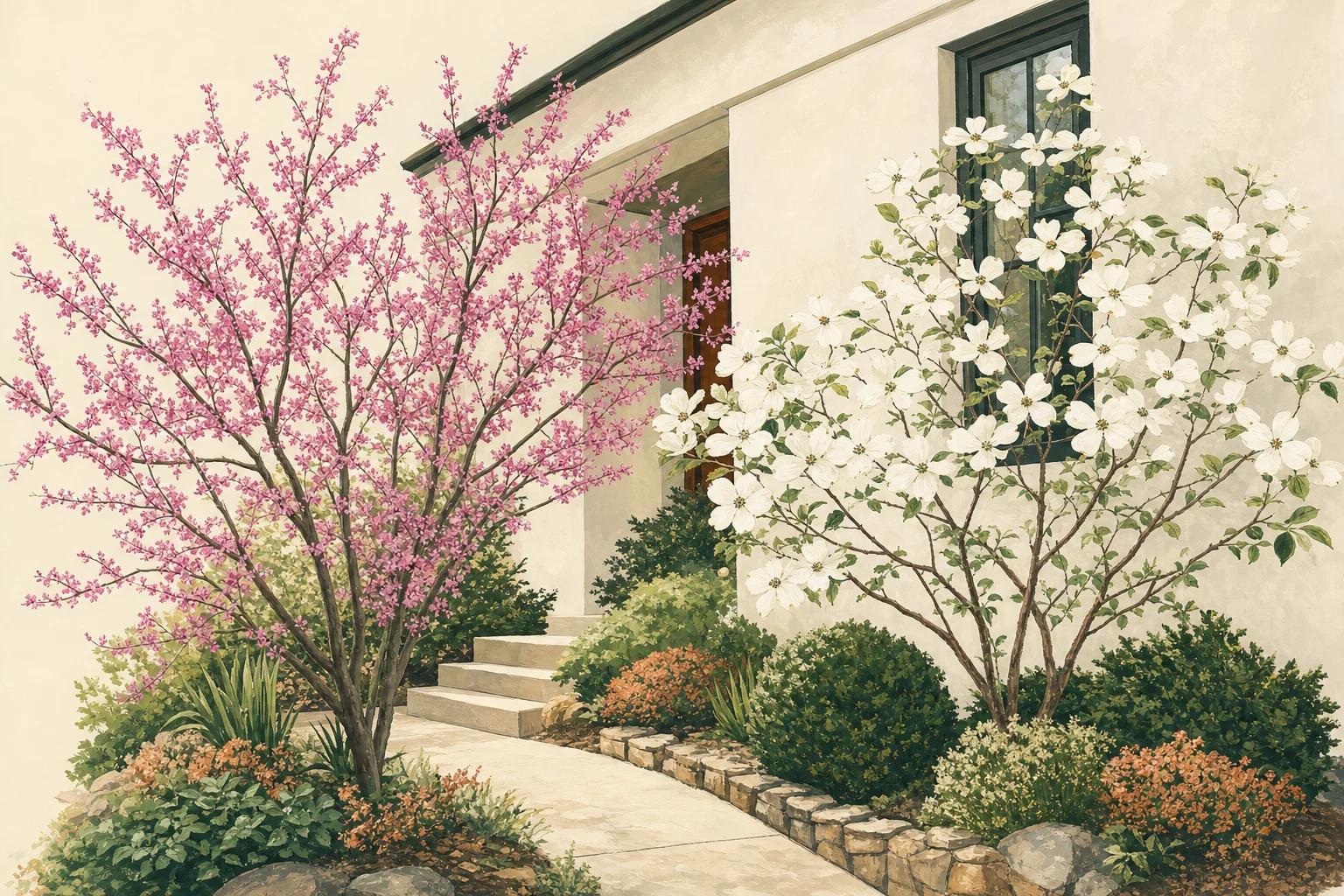
Star magnolia opens fragrant flowers of 12–18 narrow, strap-like tepals in March. At 15–20 feet (4.6–6 m) tall and 10–15 feet (3–4.6 m) wide in Zones 4–8, it fits a front yard where a full-size magnolia would not. It flowers best in full sun. Do not plant it against a warm south wall: the heat coaxes the buds open in late winter, where a frost catches them. It is listed as non-toxic to pets.
Serviceberry 'Autumn Brilliance' (Amelanchier × grandiflora)
Serviceberry 'Autumn Brilliance' earns its space three times: white flowers among bronze-tinted new leaves in April, small blueberry-like edible fruit about 3/8 inch (1 cm) across in June, and red fall color. It grows 15–25 feet (4.6–7.6 m) tall in Zones 4–9, in full sun to part shade. Its one habit to manage is root suckers, which turn it into a shrubby clump unless you cut them out. It is one of the best replacements for Callery pear.
Flowering dogwood (Cornus florida)
Flowering dogwood is the classic native white tree of April and May. Its "flower" is really four white bracts, together 3–4 inches (8–10 cm) across. It reaches 15–30 feet (4.6–9 m) in Zones 5–9 and does best in part shade and rich, acidic soil. Dogwood anthracnose is its most serious disease, so choose another tree where it is established locally. Near Chicago it is borderline hardy, and because it flowers on old wood a harsh winter can kill the buds.
White bleeding heart (Lamprocapnos spectabilis 'Alba')
White bleeding heart hangs pure white lockets in April and May, on plants 2–2.5 feet (0.6–0.75 m) tall in part to full shade. It is hardy in Zones 3–9 and rabbits avoid it. The catch is that its foliage goes dormant by midsummer, sooner if the soil dries, so plant a later hosta or fern beside it to fill the gap.
White wild indigo (Baptisia alba var. macrophylla)
White wild indigo sends up spires of white pea flowers over blue-green leaves in April and May, then black seed pods. It is a drought-tolerant native, 2–4 feet (0.6–1.2 m) tall and occasionally 5 feet (1.5 m), hardy in Zones 3–9 in sun to part shade. Site it once: its deep roots make established plants hard to move. Keep it away from black walnut, whose juglone it does not tolerate, and expect taller plants in part shade to need support.
Late spring and early summer white (May to July)
From late May into July, fragrant shrubs and big-flowered perennials overlap with the first hydrangeas.
Fringetree (Chionanthus virginicus)
Fringetree covers itself in late May and June with fleecy, fragrant clusters of creamy white flowers 4–8 inches (10–20 cm) long. It is a native small tree of 12–20 feet (3.7–6 m), hardy in Zones 3–9, and it tolerates clay, city conditions and black walnut. Be patient with it: it grows slowly, transplants poorly and can be hard to find. Plants are male or female, and only females set fruit. The guide to flowering trees has more small trees for spring.
Mockorange (Philadelphus × virginalis)
Mockorange is grown for scent: fragrant white flowers in May and June on a shrub 5–10 feet (1.5–3 m) tall and wide in Zones 5–8. It flowers on the previous year's wood, so prune right after bloom; an overgrown plant can be cut to the ground then to start again. In the West, wild mockorange (P. lewisii), native to California, Oregon, Washington, Idaho and Montana, is the fragrant native choice and grows up to 12 feet (3.7 m).
Peony (Paeonia lactiflora)
Garden peonies come in large, fragrant white forms, are long-lived and can be left undivided for years. Plants grow 1.5–2.5 feet (0.45–0.75 m) tall in Zones 3–8 and flower from late May into early June. Each plant blooms for only 7–10 days, so mix early, midseason and late cultivars to stretch the show to about six weeks, from late April to early June. Set the eyes about 2 inches (5 cm) below the soil surface. Deer and rabbits tend to leave them alone, but they are toxic to dogs, cats and horses. More in the peony growing guide.
Oakleaf hydrangea (Hydrangea quercifolia)
Oakleaf hydrangea carries upright white cones from May to July that age to purplish pink, then adds fall leaf color and winter interest. It grows 4–8 feet (1.2–2.4 m) tall and wide in Zones 5–9 in sun to part shade. It flowers on old wood, so prune, if at all, right after flowering. In Zone 5 give it a sheltered spot and winter protection, because below -10°F (-23°C) it can lose its flower buds or die to the ground.
Astilbe 'Deutschland' (Astilbe × arendsii)
Astilbe 'Deutschland' raises pure white plumes on stems to 2 feet (0.6 m) in May and June, over a clump 1.5–2 feet (0.45–0.6 m) wide. It is hardy in Zones 4–9 in part to full shade, and deer and rabbits tend to pass it by. It needs soil that stays moist; in a dry spell the leaves turn brown.
Clematis 'Henryi'
Clematis 'Henryi' is the white vine to plant instead of sweet autumn clematis. It opens large creamy-white flowers with brown anthers in June on a vine 6–8 feet (1.8–2.4 m) long, hardy in Zones 4–8. Give it a trellis, sun on its top growth and a cool, shaded root zone, and prune it as a Group 2 clematis. Its sap can irritate skin, and all clematis are toxic to dogs, cats and horses. See the clematis growing guide for pruning groups.
'Iceberg' rose (Rosa)
The 'Iceberg' rose is the longest-flowering white on this list, fragrant and in bloom from May to frost if you deadhead it. It grows 3–5 feet (0.9–1.5 m) tall and 2–3 feet (0.6–0.9 m) wide in Zones 5–9 and needs full sun. Water at the base and keep air moving around it to limit leaf diseases, and give it winter protection in cold areas. It has thorns, but roses are non-toxic to dogs, cats and horses.
Summer white (June to September)
Summer white comes from hydrangeas in shade and from long-flowering perennials in sun, most of them North American natives or their selections.
'Annabelle' and Incrediball smooth hydrangea (Hydrangea arborescens)
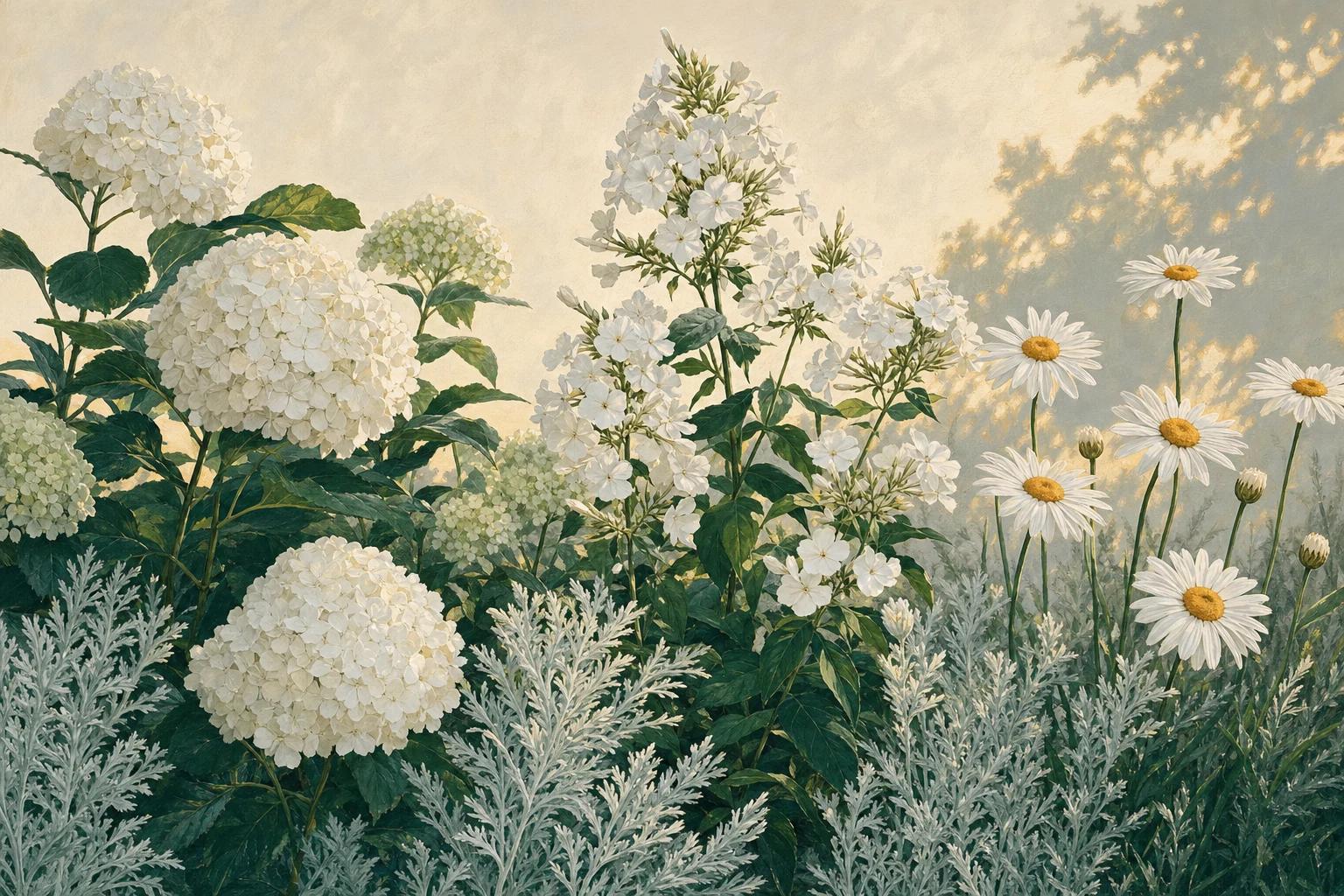
The 'Annabelle' hydrangea, found in the wild near Anna, Illinois, carries sterile white heads 8–12 inches (20–30 cm) across from June for up to two months. It grows 3–5 feet (0.9–1.5 m) tall and 4–6 feet (1.2–1.8 m) wide in Zones 3–9. Give it part shade, or full sun only with steady moisture, because it does not tolerate drought. It flowers on new wood, so you can cut every stem close to the ground in late winter and still get flowers. Incrediball, 4–5 feet (1.2–1.5 m) tall, was bred for sturdier stems; give it six hours of sun for the strongest ones, and expect its heads to age from white to jade green. All hydrangeas are toxic to pets. The hydrangea growing guide covers pruning by type.
'White Swan' coneflower (Echinacea purpurea)
The 'White Swan' coneflower sets white petals around a coppery cone from June to August and draws butterflies, then birds to the seedheads. It grows 2–3 feet (0.6–0.9 m) tall in Zones 3–8, in full sun to part shade, and tolerates drought once established. Leave some seedheads and it will self-sow; divide crowded clumps about every four years. 'PowWow White' is a similar white of the same height.
Garden phlox 'David' (Phlox paniculata)
Phlox 'David' is the standard pure white phlox: fragrant panicles 6–9 inches (15–23 cm) long from July to September on stems 3–4 feet (0.9–1.2 m) tall, hardy in Zones 3–8. Its reputation rests on mildew resistance, but resistant is not immune. Space plants for air movement, water the soil rather than the leaves, and cut the stems to the ground in winter. Phlox bugs and spider mites can still find it. See the phlox growing guide.
'Becky' Shasta daisy (Leucanthemum × superbum)
The 'Becky' Shasta daisy holds white daisies with yellow centers on stems 3–4 feet (0.9–1.2 m) tall from July to September. It needs full sun, is hardy in Zones 5–9, and deer and rabbits tend to leave it alone. Good drainage is essential, because wet soil in winter kills it. It is short-lived, so divide it every two to three years and deadhead it for more flowers. It is a hybrid, not the weedy oxeye daisy.
'Whirling Butterflies' gaura (Gaura lindheimeri)
Gaura 'Whirling Butterflies' opens a few white flowers at a time on wiry stems from May to September, so a clump looks like a cloud of moths. It grows 2–3 feet (0.6–0.9 m) tall in Zones 5–9 and wants full sun and sharp drainage; its taproot gives it heat and some drought tolerance. In rich soil it flops, so cut it back by half in late spring. The flowers blush pink as they fade, and the cultivar is sterile, so it will not reseed.
White hardy hibiscus (Hibiscus moscheutos)
Hardy hibiscus is a native perennial with large flowers from July to September, and it tolerates wet soil. 'Disco Belle White' has a maroon eye and stays 2–2.5 feet (0.6–0.75 m) tall, while the species reaches 3–7 feet (0.9–2.1 m). 'Luna White' is a second white cultivar to look for. Grow it in full sun in Zones 5–9 and water deeply in dry spells. It is late to emerge in spring, so mark its spot. Cut the stems to 3–4 inches (8–10 cm) in late fall.
Summersweet 'Vanilla Spice' (Clethra alnifolia)
Summersweet 'Vanilla Spice' is a native shrub with fragrant white bottlebrush spikes in July and August, its florets about twice the size of other summersweets. It grows 3–6 feet (0.9–1.8 m) tall in Zones 4–8 and takes heavy shade and wet soil, though the soil must not dry out. Pull root suckers if you want a tidy shrub rather than a colony, and prune in late winter.
Crape myrtle 'Natchez' (Lagerstroemia)
Crape myrtle 'Natchez', a mildew-resistant hybrid from the US National Arboretum, is the white of the Southern summer, flowering from July to September above cinnamon-colored peeling bark. In the South it reaches 21 feet (6.4 m). It is hardy in Zones 6–9 in full sun; in Zones 5–6 the top often dies to the ground in winter and the plant stays much smaller. Unlike many whites here, it is safe around dogs, cats and horses.
Fall white (August to December)
Fall white comes from a few late perennials and, in Zones 7–9, sasanqua camellia.
Japanese anemone 'Honorine Jobert' (Anemone × hybrida)
Japanese anemone 'Honorine Jobert', found in France in 1858, opens white flowers around a ring of yellow stamens in August and September on stems 3–4 feet (0.9–1.2 m) tall. Grow it in Zones 4–8, ideally in part shade out of the wind; hot, dry sun burns the leaves, and it does not do well south of Zone 7. It is slow to settle in, then spreads by rhizomes, and deer tend to avoid it. The anemone growing guide covers dividing it.
Boltonia 'Snowbank' (Boltonia asteroides)
Boltonia 'Snowbank' makes a cloud of small white daisies in August and September on a clump 3–4 feet (0.9–1.2 m) tall and wide, hardy in Zones 4–9. It handles clay and wet soil but needs full sun, and in shade or rich soil it flops. Pinch it or cut it back by one-third in late spring to early summer for a shorter, sturdier plant.
White wood aster (Eurybia divaricata)
White wood aster is a fall white that copes with dry shade, with white flowers in August and September on plants 1–2.5 feet (0.3–0.75 m) tall in Zones 3–8. It is native to eastern North America and grows in part to full shade. Give it some air movement to limit leaf disease.
Sasanqua camellia 'Setsugekka' (Camellia sasanqua)
Sasanqua camellia is an evergreen shrub with fragrant flowers from September to December, but the species and its cultivars come in white, pink or red, so buy a named white. 'Setsugekka' has silvery white petals. Sasanquas grow 6–10 feet (1.8–3 m) tall in Zones 7–9, best in dappled shade and acidic, moist, well-drained soil with mulch over the roots. They are not reliably hardy around St. Louis. For more year-round structure, see the guide to evergreen shrubs.
White flowers for night and moon gardens
White and pale flowers are the ones that read longest after dusk, because moonlight or porch light reflects off their petals long after reds, oranges, blues and purples have disappeared.
Planning a moon garden
- Find where the light falls. Walk the yard at dusk and note which beds catch moonlight. Choose one near a patio, seat or window, so you are close enough to notice the scent.
- Keep the palette pale. Use white, ivory, pale yellow, lavender, silver and gray, and plant in groups so each color reads as a mass rather than dots.
- Add silver leaves. Silver mound artemisia (9–12 inches, or 23–30 cm, tall in Zones 4–7), lamb's ears, snow-in-summer and dusty miller turn metallic in cool evening light and hold the scheme together between blooms.
- Layer the fragrance. Combine several evening-scented plants that peak at different times, from mockorange in May to tuberose in September.
- Give it bones and reflection. Add evergreens for winter structure, a vine for height, and a pale birdbath, light stone or water feature to bounce the light.
- Light it low and warm. Night-blooming flowers draw moths, beetles, flies and bees, and bright or blue light can confuse them. Use subdued amber path lights, candles or soft white string lights.
Plant shrubs and perennials in late summer to early fall; set out tender annual flowers and bulbs after the last spring frost.
Moonflower (Ipomoea alba)
Moonflower is the signature night bloomer: fragrant white trumpets up to 6 inches (15 cm) across unfold in early evening, stay open all night and close before noon the next day. The vine climbs 10–15 feet (3–4.6 m) in one season and is hardy only in Zones 10–12, so most gardeners grow it as an annual on a trellis in full sun. Start seed indoors 6–8 weeks before the last frost, notching the seed coat first. In Missouri, seed started indoors in April flowered in late June, while seed sown outdoors in May did not flower until September. Its seeds are toxic to dogs, cats and horses. It is native to Florida and tropical America and is recorded as invasive at Haleakala National Park in Hawaii, so check your state's invasive list before planting it outside its native range.
Flowering tobacco (Nicotiana sylvestris and N. alata)
Woodland tobacco (Nicotiana sylvestris) hangs clusters of long white tubes on plants 3–5 feet (0.9–1.5 m) tall from June to frost, strongly fragrant on summer evenings; Nicotiana alata is the other fragrant species. Both are hardy only in Zones 10–11 and grown as annuals elsewhere: start seed 6–8 weeks before the last frost. Give them afternoon shade where summers are hot, because they fade in heat, and stake tall plants. Keep them out of the vegetable garden: they share viruses with tomato, pepper, eggplant and potato. All Nicotiana contain nicotine and are toxic to dogs, cats and horses.
Tuberose (Polianthes tuberosa)
Tuberose opens waxy white flowers with an intense scent on spikes 2–3 feet (0.6–0.9 m) tall in August and September. Plant the rhizomes 2 inches (5 cm) deep and 6–8 inches (15–20 cm) apart after the last frost, in full sun. It survives winter outdoors to Zone 7 with protection; colder than that, lift the rhizomes in fall and store them dry.
Gardenia (Gardenia jasminoides)
Gardenia has the strongest scent of any white here: very fragrant flowers 2–4 inches (5–10 cm) across in May and June, then a few more through summer. It grows 3–8 feet (0.9–2.4 m) tall and is hardy to Zone 8, with some newer cultivars hardy to Zone 7a. It needs acidic soil below pH 6.0, steady moisture with good drainage, and morning sun with afternoon shade. Gardenias are demanding: whiteflies and the sooty mold that follows them are the usual pests, stress makes buds drop, and fall fertilizing should be skipped. It is toxic to dogs, cats and horses.
'Casa Blanca' lily (Lilium)
The 'Casa Blanca' lily is a large, heavily fragrant white Oriental lily for June and July, 3–4 feet (0.9–1.2 m) tall in Zones 5–8 in sun to part shade. Plant bulbs in groups for scent at dusk and stake them in windy spots. It is dangerous to cats: all true lilies can cause kidney failure, though dogs and horses are not affected. See the lily growing guide for planting depth.
Other whites earn a place in a night garden too. Showy evening primrose (Oenothera speciosa) opens white cups that age to rosy pink from May to July on plants 9–24 inches (23–61 cm) tall in Zones 4–9. It spreads hard by rhizomes and seed, so give it a contained bed. Star jasmine is an evergreen, fragrant vine for Zones 8–10 that flowers in May and June and is non-toxic to pets. Stock, night phlox, petunias and, outside California, sweet alyssum also scent the evening air, and summersweet, mockorange and phlox 'David' from the lists above belong here as well.
Angel's trumpet (Brugmansia) often appears on night-garden lists for its evening scent, but it is among the most poisonous ornamental plants. Its flowers, leaves and seeds contain tropane alkaloids that can cause hallucinations and paralysis, and every part of the plant is poisonous. Do not grow it where children or pets play.
How to design with white
Use white to link and calm other colors, to light up shade, and to carry a garden into the evening, choosing pure or creamy whites to suit the colors around them.
Pure versus creamy white. Whites differ more than they seem to on a plant tag. Astilbe 'Deutschland' and phlox 'David' are pure white; clematis 'Henryi', fringetree and white wild indigo lean creamy.
White as the peacemaker. White combines with nearly every flower color, in a container or a border. It makes the colors next to it look more vivid. A drift of phlox 'David' between hot pink and orange keeps the two from fighting. The guide to garden colors covers the color wheel, and border planting shows how to repeat a color down a bed.
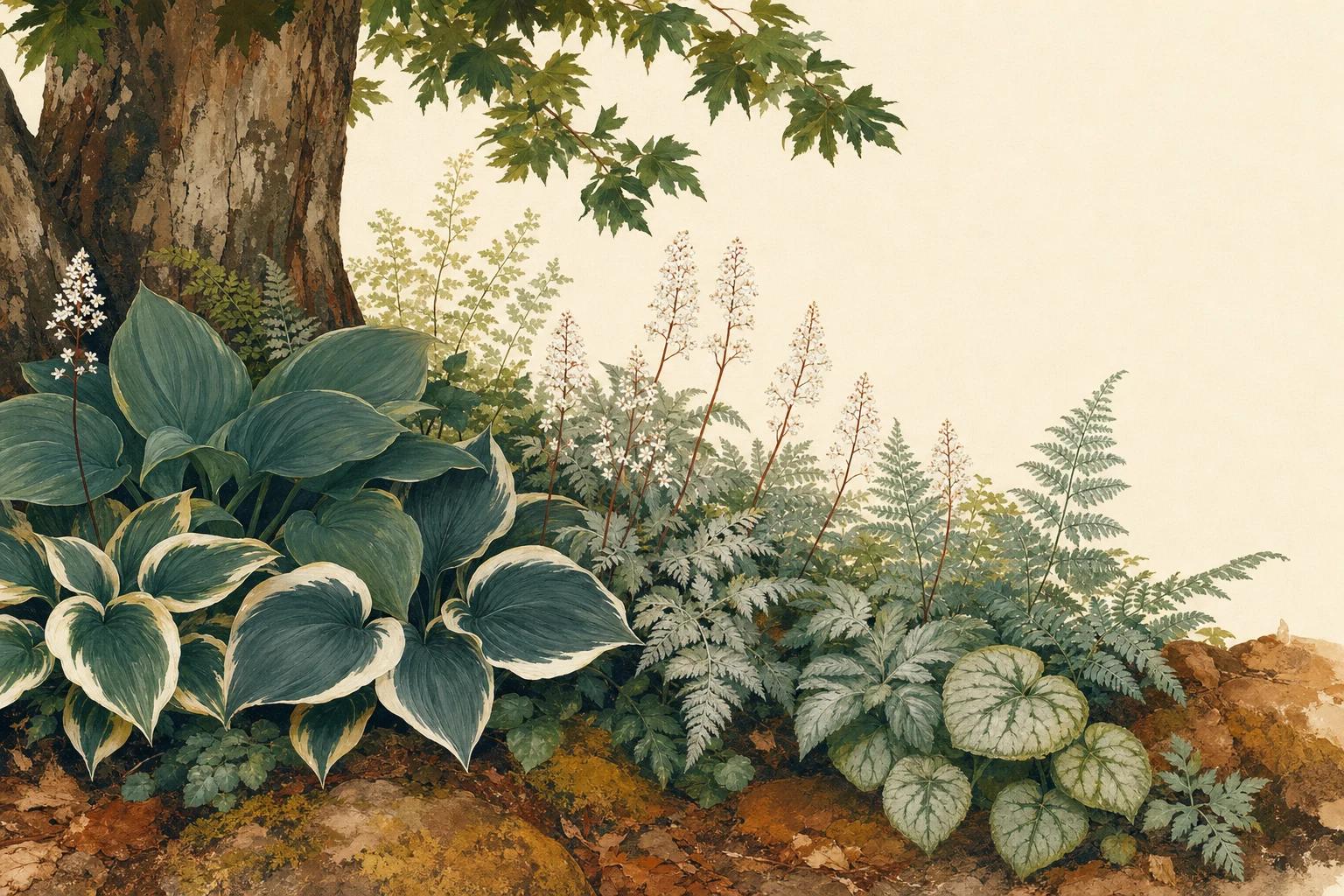
White in shade. In low light, white flowers and white-edged leaves read from across the yard when darker colors disappear. Beyond the shade picks above, try Hosta 'Fragrant Bouquet', with fragrant near-white flowers in June and July over variegated leaves, 1–1.5 feet (0.3–0.45 m) tall in Zones 3–8 (toxic to pets). Foamflower is a native, semi-evergreen groundcover with white spires in May, 9–12 inches (23–30 cm) tall in Zones 4–9; wet winter soil kills it. Black cohosh raises fragrant white wands 4–6 feet (1.2–1.8 m) tall in June and July, Zones 3–8, but scorches if the soil dries. For a shaded wall, climbing hydrangea flowers white from May to July and eventually climbs 30–50 feet (9–15 m) in Zones 4–8, after a slow start. The shade plants guide has more by light level.
Whites that do not stay white. Plan for color change. Oakleaf hydrangea ages to purplish pink, Incrediball to jade green, and gaura and showy evening primrose to pink. That is welcome in a mixed border and a problem in a strict white garden, where phlox 'David', 'Becky', boltonia and white wood aster hold their color.
'Limelight' will not hold a white border. Hydrangea 'Limelight' opens chartreuse-lime and ages to rose. It glows at dusk, but not as a white. For true white, use 'Annabelle', Incrediball or oakleaf hydrangea.
White flowers by region
Match the plant to both your winter low and your summer heat: the best northern whites sulk in the Deep South, and the best southern whites die in a northern winter.
| Region | Lean on | Watch out for |
|---|---|---|
| Cold North (Zones 3–4) | Peony, 'Annabelle', phlox 'David', 'White Swan', white wild indigo, white wood aster, snowdrop, fringetree; from Zone 4, star magnolia, serviceberry, boltonia | Oakleaf hydrangea, dogwood, gaura and 'Becky' start at Zone 5 |
| Midwest and Northeast (Zones 5–6) | Serviceberry, fringetree, mockorange, astilbe, summersweet, 'Honorine Jobert' | Oakleaf buds die below -10°F (-23°C) in Zone 5; dogwood buds lost in harsh winters; crape myrtle dies back |
| Mid-South and Southeast (Zones 7–9) | Gardenia, sasanqua camellia, crape myrtle 'Natchez', sweetbay magnolia, star jasmine (8–10) | Japanese anemone and snowdrop struggle south of Zone 7; phlox needs air in humid heat |
| Florida and Gulf Coast | Star jasmine, crape myrtle, sweet alyssum | Sweet autumn clematis, Callery pear, night-blooming jasmine and spider flower rated high invasion risk |
| Pacific Northwest and California | Wild mockorange; in California also Matilija poppy and bush anemone | Foxglove and sweet alyssum escape into California wildlands; bush anemone fails in wet soil |
| Arid Southwest and Mountain West | Blackfoot daisy, Apache plume | Both want dry soil, and blackfoot daisy needs sharp drainage; Apache plume can seed itself too freely |
Zones on the USDA 2023 map.
In Zones 5 and 6, a frozen-back crape myrtle can be cut to about 8 inches (20 cm) in spring and grown as a flowering shrub, much like a butterfly bush. Sweetbay magnolia, a native that takes wet soil, flowers white and fragrant in May and June in Zones 5–10. In California, foxglove colonizes disturbed ground on the central and northern coast and in the Sierra Nevada foothills, so leave white foxglove out of gardens there.
The West has its own native whites. Matilija poppy (Romneya coulteri), from the dry washes and canyons of southern California, flowers white from May to July on plants up to about 8 feet (2.4 m) tall in full sun and dry soil. Bush anemone (Carpenteria californica), a fragrant evergreen shrub found wild only in the Sierra Nevada foothills, flowers white from May to July, grows 4–6 feet (1.2–1.8 m) tall in Zones 8–10 and does not tolerate wet soil. From Colorado and Oklahoma to Arizona and Texas, blackfoot daisy makes a mound seldom over 6 inches (15 cm) tall, with fragrant white daisies from March to November in dry, alkaline soil, and Apache plume, a shrub up to 12 feet (3.7 m), flowers white from May into December and blooms in its first year from seed.
Invasive white flowers to avoid and what to plant instead
Several white-flowered plants still sold in nurseries escape into woods, fields and wetlands, and some are now illegal to sell or plant.
| Avoid | Where it is a problem | Plant instead |
|---|---|---|
| Callery pear, including 'Bradford' (Pyrus calleryana) | Banned in Ohio since 2023; Pennsylvania noxious weed, no sale or planting; South Carolina nursery sales banned 2024; Connecticut ban Oct 2027; Illinois 2028; invasive in North Carolina; high risk in Florida | Serviceberry, fringetree, flowering dogwood |
| Sweet autumn clematis (Clematis terniflora) | Invasive in North Carolina; escaped across the East and Midwest; high risk in Florida | Clematis 'Henryi' or native virgin's bower |
| Japanese honeysuckle (Lonicera japonica) | Highly invasive in North Carolina; prohibited in Connecticut and Florida; noxious in parts of the Midwest | Star jasmine (Zones 8–10) or native trumpet honeysuckle |
| Chinese privet (Ligustrum sinense) | Invasive in North Carolina; prohibited in Florida | Sweetbay magnolia, fragrant tea olive, blackhaw viburnum |
| Multiflora rose (Rosa multiflora) | Noxious weed in Missouri; prohibited in Connecticut | 'Iceberg' rose |
| Dame's rocket (Hesperis matronalis) | Prohibited in Connecticut; noxious in parts of the Midwest | Flowering tobacco or phlox 'David' |
| Night-blooming jasmine (Cestrum nocturnum) | High invasion risk in Florida, not recommended | Gardenia or star jasmine |
| Spider flower (Cleome hassleriana) | Predicted invasive in Florida | White zinnias |
| Star-of-Bethlehem (Ornithogalum umbellatum) | Not for Midwestern gardens; potentially invasive in Connecticut | Snowdrop |
| Oxeye daisy (Leucanthemum vulgare) | Invasive weed outside its native range | 'Becky' Shasta daisy |
State listings as checked in October 2026; rules change, so check your own state's list before planting.
Callery pear was first brought to the US in 1908, and 'Bradford' went on sale in 1961. Its April flowers smell foul, its branches split under their own weight after 15–20 years, and its seedlings form thorny thickets. Cultivars sold as sterile cross-pollinate with one another and with other pears, so their seed is viable and the invasion keeps spreading.
Sweet autumn clematis smothers shrubs and small trees with a 15–30 foot (4.6–9 m) vine covered in fragrant white flowers from August to October. All parts are toxic, and the sap can irritate skin and cause mouth ulcers.
Japanese honeysuckle has fragrant white flowers that age to creamy yellow from late spring into fall. Chinese privet flowers white in late spring and forms dense thickets that crowd out native plants. Multiflora rose forms thorny thickets that take over pastures.
Lily of the valley deserves caution: in good conditions it spreads by rhizomes until it is weedy, and every part is toxic to dogs, cats and horses. Foamflower and white bleeding heart give a similar spring white in shade without taking over. Seed sold as 'May Queen' daisy is often the weedy oxeye species itself, so buy a named Shasta daisy instead.
When you have chosen your whites, map where each one goes, and how wide it will grow, in Sow's garden planner.
Frequently asked questions
What are some examples of white flowers?
Peony, hydrangea, garden phlox, Shasta daisy, rose and flowering dogwood are the best known. Match the pick to the site: white wild indigo, 'White Swan' coneflower and gaura for dry sun; white hardy hibiscus, summersweet, sweetbay magnolia and boltonia for wet soil; 'Annabelle' hydrangea, astilbe 'Deutschland', white wood aster and foamflower for shade; and moonflower, flowering tobacco and tuberose for evening scent.
What are some white floral scents?
Gardenia is the most powerful, with 2–4 inch (5–10 cm) flowers in May and June and a few more through summer. Tuberose follows in August and September. Mockorange scents late spring, summersweet carries July and August, and 'Casa Blanca' lily is heavily fragrant in June and July. After dark, moonflower and flowering tobacco take over. Star magnolia, fringetree and phlox 'David' are fragrant too. Dame's rocket and sweet autumn clematis smell sweet but are invasive.
Are white lotus flowers real?
Yes. Sacred lotus (Nelumbo nucifera) flowers in pink or white in June and July. It grows in full-sun ponds in Zones 4–10 as long as its roots do not freeze in winter. It is listed as a noxious weed in at least one Midwestern state, so check your state's rules before you add it to a pond that connects to natural water.
What are the little white flowers everywhere in my lawn?
Most likely white clover, common chickweed or little bittercress. White clover makes tiny round white to pale pink heads, and in mild California climates it flowers from March to December. Common chickweed, especially common in lawns, has starry flowers whose five deeply split white petals look like ten. Little bittercress carries 2–10 tiny white flowers per stem. In planted beds, the low white annual is usually sweet alyssum.
Which white flowers are safe for dogs and cats?
Roses, crape myrtle, star jasmine, star magnolia, zinnias and Japanese camellia are listed as non-toxic to dogs, cats and horses. Lilies are the urgent exception for cats: chewing a true lily, including 'Casa Blanca', can bring vomiting, loss of appetite and lethargy, then kidney failure and death. If a cat has chewed any part of a lily, call your veterinarian or an animal poison control line at once rather than waiting to see whether it gets sick.
Why are my white flowers turning pink or green?
Usually the flowers are simply aging: oakleaf hydrangea cones turn purplish pink, Incrediball heads go jade green and gaura blushes pink as each flower fades. The other cause is seedlings. 'Snowbank' boltonia does not come true from seed, and the wild species can carry pink-tinged or violet rays, so volunteers that come up beside a white plant may not be white. Pull the volunteers and increase the white plant by dividing it in spring.
What white flowers bloom all summer?
'Iceberg' rose flowers from May until frost if you deadhead it, and 'Whirling Butterflies' gaura from May to September. Flowering tobacco runs from June to frost, 'Annabelle' hydrangea holds its heads for up to two months from June, and phlox 'David', 'Becky' Shasta daisy and white hardy hibiscus cover July to September. For quick color from seed, sow white zinnias directly in the bed and choose a mildew-resistant type.
What house plant has white flowers?
Peace lily is the classic choice: its white spathes appear freely in bright, filtered light out of direct sun, at 68–85°F (20–29°C) by day, but it is toxic to dogs and cats. Moth orchid comes in white among many other colors and is non-toxic to dogs, cats and horses. Give it bright light with no direct sun, such as an east window, and 50–60% humidity.
References
- Missouri Botanical Garden. Plant Finder profiles (Galanthus nivalis, Magnolia stellata, Amelanchier 'Autumn Brilliance', Cornus florida, Lamprocapnos spectabilis 'Alba', Baptisia alba var. macrophylla, Chionanthus virginicus, Philadelphus x virginalis, Paeonia lactiflora, Hydrangea quercifolia and arborescens 'Annabelle', Astilbe 'Deutschland', Clematis 'Henryi', Rosa ICEBERG, Phlox 'David', Leucanthemum 'Becky', Echinacea 'White Swan', Gaura 'Whirling Butterflies', Hibiscus 'Disco Belle White', Clethra 'Vanilla Spice', Lagerstroemia 'Natchez', Anemone 'Honorine Jobert', Boltonia asteroides 'Snowbank', Eurybia divaricata, Camellia sasanqua, Ipomoea alba, Nicotiana, Polianthes tuberosa, Gardenia, Lilium 'Casa Blanca', Carpenteria californica, Spathiphyllum, Phalaenopsis and others). Accessed October 16, 2026.
- University of Missouri Extension. Hang the Moon with Twilight Gardens. Accessed October 16, 2026.
- University of Illinois Extension. Creating a Moonlight Garden. Accessed October 16, 2026.
- University of Illinois Extension. White Adds Simple Elegance to the Garden. Accessed October 16, 2026.
- University of Nebraska-Lincoln Extension, Lancaster County. Evening in the Garden. Accessed October 16, 2026.
- University of Kentucky Cooperative Extension, Daviess County. Enjoying White Flowers in the Evening. Accessed October 16, 2026.
- University of Nevada, Reno Extension. Moon Gardens (Publication 2133). Accessed October 16, 2026.
- NC State Extension. Extension Gardener Plant Toolbox (Camellia sasanqua and 'Setsugekka', Clematis terniflora, Pyrus calleryana, Lonicera japonica, Ligustrum sinense, Leucanthemum vulgare, Brugmansia x candida, Ipomoea alba, Chionanthus virginicus). Accessed October 16, 2026.
- USDA National Invasive Species Information Center. Terrestrial Invasive Plants (profiles for Callery pear, Japanese honeysuckle, Chinese privet and multiflora rose). Accessed October 16, 2026.
- Connecticut Invasive Plant Working Group, University of Connecticut. Connecticut Invasive Plant List. Accessed October 16, 2026.
- Pennsylvania Department of Agriculture. Controlled Plant & Noxious Weed Lists (Callery pear, Class B noxious weed). Accessed October 16, 2026.
- ASPCA Animal Poison Control. Toxic and Non-Toxic Plants List (entries for lily, Japanese show lily, hydrangea, gardenia, peony, clematis, Nicotiana, rose, Camellia japonica, crape myrtle, star jasmine, star magnolia, zinnia, peace lily, Phalaenopsis orchid and others). Accessed October 16, 2026.
- Proven Winners. Incrediball Smooth Hydrangea; Vanilla Spice Summersweet. Accessed October 16, 2026.
- Clemson Cooperative Extension Home & Garden Information Center. Gardenia (HGIC fact sheet). Accessed October 16, 2026.
- The Morton Arboretum. Trees and Plants profiles (fringe tree, flowering dogwood, Callery pear). Accessed October 16, 2026.
- UF/IFAS Center for Aquatic and Invasive Plants. Assessment of Non-Native Plants in Florida (Clematis terniflora, Pyrus calleryana, Cestrum nocturnum, Cleome hassleriana, Lonicera japonica, Ligustrum sinense, Lobularia maritima, Lagerstroemia indica, Camellia sasanqua, Trachelospermum jasminoides). Accessed October 16, 2026.
- California Invasive Plant Council (Cal-IPC). California Invasive Plant Inventory (Digitalis purpurea and Lobularia maritima profiles). Accessed October 16, 2026.
- Lady Bird Johnson Wildflower Center, University of Texas at Austin. Native Plants Database (Baptisia alba var. macrophylla, Clethra alnifolia, Magnolia virginiana, Philadelphus lewisii, Romneya coulteri, Melampodium leucanthum, Fallugia paradoxa). Accessed October 16, 2026.
- UC Statewide IPM Program, University of California Agriculture and Natural Resources. Weed Identification Gallery (white clover, common chickweed, little bittercress). Accessed October 16, 2026.
- Invasive Plant Atlas of the United States, University of Georgia Center for Invasive Species and Ecosystem Health. Ipomoea alba (Moonflower). Accessed October 16, 2026.
Sow Editorial
Written by the Sow team from university extension services, botanical gardens, USDA and NOAA data and plant breeders. Every source is listed under References.